The Boeing Company's common stock trades on the New York Stock Exchange as BA, so an ordinary brokerage account with access to US shares is all the purchase requires. What the share buys into is a planemaker rebuilding its output under closer regulatory watch: after the January 2024 door-plug accident the FAA imposed additional requirements, and the 737 program may raise production rates only with the agency's concurrence. This guide covers the three segments, the order itself and the filings that date what matters, from 737-10 certification to the 2027 conversion of Boeing's preferred stock.
What Does Boeing Do?
Boeing designs, builds and supports aircraft, defense systems and spacecraft. Its 10-K describes the company as "one of the world's major aerospace firms," and its management discussion as "one of the two major manufacturers of 100+ seat airplanes for the worldwide commercial airline industry and one of the largest defense contractors in the U.S." First incorporated in Washington state in 1916, it moved its incorporation to Delaware in 1934; its principal executive offices are in Arlington, Virginia. It reports three segments.
Commercial Airplanes (BCA) sells jetliners, mainly to airlines. The models in production are the single-aisle 737 and the widebody 767, 777 and 787; development continues on the 777X and on two 737 variants, the 737-7 and the 737-10. The 10-K names Airbus and "entrants from China" as the competitors BCA faces.
Defense, Space & Security (BDS) builds military aircraft and weapons, from fighters and trainers to rotorcraft and aircraft derived from commercial designs, such as anti-submarine and tanker jets. Its 2025 delivery table lists the F/A-18, F-15, T-7A Red Hawk, CH-47 Chinook, AH-64 Apache, MH-139 Grey Wolf, KC-46 Tanker and P-8, alongside commercial satellites. It also works on missile defense, intelligence systems and space exploration, and its results include income from joint ventures, chiefly United Launch Alliance. The filing names General Dynamics, Lockheed Martin, Northrop Grumman, RTX and SpaceX as its main competitors.
Global Services (BGS) keeps commercial and military fleets flying after delivery: spare parts, supply chain and logistics, maintenance, modifications and conversions, pilot and maintenance training, and technical data.
Two changes reshaped the company in late 2025. On 31 October it sold portions of the BGS Digital Aviation Solutions business for cash. On 8 December it completed the acquisition of Spirit AeroSystems, the maker of 737 fuselages and major structures for the 767, 777 and 787, bringing about 15,000 people inside Boeing.
How Boeing Makes Money
Revenue rose 34.5% in 2025, mostly because Commercial Airplanes delivered far more jets: 600 airplanes, up from 348 in 2024, as production recovered from the door-plug slowdown and a strike. The segment split looked like this:
| Segment | What it sells | Share of 2025 revenue | Revenue change vs 2024 |
|---|---|---|---|
| Commercial Airplanes | 737, 767, 777 and 787 jetliners | 46.4% | +81.5% |
| Defense, Space & Security | Military aircraft, weapons, satellites, space systems | 30.4% | +13.9% |
| Global Services | Parts, maintenance, modifications, training, data | 23.4% | +4.9% |
Shares are calculated from segment revenues in the 10-K against total revenue, which nets out sales between segments.
Higher revenue did not yet mean profit in every segment. Commercial Airplanes ran an operating loss in both 2025 and 2024, and the BDS loss narrowed sharply in 2025. Global Services was profitable, and in 2025 its earnings also included the gain on the Digital Aviation Solutions sale.
The customer base is international. Non-US customers, including foreign military sales arranged through Washington, accounted for 46% of total 2025 revenue and 60% of Commercial Airplanes revenue from customer contracts. Contracts with the US government, again including those sales, produced 35% of revenue. Jetliner contracts are typically signed years ahead of delivery at a fixed price adjusted by escalation formulas, and the BDS and BGS defense businesses each generated about 60% of their 2025 revenue from fixed-price contracts, where Boeing absorbs any cost overruns.
Backlog grew 30.9% during 2025, and at the end of that year about 85% of the Commercial Airplanes backlog, in dollar terms, was with airlines outside the United States. At 30 September 2026 the total included over 6,300 commercial airplanes.
BA Stock at a Glance
| Item | BA |
|---|---|
| Exchange | New York Stock Exchange (NYSE) |
| Ticker | BA |
| Security | Common stock |
| Other listed security | BA-PRA: depositary shares, each a 1/20th interest in a share of 6.00% Series A Mandatory Convertible Preferred Stock |
| CUSIP | 097023105 |
| Sector | Aerospace and defense |
| Index membership | S&P 500 and Dow Jones Industrial Average |
| Headquarters | Arlington, Virginia |
| Incorporated | Washington, 1916; reincorporated in Delaware, 1934 |
| Fiscal year | Calendar year, ending 31 December |
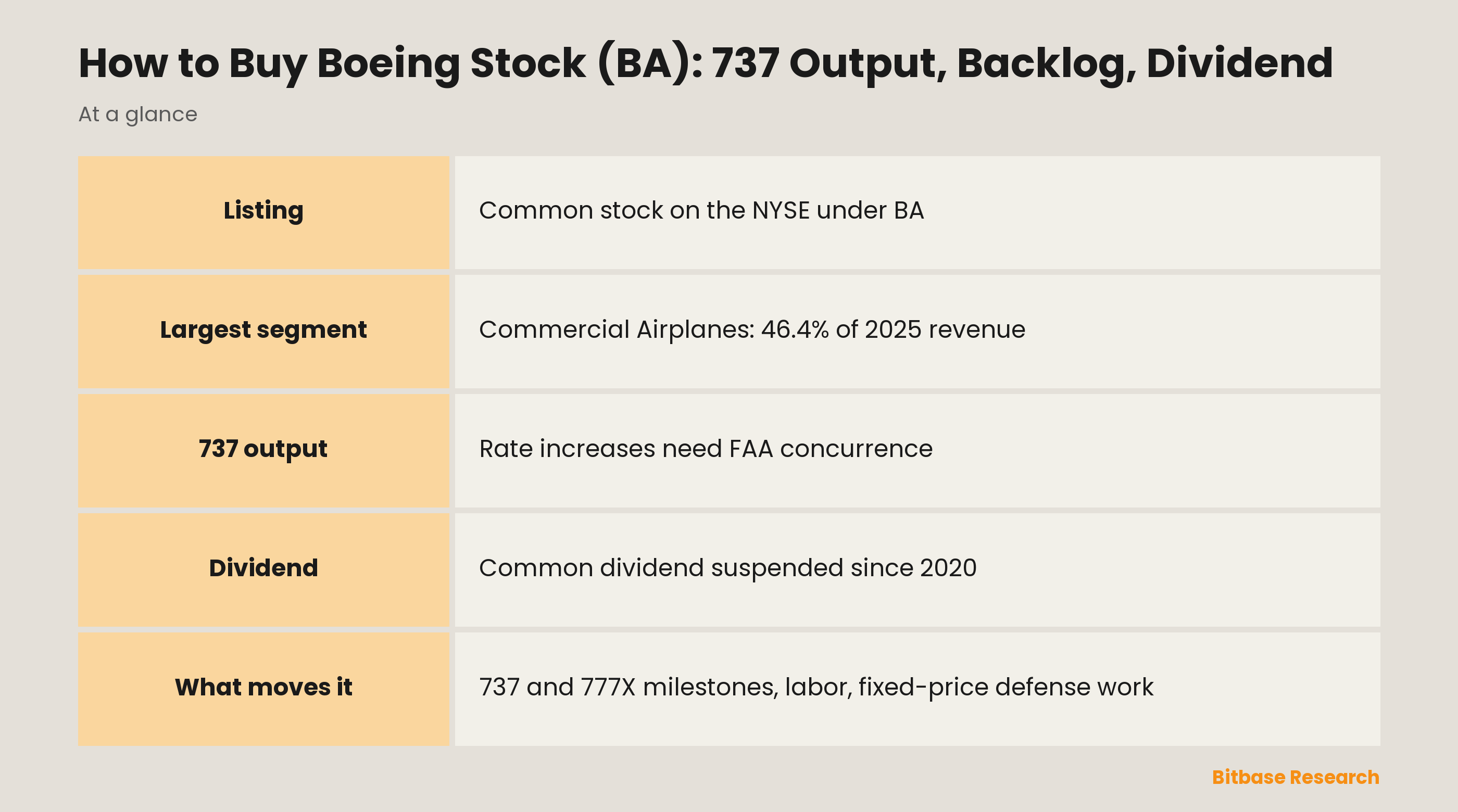
| Dividend policy | Common dividend suspended since 2020; preferred dividends paid when declared |
| SEC identifier | CIK 12927 |
Price and market value change with every trade; for live figures, open the Boeing stock page on Bitbase.
How to Buy Boeing Stock
Boeing is a US issuer listed at home, so the shares you order are the common stock itself, with no depositary receipt involved. Seven steps cover it:
1. Pick a broker with NYSE access. Investors abroad can use a domestic broker that offers US shares or an international brokerage; find out which legal entity keeps your assets and which regulator oversees it.
2. Open the account and state your tax status. Non-US individuals certify foreign status on IRS Form W-8BEN; the broker relies on it when deciding whether a treaty rate applies.
3. Add funds. A currency conversion carries its own spread or fee, which can outweigh the commission on a small order.
4. Select the right line. Search for BA and confirm it reads The Boeing Company common stock on the NYSE. BA-PRA is a different security: depositary shares in the mandatory convertible preferred stock.
5. Set the order type. According to the SEC's Investor.gov, a market order "guarantees that the order will be executed, but does not guarantee the execution price," whereas a limit order executes only "at a specific price or better."
6. Decide the size. Fractional shares let you invest a fixed amount, but "not every brokerage firm offers fractional share investing," and with a fraction you "may not have voting rights."
7. Keep the confirmations. Trade confirmations and statements show what you paid, which you will need when you sell.
Brokers that accept orders outside the main session will show you regular-session and extended-hours prices, which can differ; in thin trading, a limit order sets the most you will pay.
Outside the United States, the IRS says that most US-source income received by a foreign person is "subject to U.S. tax of 30%," and that "a reduced rate, including exemption, may apply" under a tax treaty. For a BA holder that withholding applies to dividends, and the common dividend has been suspended since 2020; your home country may also tax gains on a sale.
Through a fund, Boeing is one position among many. State Street's holdings files dated 28 October 2026 list it in SPY, which tracks the S&P 500, in DIA, which tracks the Dow Jones Industrial Average, and in XLI, the Industrial Select Sector fund.
What Moves BA Stock
The 737 production rate. The single-aisle 737 made up 447 of the 600 deliveries in 2025, and its rate needs the FAA's concurrence. The 10-K records a recovery from below 38 a month at the start of 2025 to 42 in the fourth quarter, after the FAA and Boeing jointly agreed in October 2025 that the program's key performance indicators supported it. In the second quarter of 2026 the program began moving from 42 to 47 a month with FAA concurrence; Boeing now expects to stabilize at 47 in 2027 and only then plans a step to 52. Low-rate work on a new 737 line began in July 2026, and that line must be production-certified by the FAA before its first delivery.
Certification of new models. The 737-7 and its engine anti-ice solution were certified in the third quarter of 2026, and the 737-10 in October 2026. The 737-10 alone accounted for about 33% of undelivered 737 orders at 30 September 2026, and the 737-7 for about 6%; Boeing held about 45 aircraft of the two models in inventory on that date. The 777X, launched in 2013, is still in certification flight testing: Boeing expects approval for the final phases by the end of 2026 and first delivery of the 777-9 in 2027, after taking additional reach-forward losses on the program in 2024 and 2025. It is also working with the engine supplier and the FAA to certify a fix for an engine durability issue found in 2025.
The widebody lines. The 787 has held at eight a month. The 777 has been disrupted since the third quarter of 2026 by parts shortages at a key supplier, which Boeing expects to last through the first half of 2027, and the 777 and 777X programs had near break-even gross margins at 30 September 2026. The 10-Q warns that further disruption could bring higher abnormal costs or more reach-forward losses.
Labor. About 40% of the workforce was union-represented at the end of 2025. A 53-day strike by IAM District 751 in 2024 halted most commercial production, and a 101-day strike by IAM District 837 in St. Louis in 2025 disrupted defense programs including the F/A-18, F-15 and T-7A. On 1 October 2026, engineers and technicians represented by SPEEA ratified two new contracts running through 2030.
Defense fixed-price programs. Five fixed-price development programs, KC-46A Tanker, T-7A Red Hawk, Commercial Crew, VC-25B and MQ-25, took additional losses in 2024, and 2025 losses on them were mainly on the KC-46A. On the award side, the US Navy selected Boeing in the third quarter of 2026 to design, build and deliver the F/A-XX fighter, an order not yet in backlog pending completion of the source selection and evaluation review process.
Legal and trade matters. On 29 May 2025 Boeing and the US Department of Justice entered into a non-prosecution agreement to resolve the department's determination that Boeing had not fulfilled its obligations under a January 2021 deferred prosecution agreement relating to the Lion Air flight 610 and Ethiopian Airlines flight 302 accidents. In September 2026, after court proceedings concluded, Boeing released funds from escrow for the payments the agreement requires. Securities lawsuits remain pending. On trade, certain customers in China paused accepting deliveries in the second quarter of 2025 during tariff negotiations before resuming.
Risks Boeing Lists in Its 10-K
Item 1A is extensive; for a BA shareholder these are the entries to read first:
Airline demand. "We depend heavily on commercial airlines, subjecting us to unique risks." The 10-K adds that the airline industry "has been cyclical," and that a weaker economy or a struggling major customer can mean fewer orders or postponed deliveries.
The production system. The commercial business depends on "our ability to maintain a healthy production system" and to "achieve planned production rate targets," and on certifying new models, where "the FAA ultimately determines the timing of certification and entry into service." Late deliveries can give customers the right to compensation or to terminate orders.
Fixed-price contracts. "Our fixed-price contracts subject us to losses when we have cost overruns," and when estimated costs exceed the estimated price, Boeing recognizes reach-forward losses.
Work stoppages. "Work stoppages by our employees have adversely affected and could continue to adversely affect our business," and both recent strikes began after union leadership had recommended ratifying a tentative agreement.
Credit. "We cannot be assured that we will be able to maintain an investment grade rating," and a downgrade could raise the cost of borrowing.
The preferred stock. The common stock "ranks junior to the Mandatory convertible preferred stock" on dividends and in a liquidation, and the conversion of that preferred stock, the exchange of notes assumed with Spirit and equity awards "will dilute the interests of our existing shareholders."
Two further risks come from owning any single stock. Your result depends on how one company executes, and if your money starts in another currency, exchange-rate moves add to or subtract from what you earn.
How to Research BA Yourself
Boeing's filings sit on EDGAR under CIK 12927. The 10-K is the annual report and 10-Qs cover the first three quarters; 8-Ks arrive whenever something reportable happens, from earnings releases to the Spirit closing. The same reports are free on Boeing's own website.
A few pages repay a close read. In the 10-K and each 10-Q, the Commercial Airplanes section of the management discussion has a "Program Highlights" part that updates production rates, certification status and reach-forward losses program by program, and a table of accounting quantities and undelivered firm orders by program. Item 1A holds the risk factors, and a note to the financial statements covers legal proceedings, including the matters arising from the 737 MAX accidents.
Two details prevent misreadings. Boeing's contractual backlog excludes purchase options and announced orders for which definitive contracts have not been executed, so an order announced at an event may not appear in it yet. And the structured cover of the annual report, R1.htm, lists two registered securities, BA and BA-PRA; only the first is the common stock. Live prices are on the stock page linked above, and other listed companies are in the US stock pages on Bitbase.
Boeing Stock FAQ
Does Boeing pay a dividend?
Not on its common stock as of its latest filings. The annual report for 2025 states that the common dividend "has been suspended since 2020," and the open-market repurchase program was terminated in March 2020. Boeing does pay declared dividends on its 6.00% mandatory convertible preferred stock, most recently declared in August 2026, and with limited exceptions no common dividend can be paid while accumulated preferred dividends are unpaid.
Can I buy Boeing stock with crypto?
Not directly. A broker fills a BA order in US dollars, so any crypto must be converted to cash and transferred to the brokerage account first; depending on your country, that conversion may count as a taxable sale. The result is a registered share that carries voting rights, and knowing how a share differs from a crypto asset helps keep the two decisions separate.
What is Boeing's mandatory convertible preferred stock?
A second NYSE-listed security, BA-PRA, issued in the fourth quarter of 2024. Each depositary share is a 1/20th interest in a share of 6.00% Series A Mandatory Convertible Preferred Stock. Unless converted earlier, each preferred share converts automatically on or about 15 October 2027 into between 5.8280 and 6.9940 common shares, subject to adjustment, which is why the 10-K flags dilution for common shareholders.
Is Boeing in the Dow and the S&P 500?
Yes, both. State Street's holdings files dated 28 October 2026 list Boeing in SPY and in DIA, the funds that track the S&P 500 and the Dow Jones Industrial Average, and in its Industrial Select Sector fund, XLI. Weights change daily.
Did Boeing buy Spirit AeroSystems?
Yes. The deal closed on 8 December 2025, with Boeing exchanging its own shares for all of Spirit's outstanding shares and paying off or assuming Spirit's debt. Boeing took in Spirit's Boeing-related commercial work and aftermarket business, while Spirit Defense runs as a non-integrated BDS subsidiary. The 10-K notes that Boeing must also provide services to buyers of divested Spirit businesses, including Airbus.
Conclusion
Buying BA is routine: an account with NYSE access, the common-stock line rather than BA-PRA, and a market or limit order. What the share represents is less routine: a planemaker whose results hinge on a 737 rate that rises only with the FAA's concurrence, a 777X still in certification, fixed-price defense programs and no common dividend since 2020. The Program Highlights in the next 10-Q and the certification milestones reported in Boeing's 8-Ks are the documents to check before sizing a position in a single aerospace company.
Related reading
Other Bitbase articles on this topic:
- How to Buy 3M Stock (MMM): Post-it Notes, PFAS and Solventum
- How to Buy AMETEK Stock (AME): Instruments and the Indicor Deal
- How to Buy Bloom Energy Stock (BE): Fuel Cells, AI Power and Perps
- How to Buy Lockheed Martin Stock (LMT): F-35, Missiles, Dividend
Disclaimer: This article is educational content from Bitbase Academy, provided for information only. It explains what a company or fund does and how the instruments referenced here differ from one another; it does not constitute investment, trading, tax, or financial advice, and it is neither a recommendation nor an endorsement of any security, token, or trading strategy. A tokenized stock is issued by a third party and is designed to give economic exposure to an underlying asset: it is not a share, it carries no shareholder rights, and it depends on the issuer's structure, eligibility rules, and redemption terms, which the issuer can change. Perpetual futures are leveraged derivatives that hold no underlying asset and can be liquidated, and trading hours, product availability, and eligibility differ by instrument and by jurisdiction and can change at any time. Written as of October 2026; verify everything yourself through company filings, the issuer's own documentation, and the product pages of the venue you trade on.
References
[1] Boeing Form 10-K, fiscal 2025: business, segment revenue, backlog, programs and risk factors (SEC EDGAR) www.sec.gov
[2] Boeing Form 10-Q for the quarter ended 30 September 2026: 737 rates, certification, labor and legal matters (SEC EDGAR) www.sec.gov
[3] Boeing third-quarter 2026 results release, 27 October 2026 (Form 8-K exhibit, SEC EDGAR) www.sec.gov
[4] Boeing press release, 8 December 2025: completion of the Spirit AeroSystems acquisition (Form 8-K exhibit, SEC EDGAR) www.sec.gov
[5] State Street SPDR S&P 500 ETF Trust (SPY): fund page and daily holdings www.ssga.com
[6] State Street SPDR Dow Jones Industrial Average ETF Trust (DIA): fund page and daily holdings www.ssga.com
[7] State Street Industrial Select Sector SPDR ETF (XLI): fund page and daily holdings www.ssga.com
[8] Investor.gov (SEC): Types of Orders www.investor.gov
[9] Investor.gov (SEC): Investor Bulletin on fractional share investing www.investor.gov
[10] IRS: NRA Withholding www.irs.gov





