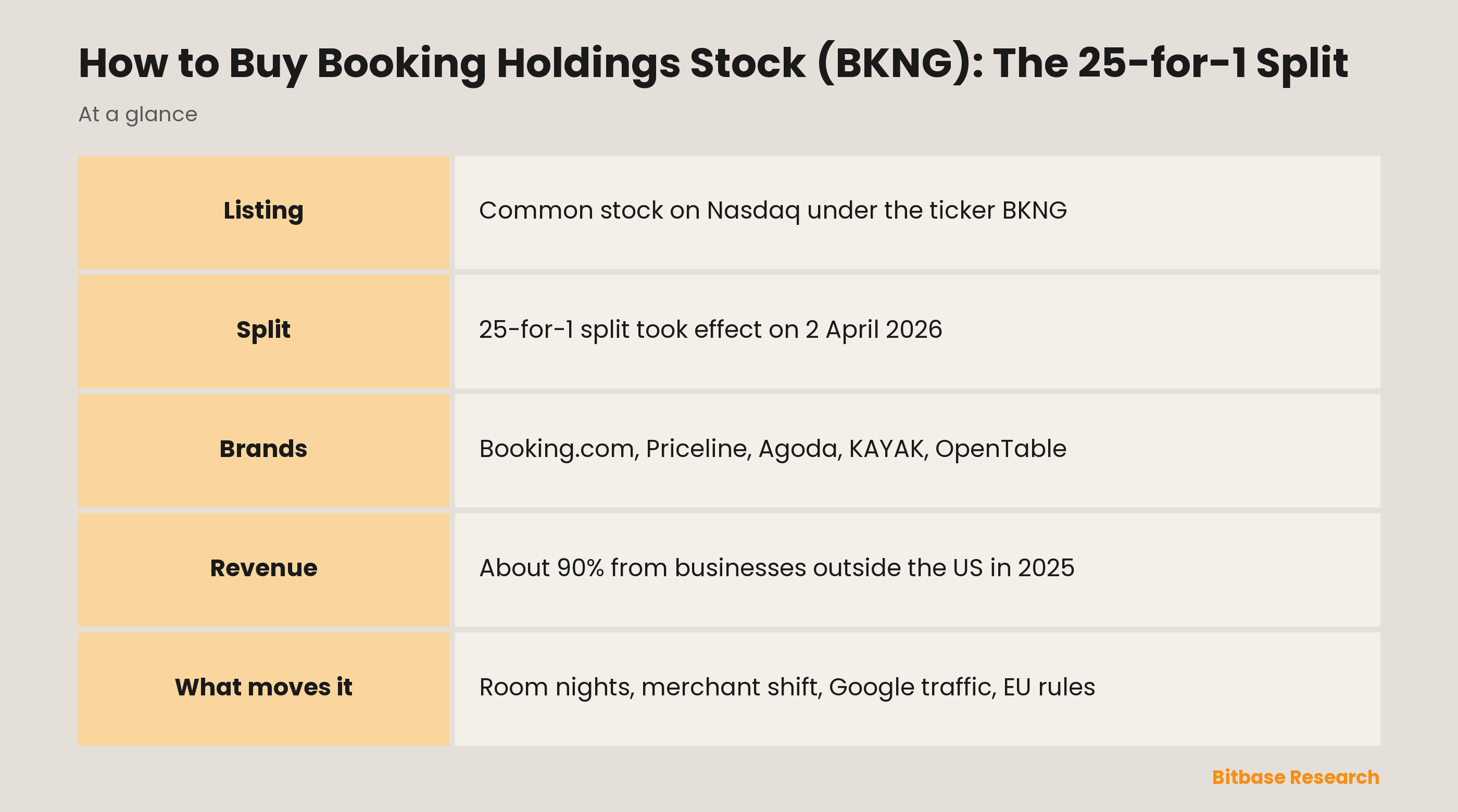
Since a 25-for-1 split took effect on 2 April 2026, each Booking Holdings share is a twenty-fifth of a pre-split share, and you buy it the usual way: through a broker with access to the Nasdaq Global Select Market, under the ticker BKNG, with a market or limit order. Behind the ticker is the owner of Booking.com, Priceline, Agoda, KAYAK and OpenTable, a Delaware company run from Connecticut that earned about 90% of its 2025 revenue through businesses outside the United States. This guide covers the brands, the shift in how Booking.com takes payment, the purchase itself and the filings worth reading first.
What Does Booking Holdings Do?
Booking Holdings runs online reservation services for travel and restaurants. Its 10-K states the mission in one line, "to make it easier for everyone to experience the world," and names five primary consumer-facing brands.
Booking.com is by far the largest. The 10-K calls it "the world's leading brand for booking online accommodation reservations, based on room nights booked," with headquarters in the Netherlands. At the end of 2025 it listed about 4.4 million properties in more than 220 countries and territories: roughly half a million hotels, motels and resorts, and about 3.9 million homes, apartments and other unique places to stay. It also sold flights in more than 55 markets, alongside tours, car rental and ground transport.
Priceline, which shares the group's head office in Norwalk, Connecticut, is "a leader in discount travel reservations, primarily in North America," selling hotel stays, flights, rental cars, packages and cruises.
Agoda, headquartered in Singapore, is an accommodation service "catering primarily to consumers in the Asia-Pacific region," now also selling flights and attractions.
KAYAK, also based in Norwalk, is a meta-search engine: it lets travellers "search and compare travel itineraries and prices from hundreds of online travel platforms at once" and earns money by referring them on.
OpenTable, based in San Francisco, takes restaurant reservations for diners and sells reservation-management services to restaurants, primarily in the United States.
The group reports all five as a single reportable segment, and Glenn Fogel is chief executive.
The history explains the names. The company started as priceline.com, formed as a Delaware limited liability company in 1997 and converted into a corporation in July 1998. It went public on 29 March 1999, quoted on Nasdaq under the ticker PCLN. The international business was bought rather than built: priceline.com acquired Booking.com Limited, a UK online hotel service, in September 2004 and Amsterdam-based Booking.com B.V. in July 2005, then Agoda in November 2007, KAYAK in May 2013 and OpenTable in July 2014. The parent became The Priceline Group in April 2014 and Booking Holdings in February 2018, a rename that brought the BKNG ticker with it.
The current strategy, the "Connected Trip," aims to join planning, booking, payment and in-trip help into one AI-assisted service built around the hotel booking; flight tickets, one of the additions, grew about 37% in 2025.
How Booking Holdings Makes Money
Nearly all revenue comes from travel reservations, which the income statement sorts into three lines:
| Revenue line | What it covers | Share of 2025 revenue | Change vs 2024 |
|---|---|---|---|
| Merchant | Bookings where the group collects the traveller's payment: commissions and margins, payment income such as card processing rebates, travel insurance | 66.0% | Up 25.5% |
| Agency | Bookings where the group does not handle the payment; almost entirely Booking.com accommodation commissions | 29.6% | Down 6.5% |
| Advertising and other | KAYAK referrals and ads, OpenTable reservation and subscription fees, ad placements on other brands | 4.4% | Up 11.3% |
Shares are calculated from the fiscal 2025 income statement and rounded.
Total revenue rose about 13% in 2025, including what the 10-K calls "a benefit of about 3%" from exchange rates. The telling detail is that the first two lines moved in opposite directions. Booking.com is moving accommodation from the agency model, in which the traveller pays the property and Booking.com earns a commission, to the merchant model, in which Booking.com takes the payment, generally at the time of booking. Merchant business was 70% of gross bookings in 2025, up from 63% a year earlier, and 73% in the second quarter of 2026.
The shift brings extra income, such as card rebates, and extra costs, because payment processing, chargebacks and fraud now fall on the group. For 2025 the 10-K says "the incremental revenues from facilitating payments were greater than the associated incremental variable expenses."
Gross bookings, the value of all travel booked through the online travel brands net of cancellations, rose 12.4% in 2025, and revenue equalled 14.5% of them, up from 14.3%. Room nights, the volume measure, rose 8%, "driven primarily by healthy travel demand in Europe and Asia."
The largest expense is marketing, equal to 30.4% of 2025 revenue and mostly spent on "online search engines (primarily Google), affiliate marketing, meta-search, and social media channels." Measured against gross bookings it was 4.4% in both 2024 and 2025, helped by direct bookings, which made up a mid-fifties percentage of room nights. Homes and apartments, which the filing calls alternative accommodations, were about 36% of Booking.com's room nights.
Geography needs a careful reading. About 90% of 2025 revenue came from businesses outside the United States, most of it attributed to one entity domiciled in the Netherlands, and the split follows where the business sits, not where the traveller lives. In the 10-K's own example, "a reservation made through Booking.com at a hotel in New York by a consumer in the U.S. is part of the results of the Company's businesses outside of the U.S."
BKNG Stock at a Glance
| Item | Detail |
|---|---|
| Exchange | Nasdaq Global Select Market |
| Ticker | BKNG (common stock) |
| Other symbols on the 10-K cover | 20 series of senior notes, coded BKNG plus a maturity, such as BKNG 28; these are bonds, not shares |
| Sector | Online travel and restaurant reservations |
| Index membership | S&P 500 and Nasdaq-100 |
| Benchmarks in the 10-K | NASDAQ Composite, S&P 500 and RDG Internet Composite |
| Headquarters | Norwalk, Connecticut |
| Incorporated | Delaware |
| Fiscal year | Calendar year, ending 31 December |
| Dividend policy | Quarterly cash dividends under a policy adopted in January 2024; shares also repurchased |
| Stock splits | 25-for-1 forward split in April 2026; 1-for-6 reverse split in June 2003 |
| Listing history | IPO on 29 March 1999 as priceline.com (PCLN); BKNG since February 2018 |
| SEC identifier | CIK 1075531 |
None of these rows is a price. Quotes, volume and market value are on the Booking Holdings stock page on Bitbase, which updates as the shares trade.
How to Buy Booking Holdings Stock
BKNG is a single class of common stock issued by a US company, so the only choice is the broker, not the security:
1. Choose a broker with Nasdaq access. Check which legal entity holds your account and who regulates it.
2. Open and verify the account. Non-US individuals usually sign IRS Form W-8BEN to certify foreign status, which matters for BKNG because it pays dividends.
3. Fund the account in US dollars. If your money starts in another currency, the conversion spread is a cost on top of any commission.
4. Search BKNG and confirm the line. It should read Booking Holdings common stock on Nasdaq. Symbols such as BKNG 28 or BKNG 46 belong to the company's senior notes.
5. Set the order type. A market order "guarantees that the order will be executed, but does not guarantee the execution price," while a limit order fills only "at a specific price or better."
6. Decide the amount. After the split one share is a much smaller unit, so whole shares divide a budget more finely. For a fixed cash sum, ask about fractional shares: "Not every brokerage firm offers fractional share investing," and "some firms only allow market orders for fractional share investing."
7. Keep the confirmations. Your cost basis for a later sale starts with them.
About the split. Holders of record at the close on 6 March 2026 received 24 additional shares for each share held, distributed after the close on 2 April 2026. Later quarterly reports restate every per-share figure on that basis, so earnings, dividends and buyback prices per share in older documents must be divided by 25 before comparison.
Fractional holders still take part in corporate actions: Investor.gov notes that they "will still receive dividends and participate in other corporate actions such as stock splits," though "you may not have voting rights if you own fractional shares."
Outside the United States, the dividend is where US tax reaches you. The IRS says "most types of U.S. source income received by a foreign person are subject to U.S. tax of 30%," and that a lower rate or exemption may apply under the tax code or "a tax treaty between the foreign person's country of residence and the United States." Gains on a sale are taxed under the rules where you live.
Through an index fund, you hold BKNG without picking it. Because it sits in the S&P 500 and the Nasdaq-100, any fund that copies either index in full carries it; the daily holdings file of SPY, State Street's S&P 500 trust, showed it on 28 October 2026. A separate guide explains how an S&P 500 index fund is put together.
What Moves BKNG Stock
Room nights and the calendar. The quarterly results releases lead with room nights: up 8% in 2025, 6% in the first quarter of 2026 and 5% in the second. Revenue is recognised when the guest checks in, not when the trip is booked, and because European and North American check-ins peak in summer, the 10-K says the company typically has "our highest level of profitability in the third quarter and our lowest level of profitability in the first quarter." Bookings therefore reach revenue with a lag that a longer booking window stretches.
The merchant shift. As Booking.com moves to merchant, merchant revenue outgrows the business and agency revenue shrinks, so neither line alone says much about demand. The merchant share of gross bookings, 73% in the second quarter of 2026, shows how far the move has gone.
Google, search and AI agents. Most marketing money goes to performance channels, led by search engines and above all Google, and the second-quarter 10-Q for 2026 reports falling traffic from organic search: "we expect SEO traffic to decline in the short to medium term, which may lead to increased spend in paid marketing channels." Marketing as a share of gross bookings, 4.7% in that quarter against 4.6% a year earlier, is the quickest read on whether traffic is getting dearer. KAYAK shows what dearer traffic can do: in 2025 the group wrote down KAYAK's goodwill and intangible assets, citing "expected increases in customer acquisition costs."
Conflict and travel shocks. The report for the first quarter of 2026 added a risk factor on the conflict in the Middle East, which brought more cancellations and slower new bookings, mainly in March. In the second quarter the company described higher flight prices, less capacity on some international routes and weaker long-haul demand, while domestic and short-haul travel held up; gross bookings still rose 9% and revenue 8%.
The euro and sterling. Results are in dollars, but the currency exposure is "principally related to Euros and British Pounds Sterling." Exchange rates added about 3 points to 2025 revenue growth; a stronger dollar would subtract.
Where Booking Holdings Shareholders Carry Risk
The 10-K lists many risk factors; six matter most to someone holding BKNG:
Travel demand. "Declines or disruptions in the travel industry could adversely affect our business and financial performance." The filing names pandemics, wars, sanctions, natural disasters and overtourism among the events that can cut demand abruptly, and in 2026 the company added: "We face risks related to the conflict in the Middle East."
Reliance on other platforms. "We are dependent on travel service providers, restaurants, search platforms, and other third parties." The filing explains that "a significant portion of consumer traffic to our services is derived from third-party platforms, including Google and other search engines."
Competition, including AI. "Intense competition could reduce our market share and harm our financial performance." The 10-K notes that Google has built travel products into Google Maps and its Gemini AI, and warns that AI agents could end up disintermediating online travel companies.
European scrutiny. The European Commission has designated the company a gatekeeper under the Digital Markets Act and Booking.com a Very Large Online Platform under the Digital Services Act. Spain's competition authority fined Booking.com in 2024 and restricted its parity clauses and hotel ranking criteria; the decision is suspended while Booking.com appeals. A Swiss order to lower its average commission is also under appeal, and two Dutch foundations have filed claims on behalf of European hotels and consumers.
Tax. "We may not be able to maintain our "Innovation Box Tax" benefit." Dutch law taxes qualifying innovative income at 9% rather than the statutory 25.8%, part of Booking.com's earnings has qualified, and losing that treatment "could substantially increase our effective tax rate."
The share price itself. "Our stock price is highly volatile," the 10-K says, naming among the triggers "announcements of Gen AI developments or related product launches, particularly relating to agentic capabilities."
How to Check BKNG in Its Own Filings
Booking Holdings files on EDGAR under CIK 1075531: an annual 10-K, quarterly 10-Qs for the first, second and third quarters, and 8-Ks for results and events such as the split, set out in the 8-Ks of 18 February and 2 April 2026.
In the 10-K, the business section describes the brands, Item 5 the dividend policy and recent buybacks, and management's discussion the operating metrics. The notes cover the competition cases and the split of revenue between the United States and elsewhere. The structured cover, R1.htm, lists all 21 registered securities, the quickest way to confirm that only one is common stock. Bitbase's US stock pages cover other listed companies.
Booking Holdings Stock FAQ
Does Booking Holdings pay a dividend?
Yes. On 25 January 2024 the board adopted a policy "pursuant to which we intend to pay quarterly cash dividends on our common stock," and payments continued after the split; the dividend declared in August 2026 was payable on 30 September 2026. Each declaration depends on the board's view of performance, cash flow, capital needs and liquidity, so check the latest results release for the amount.
Has Booking Holdings stock ever split?
Yes, in both directions. A 25-for-1 forward split took effect after the close on 2 April 2026, and authorised shares rose from 1 billion to 25 billion. In June 2003, when the company was priceline.com and traded as PCLN, it carried out a 1-for-6 reverse split. Per-share history has to be adjusted for both before you compare across years.
Can I buy Booking Holdings stock with crypto?
Not directly. BKNG shares are bought through a brokerage account and paid for in US dollars, so crypto must first be sold for cash and the cash sent to the broker; depending on where you live, that sale may be taxable in itself. They are also different assets: a BKNG share is equity in the company, with a vote and a claim on any dividend declared, and a cryptocurrency carries neither. The guide to buying stocks with crypto walks through the conversion.
Is BKNG in the S&P 500 and the Nasdaq-100?
Yes, in both. Nasdaq's own Nasdaq-100 membership list for 29 October 2026 names Booking Holdings, and the SPY holdings file for 28 October 2026 includes it as an S&P 500 member. How Nasdaq the exchange, Nasdaq the company and the Nasdaq-100 differ is covered in a separate guide.
Why did the ticker change from PCLN to BKNG?
Because the company changed its name. The Priceline Group Inc. became Booking Holdings Inc. on 21 February 2018, and its common stock began trading as BKNG on 27 February 2018; existing share certificates stayed valid. Priceline carries on as one of the five brands.
Conclusion
Buying BKNG needs a Nasdaq-capable broker, the right line among the BKNG symbols and a choice of order type and size, which the split has made easier to tune. Understanding it takes longer: most revenue is earned outside the United States, Booking.com is moving toward taking payments itself, and much of the traffic is bought from Google while AI changes search. Room nights and merchant mix in each 10-Q, the competition cases in the notes and the dividend declarations are the places to look before deciding how much of a portfolio one travel company should be.
Related reading
Other Bitbase articles on this topic:
- How to Buy Airbnb Stock (ABNB): Class A Votes, Fees, City Rules
- How to Buy Carvana Stock (CVNA): Class A Shares, Split and Perps
- How to Buy Ferrari Stock (RACE): Dual Listing and Loyalty Votes
- How to Buy PACCAR Stock (PCAR): Kenworth, Peterbilt and DAF
Disclaimer: This article is educational content from Bitbase Academy, provided for information only. It explains what a company or fund does and how the instruments referenced here differ from one another; it does not constitute investment, trading, tax, or financial advice, and it is neither a recommendation nor an endorsement of any security, token, or trading strategy. A tokenized stock is issued by a third party and is designed to give economic exposure to an underlying asset: it is not a share, it carries no shareholder rights, and it depends on the issuer's structure, eligibility rules, and redemption terms, which the issuer can change. Perpetual futures are leveraged derivatives that hold no underlying asset and can be liquidated, and trading hours, product availability, and eligibility differ by instrument and by jurisdiction and can change at any time. Written as of October 2026; verify everything yourself through company filings, the issuer's own documentation, and the product pages of the venue you trade on.
References
[1] Booking Holdings Form 10-K, fiscal 2025 (SEC EDGAR) www.sec.gov
[2] Booking Holdings Form 10-Q, quarter ended 30 June 2026 (SEC EDGAR) www.sec.gov
[3] Booking Holdings Form 10-Q, quarter ended 31 March 2026 (SEC EDGAR) www.sec.gov
[4] Booking Holdings second-quarter 2026 results release, 4 August 2026 (SEC EDGAR) www.sec.gov
[5] Booking Holdings Form 8-K, 18 February 2026: stock split announced (SEC EDGAR) www.sec.gov
[6] Booking Holdings Form 8-K, 2 April 2026: charter amendment for the split (SEC EDGAR) www.sec.gov
[7] Booking Holdings Form 8-K, 21 February 2018: name change and BKNG ticker (SEC EDGAR) www.sec.gov
[8] The Priceline Group Form 8-K, 1 April 2014: name change (SEC EDGAR) www.sec.gov
[9] priceline.com Form 10-K, fiscal 2002: formation and 1999 IPO (SEC EDGAR) www.sec.gov
[10] priceline.com Form 8-K, 16 June 2003: 1-for-6 reverse stock split (SEC EDGAR) www.sec.gov
[11] priceline.com Form 10-K, fiscal 2007: Booking.com and Agoda acquisitions (SEC EDGAR) www.sec.gov
[12] The Priceline Group Form 10-K, fiscal 2014: KAYAK and OpenTable acquisitions (SEC EDGAR) www.sec.gov
[13] Nasdaq: Nasdaq-100 index constituents www.nasdaq.com
[14] State Street SPDR S&P 500 ETF Trust (SPY): daily holdings www.ssga.com
[15] Investor.gov (SEC): Types of Orders www.investor.gov
[16] Investor.gov (SEC): fractional share investing www.investor.gov
[17] IRS: NRA Withholding www.irs.gov





