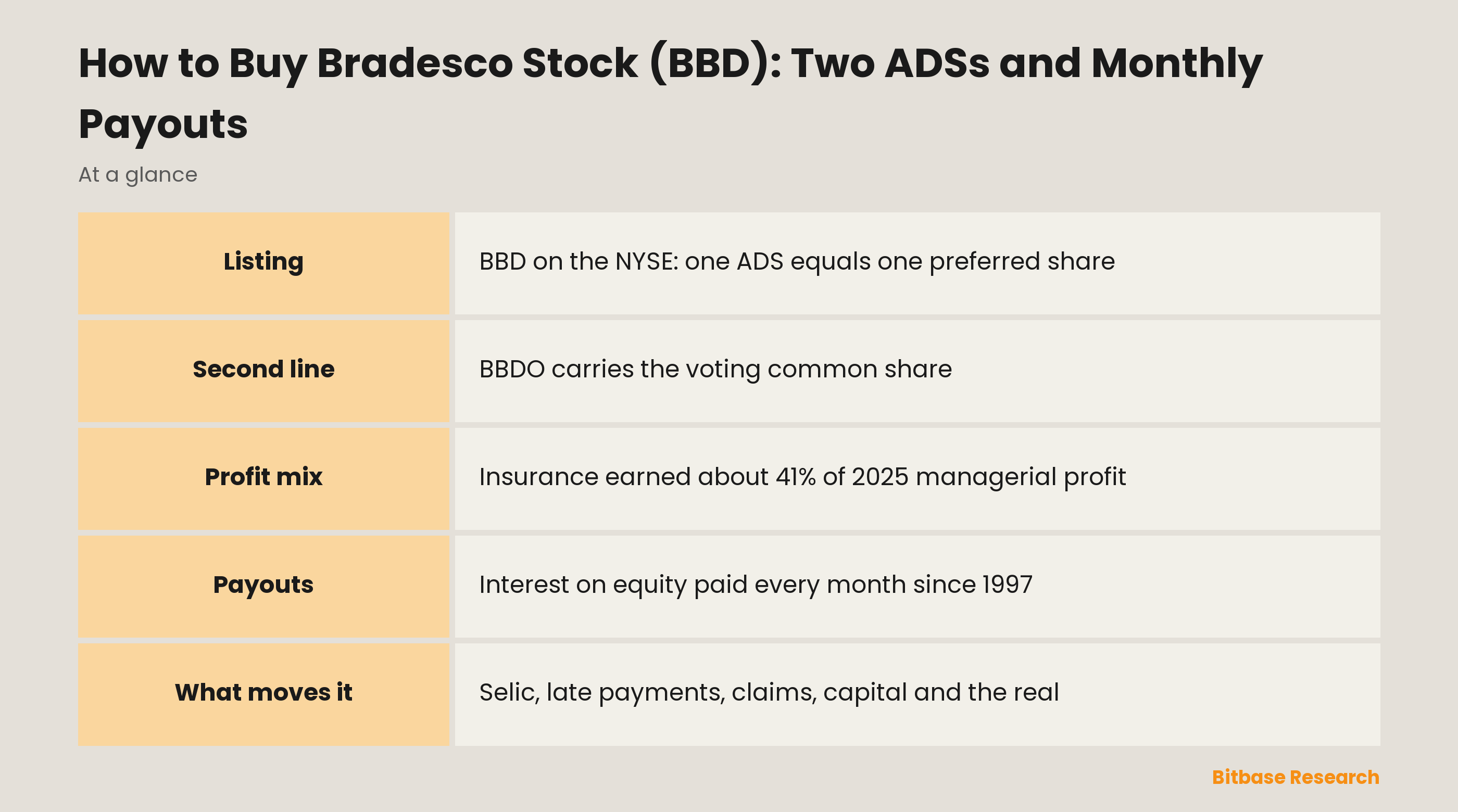
Buying Bradesco from outside Brazil usually means the BBD American depositary share (ADS) on the New York Stock Exchange, which any broker with access to US-listed securities can fill; each BBD stands for one non-voting preferred share, while a second ADS, BBDO, stands for one common share. Both classes also trade in São Paulo, as BBDC4 and BBDC3. Bradesco is a bank with an unusually large insurer inside it: its insurance, pension and capitalization segment produced about 41% of 2025 managerial net income, and the bank has paid shareholders every month since 1970.
What Does Bradesco Do?
Banco Bradesco is a full-service Brazilian bank whose head office sits in Cidade de Deus, in Osasco, a city next to São Paulo. It opened in 1943 as Banco Brasileiro de Descontos, began an aggressive expansion in 1948 and, by the end of the 1960s, had become the largest private-sector commercial bank in the country. In 1988 it absorbed its real estate finance, investment banking and consumer credit subsidiaries, became a multiple-service bank and took the name Banco Bradesco.
The annual report on Form 20-F splits the group into two segments. Banking takes deposits, lends to households and to companies of every size, issues cards and runs leasing, consortia, asset management and brokerage. Consortia are pooled purchase plans for cars, trucks and property, popular in Brazil, which Bradesco runs with monthly draws. The second segment, insurance, pension plans and capitalization bonds, is Grupo Bradesco Seguros: auto, property, life and health cover, private pensions, and capitalization bonds, a savings product that enters the buyer into prize draws. With 22.8% of Brazil's premiums, pension contributions and capitalization income at September 2025, the filing calls the group "the largest company in the Brazilian insurance market."
Scale is the other trait. At the end of 2025 Bradesco served 74.3 million clients, and 30.2 million of them had a digital profile; Banco Digio, its all-digital bank, had 10.0 million unique clients. The branch network is being cut on purpose, to 2,009 from 2,305 a year earlier, while Bradesco Expresso kept growing to 39,335 points: supermarkets, drugstores and other shops whose staff accept account and loan applications, withdrawals and bill payments for the bank. Bradesco also remains the leading payer of state pension benefits, serving more than 10.8 million retirees and pensioners. Less than 3.5% of revenue comes from abroad, through units such as Bradesco Bank in Miami and Bradescard Mexico.
For deposits, the 20-F lists Itaú Unibanco, Caixa Econômica Federal, Banco do Brasil and Santander as the main rivals; in loans, Itaú Unibanco, Banco do Brasil, Santander Brasil and Sicredi. In cards, it adds, digital banks "have increased their importance." The closest listed peer has its own guide: buying Itaú Unibanco stock.
How Bradesco Makes Money
Lending still pays most of the bills, but not most of the profit. In the managerial accounts of the 2025 segment note, financial margin, the gap between what Bradesco earns on loans and securities and what it pays for funding, made up 61.7% of revenue; fees and commissions 28.7%; and insurance results 9.6%.
| Segment | Share of 2025 managerial revenue | Share of 2025 managerial net income |
|---|---|---|
| Banking | 82.8% | 58.7% |
| Insurance, pension plans and capitalization bonds | 16.8% | 41.0% |
Revenue here means financial margin plus fees plus insurance results, before credit losses; a small "other activities" segment and intersegment eliminations make up the remainder. The managerial figures differ from the IFRS statements.
The gap between the two columns is the story. Banking carries the cost of bad loans: in 2025 expected credit losses swallowed close to a third of its revenue. Insurance carries none of that, so a much smaller revenue line turns into a far larger share of profit. On the IFRS figures, net income rose 36.4% in 2025 and fee and commission income 9.7%.
The bank keeps diversifying around that core. In 2025 it completed a 50% stake in Banco John Deere, which finances farm and construction machinery, and in April 2026 it folded its healthcare businesses into one listed company, Bradsaúde, the former Odontoprev, in which it owns 91.35%.
BBD Stock at a Glance
| Item | Detail |
|---|---|
| Issuer | Banco Bradesco S.A., organized under the laws of Brazil |
| New York lines | BBD (preferred-share ADS), listed on the NYSE in 2001; BBDO (common-share ADS), listed in March 2012 |
| ADS ratio | One ADS = one share of the matching class, for both lines |
| São Paulo lines | BBDC4 (preferred) and BBDC3 (common) on B3 |
| Depositary | The Bank of New York Mellon |
| Sector | Banking and insurance |
| Headquarters | Cidade de Deus, Osasco, São Paulo state |
| Financial year | Calendar year; the 20-F uses IFRS |
| Payout policy | At least 30% of adjusted net income; interest on shareholders' equity paid monthly |
| Main holders | Cidade de Deus Participações, Fundação Bradesco, NCF Participações |
| SEC filings | CIK 1160330; Form 20-F each year, Form 6-K in between |
The preferred and common shares are registered on the NYSE only so the ADSs can exist; they are "not for trading," so in New York the choice is between BBD and BBDO. The price of BBD moves with São Paulo and the exchange rate through the day; follow it on the Bradesco stock page on Bitbase.
How to Buy Bradesco Stock
Decide on the line first, then follow the usual steps:
1. Choose BBD or BBDO. BBD carries the preferred share, with higher dividends and almost no vote; BBDO carries the common share, with a vote and a slightly smaller payout. BBD is the more widely held of the two: ADRs accounted for 25.56% of the preferred shares at the end of 2025, against 0.11% of the common shares.
2. Open an account with a broker regulated where you live that offers NYSE stocks, and complete its identity and tax-residence checks.
3. Fund the account, checking what the currency conversion costs as well as the commission.
4. Find the right ticker. BBD and BBDO look alike, and the security description should name Banco Bradesco ADSs.
5. Pick an order type. A market order fills at the next available price, a limit order only at your price or better.
6. Decide on size. Whether you can buy a fraction of an ADS depends on the broker.
ADS or São Paulo shares. The ADSs are held through The Bank of New York Mellon, which converts payouts into dollars; the deposit agreements let it charge per-ADS fees on cash distributions and an annual service fee. Buying BBDC4 or BBDC3 directly on B3 is possible for a non-resident, but it means meeting Brazil's rules for foreign investors, which can include appointing a local representative and keeping the shares with an authorized Brazilian custodian. Going the other way has a cost too: the 20-F warns that exchanging ADSs for the underlying shares can mean losing Brazilian tax advantages and the ability to remit foreign currency abroad.
Brazilian tax on payouts. Bradesco pays mostly as interest on shareholders' equity, known in Brazil as JCP (juros sobre capital próprio), a distribution that the bank can deduct from its own taxable income. From 1 January 2026 the withholding rate on JCP rose to 17.5% from 15%, or 25% for residents of low-tax jurisdictions. Dividends, historically exempt, have borne 10% withholding since January 2026, though profits earned up to 2025 can in some cases still be paid out without it if distributed by the end of 2028. Brazil and the United States have no income tax treaty. The same rules appear in the Petrobras stock guide; how your own country taxes the payment is a question for a tax adviser.
Through a fund. The N-PORT report of the iShares MSCI Emerging Markets ETF for 31 August 2026 listed both Bradesco classes among its holdings, as small positions in a portfolio spread across hundreds of companies.
What Moves BBD Stock
The Selic. Brazil's base rate was raised to 15% in June 2025, cut to 14.75% in March 2026, and stood at 13.75% at the end of September 2026 in Bradesco's own indicator table. The 20-F says both directions can hurt: increases reduce demand for credit and raise funding costs and defaults, while cuts reduce the income earned on interest-bearing assets.
Late payments by smaller companies. In the third quarter of 2026 loans more than 90 days overdue rose to 4.6% of the portfolio. Bradesco said almost half of the increase came from working capital loans to micro, small and medium-sized companies backed by federal government guarantee funds, and that it was adjusting credit models and prices in response.
The insurance arm. Because the insurance segment supplies about two-fifths of profit, claims matter as much as loan losses. The 20-F explains that insurance income depends on actual claims staying close to the assumptions used to price policies, and floods, pandemics or longer lifespans can upset them.
Capital and dilution. Common equity stood at 11.2% of risk-weighted assets at the end of 2025, up from 10.5%, against a regulatory floor of 8.0% including buffers. In 2026 the bank went further: at the request of its controlling shareholders it sold new common and preferred shares to existing holders, at a 6% discount to market, in a rights issue that the central bank approved on 8 October. The common equity ratio reached 12.1% at the end of September. A renewed buyback runs from 8 November 2026 to 8 May 2028.
Tax changes. Higher withholding on JCP and the new dividend tax change what shareholders keep, and the same law raised the social contribution on net income paid by financial companies from April 2026.
The real. Because each BBD is backed by a single BBDC4 share, its dollar price is the São Paulo price translated at the current exchange rate.
Five Pressure Points in Bradesco's 20-F
The 20-F lists dozens of risk factors. These five reach shareholders most directly.
Brazil's economy and government. "The Brazilian government exercises influence over the Brazilian economy, and Brazilian political and economic conditions have a direct impact on our business." Bradesco also holds Brazilian government bonds, so the country's creditworthiness feeds into the value of its securities portfolio.
Seasoning loan books. The bank's loans grew in 2025, and the filing warns that defaults can lag that growth, since new loans do not fall due right away, with individuals usually more prone to arrears than companies.
Competition. Rivals include "other large banks and insurance companies, both public and private," along with fintechs and big technology companies, and Open Finance, which lets clients share their data between institutions, has intensified that competition.
Limited votes. BBD holders own preferred shares, which vote only in cases set by law, such as minimum dividends going unpaid for up to three consecutive years. Even BBDO holders vote only if Bradesco asks the depositary to collect instructions.
Dilution. The 20-F warns that ADS holders "may also be unable to participate in rights offerings by us, and your holdings may be diluted as a result" unless rights are registered or exempt in the US. The 2026 capital increase is a recent case of new shares being issued.
On top of that sit the risks of any single stock: one bank concentrates your money in one country's credit cycle, and a dollar-priced ADS adds currency risk.
How to Research BBD Yourself
Start on EDGAR, where Bradesco files under CIK 1160330. The FY2025 Form 20-F was filed on 25 March 2026; it holds the risk factors, segment results, the shareholder table, the bylaws on payouts and the Brazilian tax summary. Form 6-K carries everything since: quarterly results, each declaration of interest on shareholders' equity, the 2026 capital increase, the buyback renewal and notices from large investors, such as BlackRock reporting about 10.06% of the preferred shares on 8 October 2026.
Read the quarterly releases with care. Bradesco leads with recurring net income, an adjusted figure; it rose 14.6% from a year earlier in the third quarter of 2026, while the IFRS statements filed alongside can tell a different story. Per-share history also needs adjusting for the new shares issued in 2026. For other companies, browse more stock pages on Bitbase.
Bradesco Stock FAQ
What is the difference between BBD and BBDO?
BBD represents one preferred share and BBDO one common share. Preferred shares receive dividends 10% higher per share than common shares and have priority in a liquidation, but no vote in most matters. Common shares vote, and in a change of control their minority holders are entitled to 100% of the price paid per share to the controlling holders, against 80% for preferred shares.
Does Bradesco pay a dividend?
Yes, and often. Bradesco has distributed dividends monthly since 1970 and has paid interest on shareholders' equity every month since July 1997, with larger interim amounts declared on top; the bylaws require at least 30% of adjusted net income each year. The 20-F says the bank has "never failed to pay the mandatory dividend." ADS holders receive dollars from the depositary after its fees and Brazilian withholding.
Can I buy Bradesco stock with crypto?
Not directly. BBD and BBDO are bought with dollars through a brokerage account, and BBDC4 and BBDC3 with reais, so crypto would have to be sold first and the cash moved to the broker; depending on where you live, that sale can be taxable.
Who controls Bradesco?
Cidade de Deus Participações, a holding company, owned 46.17% of the voting common shares at the end of 2025. Behind it stands Fundação Bradesco, a non-profit education foundation founded in 1956, which held 31.53% of total capital directly and indirectly. The preferred shares, by contrast, were 96.52% in market hands, and foreign investors held 63.92% of that class.
Why did Bradesco issue new shares in 2026?
The controlling shareholders asked for a capital increase to keep funding the bank's transformation plan, including technology, and committed to subscribe for most of it. Every shareholder received rights to about 5.72 new shares for every 100 held, in the same class, and all the shares were taken up; the central bank approved the increase on 8 October 2026.
Conclusion
Bradesco is two businesses under one ticker: a lender exposed to Brazilian rates and arrears, and the country's largest insurer, which earned about 41% of its 2025 managerial profit. Deciding between BBD's higher payout and BBDO's vote comes first, followed by Brazil's new withholding on JCP and dividends. Before sizing a position, read the latest 20-F and the 6-Ks on the capital increase and on late payments, since both are still unfolding.
Related reading
Other Bitbase articles on this topic:
- How to Buy Citizens Financial Stock (CFG): Private Bank Growth
- How to Buy Credicorp Stock (BAP): BCP, Yape and Dividends in Soles
- How to Buy Fifth Third Stock (FITB): Comerica Deal and NYSE Move
- How to Buy Huntington Bancshares Stock (HBAN): Cadence and Veritex
Disclaimer: This article is educational content from Bitbase Academy, provided for information only. It explains what a company or fund does and how the instruments referenced here differ from one another; it does not constitute investment, trading, tax, or financial advice, and it is neither a recommendation nor an endorsement of any security, token, or trading strategy. A tokenized stock is issued by a third party and is designed to give economic exposure to an underlying asset: it is not a share, it carries no shareholder rights, and it depends on the issuer's structure, eligibility rules, and redemption terms, which the issuer can change. Perpetual futures are leveraged derivatives that hold no underlying asset and can be liquidated, and trading hours, product availability, and eligibility differ by instrument and by jurisdiction and can change at any time. Written as of November 2026; verify everything yourself through company filings, the issuer's own documentation, and the product pages of the venue you trade on.
References
[1] Banco Bradesco, Form 20-F for 2025 (SEC EDGAR) www.sec.gov
[2] Banco Bradesco, Form 6-K: 3Q26 results release (23 October 2026) www.sec.gov
[3] Banco Bradesco, Form 6-K: capital increase by private subscription (29 July 2026) www.sec.gov
[4] Banco Bradesco, Form 6-K: central bank approval of the capital increase (8 October 2026) www.sec.gov
[5] Banco Bradesco, Form 6-K: renewal of the share buyback programme (22 October 2026) www.sec.gov
[6] Banco Bradesco, Form 6-K: change in relevant shareholding, BlackRock (13 October 2026) www.sec.gov
[7] iShares MSCI Emerging Markets ETF, Form N-PORT (31 August 2026) www.sec.gov





