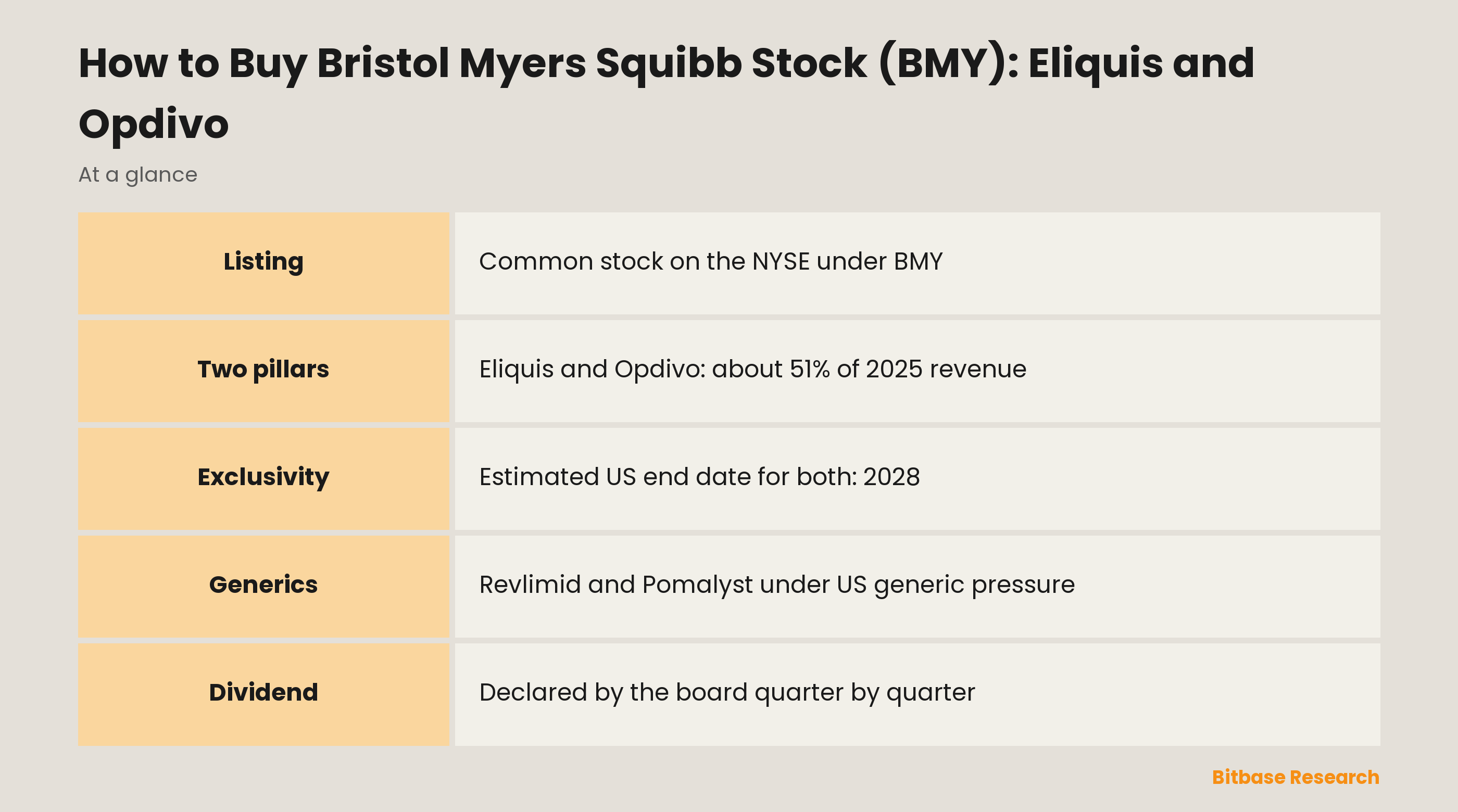
Your route to Bristol Myers Squibb stock is any brokerage account that can trade on the New York Stock Exchange, where the company's common stock is listed as BMY. Behind the ticker is a drugmaker leaning on two medicines: the blood thinner Eliquis and the cancer immunotherapy Opdivo brought in about 51% of 2025 revenue, and the 10-K puts the estimated end of their US market exclusivity in 2028. This guide covers the revenue mix, the purchase and the filing dates that matter.
What Does Bristol Myers Squibb Do?
Bristol Myers Squibb, or BMS, discovers, develops, makes and sells prescription medicines. Its 10-K describes a single segment devoted to "innovative medicines that help patients prevail over serious diseases," mainly in oncology, hematology, immunology, cardiovascular disease and neuroscience. It was incorporated in Delaware in 1933 as Bristol-Myers Company and took its present name in 1989 as a result of a merger. Head office is in Princeton, New Jersey.
The filings split the products in two. The Growth Portfolio holds the newer medicines: Opdivo and Opdivo Qvantig, an under-the-skin version launched in the US in January 2025; Yervoy, approved alongside Opdivo for several cancers; Orencia for rheumatoid arthritis; Reblozyl for certain anaemias; the CAR-T cell therapies Breyanzi and Abecma; the heart drug Camzyos; and Cobenfy, which the FDA approved for adult schizophrenia in September 2024.
The Legacy Portfolio is led by Eliquis, an oral anticoagulant for stroke prevention in atrial fibrillation and for blood clots, which BMS discovered and sells with Pfizer. Next come the multiple myeloma drugs Revlimid and Pomalyst, inherited from Celgene, acquired on 20 November 2019.
How Bristol Myers Squibb Makes Money
Revenue was roughly flat in 2025: newer medicines and Eliquis grew while generics cut into older drugs. The 10-K's product table, as shares:
| Product | Portfolio | Share of 2025 revenue | Change vs 2024 |
|---|---|---|---|
| Eliquis | Legacy | 30.0% | +8% |
| Opdivo | Growth | 20.9% | +8% |
| Orencia | Growth | 7.7% | +1% |
| Revlimid | Legacy | 6.1% | −49% |
| Yervoy | Growth | 6.0% | +15% |
| Pomalyst/Imnovid | Legacy | 5.7% | −23% |
| Reblozyl | Growth | 4.8% | +31% |
| Breyanzi | Growth | 2.8% | +82% |
| All other products | Both | 16.0% | — |
Shares are calculated from fiscal 2025 figures and rounded.
Overall, the Growth Portfolio supplied about 55% of 2025 revenue and grew 17%; the Legacy Portfolio supplied about 45% and shrank 15%. In the first nine months of 2026 the newer group's share reached about 57%.
Both leading products have partners. Pfizer funds 50% to 60% of Eliquis development costs, and the two share profits and losses equally except in certain countries where Pfizer sells it alone; BMS books the sales in its main markets and pays Pfizer's half as a cost, the arrangement the guide to buying Pfizer stock describes from the other side. Opdivo is developed and sold jointly with Ono Pharmaceutical in Japan, South Korea and Taiwan.
The US supplied about 69% of 2025 revenue, international markets 29% and royalties and alliance income on products BMS does not sell 2%. Three US wholesalers handle about 87% of gross US revenues.
BMY Stock at a Glance
| Item | Detail |
|---|---|
| Exchange | New York Stock Exchange (NYSE) |
| Ticker | BMY |
| Security | Common stock |
| Other registered securities | Six series of notes and the Celgene contingent value rights, each with its own symbol |
| Sector | Healthcare: biopharmaceuticals |
| Index membership | S&P 500 |
| Headquarters | Princeton, New Jersey |
| Incorporated | Delaware, 1933 |
| Fiscal year | Ends 31 December |
| Dividend policy | Cash dividend, authorised by the board quarter by quarter |
| SEC identifier | CIK 14272 |
The quote, market value and yield change by the minute; they are on the Bristol Myers Squibb stock page on Bitbase.
How to Buy Bristol Myers Squibb Stock
BMY is the ordinary share of a US company, with no depositary receipt or second class involved. The purchase runs through a broker:
1. Pick a broker that reaches the NYSE. Outside the US, that may be a local firm with a US service or an international one; confirm the legal entity behind your account and its regulator.
2. Open the account. Non-US individuals usually file IRS Form W-8BEN, which lets a treaty rate apply to US dividends.
3. Deposit money. A currency conversion costs something too, on top of commission.
4. Search BMY. The line should say Bristol-Myers Squibb common stock, NYSE; BMY35 is one of the company's notes and CELG RT the Celgene rights.
5. Choose the order. A market order "guarantees that the order will be executed, but does not guarantee the execution price"; a limit order executes only "at a specific price or better."
6. Decide the size. Fractional shares let you spend a set sum, though "not every brokerage firm offers fractional share investing."
Outside the United States, BMY dividends are US-source income. The IRS says "most types of U.S. source income received by a foreign person are subject to U.S. tax of 30%," and "a reduced rate, including exemption, may apply" under a treaty. Your own country may tax the payment as well.
Through an index fund, BMS arrives as one constituent of the S&P 500; State Street's SPY held it on 28 October 2026.
What Moves BMY Stock
Generic copies of the Celgene drugs. "We expect continued generic erosion within our Legacy Portfolio in 2026 primarily due to Revlimid and Pomalyst in the U.S.," the 10-K says. US generic licences for Revlimid stopped being volume-limited on 31 January 2026, and generic Pomalyst arrived that March. Over the first nine months of 2026, Revlimid revenue fell 54% and Pomalyst 59%.
The 2028 dates for Eliquis and Opdivo. The 10-K's exclusivity table lists 2028 as the estimated minimum US date for both. Generic makers that settled Eliquis patent cases may launch in the US that year; in the EU, the apixaban patents and related protection certificates expire in November 2026. For Opdivo the EU date is 2030, and in September 2026 BMS and Ono sued Amgen over its application for a nivolumab biosimilar. Opdivo revenue fell 5% in the first nine months of 2026, which the 10-Q puts down mainly to lower US demand "reflecting greater utilization of Opdivo Qvantig."
US drug pricing. Under the Inflation Reduction Act, a government-set Medicare price for Eliquis has applied since 1 January 2026, Pomalyst follows in 2027, and Orencia was selected in January 2026 for prices from 2028. Under a December 2025 agreement with the US government, BMS supplies Eliquis free to Medicaid from 2026 and receives certain tariff relief until January 2029. A 2026 cut to the Eliquis US list price lowered rebates and lifted realised net prices; Eliquis revenue rose 21% in the first nine months.
Royalties that expire. The royalties on Merck's Keytruda and Roche's Tecentriq are booked in other income, not revenue, and are expected to terminate on 31 December 2026; the 10-K says royalties have represented "a significant percentage of our pretax income."
Successors. In August 2026 the FDA approved Zenbexus (iberdomide), the first CELMoD from BMS, with daratumumab and dexamethasone for adults with multiple myeloma after at least one prior line of therapy, and it has accepted an application for mezigdomide with a decision date of 13 May 2027. Growth Portfolio revenue rose 12% in the third quarter of 2026.
Risks Bristol Myers Squibb Flags in Its 10-K
Of the risk factors in Item 1A, four speak most plainly to a BMY holding:
Pricing. "Increased pricing pressure and other restrictions in the U.S. and abroad continue to negatively affect our revenues and profit margins."
Exclusivity. "We could lose market exclusivity of a product earlier than expected," and sales of Orencia, Eliquis and Opdivo are expected to decline once it ends.
Concentration. "We depend on several key products for most of our revenues, cash flows and earnings," and the filing names Eliquis, Opdivo, Opdivo Qvantig, Orencia, Reblozyl and Yervoy.
Debt. "We have significant indebtedness that could have negative consequences," which the filing links to the 2024 purchases of Mirati, Karuna and RayzeBio.
On the shares themselves, the 10-K adds that "there can be no guarantee that we will pay dividends or repurchase stock."
Reading the BMY Filings Yourself
BMS files on EDGAR under CIK 14272: an annual 10-K, three quarterly 10-Qs and 8-Ks for events such as each results release. In the 10-K, Item 1 has the exclusivity table, Item 1A the risks, the alliances note the Pfizer and Ono terms, and the legal proceedings note the Eliquis patent cases.
The 10-K's structured cover, R1.htm, lists eight registered securities; BMY is the common stock alone. Quotes for other companies are under more US stock pages on Bitbase.
Bristol Myers Squibb Stock FAQ
Does Bristol Myers Squibb pay a dividend?
Yes. "Dividends are authorized on a quarterly basis by our Board of Directors," the 10-K says, and each 2026 quarter was declared at a higher amount per share than in 2025. Future payments are not guaranteed.
Can I buy Bristol Myers Squibb stock with crypto?
Not directly. BMY is bought through a broker and priced in US dollars, so crypto has to be converted to cash and the cash transferred first; that sale may be taxable where you live. The guide to using crypto to fund a stock purchase walks through it.
Is BMY in the S&P 500?
Yes. State Street's daily holdings file for SPY, its S&P 500 trust, listed Bristol Myers Squibb in October 2026.
Is it Bristol-Myers Squibb or Bristol Myers Squibb?
The same company. SEC filings use the legal name with a hyphen, Bristol-Myers Squibb Company; the company's releases write Bristol Myers Squibb.
Has BMY stock ever split?
Yes. Equity tables in the annual reports filed in 1998 and 2000 each record a two-for-one stock split, entered among the share movements of 1996 and of 1998. Per-share figures from that decade need adjusting.
Conclusion
The order itself is simple: NYSE access, the BMY common stock line, a market or limit order. Judging the business takes more work: Eliquis and Opdivo face 2028 in the US, Revlimid and Pomalyst already compete with generics, and the Growth Portfolio grew 17% in 2025. Read the exclusivity table and the newest 10-Q before sizing a position.
Related reading
Other Bitbase articles on this topic:
- How to Buy AbbVie Stock (ABBV): Skyrizi and Rinvoq After Humira
- How to Buy Amgen Stock (AMGN): Repatha, Prolia and MariTide
- How to Buy argenx Stock (ARGX): Nasdaq, Brussels and VYVGART
Disclaimer: This article is educational content from Bitbase Academy, provided for information only. It explains what a company or fund does and how the instruments referenced here differ from one another; it does not constitute investment, trading, tax, or financial advice, and it is neither a recommendation nor an endorsement of any security, token, or trading strategy. A tokenized stock is issued by a third party and is designed to give economic exposure to an underlying asset: it is not a share, it carries no shareholder rights, and it depends on the issuer's structure, eligibility rules, and redemption terms, which the issuer can change. Perpetual futures are leveraged derivatives that hold no underlying asset and can be liquidated, and trading hours, product availability, and eligibility differ by instrument and by jurisdiction and can change at any time. Written as of October 2026; verify everything yourself through company filings, the issuer's own documentation, and the product pages of the venue you trade on.
References
[1] Bristol-Myers Squibb Form 10-K, fiscal 2025: products, revenue, exclusivity and risk factors (SEC EDGAR) www.sec.gov
[2] Bristol-Myers Squibb Form 10-Q, quarter ended 30 September 2026 (SEC EDGAR) www.sec.gov
[3] Bristol Myers Squibb third-quarter 2026 results release, 29 October 2026 (SEC EDGAR) www.sec.gov
[4] Bristol-Myers Squibb Form 10-K, fiscal 2019: Celgene acquisition (SEC EDGAR) www.sec.gov
[5] Bristol-Myers Squibb Form 10-K, fiscal 1997: stockholders' equity note (SEC EDGAR) www.sec.gov
[6] Bristol-Myers Squibb Form 10-K, fiscal 1999: stockholders' equity note (SEC EDGAR) www.sec.gov
[7] State Street SPDR S&P 500 ETF Trust (SPY): daily holdings www.ssga.com
[8] Investor.gov (SEC): Types of Orders www.investor.gov
[9] Investor.gov (SEC): fractional share investing www.investor.gov
[10] IRS: NRA Withholding www.irs.gov





