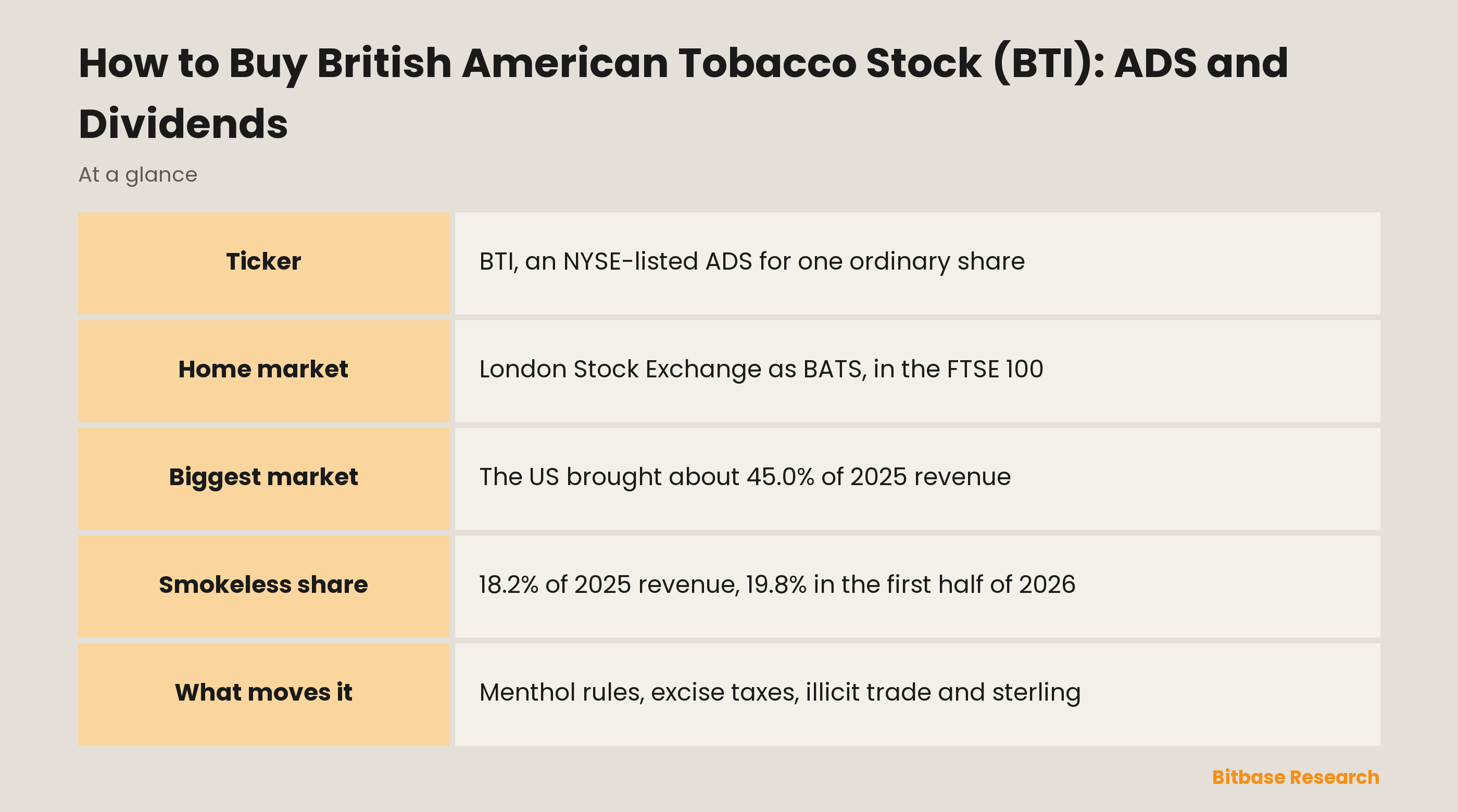
Buying an American depositary share (ADS) on the New York Stock Exchange is the usual way to own British American Tobacco from the United States: the ticker is BTI, any broker with NYSE access can take the order, and each ADS stands for exactly one ordinary share of the London-listed parent. BAT is registered in England, yet its largest market is across the Atlantic: the US business, built on Reynolds American, brought in about 45.0% of 2025 revenue, against about 1% from the UK. This guide covers how the group earns that money, how BTI compares with the London shares and which risks its annual report puts on record.
What Does British American Tobacco Do?
British American Tobacco p.l.c. (BAT) is the holding company of a group that makes and sells cigarettes and other tobacco and nicotine products. It runs the business in three regions: the United States; Americas and Europe (AME), which covers Europe, Latin America and Canada; and Asia-Pacific, Middle East and Africa (APMEA), which also takes in Central Asia and the Caucasus. Tadeu Marroco has been chief executive since May 2023.
Cigarettes are still the core. The group sells them in more than 140 markets from 36 cigarette factories in 35 markets, under international brands such as Kent, Dunhill, Lucky Strike, Pall Mall and Rothmans and, in the US, Newport, Camel and Natural American Spirit. Alongside them sits what BAT calls its smokeless portfolio. Three newer lines are grouped as New Categories: vapour products sold as Vuse, which use a battery to heat a liquid containing nicotine; heated products sold as glo, in which a device heats a tobacco or plant-based consumable instead of burning it; and Modern Oral, the Velo nicotine pouches, which are usually made without tobacco leaf. The fourth line, Traditional Oral, means snus and moist snuff, with US brands such as Grizzly, Kodiak and Camel Snus.
The name goes back to a 1902 agreement: BAT Ltd. was formed that year as a joint venture between the Imperial Tobacco Company and the American Tobacco Company. It entered the US market in 1927 by buying Brown & Williamson, diversified under B.A.T Industries from the 1960s to the 1980s into businesses ranging from paper to financial services, and later refocused on tobacco. The present parent company was incorporated in England and Wales in July 1997 and has been listed in London on its own since 1998.
Acquisitions shaped the rest. BAT merged with Rothmans International in 1999 and bought Imperial Tobacco Canada in 2000. In 2004 Brown & Williamson's US operations were combined with RJR Tobacco to form Reynolds American, in which BAT then held about 42%. On 25 July 2017 BAT completed the purchase of the remaining 57.8%, Reynolds American stopped being a public company, and on the same day BAT's ADSs began trading on the NYSE.
BAT also owns stakes in companies it does not run. The largest is in ITC, an Indian company from which the group also buys tobacco leaf: after partial sales in 2024 and 2025, BAT held 22.91% of it at the end of 2025.
How British American Tobacco Makes Money
BAT reports revenue after duty, excise and other taxes have been deducted, and those taxes are larger than what remains: in 2025 they came to about 1.26 times revenue. Revenue itself fell 1.0% as reported, after a 3.1% drag from translating other currencies into sterling; at constant exchange rates it rose 2.1%.
Cigarettes bring in most of the money; the smaller lines are where the change is:
| Product category | Share of 2025 revenue | Change vs 2024 | Brands named in the 20-F |
|---|---|---|---|
| Combustibles | 78.9% | −2.3% | Kent, Dunhill, Lucky Strike, Pall Mall, Rothmans; Newport, Camel and Natural American Spirit in the US |
| Vapour | 6.0% | −10.4% | Vuse |
| Modern Oral | 4.5% | +47.4% | Velo |
| Traditional Oral | 4.1% | −4.5% | Grizzly, Kodiak, Camel Snus |
| Heated Products | 3.6% | −0.7% | glo |
| Other | 2.9% | — | — |
Shares are worked out from the segment note of the 20-F; changes are in sterling as the 20-F reports them.
Taken together, the four smokeless lines made up 18.2% of 2025 revenue, and BAT's stated ambition is for them to supply more than half of revenue by 2035. Modern Oral moved the most: in the US, where the group launched Velo Plus, its revenue rose 297%. Vapour went the other way, which the filing attributes to the "continued proliferation of illegal single-use vapour products in the U.S. and Canada" and to exits from several APMEA markets.
By region, the US produced 45.0% of revenue, AME 36.3% and APMEA 18.6%. US revenue rose 2.3%, with higher cigarette prices and Velo Plus offsetting lower cigarette volume; AME rose 0.7%; APMEA fell 10.9%, which BAT puts down to "regulatory and fiscal challenges in Australia and Bangladesh." The UK, where the parent is registered, accounted for about 1% of revenue.
Group cigarette volume fell 7.9% in 2025, so the combustible business held its revenue mainly through price. And Traditional Oral is almost entirely American, with 96.5% of its revenue earned in the US.
The half-year report published in July 2026 kept the same pattern: smokeless products reached 19.8% of revenue in the first six months, and US revenue grew 8.5% at constant exchange rates while APMEA shrank.
BTI Stock at a Glance
| Item | Detail |
|---|---|
| What BTI is | An American depositary share (ADS) of British American Tobacco p.l.c., each representing one ordinary share |
| New York listing | NYSE since 25 July 2017, as a sponsored Level III programme |
| Depositary | Citibank, N.A., which is also the transfer agent |
| Primary listing | London Stock Exchange, code BATS, listed since 8 September 1998 |
| Secondary listing | Johannesburg Stock Exchange, trading code BTI, listed since 28 October 2008 and priced in rand |
| Index membership | FTSE 100 for the London shares; JSE Top 40 for the Johannesburg line |
| Held as ADSs | About 17.4% of the ordinary shares outstanding on 5 February 2026 |
| Other NYSE lines | 29 note issues with symbols built on BTI, such as BTI26 |
| Legal form | Public limited company registered in England and Wales; registered office at Globe House, London |
| Fiscal year | Calendar year; IFRS accounts reported in pounds sterling |
| Dividend policy | Four quarterly payments; a progressive dividend of 65% of long-term sustainable earnings |
| SEC filings | Form 20-F each year plus Forms 6-K, CIK 1303523 |
The table leaves out the price on purpose. For the live quote, chart and trading volume, open the British American Tobacco stock page on Bitbase.
How to Buy British American Tobacco Stock
One company, three markets. From the US, BTI is the straightforward choice: it is priced in dollars, trades during New York hours and is backed share for share by BAT's ordinary shares.
1. Pick the market, then the broker. Any broker that offers NYSE stocks can buy BTI; London or Johannesburg shares need a broker with access to those exchanges.
2. Open an account you qualify for. Brokers choose which countries' residents they accept and check identity before the first trade.
3. Fund it. If your money is not in dollars, the conversion rate the broker applies is a cost of its own, separate from commission.
4. Confirm the line. Search BTI and check that the result is British American Tobacco's ADS on the NYSE. Symbols such as BTI26 or BTI55 belong to BAT's bonds, and EDGAR's company data also lists an OTC symbol, BTAFF; the ADS is the only BAT equity that trades on the NYSE. A listed symbol is reserved for one security at a time, a guarantee that crypto tickers do not carry.
5. Choose the order type. A market order fills at whatever price comes next; a limit order sets a ceiling and can go unfilled.
6. Decide on size. Whether you can buy part of an ADS depends on the broker; some trade whole units only.
ADS or London share. Citibank holds the ordinary shares behind the ADSs and is their registered holder. Dividends are declared in sterling and paid to ADS holders in dollars at the exchange rate on the payment date, after the depositary deducts a small fee per ADS from each payment. Votes also pass through Citibank: BAT's description of the ADS programme says the depositary will "endeavor to vote" as instructed, and "deposited securities for which no voting instructions have been received will not be voted." One cost point favours the ADS. The 20-F says transfers of ADSs should not attract UK stamp duty or stamp duty reserve tax, while buying ordinary shares outside the depositary generally costs 0.5% of the price, and placing ordinary shares into a depositary or clearance system 1.5%.
UK tax on dividends. BAT "is not required to withhold UK tax at source" from dividends on its ordinary shares or ADSs, and according to the 20-F US holders generally owe no UK tax on them unless they trade in the UK through a branch or similar presence. That does not make the income tax-free: the country where you live decides how it is taxed. None of this is tax advice.
Through a fund. The London shares are a FTSE 100 constituent, so funds that track UK stocks hold BAT in its London form; the iShares MSCI United Kingdom ETF, for example, listed BATS among its holdings on 27 October 2026.
What Moves BTI Stock
Menthol rules in the US. The 20-F describes Newport as "the leading menthol cigarette brand in the U.S., the Group's largest single market," and says Newport and the group's other menthol brands "represent a significant portion of the Group's total net sales." The FDA once announced it would ban menthol as a characterising flavour in cigarettes; the federal regulatory agenda published on 4 September 2025 lists that proposal as "withdrawn," but BAT warns there is no assurance a current or future administration will not bring it back.
Illicit vapes and FDA decisions. The FDA issued its first marketing orders for tobacco-flavoured Vuse Solo products in October 2021 and has refused others, including menthol Vuse Alto, whose denial is under appeal. Enforcement matters too: according to the 20-F, Vuse returned to revenue growth in the US in the second half of 2025, helped by tougher federal and state enforcement against illicit single-use vapes.
Canada's settlement. After a Quebec court judgment, BAT's Canadian subsidiary Imperial Tobacco Canada sought creditor protection in 2019. An Ontario court sanctioned a settlement plan on 6 March 2025, alongside substantially similar plans for the Canadian subsidiaries of Philip Morris International and Japan Tobacco International, and the plans took effect on 29 August 2025. Beyond an upfront payment, the companies pay a share of their Canadian after-tax income, starting at 85% and falling over time, until the total is paid; income from New Categories is left out of the calculation. When BAT changes its forecast of Canadian cigarette income, the provision for these payments moves, and so does reported profit.
Excise taxes. Higher duties raise shelf prices and push some smokers towards cheaper or illegal products. BAT cites Bangladesh, which raised excise sharply and changed its minimum retail price rules in January 2025, and the EU, whose proposed revision of its tobacco excise directive, published in July 2025, is not expected to take effect until 2028 or later.
Sterling against the dollar. BAT reports in pounds, and the 20-F says translation exposures "are not normally hedged." In 2025 currency translation cut reported revenue growth by 3.1%. BTI is quoted in dollars, so its price also reflects the pound-dollar rate, and so does the dollar value of each dividend.
Buybacks and the ITC stake. BAT bought back and cancelled shares equal to 1.39% of its issued share capital in 2025 and extended the programme into 2026; in October 2026 it engaged Merrill Lynch to keep buying until 23 December. The partial ITC sales in 2024 and 2025 also brought in cash.
What Could Go Wrong for BTI Holders
Of the many risk factors in the 20-F, five bear most directly on a BTI position.
Product regulation. BAT calls its industry "one of the most highly regulated in the world," with rules ranging from category bans and flavour limits to plain packaging. In the UK, the Tobacco and Vapes Bill, which includes a generational sales ban, was still going through Parliament when the 20-F was filed in February 2026.
Litigation. Some actions, the 20-F says, "involve claims in the tens or hundreds of billions in sterling." In the US, Reynolds' tobacco subsidiary RJRT makes substantial continuing payments under the Master Settlement Agreement and other state settlements, and the Canadian plans add years of payments of their own.
Illicit trade. The filing lists "competition from illicit trade" as a principal risk, with tax increases, inflation and weak enforcement pushing consumers towards cheaper counterfeit or smuggled products.
Falling consumption. Another entry covers the "effects of declining consumption of legitimate tobacco products and a tough competitive environment." Group cigarette volume fell 7.9% in 2025.
Currency and the dividend. BAT notes that "the dividend paid by the Group may be impacted if the payout ratio is not adjusted" when exchange rates swing.
Holding the ADS adds its own layer. Votes depend on instructions reaching the depositary in time, depositary fees come out of dividends, and every payment is declared by the board rather than guaranteed.
Researching BTI in BAT's Own Filings
BAT files with the SEC under CIK 1303523: a Form 20-F each year, the latest filed on 13 February 2026, and Forms 6-K for half-year results, trading updates, buyback reports and other announcements it also makes in London and Johannesburg.
In the 20-F, the risk factors come before the business overview, with a long section on regulation by product, while note 24 covers litigation, including the Canadian plans. The XBRL cover, R1.htm, lists 31 registered securities: the ADS, the ordinary shares registered only to support it, and 29 note issues. Mind the dates as well, because each year's dividend is paid during the following year: the 2025 dividend runs from May 2026 to February 2027.
BAT's investor relations pages at bat.com carry the same reports, along with presentations from its September 2026 capital markets day in Winston-Salem, North Carolina, the home of Reynolds American. For quotes on other listed companies, see Bitbase's stock section.
British American Tobacco Stock FAQ
Is BTI the same as BAT's London shares?
Each BTI ADS represents one ordinary share, the same share that trades in London as BATS and in Johannesburg under the code BTI. The wrapper is what differs: BTI trades in dollars on the NYSE, with Citibank as the registered holder that votes on your instructions and converts dividends into dollars, while the London share trades in pence and changes hands subject to UK stamp duty.
Can I buy British American Tobacco stock with crypto?
Not directly. BTI settles in dollars and the London shares in sterling, so crypto has to be sold for cash and the cash moved to a broker before an order can go in. That sale can count as a disposal for tax purposes in many countries; how crypto disposals are taxed depends on where you live.
Does British American Tobacco pay a dividend?
Yes, in four quarterly instalments. The board's stated policy is a progressive dividend of 65% of long-term sustainable earnings, and the 2025 dividend, paid between May 2026 and February 2027, was 2.0% higher than the 2024 dividend. It is declared in sterling, so the dollar amount on BTI moves with the exchange rate.
Does British American Tobacco own Reynolds American?
Yes. BAT held about 42% from 2004 and bought the rest in a deal completed on 25 July 2017, after which Reynolds American was no longer listed. Its brands include Newport and Camel, and the US, where they are sold, is BAT's largest single market.
Which stock indexes include British American Tobacco?
According to the 20-F, the London shares are part of the FTSE 100 and the Johannesburg line belongs to the JSE Top 40. Index weights change every day, so check the index provider or a fund's holdings file for the current figure.
Conclusion
For a US investor the purchase itself is simple: BTI on the NYSE, one ADS for each ordinary share and no UK tax withheld from the dividend. The harder part is the business behind it, a cigarette company whose largest market is the US, whose smokeless lines reached 18.2% of revenue in 2025 and whose results answer to menthol rules, excise taxes, illicit trade and sterling. Read the latest 20-F and half-year 6-K before deciding how much of a portfolio one tobacco company should take up.
Related reading
Other Bitbase articles on this topic:
- How to Buy Altria Stock (MO): Marlboro, Dividend, PMI Spin-Off
- How to Buy Colgate-Palmolive Stock (CL): Toothpaste and Pet Food
- How to Buy Mondelez Stock (MDLZ): Oreo, Cadbury and Cocoa Costs
Disclaimer: This article is educational content from Bitbase Academy, provided for information only. It explains what a company or fund does and how the instruments referenced here differ from one another; it does not constitute investment, trading, tax, or financial advice, and it is neither a recommendation nor an endorsement of any security, token, or trading strategy. A tokenized stock is issued by a third party and is designed to give economic exposure to an underlying asset: it is not a share, it carries no shareholder rights, and it depends on the issuer's structure, eligibility rules, and redemption terms, which the issuer can change. Perpetual futures are leveraged derivatives that hold no underlying asset and can be liquidated, and trading hours, product availability, and eligibility differ by instrument and by jurisdiction and can change at any time. Written as of October 2026; verify everything yourself through company filings, the issuer's own documentation, and the product pages of the venue you trade on.
References
[1] British American Tobacco Form 20-F for 2025: business, segments, risk factors, dividend policy and taxation (SEC EDGAR) www.sec.gov
[2] British American Tobacco 2025 Form 20-F, XBRL cover page (SEC EDGAR) www.sec.gov
[3] British American Tobacco, description of securities including the ADS programme, exhibit to the 2025 Form 20-F (SEC EDGAR) www.sec.gov
[4] British American Tobacco Half-Year Report for the six months to 30 June 2026, Form 6-K (SEC EDGAR) www.sec.gov
[5] British American Tobacco, share buyback programme announcement, 7 October 2026, Form 6-K (SEC EDGAR) www.sec.gov
[6] British American Tobacco, 2026 Capital Markets Day announcement, 29 September 2026, Form 6-K (SEC EDGAR) www.sec.gov
[7] SEC EDGAR company data for British American Tobacco, CIK 1303523 data.sec.gov
[8] iShares MSCI United Kingdom ETF, fund page and holdings file (BlackRock) www.ishares.com





