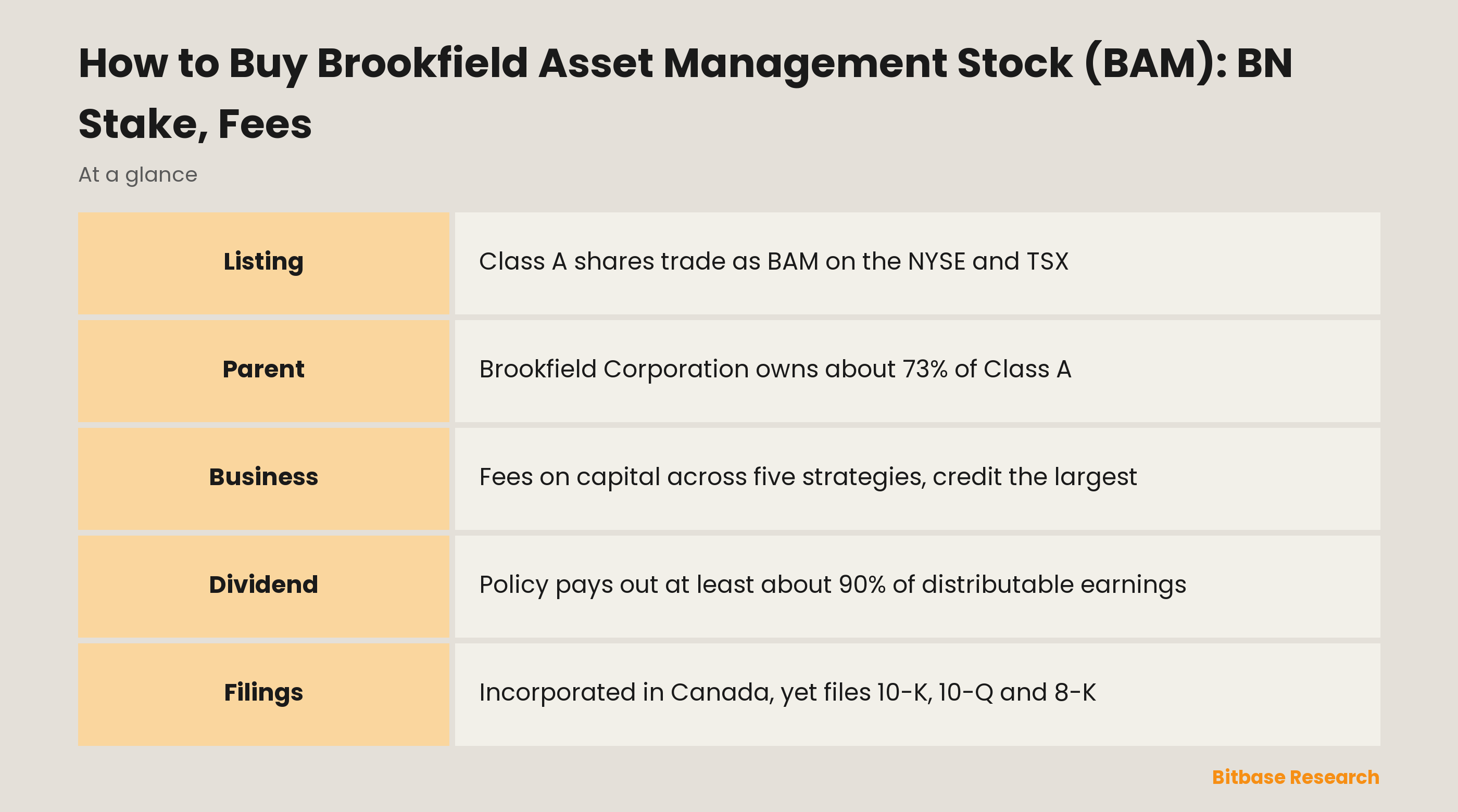
Brookfield has more than one listed company, so buying Brookfield Asset Management stock starts with picking the right line: BAM, the Class A share of Brookfield Asset Management Ltd., which any broker with access to the New York or Toronto stock exchange can buy. BAM is the group's asset manager, and its largest shareholder is the parent, Brookfield Corporation (BN), with about 73% of the Class A shares. This guide explains how BAM earns its fees, how to place the order, and what the filings say about BN, fundraising and the dividend.
What Does Brookfield Asset Management Do?
Brookfield Asset Management is an alternative asset manager: it raises money from clients, invests it through funds and listed vehicles, and charges fees for managing it. Its 10-K describes investing "client capital for the long-term with a focus on real assets and essential service businesses," for clients such as pension plans, endowments, sovereign wealth funds, insurers and private wealth investors.
The products come in three kinds: long-term private funds, "typically committed for at least 10 years with two one-year extension options"; permanent capital vehicles and perpetual strategies with no set end date; and liquid strategies. They span five strategies: infrastructure, which includes the listed Brookfield Infrastructure Partners (BIP); renewable power and transition, renamed "energy" in 2026 reports, with Brookfield Renewable Partners (BEP); private equity, with Brookfield Business Partners (BBU); real estate, including Brookfield Property Group, run on behalf of BN; and credit, which works partly through partner managers in which BAM holds significant stakes, such as Castlelake, Angel Oak and Primary Wave.
One partner, Oaktree, is now fully owned. Brookfield agreed in October 2025 to buy the roughly 26% it did not already own, and the second-quarter 2026 10-Q records completion on 31 July 2026; BAM, which had held about 74% under the equity method, consolidates Oaktree from that date.
The listed company itself is recent. BN formed it on 4 July 2022, and in December 2022 BN, then named Brookfield Asset Management Inc., passed a 25% interest in its asset management business to its shareholders through BAM and renamed itself Brookfield Corporation. BAM shares began trading on 12 December 2022. A second arrangement on 4 February 2025 swapped BN's remaining stake of about 73% for new BAM Class A shares, one for one, so BAM now owns 100% of the business and BN owns about 73% of BAM. The head office moved from Toronto to New York in October 2024, part of "positioning BAM for broader equity index inclusion, particularly those in the U.S." Connor Teskey has been chief executive since 3 February 2026; Bruce Flatt chairs the board and runs BN.
How Brookfield Asset Management Makes Money
Like BlackRock, BAM is paid mainly in fees on the capital it manages, but the capital takes a different form. The core measure is fee-bearing capital, "the total capital managed for which we earn fee revenue." It grew 12% in 2025, and 87% of it was "long-dated or perpetual in nature." The 10-K's strategy tables show how capital and fees divide:
| Strategy | Share of fee-bearing capital, end of 2025 | Share of 2025 Fee Revenues |
|---|---|---|
| Credit | 46.4% | 31.5% |
| Infrastructure | 17.7% | 23.5% |
| Real estate | 16.9% | 19.9% |
| Renewable power and transition | 11.2% | 15.1% |
| Private equity | 8.0% | 10.1% |
Percentages are computed from the dollar figures in those tables. Fee Revenues is a non-GAAP measure that counts Oaktree's base management fees at 100%.
Credit holds the largest share of capital but a smaller share of fees; for the other four strategies it is the reverse. Insurance money feeds the credit total: the 10-K lists "insurance capital inflows from BWS," the Brookfield Wealth Solutions business paired with BN, first among the drivers of 2025 credit inflows.
Base management fees made up about 89% of 2025 Fee Revenues. Incentive distributions added about 8.5% and grew 10% "as a result of an increase in BEP and BIP's quarterly dividend over the prior year of 5% and 6%, respectively." Performance fees came from BBU, whose share price "surpassed its high watermark threshold" in 2025 after missing it in 2024.
Carried interest, paid "only when investments are realized and achieve a certain preferred return," is shared with the parent: under a 2022 Relationship Agreement, carried interest generated by BAM is allocated to BN at 100% for mature funds and at 33.3% for current, new and open-ended funds. Under US GAAP, total revenues grew 21.0% in 2025, and management, advisory and incentive fees made up about 82% of them. On the company's own non-GAAP measures, Fee Revenues rose 17%, Fee-Related Earnings 22% and Distributable Earnings 14%.
The business is international. An August 2026 filing placed 49% of assets under management in the United States, 21% in Europe, 12% in Asia Pacific, 5% in Canada and 13% elsewhere as of 30 June 2026, by location of the underlying investments.
BAM Stock at a Glance
| Item | Detail |
|---|---|
| Exchanges and ticker | NYSE and TSX, both under BAM |
| Trading currency | US dollars in New York, Canadian dollars in Toronto |
| Security | Class A Limited Voting Shares, the only 12(b) security on the 10-K cover |
| Other share class | Class B Limited Voting Shares, all held by BAM Partners Trust, unlisted |
| Largest shareholder | Brookfield Corporation, about 73% of Class A |
| Sector | Alternative asset management; Financials in the XIU holdings file |
| Headquarters | New York; registered office in Vancouver |
| Incorporated | British Columbia, 4 July 2022 |
| Fiscal year | Calendar year |
| Reporting | US GAAP; Forms 10-K, 10-Q and 8-K |
| Dividend policy | Quarterly; aims to pay out at least about 90% of Distributable Earnings |
| SEC identifier | CIK 1937926 |
The live quote, market value and dividend yield are on the Brookfield Asset Management stock page on Bitbase.
How to Buy Brookfield Asset Management Stock
BAM is co-listed: the share traded in New York is the same Class A share traded in Toronto, under the same ticker, and no depositary receipt is involved. As with Royal Bank of Canada, the real decision is which market and which currency.
1. Choose the market. NYSE access buys BAM in US dollars, TSX access in Canadian dollars; check which regulator supervises your broker.
2. Open and verify the account. The tax residence you declare decides how dividends are taxed at source.
3. Fund it. If your money is in another currency, the conversion rate is a cost alongside the commission.
4. Find the right security. Type BAM and check that the listing is Brookfield Asset Management Ltd. Class A; BN, BEP and BIP are different securities.
5. Pick an order type. A market order fills at the prices available on arrival; a limit order fills only at your price or better.
6. Decide on the size. Whether fractional shares are offered, and with which voting rights, is up to the broker.
7. Keep the records. Confirmations and dividend statements document your cost basis and any tax withheld.
Dividends outside Canada. BAM is a Canadian corporation, so tax at source is Canadian. The 10-K's summary for US residents says dividends are "subject to Canadian withholding tax under Part XIII of the Tax Act at the rate of 25%," generally reduced to 15% under the Canada–US treaty. It does not cover other countries; ask your broker or tax adviser whether a treaty applies where you live. The dividend reinvestment plan is open only to registered holders resident in Canada.
US taxpayers should note the passive foreign investment company rules: the 10-K warns of "adverse U.S. federal income tax consequences" if BAM were a PFIC, while stating that BAM "does not expect to be classified as a PFIC."
Through a fund, BAM appears in the iShares S&P/TSX 60 Index ETF (XIU), whose 29 October 2026 holdings file listed it. A BN share is another indirect route, but it also carries BN's other holdings.
What Moves BAM Stock
Fundraising and flagship cycles. Fees follow capital, and the 10-K says so: "Our business depends on our ability to fundraise third-party capital, deploy that capital effectively and produce targeted investment returns." The second-quarter 2026 release reported fee-bearing capital up 19% on a year earlier, with new private equity and infrastructure flagship vintages raising money.
The listed affiliates. Fee-bearing capital in BEP, BIP and BBU moves with their market capitalization; the 10-K credits part of 2025's growth to "higher market capitalization of our listed affiliates." Their distributions drive incentive distributions, and BBU's high watermark decides whether performance fees appear, so a fall in their unit prices works the other way.
Credit and Oaktree. Credit is the largest strategy by fee-bearing capital, and BAM's statements include Oaktree's results from 31 July 2026. From third-quarter 2026 results, due on 6 November 2026, Fee Revenues and fee-bearing capital will also be presented differently, which BAM calls "a presentation change only."
BN's decisions. BN may commit up to 25% of each new sponsored fund, fees on its capital "must be agreed to by BN, in its sole discretion," and it "is not required to maintain any ownership level in BAM."
Dividend and guidance. The payout follows Distributable Earnings by policy; the board raised the quarterly dividend 15% in February 2026. Nor is there an outlook to lean on: "We also do not provide any guidance regarding our expected quarterly and annual operating results."
Index eligibility. Teskey said the 2025 arrangement "paves the way for the stock's inclusion in some of the most widely followed U.S. market indices." Index providers decide that; State Street's SPY holdings file of 29 October 2026 did not list BAM.
Risks That Come With a BAM Share
Of the many headings in Item 1A, these speak most directly to a BAM shareholder:
Uneven quarters. Results "can materially vary from quarter to quarter," the 10-K warns, partly because of "our reliance on incentive distributions and performance-based returns, such as carried interest," and that can move the dividend and the share price.
Fee pressure. As "competition and disintermediation in the asset management industry increase, we may face pressure to reduce or modify our asset management fees."
Control by BN. "BN exercises substantial influence over BAM." While BN owns more than 50% of the combined Class A and Class B shares, the two classes "vote together as a single class in the election of the Board."
Conflicts of interest. The ownership structure "may create conflicts of interest that may be resolved in a manner that is not in our best interests or the best interests of our shareholders," and many executives hold equity awards "tied to the performance of the shares of BN."
Rates and tax law. Higher interest rates "could increase our interest costs," and changes in Canadian tax law "might adversely affect BAM and/or holders of Class A Shares."
Beyond that list, one stock concentrates your money in one company, and anyone spending another currency takes on exchange-rate risk on both price and dividend.
Tracking BAM in Its Filings
BAM files with the SEC under CIK 1937926, and its documents also appear on SEDAR+ and at bam.brookfield.com. It filed a Form 20-F for 2022 and a Form 40-F for 2023, then voluntarily switched to Forms 10-K, 10-Q and 8-K from February 2025. In the 10-K, Item 1A lists the risks, Item 5 the dividend policy and Canadian tax summary, the MD&A the fee tables, and Note 1 the carried interest split with BN.
Two traps stand out. A document from before December 2022 naming Brookfield Asset Management Inc. concerns today's Brookfield Corporation, not this BAM. And results after mid-2026 combine Oaktree's consolidation with the new presentation, so compare like with like. Peers' quotes are under more US stock pages on Bitbase.
Brookfield Asset Management Stock FAQ
Is Brookfield Asset Management the same company as Brookfield Corporation?
No. They are separate listed companies. Brookfield Asset Management Ltd. (BAM) owns 100% of the asset management business; Brookfield Corporation (BN) owns about 73% of BAM's Class A shares, including about 4% held by subsidiaries of BWS, alongside its other businesses. Until December 2022 the parent was itself called Brookfield Asset Management Inc., so older material can mislead.
Can I buy Brookfield Asset Management stock with crypto?
Not directly. A broker sells BAM for US or Canadian dollars, so crypto has to be converted to cash and deposited first, and that sale can be taxable depending on your tax residence. What you hold also changes: a BAM share carries dividend and voting rights in a company, which is how a listed share differs from a crypto asset.
Does Brookfield Asset Management pay a dividend?
Yes, quarterly, at the end of March, June, September and December. The company intends to pay out "at least approximately 90% of our Distributable Earnings," and dividends "will be variable." The board declares each payment.
Is BAM on the NYSE the same stock as BAM on the TSX?
Yes. The Class A shares are co-listed on both exchanges, and the 10-K's structured cover lists them as the company's only 12(b) security. A Toronto trade settles in Canadian dollars, a New York trade in US dollars.
Is BAM in the S&P 500?
No, as of State Street's SPY holdings file dated 29 October 2026. BAM moved its head office to New York and restructured in 2025 to improve its eligibility for US indices, but inclusion is the index provider's decision. In Canada, XIU, which tracks the S&P/TSX 60, held BAM on the same date.
Why does a Canadian company file a 10-K?
By choice. BAM is incorporated in British Columbia and said in February 2025 that, although it qualified as a foreign private issuer, it would file Forms 10-K, 10-Q and 8-K. Its statements follow US GAAP.
Conclusion
Buying BAM is simple: choose New York or Toronto, confirm the line reads Brookfield Asset Management Ltd. Class A, and pick a market or limit order. Understanding the share takes longer. It is a fee business that depends on fundraising, shares part of its carried interest with BN, and has a majority owner free to sell. Read the latest 10-K and the November 2026 results, with their new presentation, before deciding how much one asset manager should weigh in a portfolio.
Related reading
Other Bitbase articles on this topic:
- How to Buy Apollo Global Management Stock (APO): Athene and Credit
- How to Buy Blackstone Stock (BX): Fees, Carry and 24/7 Perps
- How to Buy Interactive Brokers Stock (IBKR): Class A, Rates, Split
Disclaimer: This article is educational content from Bitbase Academy, provided for information only. It explains what a company or fund does and how the instruments referenced here differ from one another; it does not constitute investment, trading, tax, or financial advice, and it is neither a recommendation nor an endorsement of any security, token, or trading strategy. A tokenized stock is issued by a third party and is designed to give economic exposure to an underlying asset: it is not a share, it carries no shareholder rights, and it depends on the issuer's structure, eligibility rules, and redemption terms, which the issuer can change. Perpetual futures are leveraged derivatives that hold no underlying asset and can be liquidated, and trading hours, product availability, and eligibility differ by instrument and by jurisdiction and can change at any time. Written as of October 2026; verify everything yourself through company filings, the issuer's own documentation, and the product pages of the venue you trade on.
References
[1] Brookfield Asset Management Form 10-K, fiscal 2025: business, risk factors, dividend policy, MD&A and notes (SEC EDGAR) www.sec.gov
[2] Brookfield Asset Management Form 10-K for 2025: XBRL cover page data (SEC EDGAR) www.sec.gov
[3] Brookfield Asset Management Form 10-Q for the quarter ended 30 June 2026: Oaktree acquisition (SEC EDGAR) www.sec.gov
[4] Brookfield Asset Management Form 8-K, 4 February 2025: arrangement with BN completed, director elections and US reporting forms (SEC EDGAR) www.sec.gov
[5] Brookfield Asset Management press release, 4 February 2025: transaction closed to enhance index eligibility (Form 8-K) www.sec.gov
[6] Brookfield press release, 31 October 2024: head office moved to New York, arrangement announced (Form 6-K) www.sec.gov
[7] Brookfield Asset Management Form 20-F for 2022: listing date and original head office (SEC EDGAR) www.sec.gov
[8] Brookfield Asset Management description of registered securities, filed with the 2024 Form 10-K: share classes and director elections (SEC EDGAR) www.sec.gov
[9] Brookfield Asset Management Form 8-K, 4 February 2026: Connor Teskey appointed chief executive (SEC EDGAR) www.sec.gov
[10] Brookfield Asset Management second quarter 2026 results, 5 August 2026 (Form 8-K) www.sec.gov
[11] Brookfield Asset Management Form 8-K, 14 August 2026: assets under management by geography (SEC EDGAR) www.sec.gov
[12] Brookfield Asset Management Form 8-K, 28 September 2026: revised presentation of Fee Revenues and fee-bearing capital (SEC EDGAR) www.sec.gov
[13] BlackRock, iShares S&P/TSX 60 Index ETF (XIU): fund holdings as of 29 October 2026 www.blackrock.com
[14] State Street, SPDR S&P 500 ETF Trust (SPY): daily holdings as of 29 October 2026 www.ssga.com





