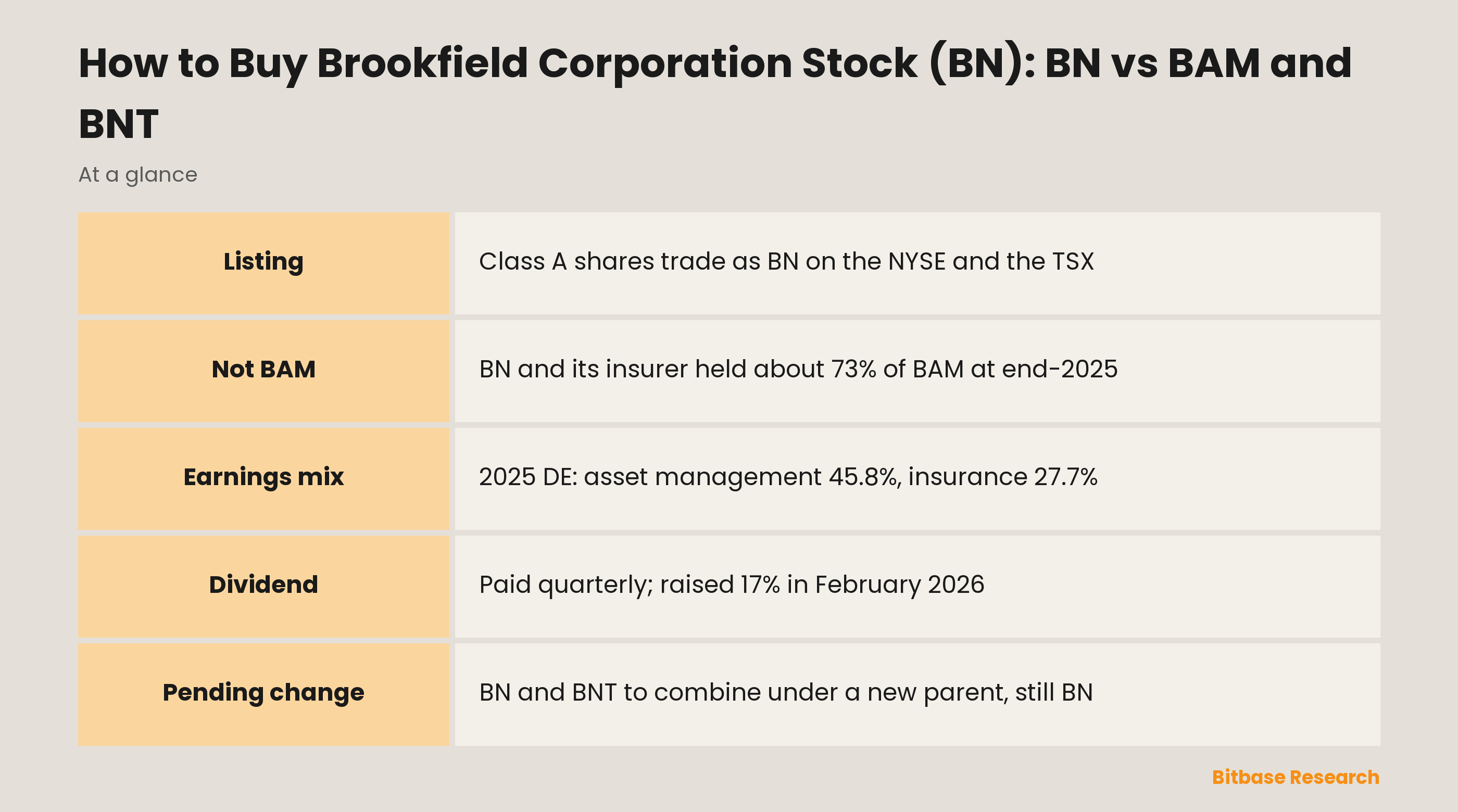
Understanding the one share class on offer keeps this simple: Brookfield Corporation's Class A limited voting shares trade as BN on both the New York Stock Exchange and the Toronto Stock Exchange, so any broker that reaches either market can buy them. That share buys the parent of the Brookfield group, which with its insurance affiliate held about 73% of Brookfield Asset Management (BAM) at the end of 2025 and has shareholder approval to fold that affiliate, Brookfield Wealth Solutions (BNT), into a new parent that keeps the BN ticker.
What Does Brookfield Corporation Do?
Brookfield Corporation describes itself as an investment firm with three core businesses: asset management, wealth solutions (insurance), and operating businesses in renewable power, infrastructure, private equity and real estate. It is an Ontario corporation based in Toronto, run by chief executive Bruce Flatt since 2002.
The name is where buyers trip. Until December 2022 this company was Brookfield Asset Management Inc. On 9 December 2022 it listed and distributed a 25% interest in its asset management business as a separate company, renamed itself Brookfield Corporation and took the ticker BN, while the new manager took BAM in New York and Toronto.
On 4 February 2025 the two were restructured again: BN handed its 73% interest in the asset management business to BAM for newly issued BAM shares, so BAM now owns that business outright and BN owns BAM shares. After BN moved about 4% of BAM to its insurance affiliate in June 2025, its own equity interest stood at 69% at year-end, or 73% counted with the affiliate.
| Business | Vehicle | BN's interest, 31 December 2025 |
|---|---|---|
| Asset management | Brookfield Asset Management (BAM) | 69% directly; 73% with BWS |
| Wealth solutions | Brookfield Wealth Solutions (BNT) | Equity-accounted "paired entity" |
| Renewable power and transition | Brookfield Renewable Partners (BEP) | 45% |
| Infrastructure | Brookfield Infrastructure Partners (BIP) | 26% |
| Private equity | Brookfield Business Partners (BBU) | 43% |
| Real estate | Brookfield Property Partners (BPY) | 100% |
The percentages are economic interests on a fully exchanged basis; BN also holds the general partnership interest in each partnership, and BBU became one listed company, Brookfield Business Corporation (BBUC), in 2026. The insurer sells annuities, life and property and casualty cover, and closed the purchase of the UK's Just Group in the first half of 2026. That year Brookfield also completed buying the roughly 26% of credit manager Oaktree it did not own.
How Brookfield Corporation Makes Money
The IFRS accounts. Consolidated statements carry the revenue of every business BN controls. On that basis private equity supplied 38.2% of 2025 revenue, infrastructure 32.3%, asset management 11.9%, renewable power and transition 10.2% and real estate 7.1%; the equity-accounted insurer adds none. Revenue fell 12.7%, and private equity alone, down 30.5%, lost more than the group did. Much of the profit belongs to other owners of those businesses: shareholders were entitled to 40.4% of 2025 net income.
Distributable earnings. Management judges BN by distributable earnings (DE), a non-IFRS measure of the earnings it receives that are available to shareholders or for reinvestment. Before realizations, DE from the three businesses split like this:
| Source | What BN collects | Share of 2025 DE from the three businesses |
|---|---|---|
| Asset management | Its share of BAM's fee-related earnings, plus returns on capital it puts into BAM-managed funds | 45.8% |
| Wealth solutions | The spread between investment returns and the cost of policy liabilities | 27.7% |
| Operating businesses | Cash distributions from the renewable, infrastructure, private equity and real estate holdings | 26.5% |
After corporate costs and preferred dividends, DE before realizations rose 10.6% in 2025, with wealth solutions up 23.8%. That mix is why BN does not read like a fee business such as BlackRock: more than half of it came from insurance and from companies BN owns.
BN Stock at a Glance
| Item | BN |
|---|---|
| Exchanges | New York Stock Exchange (NYSE) and Toronto Stock Exchange (TSX) |
| Ticker | BN on both |
| Security | Class A limited voting shares, one vote each; not an ADR |
| Other common class | 85,120 Class B shares, held in the BAM Partnership trust, which elect half the board |
| Quote currency | US dollars on the NYSE, Canadian dollars on the TSX |
| Look-alike symbols | BAM (asset manager), BNT (insurer), BNH and BNJ (notes on the NYSE), BN.PR and BN.PF series (TSX preference shares) |
| Reporting | Calendar fiscal year; IFRS in US dollars; Form 40-F yearly, Form 6-K for quarters |
| Dividends | Quarterly, paid at the end of March, June, September and December |
| Last split | Three-for-two, 9 October 2025 |
| Index funds | In iShares XIU (S&P/TSX 60); not in SPY (S&P 500), per 29 October 2026 holdings files |
| Pending change | Combination with BNT under a new parent, Brookfield Corporation Ltd., to trade as BN |
For a live quote, see Bitbase's Brookfield Corporation stock page. Both markets trade the same class, so the two prices differ mainly by the exchange rate.
How to Buy BN Stock in New York or Toronto
1. Pick a market your broker reaches. A US broker can buy BN on the NYSE; one with Canadian access adds the TSX. Check that it is licensed where you live.
2. Fund the account in that market's currency. A currency conversion can cost more than the commission.
3. Search BN and read the security name. It should say Brookfield Corporation, Class A limited voting shares, not BAM, BNT, a note or a preference share.
4. Choose the order type. A limit order sets the most you will pay; a market order takes the prices available in the book.
5. Size the position. Some brokers sell fractional shares, which may come without a vote.
6. Keep the trade records. Your cost and any tax taken from dividends matter at tax time.
Dividend reinvestment. BN's own plan pays dividends in new shares only to registered holders resident in the US or Canada; if your shares sit with a broker, ask whether it offers reinvestment.
Tax on dividends. The 40-F does not state the withholding rate for shareholders outside Canada. Your broker can say what it deducts, and a tax adviser whether your country taxes the dividend again.
BNT is a separate security. A Brookfield Wealth Solutions Class A exchangeable share is designed to give the economic return of one BN share and receives the same distributions, but the insurer issues it, not BN.
What Moves BN Stock
Fundraising at BAM. With 45.8% of the three businesses' DE coming from asset management, BN's earnings follow BAM's ability to raise and invest client money. In 2025 fee-bearing capital grew 12%, 87% of it long-dated or perpetual, and fee-related earnings rose 22%. Part of that capital is measured by the market value of BEP, BIP and BBU, so their share prices feed back into BAM's fees.
Insurance growth. Wealth solutions grew fastest of the three businesses in 2025, and the Just Group purchase took it into the UK in 2026.
Realizations. Carried interest and disposition gains arrive when funds sell assets, so they swing. Net realized carried interest rose 39.0% in 2025, but disposition gains shrank after a 2024 in which most of them came from selling part of the BAM stake to help pay for American Equity. Total DE fell 4.2% even as DE before realizations grew.
A simpler structure. Beyond the BNT combination, the company said in May 2026 that it was weighing similar plans for its two infrastructure and two energy vehicles, citing "the dominance of index investing" among its reasons for preferring "simpler structures with larger market capitalizations."
Buybacks. BN bought back Class A shares through 2025 and the first half of 2026, under a bid opened in May 2025 for up to 10% of the public float.
Debt at two levels. At the end of 2025 corporate debt was 21% of BN's own capitalization, against 50% for the consolidated group. Only 6% of consolidated leverage has recourse to BN; the rest reaches BN through the value and distributions of the businesses that carry it.
The Downside of Brookfield's Structure
It needs other people's money. "Our Asset Management business depends on its ability to fundraise third-party capital, deploy that capital effectively, and produce targeted investment returns," the annual report says.
Debt and interest rates. Among its financing risks: "our cash flow may be insufficient to meet required payments of principal and interest." It also warns that "rising interest rates could increase our interest costs and adversely affect our financial performance."
Backing the insurer. A support agreement commits BN to take all actions reasonably necessary to let BWS pay its quarterly distributions, and BN or BWS "may issue additional shares in the future," which could dilute existing holders.
Affiliates' share prices. The Class A trading price "cannot be predicted," and the listed causes include moves in the market price of the listed affiliates, which a BN holder is exposed to without owning them.
Control sits with Class B. Class A holders elect half the board and the 85,120 Class B shares elect the other half. A trust holds them, owned one third by Bruce Flatt, one third by Jack Cockwell and one third jointly by five other individuals named in the annual information form (AIF). A 1997 trust agreement bars selling those shares into a takeover bid unless a matching offer goes to Class A holders.
How to Research BN Through Its Filings
Brookfield Corporation files on EDGAR under CIK 1001085. The 2025 Form 40-F, filed on 18 March 2026, holds the AIF and, separately, the annual report with the management's discussion and analysis (MD&A) and audited statements. Quarterly results arrive as Form 6-K, the second-quarter release on 13 August 2026, and SEDAR+ carries the same documents; BAM, BNT, BEP, BIP and BBUC file their own. Watch the 6-K feed for the BNT combination, and use Bitbase's stock market listings to set BN beside other names.
Questions About Brookfield Corporation Stock
Is Brookfield Corporation the same as Brookfield Asset Management?
No. Brookfield Corporation (BN) is the parent; Brookfield Asset Management (BAM) is a separately listed asset manager that BN spun out in December 2022. Since February 2025 BAM has owned the whole asset management business, and at 31 December 2025 BN and its insurer together held about 73% of BAM's Class A shares. BN gives you that stake plus insurance and operating businesses; BAM gives you only the manager.
Does Brookfield Corporation pay a dividend?
Yes. Class A and Class B shares receive the same quarterly dividend, paid at the end of March, June, September and December at the board's discretion. In February 2026 the board raised it by 17%. Registered holders resident in the US or Canada can take it in new shares.
Is BN in the S&P 500?
No. State Street's SPY holdings file for 29 October 2026 does not list it, while iShares XIU, which tracks the S&P/TSX 60, holds it.
What happens to BN shares when the BNT combination closes?
Under the plan approved on 16 July 2026, each BN and each BNT Class A share is to be exchanged one-for-one for a share of Brookfield Corporation Ltd., trading as BN in New York and Toronto. US holders need do nothing, the company says, while taxable holders in Canada and the UK can elect to defer tax. It expected closing by year-end, subject to regulatory approvals, with the quarterly distribution unchanged.
Can I buy Brookfield Corporation stock with crypto?
Not directly. Brokers want US or Canadian dollars for BN, so you would first sell crypto for one of those currencies and move the cash into a brokerage account. That sale may be a taxable event where you live; see how crypto disposals are taxed first.
Conclusion
Placing the order is routine: BN, Class A shares, in New York or Toronto. What needs more thought is what the share holds: a controlling stake in BAM, an insurer due to be combined with the parent and stakes of 26% to 45% in listed operating companies, with half the board chosen by the Class B holder. Read the latest 40-F and 6-K filings, and check the status of the BNT combination before you buy.
Related reading
Other Bitbase articles on this topic:
- How to Buy American Tower Stock (AMT): Carrier Rent, REIT Payouts
- How to Buy Digital Realty Stock (DLR): Data Centers, Power, REIT
- How to Buy Equinix Stock (EQIX): Data Center REIT on Nasdaq
- How to Buy Public Storage Stock (PSA): Dividends and the NSA Deal
Disclaimer: This article is educational content from Bitbase Academy, provided for information only. It explains what a company or fund does and how the instruments referenced here differ from one another; it does not constitute investment, trading, tax, or financial advice, and it is neither a recommendation nor an endorsement of any security, token, or trading strategy. A tokenized stock is issued by a third party and is designed to give economic exposure to an underlying asset: it is not a share, it carries no shareholder rights, and it depends on the issuer's structure, eligibility rules, and redemption terms, which the issuer can change. Perpetual futures are leveraged derivatives that hold no underlying asset and can be liquidated, and trading hours, product availability, and eligibility differ by instrument and by jurisdiction and can change at any time. Written as of October 2026; verify everything yourself through company filings, the issuer's own documentation, and the product pages of the venue you trade on.
References
[1] Brookfield Corporation annual information form for 2025, filed with Form 40-F (SEC EDGAR) www.sec.gov
[2] Brookfield Corporation 2025 annual report: MD&A and audited financial statements, Form 40-F (SEC EDGAR) www.sec.gov
[3] Brookfield Corporation Form 40-F for 2025: XBRL cover page data (SEC EDGAR) www.sec.gov
[4] Brookfield Corporation annual information form for 2022: December 2022 asset manager listing and name change (SEC EDGAR) www.sec.gov
[5] Brookfield Corporation fourth quarter and 2025 results, 12 February 2026: dividend increase (Form 6-K) www.sec.gov
[6] Brookfield Corporation first quarter 2026 results, 14 May 2026: plans to combine BN and BNT (Form 6-K) www.sec.gov
[7] Brookfield Corporation and Brookfield Wealth Solutions receive board approval for corporate simplification, 26 May 2026 (Form 6-K) www.sec.gov
[8] Brookfield Corporation announces shareholder approval of the simplification transaction, 16 July 2026 (Form 6-K) www.sec.gov
[9] Brookfield Corporation second quarter 2026 results, 13 August 2026: Just Group, buybacks and share treatment in the simplification (Form 6-K) www.sec.gov
[10] Brookfield completes acquisition of Oaktree, 3 August 2026 (Form 6-K) www.sec.gov
[11] BlackRock, iShares S&P/TSX 60 Index ETF (XIU): fund holdings as of 29 October 2026 www.blackrock.com
[12] State Street, SPDR S&P 500 ETF Trust (SPY): daily holdings as of 29 October 2026 www.ssga.com





