
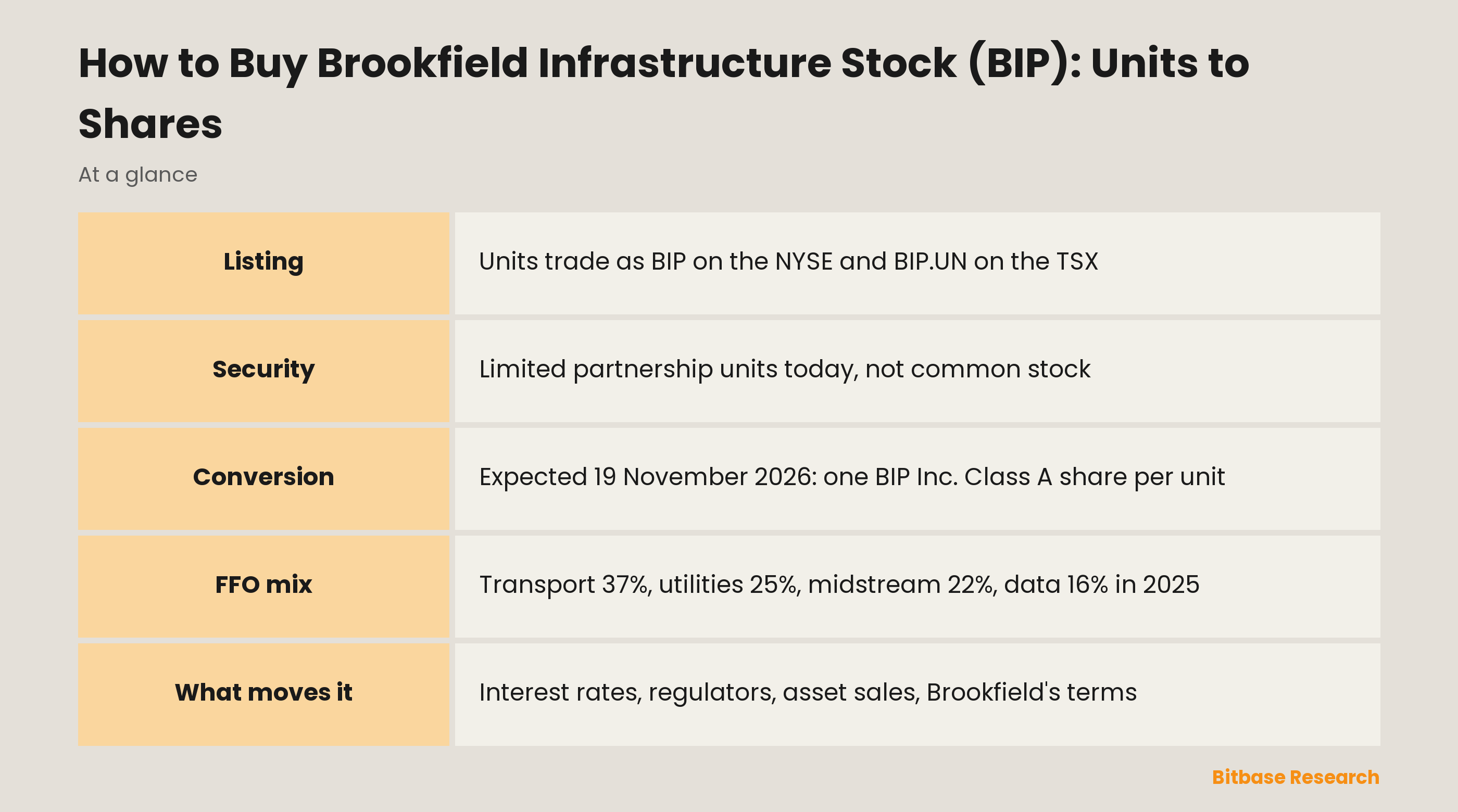
Brookfield Infrastructure is listed as BIP on the New York Stock Exchange and as BIP.UN in Toronto, and any broker that reaches either market can buy it, but what trades there today is a limited partnership unit, not common stock. That is about to change: the partnership expects to convert into Brookfield Infrastructure Partners Inc. on 19 November 2026, swapping each unit one-for-one for a Class A share that should trade as BIP from around 23 November. Both wrap the same utilities, transport, midstream and data businesses, and data, the smallest of the four by 2025 funds from operations, grew fastest.
What Does Brookfield Infrastructure Do?
Brookfield Infrastructure buys, runs and sells physical networks. Its annual report says it "owns and operates high-quality, long-life assets in the utilities, transport, midstream and data sectors across the Americas, Asia Pacific and Europe," with a focus on "contracted and regulated revenues that generate predictable and stable cash flows." The partnership was established in Bermuda on 21 May 2007 and spun off from Brookfield on 31 January 2008. Its management, including chief executive Sam Pollock, is provided by Brookfield under a master services agreement.
Utilities earn a return on a regulated or contract-set asset base: about 7.3 million operating connections, mostly electricity and natural gas, transmission lines in Brazil, home heating and water services in North America and Europe, and an industrial gas business in South Korea.
Transport collects access fees, freight rates, tolls and lease payments. It owns about 7.4 million twenty-foot-equivalent containers, a US LNG export terminal, more than 110 short line and regional railroads, ports and toll roads.
Midstream moves, processes and stores energy through about 19,500 kilometers of pipelines in the United States and Canada, with processing plants and storage.
Data covers about 309,000 telecom towers in Europe, the UK and India, fiber networks, and more than 150 data centers with roughly 1.2 gigawatts of operating capacity.
The same portfolio can also be held through Brookfield Infrastructure Corporation (BIPC), a Canadian company listed in New York and Toronto whose dividends are "expected to continue to be declared and paid at the same time and in the same amount per share as distributions on each unit." For Brookfield's side, see our Brookfield Corporation stock guide on the parent and our Brookfield Asset Management stock guide on the manager.
How Brookfield Infrastructure Makes Money
Management tracks funds from operations (FFO), a non-IFRS figure that the 20-F says "can be used on a per unit basis as a proxy for future distribution growth over the long term." In 2025 it split as follows:
| Segment | Share of 2025 segment FFO | Change against 2024 | How it earns |
|---|---|---|---|
| Utilities | 25% | Up 7% on a comparable basis | Return on a rate base that grows as capital is invested |
| Transport | 37% | Flat after adjusting for asset sales and currency | Access charges, freight rates, tolls, container leases |
| Midstream | 22% | Up 7% | Gathering, processing, transport and storage fees |
| Data | 16% | Up more than 50% | Tower rents, fiber contracts, data center capacity |
Shares exclude corporate costs. Total FFO rose 6%.
Two mechanisms drive growth. One is indexation: "our rate base increases with capital that we invest to upgrade and expand our systems," and many contracts adjust with inflation. The other is what the company calls capital recycling, selling stakes in mature businesses and putting the money into acquisitions and construction, with a target of "a total return of 12% to 15%+ per annum on the infrastructure assets that we own, measured over the long-term." Sales in 2025, including an Australian container terminal, removed earnings, which is why transport stood still while its rail and toll volumes rose.
Third-quarter 2026 FFO per unit marked the "third consecutive quarter of achieving our 10% growth target," led by data at 25%. Newer lines are tied to artificial intelligence: a partnership with NAVER to finance more than 200 megawatts of compute capacity in South Korea and one with Drax to potentially develop an AI factory in the UK.
BIP Stock at a Glance
| Item | BIP |
|---|---|
| Exchanges and symbols | New York Stock Exchange (BIP) and Toronto Stock Exchange (BIP.UN) |
| Security today | Non-voting limited partnership units; not common stock, not an ADR |
| Issuer | Brookfield Infrastructure Partners L.P., a Bermuda exempted limited partnership in Hamilton |
| Sister listing | Brookfield Infrastructure Corporation (BIPC), NYSE and TSX |
| Look-alike symbols | BIP PR A, BIP PR B (preferred units); BIPH, BIPI, BIPJ (subordinated notes) |
| Reporting | Form 20-F yearly, Form 6-K for quarters; IFRS, US dollars, calendar year |
| Distributions | Quarterly; the January 2026 increase was the 17th in a row |
| US tax form | Schedule K-1, as a partnership |
| Pending change | Conversion into Brookfield Infrastructure Partners Inc., a British Columbia corporation, expected 19 November 2026 |
| SEC identifier | CIK 1406234 |
The Brookfield Infrastructure stock page on Bitbase carries the live price.
How to Buy Brookfield Infrastructure Stock
1. Pick the exchange. A US broker trades BIP in US dollars; one with Canadian access can also trade BIP.UN in Canadian dollars. Confirm the firm is authorized where you live.
2. Read the security name. Until closing it should say Brookfield Infrastructure Partners L.P. units, afterwards Brookfield Infrastructure Partners Inc. Class A shares. BIPC is a different security, and BIP PR A, BIP PR B, BIPH, BIPI and BIPJ are preferred units and notes with fixed payments.
3. Fund the account. Paying in a third currency adds a conversion spread to any commission.
4. Set the order. A limit order caps your price; a market order fills at whatever the book offers.
5. Keep the confirmations. Your purchase cost carries over when units become shares.
Around the conversion. Units held at closing are exchanged automatically, one Class A share per unit, so there is nothing to elect. The partnership declared no fourth-quarter 2026 distribution on the units because of the timing; BIP Inc. intends, subject to board approval, to pay a fourth-quarter dividend after closing in line with the current quarterly distribution. The unit reinvestment plan ended on 5 November 2026.
Partnership paperwork. BIP has agreed to use commercially reasonable efforts to give US taxpayers Schedule K-1 information "no later than 90 days after the close of each calendar year," which can mean a filing extension. Holders with no US filing requirement get a K-1 only if they request it within 60 days of year-end. Brokers can be required to withhold 10% on sales of partnership units, but the general partner issues quarterly notices certifying that an exception applies. The company lists the end of K-1s among the conversion's benefits; BIP Inc. is expected to report on Form 1099 in the US and T5 in Canada.
Dividends from a Canadian corporation. Per the circular, holders outside Canada will pay 25% Canadian withholding tax on BIP Inc. dividends, generally 15% for US residents entitled to the full benefits of the Canada-US treaty. Your home country may tax the dividend again.
BIPC holders are exchanged one-for-one into the same Class A shares, and BIPC is to be delisted, leaving one listed common security.
What Moves BIP Stock
Interest rates. The business runs on long-dated debt, and the 20-F warns that "the risk of loss associated with a leveraged company, all other things being equal, is generally greater than for companies with comparatively less debt." Higher rates raise refinancing costs.
Regulators. Because some services are provided "on a monopoly or near monopoly basis, many of our operations are subject to forms of economic regulation." A rate review or concession decision can reset a segment's earnings.
Asset sales. Proceeds fund new investments, so prices and timing matter, and each sale removes earnings until the money is redeployed. In November 2026 management said it expects to exceed its 2026 sales target.
Data and AI. The fastest-growing segment depends on hyperscale customers continuing to build.
Volumes. "Our Australian rail operation relies on demand for iron ore for steel production," the 20-F notes.
The new structure. Management says the corporation should "support increased index demand and make Brookfield Infrastructure easier to own through a traditional corporate structure." Whether that demand materializes is not yet known.
Brookfield's Grip and Other BIP Risks
Distributions can stall. "We may not be able to continue paying comparable or growing cash distributions to our unitholders in the future." The company targets 5% to 9% annual increases, and distributions grew at a 9% compound rate over 15 years, but a target is not a promise.
The sponsor's terms. Brookfield holds about 26.5% of the partnership on a fully exchanged basis, takes a base management fee of 1.25% a year of the group's market value, and receives incentive distributions above set levels. The arrangements "do not impose on Brookfield any fiduciary duties to act in the best interests of our unitholders or preferred unitholders."
Little voting power. Unitholders "do not have a right to vote on partnership matters or to take part in the management of our partnership." After the conversion Class A shares get one vote each, but the Class B shares, issued for the general partner's shares and held through a Brookfield subsidiary, cast as a class the number of Class A shares outstanding minus 100.
Illiquid assets. Funding growth through sales "could be difficult, as such assets can be hard to sell, especially if market conditions are poor."
Currency. Many assets sit outside the United States while distributions are paid in US dollars, and exchange-rate swings "could reduce the value of cash flows generated by our operating entities."
How to Research BIP Yourself
The partnership files on EDGAR under CIK 1406234 and on SEDAR+ in Canada. The 2025 Form 20-F, filed in March 2026, has the risk factors, the assets by segment, the FFO tables, a related-party section on the fees and incentive distributions paid to Brookfield, and a taxation section with the K-1 rules.
Quarterly results come as Form 6-K, most recently on 6 November 2026. For the conversion, read the joint management information circular dated 26 August 2026, which sets out BIP Inc.'s share terms, voting structure and tax treatment. BIPC files its own 20-F, so check which entity a document comes from. Bitbase's US stock pages put BIP beside other listed companies.
Brookfield Infrastructure Stock FAQ
Is BIP a stock or a partnership unit?
A partnership unit, for now, with no vote on partnership matters. At closing, expected on 19 November 2026, each unit becomes one Class A subordinate voting share of a British Columbia corporation.
What happens to my BIP units at closing?
They are exchanged automatically, one share per unit. The new shares are expected to trade on the NYSE and the TSX as BIP from around 23 November 2026, and the circular expects the exchange to be tax-deferred for the vast majority of US and Canadian holders.
What is the difference between BIP and BIPC?
BIP is the Bermuda partnership; BIPC is a Canadian corporation paying the same amount at the same time. Both are exchanged into BIP Inc. Class A shares, and BIPC is to be delisted.
Does Brookfield Infrastructure pay a distribution?
Yes, quarterly, and the January 2026 increase was the 17th consecutive one. None was declared on the units for the fourth quarter of 2026 because of the conversion; BIP Inc. intends to pay one after closing, subject to board approval.
Can I buy Brookfield Infrastructure stock with crypto?
Not as such. BIP trades on stock exchanges for US or Canadian dollars, so crypto has to be sold for cash and the money moved to a brokerage account. That sale may be taxable; see how crypto disposals are taxed first.
Conclusion
BIP is a portfolio of regulated and contracted networks run by Brookfield, and in late 2026 it is changing wrappers, from a Bermuda partnership that issues K-1s to a Canadian corporation with Class A shares. The assets, the fees and Brookfield's control stay the same. Before buying, confirm the conversion closed as planned, read the 20-F on leverage and the Brookfield arrangements, and decide how much one sponsor's infrastructure portfolio should weigh in yours.
Related reading
Other Bitbase articles on this topic:
- How to Buy Ameren Stock (AEE): Callaway, DRPlus, Data Centers
- How to Buy American Water Works Stock (AWK): Rates, PFAS, Merger
- How to Buy Atmos Energy Stock (ATO): Gas Only, Mostly in Texas
- How to Buy Fortis Stock (FTS): 10 Utilities and a Dividend Streak
Disclaimer: This article is educational content from Bitbase Academy, provided for information only. It explains what a company or fund does and how the instruments referenced here differ from one another; it does not constitute investment, trading, tax, or financial advice, and it is neither a recommendation nor an endorsement of any security, token, or trading strategy. A tokenized stock is issued by a third party and is designed to give economic exposure to an underlying asset: it is not a share, it carries no shareholder rights, and it depends on the issuer's structure, eligibility rules, and redemption terms, which the issuer can change. Perpetual futures are leveraged derivatives that hold no underlying asset and can be liquidated, and trading hours, product availability, and eligibility differ by instrument and by jurisdiction and can change at any time. Written as of November 2026; verify everything yourself through company filings, the issuer's own documentation, and the product pages of the venue you trade on.
References
[1] Brookfield Infrastructure Partners Form 20-F for 2025 (SEC EDGAR) www.sec.gov
[2] Brookfield Infrastructure Partners 2025 Form 20-F, XBRL cover page (SEC EDGAR) www.sec.gov
[3] Brookfield Infrastructure 2025 year-end results release, Form 6-K (SEC EDGAR) www.sec.gov
[4] Brookfield Infrastructure announces plan to simplify its structure, 21 July 2026, Form 6-K (SEC EDGAR) www.sec.gov
[5] Joint management information circular of BIP and BIPC, 26 August 2026, Form 6-K (SEC EDGAR) www.sec.gov
[6] Brookfield Infrastructure update on the simplification, 5 November 2026, Form 6-K (SEC EDGAR) www.sec.gov
[7] Brookfield Infrastructure third-quarter 2026 results, Form 6-K (SEC EDGAR) www.sec.gov





