
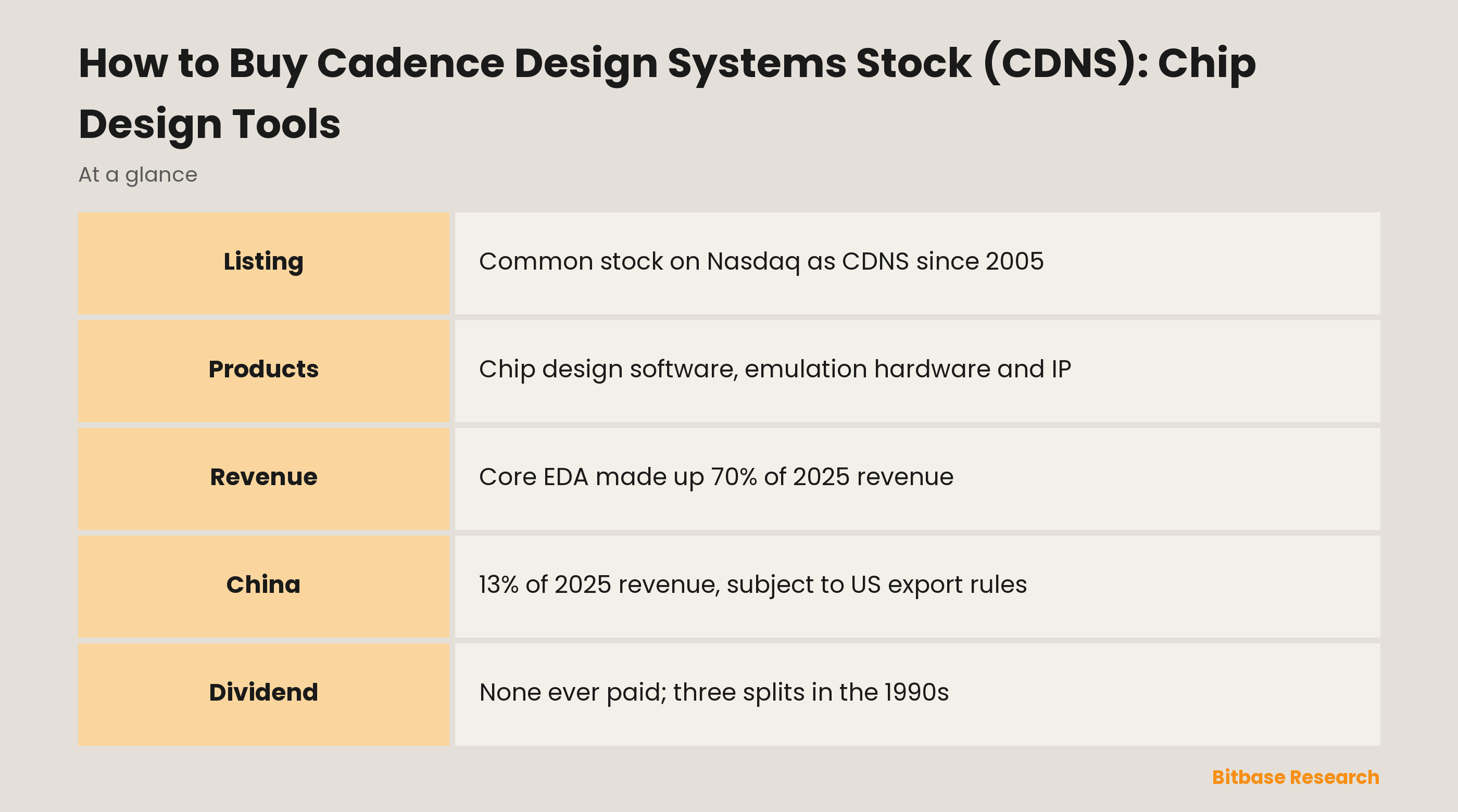
Behind the ticker CDNS is Cadence Design Systems, which sells the software engineers use to design and verify chips; its common stock trades on the Nasdaq Global Select Market, so any brokerage account with access to US exchanges can buy it. Core EDA tools brought in about 70% of 2025 revenue, but roughly a fifth is booked up front as emulation hardware, IP and some software are delivered, so quarters can swing. This guide explains Cadence's three product lines, walks through a purchase, covers why the ticker changed in 2005 and traces how US export rules on China run through the business.
What Does Cadence Design Systems Do?
Cadence makes electronic design automation (EDA) software, the programs chip designers use to lay out a circuit, simulate it and check it before a foundry manufactures it. Its fiscal 2025 annual report describes a company that "develops computational, AI-driven software, accelerated hardware, and silicon intellectual property ("IP") products and solutions." The customers are semiconductor companies and "systems companies that design and manufacture electromechanical systems" with electronics inside.
The company dates from May 1988, when SDA Systems merged into ECAD; the combined business took the name Cadence Design Systems the following month. It is incorporated in Delaware and headquartered in San Jose, California. Anirudh Devgan has been chief executive since December 2021 and president since November 2017.
The 10-K sorts the products into three categories:
Core EDA covers chip design and verification. Virtuoso, which the 10-K says "is considered the industry standard for custom and analog IC design," handles analog, RF and mixed-signal circuits; Innovus lays out large digital chips; Jasper and Xcelium check that a design behaves as specified. This category also holds the hardware: Palladium emulation systems and Protium FPGA-based prototyping platforms, which the filing says "significantly reduce simulation times" for chips such as GPUs and AI processors.
Semiconductor IP is pre-designed circuitry that customers place inside their own chips: interface and memory-interface blocks for standards such as PCI Express and High Bandwidth Memory, plus Tensilica digital signal processors. In 2025 Cadence added the Artisan foundation IP business it bought from Arm, covering standard cell libraries, memory compilers and general-purpose I/Os, and Secure-IC, a specialist in embedded security.
System Design and Analysis (SD&A) moves beyond the chip to packages, circuit boards and whole products: Allegro and OrCAD for PCB design, Sigrity, Clarity and Celsius for signal, electromagnetic and thermal analysis, and Fidelity for computational fluid dynamics. The 2024 purchase of BETA CAE and the Hexagon design and engineering business, completed in February 2026 and home of the MSC Nastran structural-analysis and Adams multibody-dynamics tools, both landed here. In May 2025 Cadence also announced the M2000, a supercomputer for simulation co-developed with NVIDIA.
All of this is reported as one operating segment, and the hardware is built by subcontractors.
How Cadence Design Systems Makes Money
Cadence licenses rather than sells most of its software. Time-based licences usually run two to three years, with payments spread across the term, and some let customers "remix among the products" they licensed. Emulation hardware is sold or leased, IP is licensed for specific designs, and some IP contracts add royalties as customers ship chips that contain it.
| Product category | What it includes | Share of 2025 revenue | Share of 2024 revenue | Growth in Q3 2026, year on year |
|---|---|---|---|---|
| Core EDA | Custom, digital and verification software; Palladium and Protium hardware | 70% | 71% | 20% |
| Semiconductor IP | Interface, memory and foundation IP; Tensilica processors | 14% | 13% | 24% |
| System Design and Analysis | PCB, packaging, multiphysics and structural analysis | 16% | 16% | 30% |
Shares are from the 10-K; growth rates are from the third-quarter 2026 results release.
Most of the money recurs. In 2025, 80% of revenue was recurring, recognised over time or under short licences that are typically renewed, and the remaining fifth was up-front, "primarily generated by our sales of hardware products, individual IP licenses and certain software licenses with a term greater than one year." In 2024 the split was 83% to 17%. Product and maintenance made up 91% of 2025 revenue and services the other 9%; revenue grew 14% over the year, and no single customer reached 10% of it.
Contracts also reach well ahead. Of the obligations Cadence had contracted but not yet fulfilled at the end of 2025, leaving out commitments whose products customers have yet to choose, it expected to recognise 53% within 12 months and 43% over the following two years.
By customer location, the United States contributed 44% of 2025 revenue, the rest of Asia outside China and Japan 19%, Europe, the Middle East and Africa 15%, China 13%, Japan 6% and the Americas outside the US 3%. Research and development absorbed 33% of revenue, more than any other operating expense.
CDNS Stock at a Glance
| Feature | CDNS |
|---|---|
| Exchange | Nasdaq Global Select Market |
| Ticker | CDNS, used since 31 October 2005; before that the shares traded as CDN on the NYSE and Nasdaq |
| Share class | One class of common stock; no other security is listed on the 10-K cover |
| CUSIP | 127387108 |
| Business | Software, hardware and IP for designing chips and electronic systems |
| Index membership | S&P 500 and Nasdaq-100 |
| Headquarters | San Jose, California |
| Origins | Incorporated in Delaware; formed by the May 1988 merger of SDA Systems into ECAD |
| Fiscal year | Ends 31 December; a calendar year since fiscal 2023 |
| Dividend policy | No cash dividend has ever been paid; capital goes back through buybacks |
| Stock splits | Three-for-two (October 1995), three-for-two (May 1996), two-for-one (November 1997) |
| SEC identifier | CIK 813672 |
Price, valuation and trading volume change by the minute; the Cadence Design Systems stock page on Bitbase shows them live.
How to Buy Cadence Design Systems Stock
Cadence is a Delaware company listed in the United States, so there is a single line to buy and no depositary receipt in the way. The usual sequence:
1. Find a broker that can trade Nasdaq shares. For investors abroad this is either a domestic broker with a gateway to US markets or a global one; confirm the regulator and the legal entity that would hold your shares.
2. Open and verify the account. A non-US individual may be asked for IRS Form W-8BEN; the IRS says to submit it "when requested by the withholding agent or payer."
3. Fund it. CDNS is quoted in US dollars, so the cost of converting your currency belongs in the comparison next to the commission.
4. Look up CDNS and confirm the match. The line should say Cadence Design Systems, Inc. common stock, Nasdaq; where an order screen wants a CUSIP, enter 127387108.
5. Pick the order type. In FINRA's words, a market order "provides the most certainty that your order will be executed"; a limit order guarantees "your limit price or a better price if your order is executed," with "a chance your order doesn't get executed at all."
6. Decide how much. Buying a fraction of a share lets a fixed budget go in at once, but "the availability of fractional share trading varies by brokerage firm," a fractional owner "might not have shareholder voting rights," and FINRA adds that "at the moment, you can't transfer fractional shares to another brokerage firm."
7. Save every trade confirmation. Your cost basis for tax rests on them.
Non-US holders have no dividend withholding to worry about, because Cadence pays no dividend; the tax on any eventual gain follows the rules of their home country.
Index funds offer indirect exposure. Cadence was listed among the holdings of State Street's S&P 500 fund, SPY, on 29 October 2026, and of Invesco's Nasdaq-100 fund, QQQ, on 28 October 2026, in each case alongside more than a hundred other companies.
What Moves CDNS Stock
Design starts, now led by AI chips. Purchases of Cadence products "are dependent upon the commencement of new design projects by semiconductor and electronics systems companies," and those industries are "cyclical." The company ties current demand to three AI "horizons": chips for data centres and hyperscalers, AI built into physical systems such as vehicles and robots, and life sciences. Third-quarter 2026 revenue rose 22% from a year earlier, and no product category grew by less than a fifth.
Hardware and IP deliveries. Up-front revenue lands when products ship, and the risk factors warn that "changes in bookings or deliveries for these products, relative to expectations, will have a more immediate impact on our revenue" than time-based software does. That share has been climbing: up-front revenue was 17% of the 2024 total, a fifth in 2025 and 22% over the 12 months to September 2026. A quarter can turn on when a set of Palladium or Protium systems ships.
China and US export rules. China produced 13% of 2025 revenue. On 23 May 2025 the Commerce Department's Bureau of Industry and Security (BIS) told Cadence that exporting EDA software and technology needed a licence whenever a party to the transaction was in China; on 2 July it rescinded the requirement "effective immediately." In the weeks between, the 10-K says, "our revenue in China decreased primarily due to reduced deliveries of software offerings." China revenue still grew 19% over the year and 35% in the first nine months of 2026, though only 4% in the third quarter. A separate BIS rule extending restrictions to companies 50% or more owned by listed entities is suspended until 9 November 2026; according to the latest 10-Q, a US–China arrangement announced in September 2026 is expected to extend that suspension, but BIS had not yet done so formally.
Acquisitions. Deals keep reshaping the mix: after the 2024 and 2025 purchases described above, the Hexagon design and engineering business closed on 23 February 2026, paid for partly in newly issued Cadence shares. The 10-K notes that the timing of acquisitions "may affect comparability of revenue, expenses and cash flows between fiscal periods."
Competition. The filing names Synopsys, which acquired Ansys, and Siemens EDA as key competitors, alongside emerging Chinese vendors such as Huada Empyrean, X-EPIC and Primarius Technologies. It adds that China's stated aim of leading every segment of the semiconductor industry by 2030 "has resulted in and may continue to cause increased competitive capability in China."
Cadence's Own Warnings to CDNS Holders
Of the many risk factors in Item 1A, these five touch a CDNS holding most directly:
Export controls and the plea agreement. "We are subject to governmental export and import controls that subject us to liability and impair our ability to compete in global markets," the 10-K says. That liability is no longer theoretical: in July 2025 Cadence settled with BIS and the Department of Justice over export violations between 2015 and 2021, mainly sales by a subsidiary to a customer in China, and agreed to plead guilty to one count of conspiracy to commit export controls violations. The plea carries a three-year probationary term, and breaching its terms "could result in further criminal, civil, or administrative proceedings or denial of export privileges."
The chip cycle. "The growth of our business depends primarily on the semiconductor and electronics systems industries," and the company itself calls those industries cyclical.
Customer consolidation. Mergers among chipmakers "could make us more dependent on fewer customers who may be able to exert increased bargaining power in negotiations with us."
Hardware supply. Cadence relies "on a single supplier or a limited number of suppliers for certain hardware components," and supply delays have held up deliveries before.
Integration. Acquired businesses may not bring "the expected business or financial benefits," and the settlement obligations "will generally apply to any new business entities we acquire."
Two points concern the shares themselves. Without a dividend, holders depend entirely on price changes for a return, and the 10-K warns that buybacks "could also increase the volatility of the trading price of our common stock." For buyers who count in another currency, the exchange rate adds a second source of gain or loss.
How to Research CDNS Yourself
On EDGAR, Cadence's filings sit under CIK 813672. Its annual report for 2025 arrived on 19 February 2026, quarterly reports cover the first three quarters (most recently on 28 October 2026), and current reports on Form 8-K bring results and other news; the 2026 results came out on 17 February, 27 April, 27 July and 26 October. The results calls are webcast from the investor relations pages of cadence.com.
Inside the annual report, Item 1 explains the three product categories and lists rivals by name, Item 1A collects the risk factors, and the MD&A tables break revenue down by category, by region and into recurring and up-front. The legal proceedings note follows the BIS and DOJ settlement. In each 10-Q, the trade-controls paragraph near the start of the notes gives the latest position on export rules.
Three habits prevent misreadings. Fiscal years up to 2022 were 52- or 53-week years ending on the Saturday closest to 31 December, so older periods do not match calendar years exactly. Per-share prices from before October 1995 need dividing by 4.5 to compare with today. And data from before 31 October 2005 sits under the old ticker CDN. For other companies, browse more US stock pages on Bitbase.
Cadence Design Systems Stock FAQ
Does Cadence Design Systems pay a dividend?
No. According to the 10-K, Cadence has "never declared or paid" a cash dividend and does not plan one for the foreseeable future. Buybacks take that role: the repurchase program was first announced in February 2017, enlarged in May 2025 and again on 23 October 2026, has no expiration date and may be changed or ended "without prior notice."
Can I buy Cadence Design Systems stock with crypto?
Not directly. CDNS is bought with US dollars at a broker, which means selling the crypto first and transferring the proceeds into the brokerage account; whether that sale is taxed depends on your country. A separate guide walks through the routes from crypto into shares.
Is CDNS in the S&P 500 and the Nasdaq-100?
Yes, both. SPY's holdings file for 29 October 2026 and QQQ's holdings for 28 October 2026 each included Cadence, and those funds follow the S&P 500 and the Nasdaq-100. Weights move every trading day.
Why is the ticker CDNS and not CDN?
Until 28 October 2005 the stock traded as CDN on both the New York Stock Exchange and Nasdaq. Cadence then gave up the NYSE listing and, from 31 October 2005, traded solely on Nasdaq under the new symbol CDNS.
Has Cadence stock ever split?
Yes. Its filings record three splits, all between 1995 and 1997: three-for-two in October 1995 and in May 1996, then two-for-one in November 1997. One share held before October 1995 became 4.5 shares, and no split appears in its filings since.
Conclusion
Buying CDNS takes a broker with Nasdaq access, a check that the line reads Cadence Design Systems, and a market or limit order. Judging it takes more: a chip-design software company whose quarters swing with hardware and IP deliveries, whose sales into China depend on US export rules, and which operates under a plea agreement with three years of probation. Read the latest 10-K, the newest 10-Q and its trade-controls paragraph before deciding how much belongs in a single company.
Related reading
Other Bitbase articles on this topic:
- How to Buy Accenture Stock (ACN): Irish Plc, Dividends and Perps
- How to Buy ADP Stock (ADP): Payroll Fees and Client Fund Interest
- How to Buy Cloudflare Stock (NET): Share Classes and 24/7 Perps
Disclaimer: This article is educational content from Bitbase Academy, provided for information only. It explains what a company or fund does and how the instruments referenced here differ from one another; it does not constitute investment, trading, tax, or financial advice, and it is neither a recommendation nor an endorsement of any security, token, or trading strategy. A tokenized stock is issued by a third party and is designed to give economic exposure to an underlying asset: it is not a share, it carries no shareholder rights, and it depends on the issuer's structure, eligibility rules, and redemption terms, which the issuer can change. Perpetual futures are leveraged derivatives that hold no underlying asset and can be liquidated, and trading hours, product availability, and eligibility differ by instrument and by jurisdiction and can change at any time. Written as of October 2026; verify everything yourself through company filings, the issuer's own documentation, and the product pages of the venue you trade on.
References
[1] Cadence Design Systems Form 10-K, fiscal 2025 (SEC EDGAR) www.sec.gov
[2] Cadence Form 10-Q, quarter ended 30 September 2026 (SEC EDGAR) www.sec.gov
[3] Cadence release, 26 October 2026: third-quarter 2026 results www.sec.gov
[4] Cadence release, 26 October 2005: sole Nasdaq listing under CDNS www.sec.gov
[5] Cadence Form 10-K, fiscal 1997: 1988 merger and stock splits www.sec.gov
[6] Cadence Form 10-K, fiscal 2023: change of fiscal year end www.sec.gov
[7] State Street: SPY daily holdings, 29 October 2026 www.ssga.com
[8] Invesco: QQQ, which tracks the Nasdaq-100, and its holdings www.invesco.com
[9] FINRA: Order Types www.finra.org
[10] FINRA: Investing in Fractional Shares www.finra.org
[11] IRS: About Form W-8 BEN www.irs.gov





