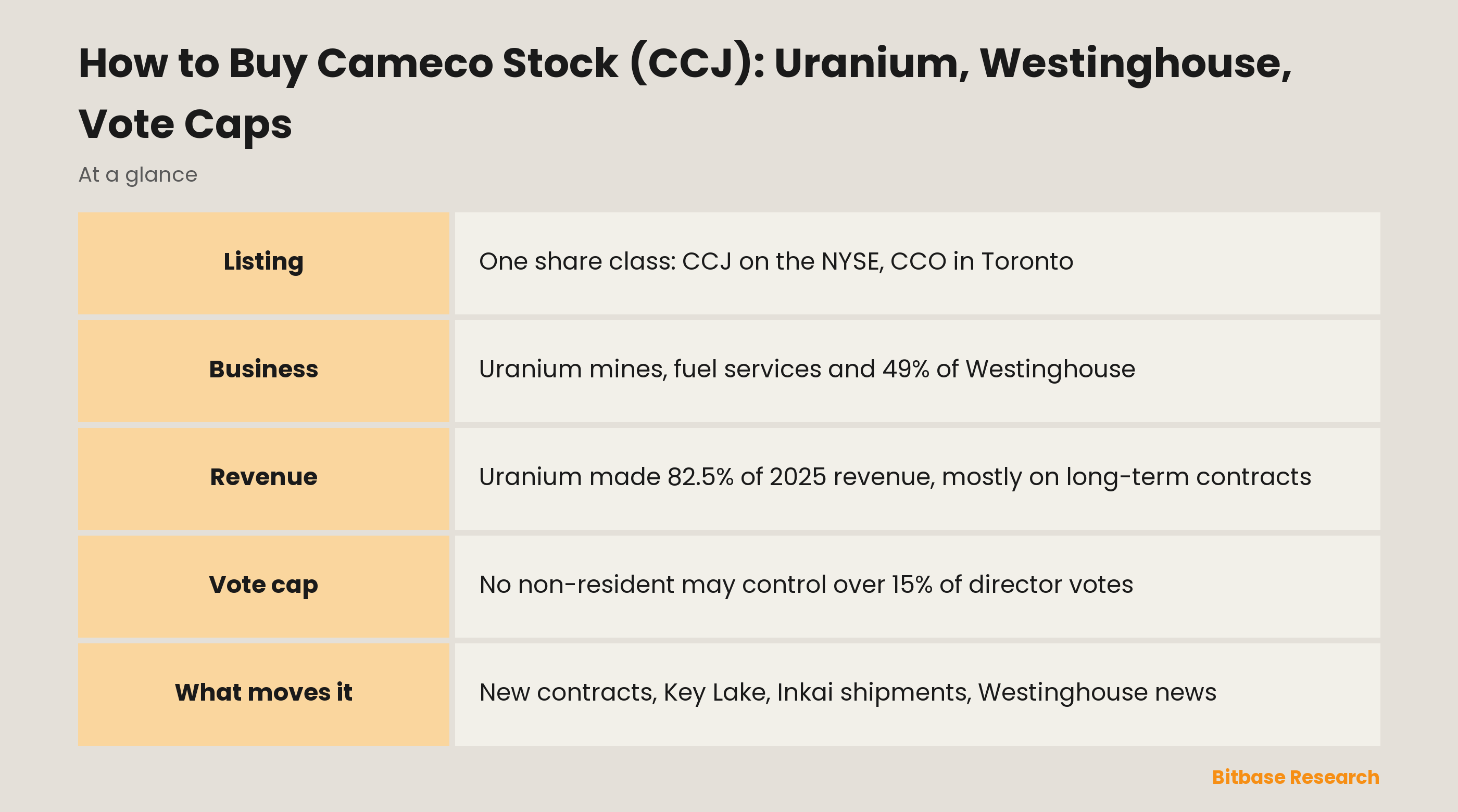
One set of Cameco common shares carries two tickers, CCJ on the New York Stock Exchange and CCO on the Toronto Stock Exchange, so a broker that reaches either market can take the order. Behind the shares sits a uranium miner and fuel processor based in Saskatoon that also owns 49% of Westinghouse, the reactor designer, and whose articles contain a rule few listed companies have: a single holder outside Canada may not control more than 15% of the votes for directors. Below: where the revenue comes from, how a purchase works and what tends to move the share.
What Does Cameco Do?
Cameco sells nuclear fuel and the services that turn raw uranium into it. Its annual information form (AIF), a yearly disclosure document required in Canada, says its operations "span the nuclear fuel cycle from exploration to fuel services, which include uranium production, refining, uranium dioxide (UO2) and uranium hexafluoride (UF6) conversion services and CANDU fuel manufacturing for heavy water reactors."
It was incorporated on 19 June 1987, when two Crown corporations were privatized and merged: Saskatchewan Mining Development Corporation and Eldorado Nuclear Limited. That origin still shapes the share register, as the buying section explains. The head office is in Saskatoon, and staff numbered 3,082 at the end of 2025.
Uranium is the core, and three operations count as tier one. The McArthur River mine sends its ore to the Key Lake mill, both in northern Saskatchewan, where Cameco is the operator with 69.805% of the mine and 83.333% of the mill and Orano holds the rest. At Cigar Lake, also in Saskatchewan, Cameco owns 54.547% and operates, alongside Orano and TEPCO Resources. In Kazakhstan it holds 40% of JV Inkai, with Kazatomprom owning 60%. The company says its tier-one production made up 15% of world output in 2025 and that it has "controlling ownership of the world's largest high-grade mineral reserves." Smaller tier-two sites in Saskatchewan, Wyoming and Nebraska are suspended or curtailed.
Fuel services takes concentrate further down the chain. In Ontario, the Blind River refinery produces uranium trioxide, the Port Hope facility converts it into UF6 for light-water reactor fuel or UO2 for CANDU reactors, and Cameco Fuel Manufacturing builds CANDU fuel bundles. In UF6, the AIF puts Cameco's share of world primary conversion capacity at about 18%.
Westinghouse is the third pillar. Cameco and Brookfield bought it together, closing on 7 November 2023, and Cameco owns 49% through a limited partnership in which Brookfield holds 51%. Westinghouse designs AP1000 and small modular reactors and supplies fuel and services to light-water reactors, with fuel plants in the US, the UK and Sweden. Its board has three seats per partner; most decisions follow ownership, but the annual budget and business plan need both sides.
Cameco also owns 49% of Global Laser Enrichment (GLE), which is testing laser technology that, the AIF says, "if successful," will enrich uranium commercially.
How Cameco Makes Money
Two segments produce the reported revenue. Westinghouse is equity-accounted, so its sales never reach Cameco's top line; only Cameco's share of its earnings appears, lower down.
| Segment | Share of 2025 revenue | What it sells | Main buyers |
|---|---|---|---|
| Uranium | 82.5% | Uranium concentrate (U3O8) from Cameco's mines, purchases and inventory | Nuclear utilities |
| Fuel services | 16.2% | Refining, UF6 and UO2 conversion, CANDU fuel bundles | Utilities and reactor operators |
| Westinghouse (49%) | Not in revenue | Reactor fuel, services and new reactor projects | Reported as equity earnings |
The small remainder came from other activities. Revenue rose 11.0% in 2025.
Most of the money arrives through contracts signed years in advance. The 2025 MD&A says Cameco delivers "the majority of our uranium under long-term contracts each year, some of which are tied to market-related pricing mechanisms quoted at the time of delivery. Therefore, our net earnings and operating cash flows are generally affected by changes in the uranium price." Prices are either base-escalated, fixed at signing and raised over the term, or market-referenced, set near delivery from spot and long-term indicators, often with a floor and a ceiling. Market-related contracts brought in 63.1% of 2025 revenue overall and 74.8% of uranium revenue, while fuel services sold mostly at fixed prices.
The customer base is small. Cameco sells to nuclear utilities in 16 countries, and at the end of 2025 it had contracts with 39 customers in uranium and 33 in UF6 conversion. The five largest accounted for 56% of uranium commitments and 53% of conversion commitments, and the AIF notes that the two largest uranium customers produced about 23% of that segment's 2025 revenue. By customer region, the Americas took 52.1% of revenue, Europe 25.6% and Asia 22.3%.
Currency adds a layer: sales contracts are "routinely denominated in US dollars," production costs are "largely denominated in Canadian dollars," and Cameco hedges part of the gap.
Westinghouse pays cash only when the partners' annual budget and its cash balance allow; the first distribution since the acquisition came in 2025.
CCJ Stock at a Glance
| Feature | CCJ |
|---|---|
| Exchanges | New York Stock Exchange (CCJ) and Toronto Stock Exchange (CCO) |
| Security | Common shares without par value, the one class listed under Section 12(b) |
| Depositary receipt | None; Toronto and New York quote one share class |
| Other share classes | One class B share held by the Province of Saskatchewan; no preferred shares outstanding |
| Business | Uranium mining, nuclear fuel services and a 49% stake in Westinghouse |
| Index membership | In XIU, an S&P/TSX 60 fund; absent from SPY, an S&P 500 fund |
| Headquarters | Saskatoon, Saskatchewan |
| Incorporated | 1987, under the Canada Business Corporations Act |
| Fiscal year | Ends 31 December |
| Reporting | IFRS, in Canadian dollars |
| SEC annual report | Form 40-F, with quarterly reports furnished on Form 6-K |
| Ownership limits | No non-resident above 15% of director votes; votes cast by non-residents counted at no more than 25% of the total |
| Dividends | Once a year, decided by the board |
| SEC identifier | CIK 1009001 |
Prices, market value and yield change through the trading day; the Cameco stock page on Bitbase carries the live figures.
How to Buy Cameco Stock
Because CCJ and CCO are one security, the choice is mostly about currency and access. A typical purchase runs like this:
1. Choose a line. CCJ trades in US dollars on the NYSE, CCO in Canadian dollars on the TSX.
2. Open an account. The broker will check your identity and ask where you are tax resident. For Cameco that answer matters twice, for dividend tax and for the ownership rules described below.
3. Add funds. Compare the currency conversion spread with the commission; on small orders it can cost more.
4. Look up the ticker. Confirm the listing shows Cameco Corporation and the exchange you picked.
5. Set the order. A limit order names the highest price you will pay; a market order takes what is on offer, which can differ from the last quote.
6. Keep the records. Confirmations and dividend statements show your cost and any tax withheld.
The 15% rule. Under a federal law dating from the privatization, Cameco's articles stop any Canadian resident, with associates, from controlling more than 25% of the votes that elect directors, and any non-resident from controlling more than 15%. Votes cast by non-residents at a meeting are also pooled and scaled back to no more than 25% of the total, which, the AIF notes, "has resulted in non-residents receiving less than one vote per share." Breaches can cost votes or dividends or force a sale, and brokers declare residency for their clients. A small investor sits far below these thresholds, and otherwise non-resident holders have the same rights as Canadian ones.
Dividend tax. A prospectus supplement filed in November 2026 states that dividends paid to non-residents of Canada are subject to Canadian withholding tax of 25% of the gross amount, reduced by any applicable tax treaty; for a US resident entitled to the Canada-US treaty, the rate is generally reduced to 15%. Ask your broker what it will withhold for your country. For US holders, Cameco says it does not believe it is a PFIC, the US tax category for passive foreign investment companies, though the test is annual and cannot be assured.
Through a fund. BlackRock's iShares S&P/TSX 60 Index ETF (XIU) held CCO on 9 November 2026; State Street's SPDR S&P 500 ETF Trust (SPY) did not hold Cameco that day. Holdings change.
What Moves CCJ Stock
New long-term contracts. Because revenue follows contract terms, the pace of utility contracting deserves as much attention as daily prices. In its third-quarter 2026 report Cameco said it had contracts for average deliveries of more than 28 million pounds a year over the next five years, heavier in 2026 through 2028 and lighter in 2029 and 2030, and that it expects to keep "layering in volumes" with market-related pricing. Large new deals, or a long gap without them, change how much of the later years is sold.
A few sites carry the output. McArthur River, Key Lake, Cigar Lake and Inkai do most of the producing. In 2026 the Key Lake mill had a maintenance shutdown that was planned to run longer than in earlier years to install new infrastructure and repair major equipment, which lowered third-quarter production and raised costs.
Kazakhstan and the route out. Inkai's output has to travel out of Central Asia, and the AIF says the geopolitical situation has affected shipments of finished product since 2022 and could delay 2026 deliveries. Cameco is the minority partner there.
Westinghouse headlines. In October 2025 Cameco, Brookfield and the US Department of Commerce signed a binding term sheet to speed up Westinghouse reactor projects: the government arranges financing and approvals and receives a participation interest that, once vested, pays it 20% of distributions above a threshold. In September 2026 the US and South Korea announced a non-binding framework that includes six AP1000 units. Comparisons swing too: a project at Dukovany in the Czech Republic lifted Westinghouse revenue in the second quarter of 2025, so Cameco's equity earnings from January to September 2026 came in lower.
Trade policy. The AIF estimates that the global nuclear industry relies on Russia for about 14% of uranium concentrate supply, 21% of conversion and 42% of enrichment capacity, and the US has banned imports of Russian enriched uranium, with waivers possible until 2028. A US Section 232 proclamation in January 2026 opened talks on critical minerals, uranium included, with tariffs or minimum import prices held in reserve, though uranium products were exempt from the April 2025 reciprocal tariffs under the Canada-United States-Mexico Agreement.
The exchange rate. With sales in US dollars and costs in Canadian dollars, a stronger Canadian dollar squeezes margins.
New shares from treasury. On 5 November 2026 Cameco renewed an at-the-market program that lets it sell new common shares at market prices through the TSX, the NYSE or other permitted channels until 5 December 2029. Sales are at the company's discretion, proceeds may fund development, acquisitions or debt repayment, and any sales add to the share count.
Where Cameco Expects Trouble
The AIF's chapter "Risks that can affect our business" is long, and several of its items speak directly to a shareholder.
A nuclear accident anywhere. The company writes that the 2011 Fukushima accident "has had a material and adverse effect" on it, and that another major accident could bring stricter rules and public pressure to phase out nuclear power, cutting uranium demand.
One industry. "Our business segments are concentrated in the nuclear fuel and reactor cycles, with our largest segment being uranium mining," the AIF says. Competitors are few, but so are customers, and losing a large one would hurt.
A long tax dispute. Since 2008 the Canada Revenue Agency has challenged Cameco's marketing and trading structure involving foreign subsidiaries. The courts settled the 2003, 2005 and 2006 tax years in Cameco's favour, ending with the Supreme Court of Canada's refusal of leave to appeal in February 2021, but later years are still under appeal or reassessment, and the agency continues to hold cash and letters of credit that Cameco remitted or secured.
Westinghouse is not fully in Cameco's hands. The 2025 MD&A names the risks that Westinghouse cannot fund its budget or pay distributions, that disputes arise with Brookfield, and that definitive agreements with the US government fall through.
Ordinary equity risks. Holding one company's shares ties the outcome to that company alone, and the dividend has no set size: the board reviews it against cash flow, financial position, strategy and "the cyclical nature of our earnings."
How to Research CCJ Yourself
Cameco's SEC filings sit under CIK 1009001: the Form 40-F each March, with the AIF, annual MD&A and audited statements attached, and 6-Ks for quarterly reports and news. In 2026 the results came on 13 February, 5 May, 31 July and 30 October. Canadian copies are posted on SEDAR+, and the company website carries them too.
Read the AIF's "Investor information" chapter for the ownership limits, the MD&A section "Contract portfolio status" for customers and commitments, and the revenue note for the split between market-related and fixed-price sales.
Two habits prevent misreadings. Amounts are in Canadian dollars unless marked US$. And Westinghouse figures come in two forms: the AIF presents its financials on a 100% basis, while the quarterly reports often give "our share." For the other side of the fuel trade, our Constellation Energy stock guide looks at a US company that runs a nuclear fleet, and another Canadian company listed in both Toronto and New York is profiled in our Enbridge stock guide. For prices, use the Cameco page linked in the table section; the index of US stock pages on Bitbase lists further companies.
Cameco Stock FAQ
Can I buy Cameco stock with crypto?
Not directly. Brokers sell CCJ and CCO for US or Canadian dollars, so any crypto has to be converted to cash and moved over first, and converting it can create a tax bill in many countries. Shares and tokens also confer different things, as our piece on how a share differs from a crypto asset explains.
Are CCJ and CCO the same shares?
Yes. One class of common shares is quoted as CCJ in New York and CCO in Toronto; only currency and venue differ.
Does Cameco pay a dividend?
Yes, once a year rather than quarterly. The board declared the 2026 dividend on 30 October 2026, payable on 15 December to holders of record on 30 November, in Canadian dollars. The company says the decision is reviewed regularly against cash flow and the cyclical nature of its earnings.
Can investors outside Canada own Cameco shares?
Yes. The limits bite only on large positions: no non-resident, with associates, may control more than 15% of director votes, and non-residents' votes at a meeting are scaled to at most 25% of the total.
How much of Westinghouse does Cameco own?
49%, through a partnership with Brookfield, which owns 51%. Cameco books its share of earnings, not revenue, and receives cash only when the partners approve a distribution.
Is Cameco in the S&P 500?
No. SPY, the SPDR fund that tracks the S&P 500, had no Cameco position on 9 November 2026, whereas XIU, which tracks the S&P/TSX 60, owned the Toronto line, CCO, that day.
Conclusion
Cameco's fortunes rest on how much nuclear fuel utilities commit to buy years ahead, from a company that mines in Saskatchewan and Kazakhstan, converts uranium in Ontario and shares control of Westinghouse with Brookfield. Results follow contract terms, a few large sites and Canadian-dollar costs, and the vote caps that keep it Canadian-controlled rarely touch a small holder. Before buying, read the latest contract portfolio figures, the Westinghouse pages of the AIF and the November 2026 share-sale program, then judge what share of your savings a single uranium producer deserves.
Related reading
Other Bitbase articles on this topic:
- How to Buy AngloGold Ashanti Stock (AU): A UK Gold Miner on NYSE
- How to Buy ArcelorMittal Stock (MT): Real Shares, Not an ADR
- How to Buy Corteva Stock (CTVA): After the Vylor Seed Spin-Off
- How to Buy Nutrien Stock (NTR): Potash, Ag Retail and Two Listings
Disclaimer: This article is educational content from Bitbase Academy, provided for information only. It explains what a company or fund does and how the instruments referenced here differ from one another; it does not constitute investment, trading, tax, or financial advice, and it is neither a recommendation nor an endorsement of any security, token, or trading strategy. A tokenized stock is issued by a third party and is designed to give economic exposure to an underlying asset: it is not a share, it carries no shareholder rights, and it depends on the issuer's structure, eligibility rules, and redemption terms, which the issuer can change. Perpetual futures are leveraged derivatives that hold no underlying asset and can be liquidated, and trading hours, product availability, and eligibility differ by instrument and by jurisdiction and can change at any time. Written as of November 2026; verify everything yourself through company filings, the issuer's own documentation, and the product pages of the venue you trade on.
References
[1] Cameco Form 40-F for 2025 (SEC EDGAR) www.sec.gov
[2] Cameco 2025 Form 40-F, XBRL cover page (SEC EDGAR) www.sec.gov
[3] Cameco 2025 Annual Information Form (SEC EDGAR) www.sec.gov
[4] Cameco 2025 audited financial statements (SEC EDGAR) www.sec.gov
[5] Cameco 2025 annual MD&A (SEC EDGAR) www.sec.gov
[6] Cameco 2025 revenue disaggregation, XBRL (SEC EDGAR) www.sec.gov
[7] Cameco third-quarter 2026 results release, Form 6-K (SEC EDGAR) www.sec.gov
[8] Cameco at-the-market program renewal, 5 November 2026, Form 6-K (SEC EDGAR) www.sec.gov
[9] Cameco prospectus supplement, 5 November 2026 (SEC EDGAR) www.sec.gov
[10] BlackRock Canada, iShares S&P/TSX 60 Index ETF (XIU): holdings as of 9 November 2026 www.blackrock.com
[11] State Street, SPDR S&P 500 ETF Trust (SPY): daily holdings as of 9 November 2026 www.ssga.com





