
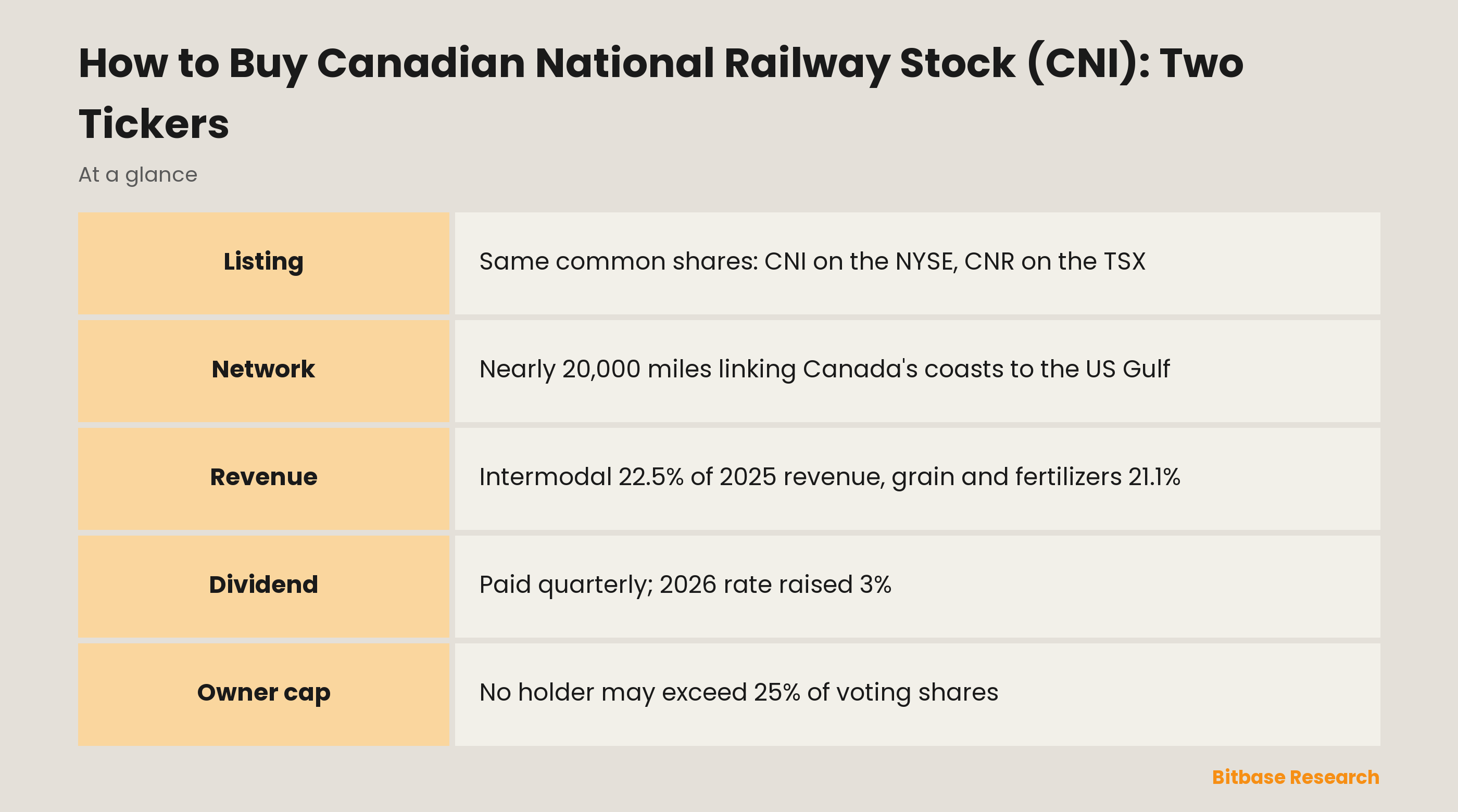
Whichever exchange your broker reaches, buying Canadian National Railway stock gets you the same common share: it trades as CNI on the New York Stock Exchange and as CNR on the Toronto Stock Exchange, so only the ticker and the currency change. Behind it is a freight railway of nearly 20,000 miles that was a Crown corporation until its 1995 listing.
What Does Canadian National Railway Do?
Canadian National Railway Company, usually called CN, hauls freight by rail from its head office in Montreal. A special act of the Parliament of Canada created it in 1919, and it stayed a Crown corporation until 28 November 1995, when its common shares were listed on the NYSE and the TSX.
Its annual information form (AIF) says the network "connects Canada's Eastern and Western coasts with the U.S. Midwest and the U.S. Gulf Coast," across eight provinces and 16 states; the US lines belong to subsidiaries such as Illinois Central Railroad. Containers move through Vancouver, Prince Rupert, Montreal, Halifax, Saint John, New Orleans and Mobile.
CN reports one business segment and seven commodity groups. It originates more than 85% of the traffic on its network and both originates and delivers more than 65%. The main rival, per its MD&A, is Canadian Pacific Kansas City, which "operates the other major rail system in Canada and services most of the same industrial areas, commodity resources and population centers"; trucks, Great Lakes and Mississippi shipping and pipelines compete too.
How Canadian National Railway Makes Money
Revenues rose 2% in 2025, mainly on higher volumes and higher freight revenue per revenue ton-mile (RTM), the industry's volume measure:
| Commodity group | Share of 2025 total revenues | 2025 vs 2024 |
|---|---|---|
| Intermodal | 22.5% | Up 4% |
| Grain and fertilizers | 21.1% | Up 7% |
| Petroleum and chemicals | 20.1% | Up 2% |
| Metals and minerals | 11.3% | Down 4% |
| Forest products | 10.6% | Down 5% |
| Coal | 5.5% | Up 3% |
| Automotive | 5.2% | Flat |
| Other revenues | 3.6% | Down 4% |
Shares are calculated from the 2025 financial statements; the changes are the MD&A's.
Intermodal is 63% international containers and 37% domestic. Grain is partly regulated: most western Canadian grain CN hauls leaves through Vancouver, Prince Rupert and Thunder Bay, and under the maximum revenue entitlement a formula caps total revenue on that traffic even though railways set their own rates. Regulated Canadian grain was 42% of the group's 2025 revenue.
By flow, 37% of 2025 revenues came from overseas traffic, 29% from transborder, 18% from Canadian domestic and 16% from US domestic; by geography, about 70% was earned in Canada and 30% in the US. No customer exceeded 10% of total revenues from 2023 to 2025, and the largest freight customer stayed under 3% of freight revenues.
Efficiency shows in the operating ratio, operating expenses as a share of revenues: 61.9% in 2025, an improvement on 63.4% in 2024.
CNI Stock at a Glance
| Item | CNI |
|---|---|
| Listings | NYSE as CNI; Toronto Stock Exchange as CNR |
| Security | Common shares, one vote each; no preferred shares outstanding |
| Trading currency | US dollars in New York, Canadian dollars in Toronto |
| Sector | Industrials (freight railroad) |
| Index funds | Held by iShares S&P/TSX 60 Index ETF (XIU); absent from SPY |
| Headquarters | Montreal, Quebec |
| Reporting | Form 40-F yearly and Form 6-K quarterly; US GAAP in Canadian dollars |
| Fiscal year | Ends 31 December |
| Dividends | Quarterly; the board sets the level once a year |
| Ownership limit | No holder above 25% of voting shares |
Live prices are on the CNI stock page on Bitbase.
How to Buy Canadian National Railway Stock
CN shares are interlisted, not wrapped in a depositary receipt: the share bought in New York is the share bought in Toronto.
1. Confirm the market. US access gives you CNI on the NYSE, Canadian access CNR on the TSX; check who regulates the broker.
2. Pass the account checks, which include a tax-residence declaration.
3. Fund it in the trading currency. CNI is priced in US dollars and CNR in Canadian dollars, and the exchange rate can cost more than the commission.
4. Read the name, not just the ticker. It should say Canadian National Railway Company. On the TSX, CNQ belongs to Canadian Natural Resources, an unrelated energy company.
5. Pick an order type. A market order takes the best price available when it arrives, which may differ from the last quote; a limit order caps what you pay but may not fill.
6. Decide on fractions. Not every broker sells fractional shares, and those that do may restrict them.
Dividends from a Canadian company. CN declares dividends in Canadian dollars. Neither the 40-F nor the 2025 MD&A covers the tax withheld on dividends to shareholders abroad, so ask your broker what is deducted.
Through a fund. XIU, BlackRock's S&P/TSX 60 fund, listed CNR among its industrials on 29 October 2026. Royal Bank of Canada is also listed in both cities, but under the same ticker in each.
What Moves CNI Stock
Cross-border trade. Transborder traffic supplied 29% of 2025 revenues. That year higher US duties on Canadian lumber weighed on lumber shipments, and US tariffs hit aluminum volumes. CN's third-quarter 2026 report adds that on 1 July 2026 the US said it would not back renewing the USMCA in its current form, and that Canada-US trade talks broke off in August without agreement.
A rival merger under review. On 18 August 2026 the US Surface Transportation Board (STB) set a schedule for reviewing Union Pacific's proposed acquisition of Norfolk Southern, described in our guide to Union Pacific shares. On 22 July 2026 CN signed a memorandum with both railroads securing competitive access, including to Kansas City, if the deal is approved and closes; a separate one would give CN rights over Union Pacific track for moves between Canada and Mexico. CN says the outcome could materially and adversely affect its competitive position.
Harvests. Grain output "varies considerably from year to year," the MD&A notes. In the third quarter of 2026, stronger Canadian and US grain exports helped lift revenues 15% on 4% more RTMs.
Fuel and the Canadian dollar. That quarter, revenue per RTM also rose on higher fuel surcharge rates, rate increases and a weaker Canadian dollar, yet the reported operating ratio climbed 2.3 points to 63.7%, partly on a technology write-down that CN excludes from its adjusted figure.
Four Business Risks That Matter for CNI
The MD&A lists more than 20 business risks. Four bear most directly on the share:
Tariffs. "The imposition of tariffs by the U.S. administration on imports from Canada and other countries combined with retaliatory tariffs by some countries, including Canada, on U.S. exports, present significant risks to global trade."
Labor. Contract disputes "have previously resulted in and could in the future potentially result in strikes, lockouts, slowdown of the business and ultimately loss of business." A lockout of Teamsters Canada Rail Conference members on 22 August 2024 was revoked within 24 hours, once the labor minister directed binding arbitration. That contract, for about 6,000 conductors and engineers, and a United Steelworkers contract for about 2,800 track workers both expire on 31 December 2026.
Dangerous goods. As a common carrier, CN "is legally required to transport dangerous goods and hazardous materials, including toxic inhalation hazard materials regardless of risk or potential exposure or loss."
Weather. Severe weather and natural disasters "have in the past caused, and could in the future again cause, disruptions to our operations."
A single stock also ties your result to one company, and investors outside Canada add currency swings.
Researching CN on EDGAR and SEDAR+
CN's SEC filer number (CIK) is 16868, and the yearly report there is a Form 40-F containing the AIF; the MD&A, audited statements and quarterly reviews arrive on Form 6-K, and the annual documents also sit on SEDAR+ and in the Investors section of cn.ca. Each commodity group in the MD&A gets a table of revenue, RTMs and carloads, which separates volume from price. Quotes for other companies are on Bitbase's stock pages.
Canadian National Railway Stock FAQ
Can I buy Canadian National Railway stock with crypto?
Not directly. Brokers sell CNI for US dollars and CNR for Canadian dollars, so crypto must be sold for cash first, which can be taxable in some countries. For how the two markets connect, see whether crypto is on the stock market.
Are CNI and CNR the same stock?
Yes. The AIF says the common shares are listed on the TSX and the NYSE "under the stock symbols CNR and CNI, respectively." No conversion ratio applies; only ticker and currency differ.
Does Canadian National Railway pay a dividend?
Yes, every quarter. The board raised the 2026 quarterly dividend by 3%, after dividends declared per share rose 5% in 2025, but the AIF warns: "There can be no assurance as to the amount or timing of such dividends in the future."
Is CNI in the S&P 500?
No. The 29 October 2026 holdings file for SPY, State Street's S&P 500 trust, lists Union Pacific, CSX and Norfolk Southern but not CN.
Has CN stock ever split?
Yes: three-for-two in February 2004, then two-for-one in February 2006 and in November 2013, each paid as a stock dividend.
Is there a limit on how many CN shares one investor can own?
Yes. No person and their associates may hold more than 25% of the voting shares; a holder past that line cannot exercise its votes, and dividends on the excess are forfeited. The cap was 15% until May 2018.
Conclusion
Buying CN needs a broker that reaches the NYSE or the TSX, the ticker that matches that market and a currency choice. Judging it is harder: revenue rides on harvests, cross-border trade and fuel, two Canadian labor contracts expire at the end of 2026, and a rival merger sits before the STB. Weigh those against the latest 40-F and quarterly review before sizing a position.
Related reading
Other Bitbase articles on this topic:
- How to Buy 3M Stock (MMM): Post-it Notes, PFAS and Solventum
- How to Buy AMETEK Stock (AME): Instruments and the Indicor Deal
- How to Buy Bloom Energy Stock (BE): Fuel Cells, AI Power and Perps
- How to Buy Norfolk Southern Stock (NSC): Merger Terms, Dividend
Disclaimer: This article is educational content from Bitbase Academy, provided for information only. It explains what a company or fund does and how the instruments referenced here differ from one another; it does not constitute investment, trading, tax, or financial advice, and it is neither a recommendation nor an endorsement of any security, token, or trading strategy. A tokenized stock is issued by a third party and is designed to give economic exposure to an underlying asset: it is not a share, it carries no shareholder rights, and it depends on the issuer's structure, eligibility rules, and redemption terms, which the issuer can change. Perpetual futures are leveraged derivatives that hold no underlying asset and can be liquidated, and trading hours, product availability, and eligibility differ by instrument and by jurisdiction and can change at any time. Written as of October 2026; verify everything yourself through company filings, the issuer's own documentation, and the product pages of the venue you trade on.
References
[1] CN Form 40-F and annual information form, fiscal 2025 (SEC EDGAR) www.sec.gov
[2] CN 2025 MD&A: commodity groups and business risks (Form 6-K, SEC EDGAR) www.sec.gov
[3] CN 2025 audited financial statements and notes (Form 6-K, SEC EDGAR) www.sec.gov
[4] CN third-quarter 2026 quarterly review: MD&A (Form 6-K, SEC EDGAR) www.sec.gov
[5] CN release, 30 January 2026: new share buyback and 3% dividend increase (Form 6-K, SEC EDGAR) www.sec.gov
[6] CN release, 28 January 2004: three-for-two stock split (Form 6-K, SEC EDGAR) www.sec.gov
[7] CN release, 24 January 2006: two-for-one stock split (Form 6-K, SEC EDGAR) www.sec.gov
[8] CN release, 22 October 2013: two-for-one stock split (Form 6-K, SEC EDGAR) www.sec.gov
[9] BlackRock: iShares S&P/TSX 60 Index ETF (XIU), fund page and holdings www.blackrock.com
[10] State Street SPDR S&P 500 ETF Trust (SPY): fund page and daily holdings www.ssga.com





