
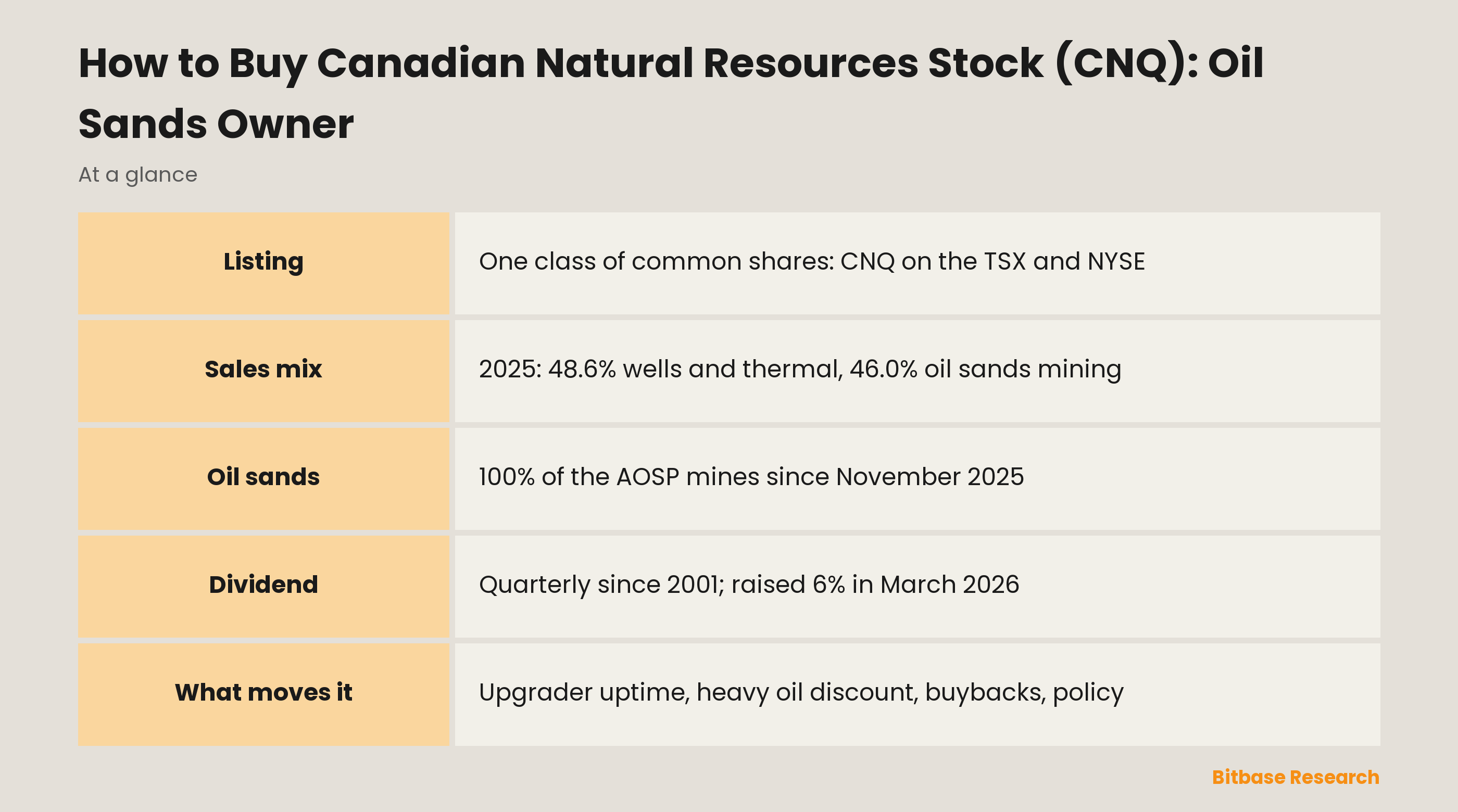
Buying on either the Toronto Stock Exchange or the New York Stock Exchange gets you the same security: Canadian Natural Resources has one class of common shares, quoted as CNQ in both markets, so any broker that reaches either exchange will do. Behind the ticker is a Calgary producer whose 2025 product sales split almost evenly between conventional and thermal production (48.6%) and oil sands mining and upgrading (46.0%), and which has owned 100% of the Athabasca Oil Sands Project mines since November 2025.
What Does Canadian Natural Resources Do?
The company calls itself a senior independent energy company producing crude oil, natural gas and natural gas liquids (NGLs) in western Canada, the UK North Sea and Offshore Africa. Incorporated in British Columbia in 1973 as AEX Minerals Corporation, it is now an Alberta corporation based in Calgary. N. Murray Edwards, a director since 1988, is executive chair; Scott Stauth is president.
Its output is mixed. In barrels of oil equivalent, 2025 production was 36% synthetic crude oil (SCO) from the oil sands mines, 27% natural gas, 17% thermal bitumen, 11% light and medium crude and NGLs, 6% primary heavy crude and 3% Pelican Lake heavy crude. Management aims to keep this "long life low decline" asset base balanced.
Oil Sands Mining and Upgrading mines oil sands with trucks and shovels, extracts the bitumen and upgrades it into SCO, a light synthetic crude. Horizon, about 70 kilometres north of Fort McMurray, is 100% owned and has upgraded on site since its first SCO in 2009. The Athabasca Oil Sands Project (AOSP) sends bitumen from its Muskeg River and Jackpine mines by pipeline to the Scotford Upgrader near Edmonton, which Shell operates.
North America Exploration and Production covers wells across four western provinces plus thermal projects such as Primrose, Kirby and Jackfish, which use steam to recover bitumen. North Sea and Offshore Africa are small and shrinking: old North Sea fields are being decommissioned, and off Côte d'Ivoire the company decided not to seek an extension for the Espoir field. Midstream and Refining holds pipelines, an interest in a cogeneration plant and 50% of the North West Redwater Partnership, a bitumen refinery.
The oil sands side was built in stages: 70% of AOSP in 2017, then in December 2024 Chevron's Alberta assets, including its 20% of AOSP and a 70% operated interest in Duvernay light oil, which took the AOSP share to 90%. On 1 November 2025 an asset swap with Shell gave it the last 10% of the mines in exchange for 10% of the Scotford Upgrader and the Quest carbon capture project, leaving it with 100% of the mines and a non-operated 80% of Scotford and Quest.
How Canadian Natural Resources Makes Money
It sells barrels and gas at benchmark-linked prices and pays royalties to the governments that lease it most of its land. In 2025, crude oil and NGLs made up 92.2% of product sales and natural gas 5.5%; royalties took 12.2%. Product sales rose 6.4%.
| Segment | What it sells | Share of 2025 product sales |
|---|---|---|
| North America Exploration and Production | Gas, light and heavy crude, thermal bitumen, NGLs | 48.6% |
| Oil Sands Mining and Upgrading | SCO and mining bitumen | 46.0% |
| North Sea and Offshore Africa | Crude oil, some gas | 1.2% |
| Midstream and Refining | Pipeline, power and processing | 1.7% |
Shares are of total product sales in the 2025 segment note; the other 2.4% is inter-segment elimination and other. Sales in the North American and oil sands segments originate in Canada, so 94.6% of the total is Canadian.
Earnings told a different story. Reported net earnings rose 77.2% in 2025, but nearly all of the increase came from items the company classes as non-operating, chiefly a non-cash gain on the AOSP swap. Adjusted net earnings from operations, which exclude them, rose 0.4%, as higher volumes met lower realized prices. Total production rose 15% to a record, with SCO up 20%, mainly thanks to the AOSP interest bought from Chevron.
CNQ Stock at a Glance
| Item | CNQ |
|---|---|
| Exchanges | Toronto Stock Exchange (TSX) and New York Stock Exchange (NYSE) |
| Ticker | CNQ on both |
| Security | Common shares, one vote each; the only class registered in the US, not an ADR |
| Quote currency | Canadian dollars on the TSX, US dollars on the NYSE |
| Fiscal year | Ends 31 December |
| Filings | 40-F each year, 6-K for quarters; IFRS, reported in Canadian dollars |
| Dividends | Quarterly since April 2001; declared in Canadian dollars |
| Index funds | Held by iShares XIU (S&P/TSX 60); not in SPY (S&P 500), per 28 October 2026 files |
| EDGAR CIK | 1017413 |
Live quotes are on Bitbase's Canadian Natural Resources stock page. As both listings are one class of share, the gap between the two prices mostly reflects the exchange rate.
How to Buy CNQ Stock in Toronto or New York
Choosing a listing is mainly a currency decision: same shares, vote and dividend either way.
1. Check which market your broker reaches. A US-only broker can buy CNQ in New York; one with Canadian access adds Toronto. Confirm it is licensed in your country.
2. Open the account. The tax residence you declare decides how dividends are taxed at source.
3. Fund it in the right currency. Toronto trades in Canadian dollars, New York in US dollars; the conversion spread may outweigh the commission.
4. Search CNQ and match the name. It should read Canadian Natural Resources Limited, common shares, on the exchange you intended.
5. Choose the order type. A limit order caps your price; a market order takes whatever the book offers.
6. Size the position. Some brokers sell fractional shares, which may carry no vote.
7. Keep the records. What you paid and what was withheld both feed your tax return.
Dividend tax. The 40-F does not say what tax a shareholder outside Canada pays on CNQ dividends. Your broker can tell you what it deducts at source, and a tax adviser whether your country taxes it again; buying in New York does not make the payer any less Canadian.
Through a fund. BlackRock's holdings list for the iShares S&P/TSX 60 Index ETF (XIU), dated 28 October 2026, includes CNQ under energy.
What Moves CNQ Stock
How the upgraders run. With 46.0% of sales from mining and upgrading, outages and turnarounds hit results directly; since a 2024 project, Horizon's major turnarounds come every second year rather than every year. SCO, light crude and NGLs made up 65% of 2025 liquids output, which the company describes as "not subject to widening heavy crude oil differentials."
The heavy oil discount and pipelines. The other 35%, thermal bitumen and heavy crude, is exposed to that discount. Contracted pipeline capacity covers about 22% of liquids production, including the Trans Mountain Expansion (TMX) to the West Coast, and the annual information form (AIF) warns that restricted transport could cut volumes and prices.
A buyback formula. Free cash flow (adjusted funds flow minus dividends, net capital spending and abandonment spending) is split by net debt: above the upper target, 60% to buybacks and 40% to the balance sheet; between targets, 75% and 25%; at or below the lower target, 100% to buybacks. In August 2026 the company said it was moving toward that lower target. Its current program covers up to 10% of the public float until 12 March 2027.
Ottawa and Alberta. Under a November 2025 memorandum of understanding (MOU) with Alberta, Ottawa agreed not to impose an oil and gas emissions cap, conditional on Alberta commitments that include carbon capture. In July 2026 the Oil Sands Alliance, formerly the Pathways Alliance, signed a trilateral MOU with both governments. Until definitive agreements are reached, targeted for November 2026, growth projects stay on hold, among them Pike 2 and a new Jackpine mine.
The Canadian dollar and US tariffs. It sells against US-dollar benchmarks, reports in Canadian dollars and carries US-dollar debt, which the management's discussion and analysis (MD&A) lists as foreign exchange risk. As of the March 2026 AIF, the US imposed 10% tariffs on Canadian products that do not meet the rules of origin of the Canada-United States-Mexico Agreement.
Reserves and gas. As at 31 December 2025, proved reserve additions and revisions replaced 218% of the year's production under Canada's NI 51-101 rules, acquisitions included. A 15-year gas supply deal, with deliveries expected from 2030, will be priced off the Japan-Korea Marker, an Asian LNG benchmark.
Risks Canadian Natural Flags in Its 40-F
Prices it cannot set. "The Company's financial condition is substantially dependent on, and highly sensitive to, the prevailing price for crude oil and natural gas," the AIF says; a sharp fall could delay projects or curtail output.
Getting barrels out. The AIF warns that "there is no certainty that alternative routes or modes of transportation" will be available or sufficient if pipelines are constrained.
Climate rules. Carbon pricing and emissions limits could raise costs that may not be recoverable in its prices. Since June 2024, Competition Act amendments expose environmental claims to deceptive-marketing rules, and the company says it has "adopted a conservative approach to its public representations."
Tailings. All three mines meet their approved tailings plans for now, but the AIF flags "the potential risk of exceeding the approved site-specific tailings profiles," which could mean posting more financial security and paying a compliance levy.
Estimates and old fields. Reserve revisions "are often necessary," the AIF notes, and in 2025 revised North Sea decommissioning cost estimates and the Espoir decision led to non-cash recoverability charges.
Payouts can change. The dividend and free cash flow allocation policies "each undergo periodic review by the Board of Directors and are subject to change."
CNQ is also a single company in one commodity group, and its Canadian-dollar dividends add currency risk for anyone spending another currency.
How to Research CNQ in the Company's Filings
Its EDGAR identifier is CIK 1017413. The 2025 Form 40-F, filed on 26 March 2026, puts the AIF, audited financial statements and MD&A into one file; quarterly results arrive as Form 6-K, the latest on 6 August 2026 for the second quarter. The same documents are on SEDAR+. A supplementary oil and gas exhibit restates reserves on the SEC basis, net of royalties at 12-month average prices, against NI 51-101's gross reserves at forecast prices, noting that "the difference between the reported numbers under the two disclosure standards can be material." To compare it with other listed names, use Bitbase's stock listings.
Canadian Natural Resources Stock: FAQ
Is CNQ the same stock on the TSX and the NYSE?
Yes. One class of common shares trades on both as CNQ; the 40-F registers only that class in the US, so the New York line is not a depositary receipt.
Does Canadian Natural Resources pay a dividend?
Yes, quarterly, under a policy adopted on 17 January 2001; payments have gone out every January, April, July and October since April 2001. The quarterly dividend rose 4% in March 2025 and 6% in March 2026, and the company says 2026 is its 26th consecutive year of increases. Dividends are declared in Canadian dollars, and the board can change the policy.
Is CNQ in the S&P 500?
No. The SPY holdings file State Street published for 28 October 2026 does not list Canadian Natural. Its index home is Canadian: iShares XIU, which tracks the S&P/TSX 60, holds it.
Did CNQ stock split?
Yes, two-for-one. Shareholders approved it on 2 May 2024, holders of record on 3 June received one extra share per share on 10 June, and split-adjusted trading began on 11 June 2024.
Can I buy Canadian Natural Resources stock with crypto?
Not directly. Brokers take Canadian or US dollars for CNQ, which means selling crypto for one of those currencies first and moving the cash to a brokerage account. That sale may be taxable; how crypto disposals are taxed depends on your country.
Conclusion
Buying CNQ is an ordinary brokerage trade, and the main choice is the currency. What you buy into is a producer built on two Canadian engines, wholly owned oil sands mines and a broad conventional and thermal base, with buybacks set by a formula and new growth waiting on government agreements. Read the latest 40-F and 6-K first, and check how dividends from Canada are taxed in your country.
Related reading
Other Bitbase articles on this topic:
- How to Buy Baker Hughes Stock (BKR): Chart, LNG and the Rig Count
- How to Buy BP Stock (BP): Six Shares per ADS and the Dividend
- How to Buy Cenovus Energy Stock (CVE): Oil Sands Without Mines
- How to Buy Occidental Petroleum Stock (OXY): Warrants, Berkshire
Disclaimer: This article is educational content from Bitbase Academy, provided for information only. It explains what a company or fund does and how the instruments referenced here differ from one another; it does not constitute investment, trading, tax, or financial advice, and it is neither a recommendation nor an endorsement of any security, token, or trading strategy. A tokenized stock is issued by a third party and is designed to give economic exposure to an underlying asset: it is not a share, it carries no shareholder rights, and it depends on the issuer's structure, eligibility rules, and redemption terms, which the issuer can change. Perpetual futures are leveraged derivatives that hold no underlying asset and can be liquidated, and trading hours, product availability, and eligibility differ by instrument and by jurisdiction and can change at any time. Written as of October 2026; verify everything yourself through company filings, the issuer's own documentation, and the product pages of the venue you trade on.
References
[1] Canadian Natural Resources Form 40-F, fiscal 2025: cover page, annual information form, audited financial statements and MD&A (SEC EDGAR) www.sec.gov
[2] Canadian Natural Resources Form 40-F, fiscal 2025: XBRL cover page data (SEC EDGAR) www.sec.gov
[3] Canadian Natural Resources 2025 financial statements: segmented information, operating segment results (XBRL, SEC EDGAR) www.sec.gov
[4] Canadian Natural Resources supplementary oil and gas information, fiscal 2025, unaudited (Form 40-F exhibit) www.sec.gov
[5] Canadian Natural Resources fourth quarter and year end 2025 results, 5 March 2026: liquids mix, dividend and free cash flow allocation policy (Form 6-K) www.sec.gov
[6] Canadian Natural Resources announces normal course issuer bid, 10 March 2026 (Form 6-K) www.sec.gov
[7] Canadian Natural Resources second quarter 2026 results, 6 August 2026: trilateral MOU, projects on hold and net debt target (Form 6-K) www.sec.gov
[8] Canadian Natural Resources MD&A for the six months ended 30 June 2026: trilateral MOU of July 2026 (Form 6-K) www.sec.gov
[9] Canadian Natural Resources announces quarterly dividend, 6 August 2026 (Form 6-K) www.sec.gov
[10] BlackRock, iShares S&P/TSX 60 Index ETF (XIU): fund holdings as of 28 October 2026 www.blackrock.com
[11] State Street, SPDR S&P 500 ETF Trust (SPY): daily holdings as of 28 October 2026 www.ssga.com





