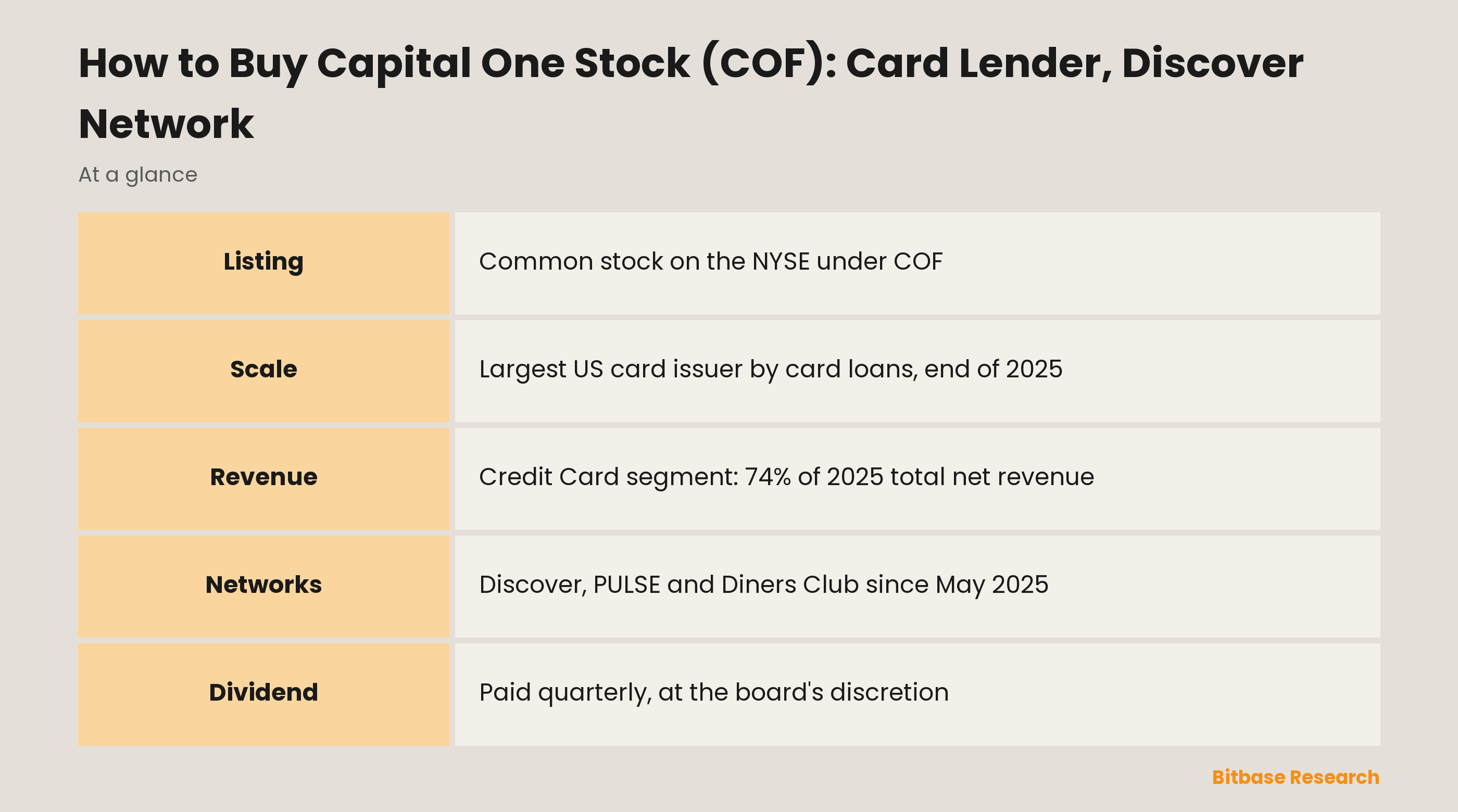
Because the New York Stock Exchange lists several Capital One securities, buying the stock means opening a brokerage account with NYSE access and ordering the common shares under the ticker COF, not the preferred depositary shares or the 2029 note that trade under longer COF symbols. Each common share is a stake in what the 10-K calls the largest credit card issuer in the United States by outstanding card loans, and since May 2025 also in the Discover, PULSE and Diners Club payment networks that came with Discover Financial Services. Cards dominate the results: the Credit Card segment produced 74% of total net revenue in 2025.
What Does Capital One Do?
Capital One lends money, takes deposits and, since 2025, runs payment networks. Its 10-K describes a Delaware holding company "established in 1994 and headquartered in McLean, Virginia," whose main operating subsidiary is Capital One, National Association. The card business is older: it started in 1953 inside Signet Bank and was separated from Signet on 24 November 1994, alongside an initial public offering. Richard D. Fairbank, named in the October 2026 results release as founder, chairman and chief executive officer, still runs it.
Besides leading in card loans, the 10-K calls it "one of the nation's largest banks based on deposits," serving customers online and through branches, cafés, call centers and ATMs. It also issues cards in the United Kingdom, through Capital One (Europe) plc, and in Canada. It had about 76,300 employees at the end of 2025.
The business is reported in three segments:
Credit Card covers US consumer and small business cards, personal loans, and the card businesses in the UK and Canada.
Consumer Banking collects deposits from consumers and small businesses, makes auto loans nationwide and, since the Discover deal, includes the payment network services.
Commercial Banking serves commercial real estate and commercial and industrial clients with loans, deposits, capital markets and treasury management.
Two acquisitions have reshaped the group. On 18 May 2025 Capital One closed its purchase of Discover Financial Services, agreed on 19 February 2024, and merged Discover Bank into its own national bank. The deal brought personal loans and what the company now calls the Global Payment Network: the Discover Network for credit and debit cards, the PULSE debit and ATM network, Diners Club International and a group of partner agreements. Discover's home loan business was sold on 24 November 2025. Then, on 7 April 2026, Capital One completed the purchase of Brex, which "offers businesses solutions to issue corporate cards, automate expense management and make secure, real-time payments," according to the 10-Q; Brex now reports inside Domestic Card.
The 10-K's list of card competitors includes issuers of Visa and Mastercard cards, American Express, which runs its own network, and private-label brands.
How Capital One Makes Money
A lender like this earns mainly on the gap between what borrowers pay and what its deposits and debt cost, and second on fees. The 2025 income statement:
| Revenue source | Share of 2025 total net revenue |
|---|---|
| Net interest income | 80.2% |
| Discount and interchange fees, net | 12.1% |
| Service charges and other customer fees | 5.3% |
| Other non-interest income | 2.4% |
Shares are calculated from the 2025 consolidated statement of income and rounded to one decimal; non-interest income as a whole came to 19.8%.
Credit cards supply most of the interest. The average yield on card loans was 17.95% in 2025, card balances made up 61.6% of loans held for investment at year-end, and Domestic Card alone has produced more than 90% of the Credit Card segment's revenue in every year from 2023 to 2025. On cards issued on other networks, merchants pay the bank an interchange fee; on cards that run over the Global Payment Network, part of what merchants pay the network is passed through to the bank. Purchase volume rose 27% in 2025.
The segment split shows how far the Discover deal tilted the mix toward cards:
| Segment | 2025 | 2024 | 2023 |
|---|---|---|---|
| Credit Card | 74% | 72% | 70% |
| Consumer Banking | 19% | 22% | 25% |
| Commercial Banking | 7% | 9% | 10% |
Shares of total net revenue as reported in the 10-K. The Other category, which holds treasury activities and integration costs, was negative and is left out, so the earlier columns add up to more than 100%.
Deposits fund the lending: Consumer Banking deposits made up 80% of funding sources at the end of 2025, and about 15% of total deposits were estimated to be uninsured, down from 18% a year earlier.
For profit, 2025 was an unusual year. Total net revenue grew 37% as Discover's loans arrived, but the provision for credit losses rose 76%, mainly because of the initial allowance set up for the acquired loans, and net income fell 48%. Per-share figures need a second adjustment: 64% more common shares were outstanding at the end of 2025 than a year earlier, because Discover holders were paid in stock.
COF Stock at a Glance
| Item | Detail |
|---|---|
| Exchange | New York Stock Exchange (NYSE) |
| Ticker | COF (common stock) |
| Other NYSE lines | Five series of preferred depositary shares (COF PRI, PRJ, PRK, PRL, PRN) and a senior note due 2029 (COF29) |
| Issuer | Capital One Financial Corporation, a bank holding company and financial holding company |
| Main bank | Capital One, National Association |
| Sector | Credit cards, consumer and commercial banking, payment networks |
| Index membership | S&P 500; the 10-K also cites the S&P 100 |
| Headquarters | McLean, Virginia |
| Incorporated | Delaware |
| Fiscal year | Ends 31 December (calendar year) |
| Dividend policy | Quarterly common dividend, declared at the board's discretion |
| Regulators | Federal Reserve for the holding company; OCC, FDIC and CFPB for the bank |
| SEC identifier | CIK 927628 |
Live figures such as the share price and market value are left to the Capital One stock page on Bitbase.
How to Buy Capital One Stock
Capital One has a single class of common stock and no ADR, so the only trap is the list of tickers. The steps:
1. Find a broker offering NYSE shares. Local and international firms both serve investors outside the United States; check which legal entity holds your account and which regulator supervises it.
2. Complete the account checks. Brokers ask non-US individuals for IRS Form W-8BEN, which the IRS says to give "to the withholding agent or payer," here the broker.
3. Add money. Funding from another currency costs a conversion, so compare the exchange rate the broker applies as well as its commission.
4. Select the right security. Search for COF and confirm that the result reads Capital One Financial Corp common stock. The preferred depositary shares often appear next to it, written differently from one broker to the next (the SEC's own records use both COF PRI and COF-PI), and the note trades as COF29; neither is common stock.
5. Choose an order type. In FINRA's description a market order "generally will execute at or near the current bid or ask prices," though "you might not get the price you saw or were originally quoted, especially in fast-moving markets." A limit order sets your maximum price, but "there's a chance your order doesn't get executed at all." See also market orders and how they get filled.
6. Size the position. A fraction of a share lets you invest a fixed sum, but FINRA notes that "the availability of fractional share trading varies by brokerage firm," that a fractional owner "might not have shareholder voting rights," and that for now such holdings cannot be moved to another broker.
7. Keep the records. Confirmations and statements establish your cost basis and record each quarterly dividend.
Tax outside the United States. According to the IRS, "most types of U.S. source income received by a foreign person are subject to U.S. tax of 30%," and a tax treaty between your country and the United States can lower or remove that rate; the W-8BEN tells the broker what to withhold. Tax may also be due where you live.
Holding it through a fund. Because COF belongs to the S&P 500, index funds tracking that index own it alongside the rest of its members.
What Moves COF Stock
Consumer credit. The card book has the highest charge-off rate of the three businesses. In 2025 the Credit Card segment's net charge-off rate was 5.09%, down from 5.88%; Consumer Banking, mostly auto loans, was at 1.59% after 2.10%, and Commercial Banking at 0.27% after 0.19%. Company-wide the rate was 3.30% against 3.39%, and the 30-plus-day delinquency rate ended 2025 at 3.59%, down from 3.98%. Card charge-offs "generally tend to be the highest in the first quarter of the year," the 10-K adds. Because Capital One files card and auto credit figures monthly, the trend shows up between quarterly reports.
The Discover integration and the networks. The 10-K expects to "continue to incur substantial expenses related to the integration of Discover," and the quarterly releases list integration costs as separate adjusting items. One milestone is done: legacy Capital One debit cards have been substantially reissued onto the Global Payment Network. What the networks earn depends on merchants accepting Discover and PULSE cards and on the rates they pay.
Interest rates and deposit costs. Net interest margin widened to 7.84% in 2025 from 6.88%, helped by higher card balances and lower deposit rates. In the falling-rate cycle Capital One passed more of the decline on to savers: its cumulative deposit beta, the change in its average interest-bearing deposit rate relative to the change in the federal funds upper bound, rose to 23% at the end of 2025 from 11% a year earlier.
Capital rules and buybacks. The Federal Reserve's stress test set Capital One's stress capital buffer at 4.5% from 1 October 2025, and in February 2026 the Fed said it would hold buffers at current levels, so without further action that 4.5% applies until 30 September 2027. The CET1 ratio stood at 14.3% at the end of 2025, against 13.5% a year before, and in October 2025 the board approved a new repurchase authorization with no expiry date. Size matters too: as a Category III bank holding company, Capital One ended 2025 with total assets about 4.4% below the level that, as a four-quarter average, would move it into Category II, with stricter liquidity rules and no option to exclude accumulated other comprehensive income from regulatory capital.
Rules on card fees. The Federal Reserve's Regulation II caps debit interchange on "debit cards issued on networks not owned by the Company"; it is being contested in court, and a 2023 proposal to lower the cap is not final. Most of Capital One's debit cards now run on its own network, but the 10-K warns that lower fees elsewhere could still create "market pressures that reduce the discount rate" on them. In the UK, interchange on consumer credit and debit cards is already capped.
Risks in Capital One's Own Words
The latest 10-Q reports no material change to the 10-K's risk factors. These bear most directly on the common stock:
Integration. "We may not be able to successfully integrate our businesses associated with the Transaction, or such integration may be more difficult, time-consuming or costly than expected." The Transaction is the Discover acquisition.
Credit. "We may experience increases in delinquencies and credit losses, or we may incorrectly estimate expected losses, which could result in inadequate reserves." The filing ties missed payments to downturns, high unemployment and inflation that outpaces wages.
Capital returns. The company "may not be able to maintain adequate capital or liquidity levels or may become subject to revised capital or liquidity requirements," which could weigh on "our ability to return capital to our stockholders." The 10-K is direct about the dividend: "There can be no assurance that we will declare and pay any dividends to stockholders."
Network economics. "A reduction in the number of large merchants that accept cards on our recently acquired Discover Network or PULSE Network or in the rates they pay could materially adversely affect our business, financial condition, results of operations and cash flows."
Legal matters. Discover's misclassification of certain cards into its highest merchant pricing tier, disclosed in 2023, led to a Federal Reserve consent order in April 2025 that Capital One has committed to satisfy; a merchant class settlement won final approval on 20 May 2026, and an SEC investigation continues with the company's cooperation. A class action over its 360 Savings accounts, which paid less than 360 Performance Savings, settled on terms that raise 360 Savings rates to match; final approval came on 20 April 2026, and an individual objector has appealed. A 2019 breach of customer data "resulted in fines, litigation, consent orders, settlements, government investigations and other regulatory enforcement inquiries."
Beyond the company, a single stock ties your result to one issuer, and this one earns most of its revenue from US consumer lending. If you measure returns in another currency, exchange rates move both the share value and the dividends.
Researching COF: Filings and Sources
EDGAR lists Capital One's filings under CIK 927628: the annual 10-K (the latest filed in February 2026), a 10-Q each quarter and 8-Ks for events. Three kinds of 8-K are worth following: the quarterly earnings release with its financial supplement, which breaks results down by segment; a monthly report of net charge-off and delinquency rates for Domestic Card and auto loans; and deal filings, such as those for the Discover closing in May 2025 and the Brex closing in April 2026.
The capital management section of the 10-K explains how the stress capital buffer, dividends and buybacks fit together, and the investor relations section of capitalone.com collects releases, presentations and webcasts. The 10-K's performance graph tracks COF's five-year total return against the S&P 500 and the S&P Financial Composite Index, two benchmarks worth reusing. Other companies are covered on Bitbase's list of US stock pages.
Capital One Stock FAQ
Does Capital One pay a dividend?
Yes, quarterly. In November 2025 the board raised the common dividend by 33%, starting with the fourth-quarter 2025 payment. Each dividend is declared at the board's discretion and depends on earnings, capital and regulatory requirements, and the 10-K says there is no assurance that dividends will be paid.
Can I buy Capital One stock with crypto?
Not directly. COF is bought through a brokerage account and paid for in US dollars, so any crypto has to be converted to cash first, which may be taxable where you live, and the money sent to the broker. The result is a share of a Delaware corporation that carries voting rights and a right to any dividend the board declares; how crypto differs from stocks explains why that is a different kind of asset.
What happened to my Discover shares?
They became Capital One shares. When the merger closed on 18 May 2025, each Discover common share was converted into 1.0192 shares of Capital One common stock, with cash paid instead of fractional shares.
Is COF in the S&P 500?
Yes. COF appears in the 28 October 2026 holdings list of SPY, State Street's S&P 500 ETF, and Capital One's 10-K says the stock is included in the S&P 100.
What are COF PRI, COF PRJ and the other COF symbols?
They are depositary shares, each a 1/40th interest in a share of Capital One's fixed-rate, non-cumulative perpetual preferred stock, Series I, J, K, L and N. Their dividends rank ahead of common dividends, but owning them does not make you a common shareholder. COF29 is a senior note due 2029. The list changes as series are issued or redeemed: Series M was redeemed in full on 1 September 2026.
Has Capital One stock ever split?
Yes. The board approved a three-for-one split in April 1999, carried out as a stock distribution on 1 June 1999. Long-run per-share comparisons also have to allow for the jump in the share count after the 2025 Discover merger.
Conclusion
The purchase itself is simple: a broker with NYSE access, the common shares under COF rather than a preferred line, and an order type you understand. The company behind the ticker is less simple. Capital One is mainly a US card lender whose earnings move with charge-offs, deposit costs and capital rules, and since 2025 it has also owned payment networks whose value depends on merchant acceptance and on completing the Discover integration. Read the latest 10-K, the newest quarterly release and the monthly credit figures before deciding what share of your portfolio a single lender should have.
Related reading
Other Bitbase articles on this topic:
- How to Buy Barclays Stock (BCS): ADS Ratio and the Ring-Fence
- How to Buy BBVA Stock (BBVA): Spanish ADS, Mexican Profits
- How to Buy BMO Stock (BMO): Canada's First Chartered Bank
- How to Buy UBS Stock (UBS): Not an ADR, Swiss Capital Rules
Disclaimer: This article is educational content from Bitbase Academy, provided for information only. It explains what a company or fund does and how the instruments referenced here differ from one another; it does not constitute investment, trading, tax, or financial advice, and it is neither a recommendation nor an endorsement of any security, token, or trading strategy. A tokenized stock is issued by a third party and is designed to give economic exposure to an underlying asset: it is not a share, it carries no shareholder rights, and it depends on the issuer's structure, eligibility rules, and redemption terms, which the issuer can change. Perpetual futures are leveraged derivatives that hold no underlying asset and can be liquidated, and trading hours, product availability, and eligibility differ by instrument and by jurisdiction and can change at any time. Written as of October 2026; verify everything yourself through company filings, the issuer's own documentation, and the product pages of the venue you trade on.
References
[1] Capital One Financial Corporation Form 10-K for fiscal 2025 (SEC EDGAR) www.sec.gov
[2] Capital One Form 10-Q for the quarter ended 30 June 2026 (SEC EDGAR) www.sec.gov
[3] Capital One Form 8-K, 19 May 2025: completion of the Discover acquisition www.sec.gov
[4] Capital One Form 8-K, 7 April 2026: completion of the Brex acquisition www.sec.gov
[5] Capital One third-quarter 2026 earnings release, 20 October 2026 (Form 8-K) www.sec.gov
[6] Capital One monthly charge-off and delinquency metrics, July 2026 (Form 8-K) www.sec.gov
[7] Capital One Form 8-K, 20 August 2026: redemption of Series M preferred stock www.sec.gov
[8] Capital One Financial Corporation Form 10-K for fiscal 1999 (SEC EDGAR) www.sec.gov
[9] Capital One Financial Corporation Form 10-K for fiscal 1996 (SEC EDGAR) www.sec.gov
[10] Capital One Form 10-Q for the quarter ended 30 June 1999: three-for-one stock split www.sec.gov
[11] State Street: SPDR S&P 500 ETF Trust (SPY), holdings as of 28 October 2026 www.ssga.com
[12] FINRA: Order Types www.finra.org
[13] FINRA: Investing in Fractional Shares www.finra.org
[14] IRS: About Form W-8 BEN www.irs.gov
[15] IRS: NRA Withholding www.irs.gov