
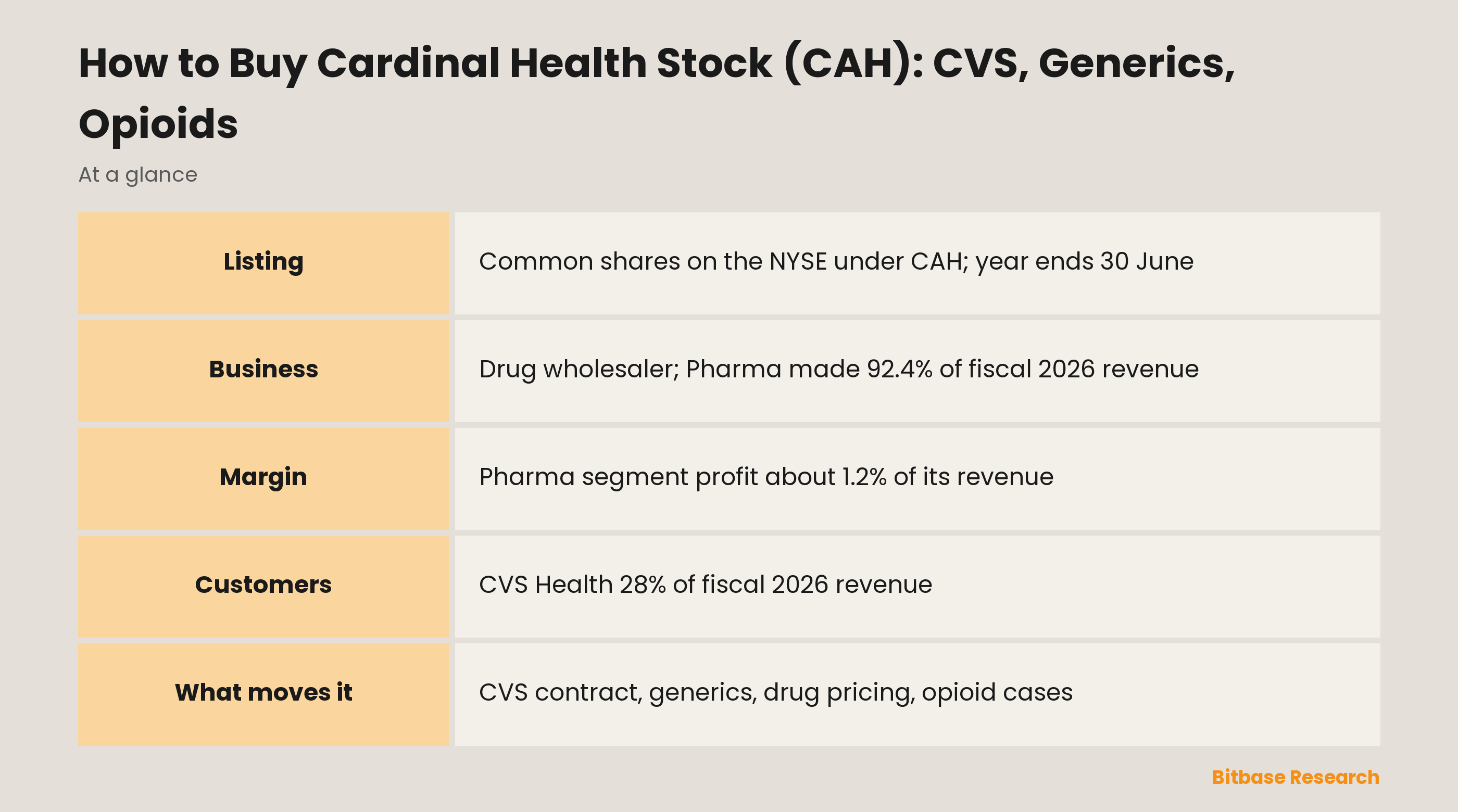
Since Cardinal Health's common shares trade on the New York Stock Exchange under the ticker CAH, any brokerage account with access to US-listed stocks can buy them. What you buy into is mostly a drug wholesaler: its Pharmaceutical and Specialty Solutions segment brought in 92.4% of revenue in fiscal 2026, a year that ended on 30 June. Below: how the business makes money, how an order works, and the risks its filings put first, from CVS Health at 28% of revenue to opioid settlements.
What Does Cardinal Health Do?
Cardinal Health sits in the middle of the US medicine supply chain, buying from drug and device makers and delivering to the places that treat patients. Its annual report calls it "a global healthcare services and products company" serving hospitals, pharmacies, surgery centers, laboratories, physician offices and patients at home. It is an Ohio corporation formed in 1979, based in Dublin, Ohio, with approximately 63,900 employees as of 30 June 2026.
Pharmaceutical and Specialty Solutions (Pharma) distributes branded, generic and specialty drugs and over-the-counter products to US pharmacies, hospitals and other providers, and sells distribution, data and launch services to drugmakers.
Global Medical Products and Distribution (GMPD) makes and sources Cardinal Health brand products, from exam gloves and syringes to wound care and surgical gowns, and distributes other manufacturers' "national brand" products in the United States and Canada.
Other groups nuclear pharmacies that make radiopharmaceuticals, at-Home Solutions, which ships supplies to patients with chronic conditions, and OptiFreight Logistics, a shipping service for providers.
The newest layer is physician services. Starting in December 2024, the company bought into specialist practices through managed services organizations (MSOs): the oncology network ION, a 73% stake in GI Alliance, Urology America and, in November 2025, Solaris Health, a urology group with more than 750 providers in 14 states. They sit in the oncology platform Navista and in The Specialty Alliance, which Cardinal Health owns approximately 76% of.
How Cardinal Health Makes Money
Most of the money passing through Cardinal Health is the price of drugs it buys and resells, so revenue is huge and margins are thin: gross margin was about 3.8% of fiscal 2026 revenue. The segment note shows where revenue and profit come from:
| Segment | What it sells | Share of fiscal 2026 revenue | Share of fiscal 2026 segment profit | Segment profit margin |
|---|---|---|---|---|
| Pharmaceutical and Specialty Solutions | Drug distribution, specialty services, MSOs | 92.4% | 74.3% | 1.2% |
| Global Medical Products and Distribution | Medical and surgical products | 5.0% | 6.9% | 2.0% |
| Other | Nuclear pharmacy, home supplies, freight | 2.7% | 18.9% | 10.4% |
The margin column is each segment's profit divided by its own revenue.
Pharma carries almost all of the revenue at the thinnest margin, while the small Other group earns nearly a fifth of segment profit. For branded drugs, compensation from manufacturers "typically is a percentage of the wholesale acquisition cost that is set by manufacturers." Generics earn the most "during the period immediately following the initial launch of a product," because their prices start high and tend to fall. To buy them at scale, Cardinal Health and CVS Health run Red Oak Sourcing, a joint venture that negotiates generic supply contracts for both and runs through June 2029.
Customers are concentrated: CVS Health accounted for 28% of fiscal 2026 revenue, the five largest customers for 43%, and members of the two largest group purchasing organizations, Vizient and Premier, for 29%. The United States made up 99.3% of segment revenue.
Fiscal 2026 revenue rose 14%, "primarily due to branded and specialty pharmaceutical sales growth from existing and new customers," and Pharma segment profit grew 23%. GMPD profit rose 91%, mainly on growth from existing customers.
CAH Stock at a Glance
| Item | Detail |
|---|---|
| Exchange | New York Stock Exchange (NYSE) |
| Ticker | CAH |
| Security | Common shares without par value, the only class on the 10-K cover |
| Sector | Healthcare: drug distribution, medical products, physician services |
| Index membership | S&P 500; also held by the Health Care Select Sector SPDR ETF (XLV) |
| Headquarters | Dublin, Ohio |
| Incorporated | Ohio, 1979 |
| Fiscal year | Ends on 30 June; fiscal 2026 ran from July 2025 to June 2026 |
| Dividend policy | Quarterly cash dividend, declared by the board |
| SEC identifier | CIK 721371 |
Quotes, market value and yield change by the minute, so they are not in the table; the Cardinal Health stock page on Bitbase shows them live.
How to Buy Cardinal Health Stock
Cardinal Health is a US company, so no depositary receipt sits between you and the stock: what trades on the NYSE is the common share.
1. Choose a broker with access to NYSE stocks. Outside the US, use a local broker that offers US markets, or a global one, and check who regulates it.
2. Open the account and pass identity checks. Non-US individuals usually file IRS Form W-8BEN so that the right treaty rate can be withheld from US dividends.
3. Deposit money. If your account is not in US dollars, check the currency conversion spread, not just the commission.
4. Search for CAH and check that the result reads Cardinal Health, Inc. common shares on the NYSE.
5. Choose how the order executes. FINRA notes that a market order "provides the most certainty that your order will be executed," but "you might not get the price you saw or were originally quoted"; a limit order executes only "at or better than a specified price," and possibly not at all.
6. Decide between whole and fractional shares. Some brokers sell fractions for a cash amount, others "don't offer fractional share trading at all," and a fractional owner "might not have shareholder voting rights."
7. Place the order and keep the confirmations, your record of cost and of dividends received.
Dividends for holders outside the US. Under IRS rules, "most types of U.S. source income received by a foreign person are subject to U.S. tax of 30%," and that "a reduced rate, including exemption, may apply," for example under a tax treaty. Your own country may tax the dividend again.
Owning it through a fund. As an S&P 500 member, Cardinal Health appears in index funds such as SPY and in sector funds such as XLV, where it is a small slice of a large basket.
What Moves CAH Stock
Big contracts starting and ending. Distribution contracts with OptumRx, which UnitedHealth Group reports as one of its four segments, expired at the end of June 2024. OptumRx had been 17% of fiscal 2024 revenue, and revenue fell 2% in fiscal 2025 before new and existing customers lifted it again. CVS Health is now the account that matters most: on 1 October 2026 the company announced a binding letter of intent to extend its distribution agreements with CVS Health through June 2032.
Generic drug economics. Generics helped Pharma profit in fiscal 2026, but launch timing, volumes and price changes "have contributed to declines in some prior years." Generics were not subject to US tariffs when the 10-K was filed, but it cites a presidential statement that they would be from 2028, with "significant uncertainty" about implementation.
Branded drug prices. Because pay is tied to manufacturers' list prices, pricing policy reaches the income statement. The Inflation Reduction Act, the 10-K says, "has and will continue to adversely impact our revenue by capping prices for certain drugs; however, our profitability has not been negatively impacted." GLP-1 medications show the gap from the other side: they lifted fiscal 2026 revenue, yet "increased GLP-1 sales did not meaningfully contribute to segment profit."
Physician practices. The Specialty Alliance's acquisitions lifted Pharma profit in fiscal 2026, while the oncology side took a goodwill impairment at the Navista and ION reporting unit. Oregon has adopted, and other lawmakers have proposed, rules limiting corporate ownership or management of physician practices.
Medical products and tariffs. Elevated supply-chain costs weighed on GMPD profit in fiscal 2024 through 2026. After the US Supreme Court ruled the emergency-powers tariffs unlawful in February 2026, Cardinal Health filed for refunds, part of which it expects to return to customers. Other tariffs remain, and price increases and cost cuts "have not fully offset the adverse impact."
Concentration, Litigation and Policy: Weighing a CAH Share
Four headings in the 10-K's risk section bear most directly on the shares.
One customer. "Our sales and credit concentration is significant." CVS Health was also 22% of gross trade receivables at 30 June 2026, so a lost contract or late payment would hit revenue and cash at once.
Opioid litigation. "Opioid-related legal proceedings and the NOSA we have entered into could have additional or unexpected negative effects on our results of operations or business." The national settlement took effect in April 2022, and the company has resolved, "without admitting liability," the claims of all 50 states, the District of Columbia and five US territories, plus more than 99% of political subdivisions. Remaining payments are expected to run mostly through 2038, and a monitor oversees its anti-diversion terms until January 2028. Private plaintiffs are outside it, with about 73 lawsuits pending.
Margin pressure. "Our Pharmaceutical and Specialty Solutions segment's profit margin could be adversely affected by changes in industry or market dynamics that we are not able to accurately predict." At a segment margin of 1.2%, there is little room for error.
Regulation and investigations. "Our business is subject to rigorous regulatory and licensing requirements." A Department of Justice civil investigative demand from November 2023 concerns a 2022 purchase of a group purchasing organization and a minority stake in a rheumatology MSO; the company says it is cooperating. The IRS has also issued two notices of proposed adjustment covering fiscal 2015 to 2020, with an outcome the company calls uncertain.
The share itself. One stock concentrates your money, dividends depend on the board, and currency moves affect both price and payout for investors outside the dollar.
Tracking Cardinal Health Through EDGAR and Its Quarterly Releases
Cardinal Health's SEC filer number (CIK) is 721371. It publishes a 10-K for each June year (the fiscal 2026 one arrived in August 2026), 10-Qs for the quarters to September, December and March, and 8-Ks for events such as earnings releases. The 10-K is laid out unusually, with MD&A first, Business and Risk Factors later and a cross-reference index at the back. Note 7 covers the opioid cases, and a separate section reconciles non-GAAP measures to GAAP, so check which one a headline number uses. For prices, use the stock page above; for other companies, browse Bitbase's US stock pages.
Cardinal Health Stock FAQ
Does Cardinal Health pay a dividend?
Yes, quarterly. Dividends paid per share in fiscal 2026 were 1% higher than in fiscal 2025, and the company expects to keep paying quarterly, though "the payment and amount of future dividends remain, however, within the discretion of our Board of Directors."
Can I buy Cardinal Health stock with crypto?
Not directly. CAH is paid for in US dollars inside a brokerage account, so any crypto would first have to be sold and the cash transferred, and that sale may be taxable where you live. The share itself is part-ownership recorded in your name, with a claim to dividends and a vote, which is how stocks differ from crypto.
Is CAH in the S&P 500?
Yes. On 29 October 2026 the daily holdings file of SPY, State Street's S&P 500 fund, listed Cardinal Health, and so did the file of XLV, its healthcare sector fund. Weights change daily.
Has Cardinal Health stock ever split?
Yes. The fiscal 2002 annual report records a three-for-two split distributed on 20 April 2001 and adjusts older figures for "all prior stock splits." The August 2009 CareFusion spin-off was different: shareholders received 81% of a new company's shares, not more Cardinal Health shares.
Conclusion
Buying CAH needs only a broker that reaches the NYSE, the CAH ticker and a market or limit order. Understanding it takes more: a wholesaler living on thin margins, one customer, CVS Health, behind more than a quarter of revenue, and opioid payments that run mostly through 2038. Read the latest 10-K with its June year-end in mind, and the 8-Ks that follow, before deciding how much of a portfolio belongs in one healthcare distributor.
Related reading
Other Bitbase articles on this topic:
- How to Buy Becton Dickinson Stock (BDX): Waters Deal and Dividend
- How to Buy Boston Scientific Stock (BSX): Farapulse and Watchman
- How to Buy Cencora Stock (COR): Ex-AmerisourceBergen, Walgreens
- How to Buy Intuitive Surgical Stock (ISRG): da Vinci, No Dividend
Disclaimer: This article is educational content from Bitbase Academy, provided for information only. It explains what a company or fund does and how the instruments referenced here differ from one another; it does not constitute investment, trading, tax, or financial advice, and it is neither a recommendation nor an endorsement of any security, token, or trading strategy. A tokenized stock is issued by a third party and is designed to give economic exposure to an underlying asset: it is not a share, it carries no shareholder rights, and it depends on the issuer's structure, eligibility rules, and redemption terms, which the issuer can change. Perpetual futures are leveraged derivatives that hold no underlying asset and can be liquidated, and trading hours, product availability, and eligibility differ by instrument and by jurisdiction and can change at any time. Written as of October 2026; verify everything yourself through company filings, the issuer's own documentation, and the product pages of the venue you trade on.
References
[1] Cardinal Health Form 10-K, fiscal 2026 (SEC EDGAR) www.sec.gov
[2] Cardinal Health Form 10-K, fiscal 2025 (SEC EDGAR) www.sec.gov
[3] Cardinal Health 8-K on the CVS Health letter of intent, 1 October 2026 (SEC EDGAR) www.sec.gov
[4] Cardinal Health Form 10-K, fiscal 2010: CareFusion spin-off (SEC EDGAR) www.sec.gov
[5] Cardinal Health Form 10-K, fiscal 2002: stock split (SEC EDGAR) www.sec.gov
[6] UnitedHealth Group Form 10-K, fiscal 2025 (SEC EDGAR) www.sec.gov
[7] State Street, SPY daily holdings, 29 October 2026 www.ssga.com
[8] State Street, XLV daily holdings, 29 October 2026 www.ssga.com
[9] FINRA, Order Types www.finra.org
[10] FINRA, Investing in Fractional Shares www.finra.org
[11] IRS, NRA Withholding www.irs.gov





