
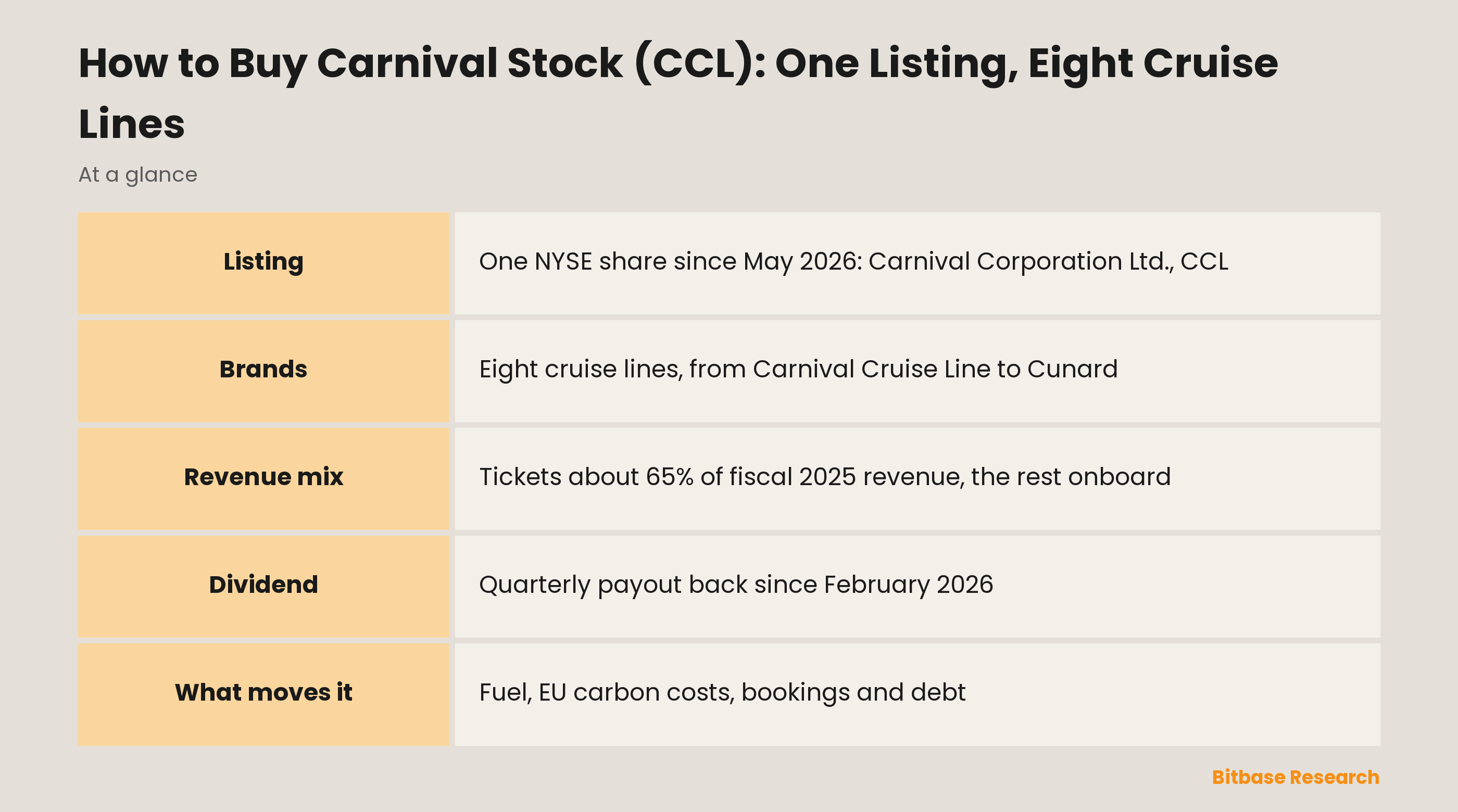
Every brokerage account that reaches the New York Stock Exchange can buy Carnival stock directly: since May 2026 the only listed Carnival shares have been the common shares of Carnival Corporation Ltd., ticker CCL. Until then Carnival had two parent companies, a second line in London and an ADS called CUK in New York, and annual reports up to fiscal 2025 still describe that setup. Below: the eight cruise lines, the order steps, the dividend that returned in early 2026, and the risks Carnival names in its own filings.
What Does Carnival Do?
Carnival sells cruise holidays, and in its own words it is "the largest global cruise company, and among the largest leisure travel companies." The fiscal 2025 annual report lists eight cruise lines. Carnival Cruise Line, Princess Cruises, Holland America Line and Seabourn are reported as the North America segment; AIDA Cruises, Costa Cruises, P&O Cruises and Cunard form the Europe segment. During 2025 the company retired the P&O Cruises (Australia) brand and folded its Australian operations into Carnival Cruise Line.
On 30 November 2025 the fleet counted 94 ships. Carnival Cruise Line alone held 35% of group passenger capacity and Princess 20%, so the North America brands together had 64% and the European brands 36%. The lines target different buyers, from value-minded families on Carnival Cruise Line to ultra-luxury guests on Seabourn; the 10-K calls AIDA the most recognized brand in the German cruise market. The group carried about 13.6 million passengers in 2025, roughly 8.1 million of them from the United States and Canada.
Seven more ships were on order at the end of fiscal 2025, due between 2027 and 2033 from Fincantieri in Italy and Meyer Werft in Germany: five for Carnival Cruise Line and two for AIDA. In September 2026 Carnival Cruise Line named the first ship of its next class Carnival Destiny, arriving in 2029.
Part of the product is on land. A Cruise Support segment runs the group's port destinations and private islands: Celebration Key on Grand Bahama, opened in July 2025, plus RelaxAway, Half Moon Cay and Princess Cays in the Bahamas, Amber Cove in the Dominican Republic, Grand Turk, Isla Tropicale in Honduras and Puerta Maya in Mexico. Those places welcomed 7.4 million guests in 2025, and Celebration Key alone received almost 2.5 million in its first year. A fourth segment, Tour and Other, holds Holland America Princess Alaska Tours.
The corporate history explains the ticker story. Carnival Corporation was incorporated in Panama in 1974 and Carnival plc in England and Wales in 2000. From 2003 the two operated as a dual listed company, "a single economic enterprise" with one executive team and identical boards but separate shareholders and stock exchange listings. That arrangement ended on 7 May 2026, when Carnival plc became a wholly owned UK subsidiary and Carnival Corporation moved its legal home from Panama to Bermuda under the name Carnival Corporation Ltd. Micky Arison has chaired the boards since 1990, and Josh Weinstein has been chief executive since 2022.
The 10-K names Royal Caribbean Group, Norwegian Cruise Line Holdings and MSC Cruises as its principal cruise competitors; together with Carnival they accounted for about 80% of industry capacity at the end of 2025. Our Royal Caribbean stock guide covers one of them.
How Carnival Makes Money
Passenger tickets brought in about 65% of fiscal 2025 revenues. The other line, onboard and other, covers drinks, internet packages, the casino, spas, shore excursions, specialty restaurants and shops, some sold through concessionaires that pay Carnival a percentage of their sales or a fee. According to the 10-K, it made up 34% of cruise revenues in 2025.
Fiscal 2025 revenues rose 6.4% to a record and operating income climbed 25%, leaving a full-year profit two years after a net loss in fiscal 2023. Interest expense fell 23%, which the company puts "substantially all" down to lower average rates, a smaller debt load and more capitalized interest. The segment note shows where the money came from:
| Segment | What it runs | Share of fiscal 2025 revenues | Operating income vs fiscal 2024 |
|---|---|---|---|
| North America | Carnival Cruise Line, Princess, Holland America, Seabourn | 66% | Up 24% |
| Europe | AIDA, Costa, P&O Cruises, Cunard | 32% | Up 20% |
| Cruise Support | Port destinations, private islands, shared services | 1% | Operating loss in 2023, 2024 and 2025 |
| Tour and Other | Holland America Princess Alaska Tours | 1% | Small operating profit |
Shares and changes are calculated from the 10-K segment note. Cruise Support's destinations are run "for the benefit of our cruise brands," so their value shows up mainly in what the ships can charge.
Counted by where guests are sourced, the United States produced 56% of fiscal 2025 revenues, Germany 13%, the United Kingdom 11% and all other countries 20%. That mix is why exchange rates matter: the European brands sell in euros and sterling, results are reported in dollars, and shipbuilding contracts are "typically denominated in euros."
Guests pay a deposit to book and the balance before sailing, so "substantially all of our passenger ticket receipts are collected in advance," which is why Carnival runs a large working capital deficit by design. Customer deposits at the end of fiscal 2025 were a year-end record, up nearly 7% on 2024.
Carnival's fiscal year ends on 30 November, and demand peaks in the third quarter, June to August, when, the 10-K says, "the largest share of our operating income is typically earned."
CCL Stock at a Glance
| Item | Detail |
|---|---|
| Exchange | New York Stock Exchange (NYSE) |
| Ticker | CCL |
| Security | Common shares of Carnival Corporation Ltd., the only class registered under Section 12(b) |
| Retired lines | Carnival plc in London, cancelled on 7 May 2026; its ADS, CUK, suspended on the NYSE the same day |
| Incorporated | Bermuda since 7 May 2026; Panama from 1974 until then |
| Headquarters | Miami, Florida |
| Sector | Leisure travel: cruises, port destinations, Alaska tours |
| Index membership | S&P 500 |
| Fiscal year | 1 December to 30 November |
| Dividend policy | Quarterly cash dividend, reinstated in December 2025 |
| Annual report | Form 10-K, filed jointly with Carnival plc through fiscal 2025 |
| SEC identifier | CIK 815097 |
Price, market value and yield are not in the table because they shift with each trade; the Carnival stock page on Bitbase carries them in real time.
How to Buy Carnival Stock
On the NYSE you buy the Bermuda parent's common share itself, not a depositary receipt, and since the unification there is no second Carnival share to weigh against it. The process:
1. Pick a broker with NYSE access. Abroad, that means a local firm offering US shares or an international broker; check who regulates it.
2. Get the account verified. Non-US individuals normally certify foreign status on IRS Form W-8BEN, which the IRS says to submit "when requested by the withholding agent or payer."
3. Deposit funds. Currency conversion has a cost, so compare rates as well as commissions.
4. Look up CCL. The result should read Carnival Corporation Ltd. common shares on the NYSE. A quote for CUK or the old London line refers to securities that no longer trade there.
5. Set the order type. FINRA says a market order "provides the most certainty that your order will be executed," while a limit order fills only "at or better than a specified price."
6. Choose the amount. Fractional shares let you invest a fixed sum, but some firms restrict them, and FINRA warns that "as a fractional share owner, you might not have shareholder voting rights."
7. File the paperwork. Confirmations and statements record your cost and later dividends.
If you held Carnival plc or CUK. Under the scheme of arrangement each Carnival plc ordinary share became one Carnival Corporation Ltd. common share, and when the deposit agreement with JPMorgan Chase Bank was terminated, ADSs were exchanged for common shares one-for-one. A former holder's account should now show CCL.
Dividend tax outside the United States. The tax section of the February 2026 shareholder proxy says a non-US holder "generally will not be subject to U.S. federal income tax or withholding tax on dividends paid on Carnival Corporation Ltd. Common Shares," unless the income is connected with a US trade or business. The same document says Bermuda's 2023 corporate income tax act contains no withholding tax and is not expected to affect holders. Your own country may still tax the payment.
Through index funds. State Street's SPY holdings file dated 6 November 2026 lists Carnival Corp Ltd, so funds tracking the S&P 500 hold it as one small position. The proxy also noted that once the London line went, the company would no longer be eligible for certain UK indices, including the FTSE UK Index Series.
What Moves CCL Stock
Fuel. Fuel took about 11% of fiscal 2025 cruise operating expenses. In the third quarter of fiscal 2026, fuel cost per metric ton, excluding emission allowances, was 36% higher than a year earlier; revenues still grew 3.5%, but operating income slipped 2%. The 10-Q warns that "any further disruptions or escalation could result in increased fuel costs." Fuel use per available lower berth day fell 3.8% in that quarter, the lever the company controls.
Carbon costs in Europe. Carnival became subject to the EU Emissions Trading System on 1 January 2024, with a three-year phase-in: the 2025 charge covered 70% of in-scope emissions, and from 2026 all in-scope emissions count.
Pricing, occupancy and the order book. Occupancy assumes two guests per cabin, so it can top 100%; it was 111.8% in the third quarter of fiscal 2026. Bookings are usually taken months ahead, so the order book signals results early: in September 2026 the company reported record third-quarter customer deposits and said 2027 was booked at record occupancy and prices.
Balance sheet and payouts. Total debt peaked in January 2023, and Carnival finished a large refinancing plan in December 2025. In the third quarter of fiscal 2026 S&P upgraded the company, the second agency to rate it investment grade, after which no secured debt remained. Cash is now going back to shareholders: the quarterly dividend resumed in February 2026, and a repurchase program announced in March 2026, with no expiration date, bought shares in each of June, July and August.
Islands and new ships. RelaxAway, Half Moon Cay and Isla Tropicale each welcomed more than 250,000 guests after their upgrades, a destination in Ensenada, Mexico is in development, and the next Carnival Cruise Line ship is due in April 2027.
Shocks to travel. For 2026 the company redeployed ships away from planned Arabian Gulf voyages and absorbed higher logistics costs linked to the Middle East conflict, and 35% of its 2026 capacity is scheduled in the Caribbean, where hurricanes hit itineraries and private islands alike.
Where Carnival's Own Filings See Trouble
Item 1A of the 10-K carries the full list, and the third-quarter 2026 10-Q reports "no material change to these risk factors since the Form 10-K filing." These bear most directly on a CCL share:
Incidents. "Our ships have been involved in outbreaks, accidents and other incidents in the past and we may experience similar or other incidents in the future."
Debt. "Our debt requires a significant amount of cash to service," and a covenant breach could trigger defaults; the 10-K also says that "despite our leverage, we may incur more debt in the future."
Fuel and emissions rules. "Emission penalties and the costs of compliant fuels may also increase our energy costs," and new rules could leave ships that miss certain standards unable to operate.
Bermuda law. Shareholder rights now follow the Bermuda Companies Act 1981 and the company's bye-laws, which the 10-K flagged as different "in some respects" from the old jurisdictions. Under Bermuda law a company may not pay a dividend if there are reasonable grounds to believe it would then be unable to pay its liabilities as they fall due.
Tax status. Section 883 of the Internal Revenue Code exempts qualifying non-US corporations, such as Carnival's North American cruise businesses, from US federal income tax on international shipping income, subject to conditions in Treasury regulations.
The stock adds two more. One company concentrates your money in a single discretionary purchase, and dividends depend on the board: under the bye-laws, each common share is entitled to dividends only "if, as and when dividends are declared."
How to Research CCL Yourself
Carnival files with the SEC under CIK 815097. The fiscal 2025 10-K, the last filed jointly with Carnival plc, came out on 27 January 2026. The third-quarter 10-Q followed on 29 September 2026 under the new name, on the same day as the 8-K carrying the earnings release. For the unification, read the February 2026 proxy statement, the 8-K of 7 May 2026 and the Form 8-A amendment filed that day, which describes the shares under Bermuda law.
In the 10-K, Item 1 lists capacity, ships and orders by brand, and the segment note sets revenue and operating income for the four segments side by side; each 10-Q adds a statistics table with occupancy and fuel cost per metric ton. The consolidated statements already combined both companies before May 2026, so revenue and profit trends run across the change; only the equity statement from 31 May 2026 shows Carnival Corporation Ltd. alone.
For live prices, use the CCL page linked in the table section; Bitbase's index of US stock pages leads to the rest of the market.
Carnival Stock FAQ
Can I buy Carnival stock with crypto?
Not directly. Brokers sell CCL for US dollars, so crypto has to be sold for cash and moved to the brokerage first, and that sale can create a tax bill where you live. The two holdings are also different in kind: a CCL share is a registered stake in a Bermuda company with rights set by its bye-laws, which is how a share differs from a crypto asset.
Does Carnival pay a dividend?
Yes, again. Carnival paid no dividend for fiscal 2025; in December 2025 the boards reinstated the quarterly dividend, first paid on 27 February 2026, and three payments followed in the first nine months of fiscal 2026. Check the latest earnings release for amounts.
What happened to Carnival plc and the CUK shares?
On 7 May 2026 Carnival plc's London listing was cancelled and the CUK shares were suspended on the NYSE before the open. Carnival plc holders received one Carnival Corporation Ltd. share for each share, ADS holders were exchanged one-for-one, and Carnival plc, now Carnival UK Ltd., filed to deregister with the SEC on 18 May 2026.
Is CCL in the S&P 500?
Yes. State Street's SPY holdings file dated 6 November 2026 includes Carnival Corp Ltd under CCL.
Where is Carnival incorporated?
In Bermuda since 7 May 2026, as an exempted company limited by shares; before that it was a Panama company. Head office remains in Miami, and it files 10-K, 10-Q and 8-K reports with the SEC.
Conclusion
Carnival in late 2026 is simpler to own than it was a year earlier: one share, one exchange and one Bermuda parent above the same eight cruise lines and private islands. What has not changed is the economics underneath, where fuel and European carbon costs, pricing on bookings taken months ahead, and a balance sheet that has only recently returned to investment grade decide how much reaches shareholders. Read the latest 10-K and 10-Q alongside the May 2026 unification filings, and size any position as a bet on one discretionary travel business.
Related reading
Other Bitbase articles on this topic:
- How to Buy AutoZone Stock (AZO): Mega Hubs, Buybacks, No Dividend
- How to Buy Chipotle Stock (CMG): No Dividend, a 50-for-1 Split
- How to Buy Copart Stock (CPRT): Salvage Auctions, ACV and Splits
- How to Buy Las Vegas Sands Stock (LVS): Macao, Singapore, No Vegas
Disclaimer: This article is educational content from Bitbase Academy, provided for information only. It explains what a company or fund does and how the instruments referenced here differ from one another; it does not constitute investment, trading, tax, or financial advice, and it is neither a recommendation nor an endorsement of any security, token, or trading strategy. A tokenized stock is issued by a third party and is designed to give economic exposure to an underlying asset: it is not a share, it carries no shareholder rights, and it depends on the issuer's structure, eligibility rules, and redemption terms, which the issuer can change. Perpetual futures are leveraged derivatives that hold no underlying asset and can be liquidated, and trading hours, product availability, and eligibility differ by instrument and by jurisdiction and can change at any time. Written as of November 2026; verify everything yourself through company filings, the issuer's own documentation, and the product pages of the venue you trade on.
References
[1] Carnival Form 10-K for fiscal 2025 (SEC EDGAR) www.sec.gov
[2] Carnival fiscal 2025 Form 10-K, XBRL segment data (SEC EDGAR) www.sec.gov
[3] Carnival Corporation Ltd. Form 10-Q for the third quarter of fiscal 2026 (SEC EDGAR) www.sec.gov
[4] Carnival Corporation Ltd. Form 10-Q, XBRL cover page (SEC EDGAR) www.sec.gov
[5] Carnival third-quarter 2026 earnings release, filed with Form 8-K (SEC EDGAR) www.sec.gov
[6] Carnival Form 8-K of 7 May 2026: DLC unification and move to Bermuda completed (SEC EDGAR) www.sec.gov
[7] Carnival Corporation Ltd. Form 8-A/A: description of common shares under Bermuda law (SEC EDGAR) www.sec.gov
[8] Carnival joint proxy statement on the DLC unification, February 2026 (SEC EDGAR) www.sec.gov
[9] State Street SPDR S&P 500 ETF Trust (SPY): fund page and daily holdings www.ssga.com
[10] FINRA: Order Types www.finra.org
[11] FINRA: Investing in Fractional Shares www.finra.org
[12] IRS: About Form W-8 BEN www.irs.gov





