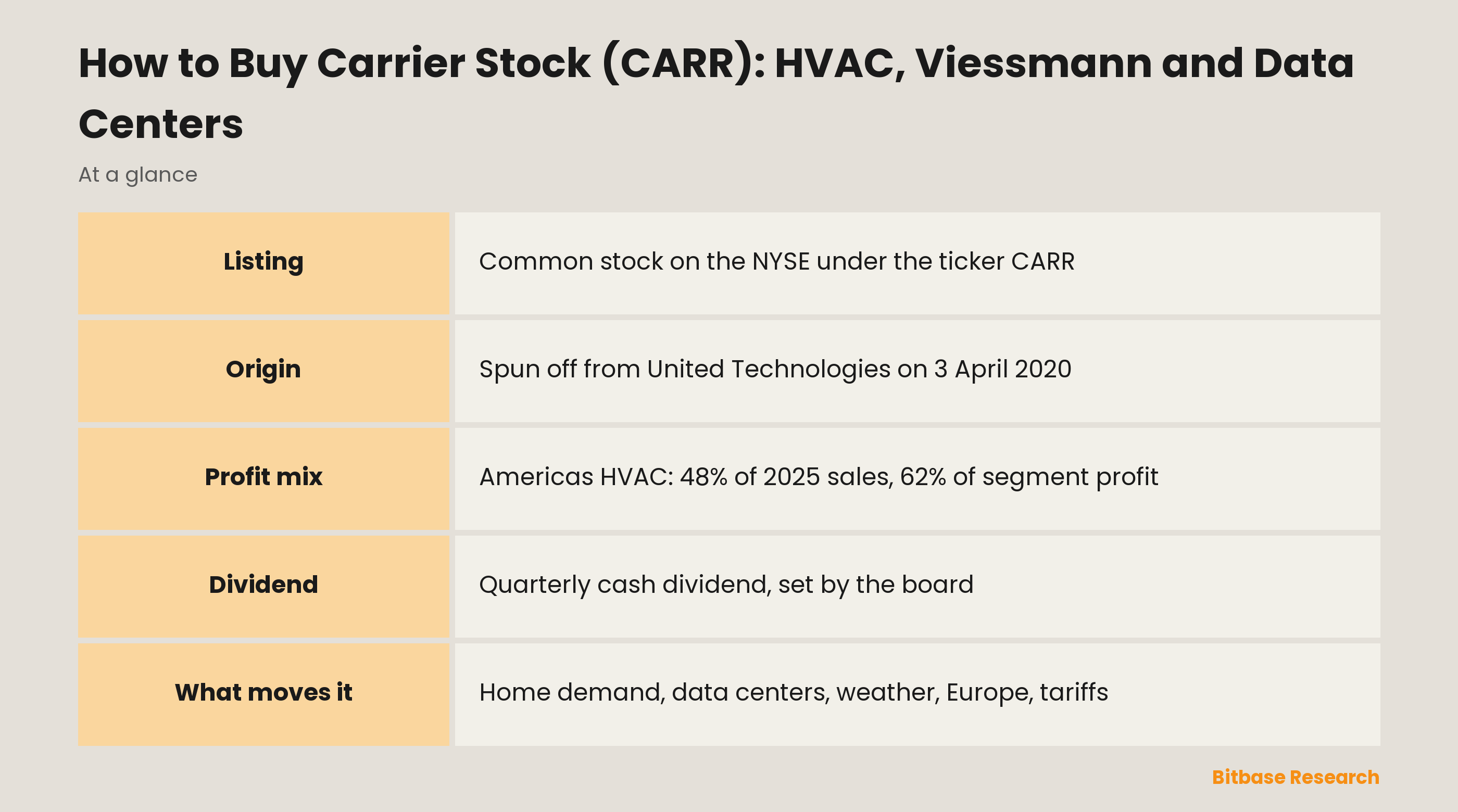
An order for Carrier stock goes through any broker that reaches the New York Stock Exchange, where the common shares trade under the ticker CARR. The company has existed on its own only since 3 April 2020, when United Technologies spun it off, and it has since sold its fire and security businesses and bought Viessmann's climate business in Germany. In 2025 its Americas HVAC segment brought in 48% of net sales but 62% of segment operating profit. Below: what Carrier sells, how a purchase works, and what its filings say moves the shares.
What Does Carrier Do?
Carrier makes heating, ventilation and air conditioning (HVAC) equipment, refrigeration units for trucks, trailers and shipping containers, and the controls and services that go with them. Its 10-K calls the company "a global leader in intelligent climate and energy solutions," with brands that include Carrier, Viessmann, Toshiba, Automated Logic and Carrier Transicold. Around the equipment it sells building services: "audit, design, installation, system integration, repair, maintenance and monitoring."
The listed company is young. Carrier Global Corporation was incorporated in Delaware on 15 March 2019, and on 3 April 2020 United Technologies Corporation, since renamed RTX, completed its spin-off through a one-for-one distribution of Carrier shares to UTC shareowners. The same separation split UTC into three independent public companies, the third being Otis. Carrier is headquartered in Palm Beach Gardens, Florida.
Since then the portfolio has been rebuilt. On 2 January 2024 Carrier acquired the climate solutions business of Viessmann Group, a residential and light commercial HVAC provider in Europe reported mainly in the Climate Solutions Europe segment. During 2024 it also divested its commercial and residential fire, access solutions, industrial fire and commercial refrigeration businesses. The 10-K says the aim was to transform Carrier into "a pure-play climate and energy solutions provider." Two more exits followed in 2026: the Riello burner and boiler business was sold on 1 July, and the NORESCO energy services business on 3 August.
The four reporting segments, introduced in 2025, divide the HVAC business by region and keep transport refrigeration separate:
Climate Solutions Americas (CSA) sells air conditioners, heat pumps, heating systems, controls, aftermarket parts and service to homes and commercial buildings in North and South America.
Climate Solutions Europe (CSE) does the same in Europe, where the Viessmann business is mainly reported.
Climate Solutions Asia Pacific, Middle East & Africa (CSAME) covers the remaining regions, including China.
The three regional segments share a set of brands: Carrier, Viessmann, Toshiba, Automated Logic, Bryant, CIAT, Day & Night, Heil and, until its sale, NORESCO.
Climate Solutions Transportation (CST) makes refrigeration units for trucks, trailers, shipping containers and intermodal transport under Carrier Transicold, plus Sensitech cargo monitoring.
Customers range across homes, offices, schools, hospitals, retailers and data centers. Products are sold directly to contractors and building owners and indirectly through joint ventures, distributors, wholesalers and dealers. The 10-K says the loss of any individual contract or customer "would not have a material adverse effect on our results." The company held about 11,000 active patents and pending applications and had about 47,000 employees at the end of 2025.
How Carrier Makes Money
Net sales fell 3% in 2025, and organic sales, which strip out currency and acquisitions, fell 1%. By segment, the year looked like this:
| Segment | Share of 2025 net sales | Share of 2025 segment operating profit | Segment margin 2025 |
|---|---|---|---|
| Climate Solutions Americas | 48% | 62% | 20.5% |
| Climate Solutions Europe | 23% | 13% | 8.8% |
| Climate Solutions Asia Pacific, Middle East & Africa | 15% | 13% | 13.4% |
| Climate Solutions Transportation | 13% | 13% | 15.6% |
Profit shares are calculated from the segment note in the 10-K. Segment operating profit is the measure Carrier's management uses; it excludes restructuring costs, amortization of acquired intangibles and other items the company treats as nonoperational, so it is higher than GAAP operating profit.
The table shows where the earnings sit. The Americas segment earns most of the profit at the highest margin, while Europe, the region Carrier paid for with the Viessmann deal, contributes almost a quarter of sales but about an eighth of segment profit.
Most revenue comes from selling equipment. In 2025, new equipment made up 72% of net sales and parts and service 28%. The company wants that second share to grow: its strategy centres on "digitally-enabled lifecycle solutions" that keep it connected to a unit after it is installed, through platforms such as Abound for buildings and Lynx, developed with Amazon Web Services, for the cold chain. International operations, including US export sales, accounted for about 52% of 2025 net sales.
Inside the Americas, 2025 was split. Residential volume fell 9%, which the 10-K puts down to reduced demand and "distributor destocking," and light commercial fell 20%, while the commercial business grew 23%. In Asia, sales in China fell 12% as residential markets weakened. Transportation's container business rose 31%, although segment sales dropped 17% overall, mostly because commercial refrigeration was sold in October 2024.
CARR Stock at a Glance
| Feature | CARR |
|---|---|
| Exchange | New York Stock Exchange |
| Ticker | CARR |
| Security | Common stock; the 10-K cover also registers three series of Carrier notes on the NYSE |
| Sector | HVAC, building controls and transport refrigeration |
| Main brands | Carrier, Viessmann, Toshiba, Automated Logic, Bryant, Carrier Transicold |
| Index membership | S&P 500 |
| Headquarters | Palm Beach Gardens, Florida |
| Incorporated | Delaware, 2019 |
| Listed since | Spin-off from United Technologies, 3 April 2020 |
| Fiscal year | Calendar year, ending 31 December |
| Dividend | Quarterly cash dividend, declared at the board's discretion |
| SEC identifier | CIK 1783180 |
Prices, market value and dividend yield change every trading day; for live data, see the Carrier stock page on Bitbase.
How to Buy Carrier Stock
Carrier is a Delaware corporation listed in New York, so there is no depositary receipt to think about: the shares that trade as CARR are the common stock itself. A purchase at a broker usually runs in seven steps:
1. Pick a broker with NYSE access. Outside the United States, that may be a local broker with US market access or a global platform; check which legal entity holds your account and who regulates it.
2. Open the account and pass verification. Investors outside the US normally certify their status on IRS Form W-8BEN, which the IRS says to submit "when requested by the withholding agent or payer."
3. Fund it. Money sent in another currency is converted to dollars, so compare the exchange rate as well as the commission.
4. Find the right line. Search CARR and confirm the result is Carrier Global Corporation common stock on the NYSE. The bonds listed under CARR28, CARR32 and CARR37 are debt, not shares.
5. Choose an order type. FINRA explains that a market order "provides the most certainty that your order will be executed," while a limit order executes only "at or better than a specified price."
6. Decide on size. Fractional shares let you invest a fixed amount, but some brokers limit them to "large-cap stocks or ETFs" or do not offer them, and FINRA notes that "as a fractional share owner, you might not have shareholder voting rights."
7. Keep the records. Confirmations and statements show your cost basis and the dividends credited to you.
Tax for investors abroad. According to the IRS, "most types of U.S. source income received by a foreign person are subject to U.S. tax of 30%," and a tax treaty can lower that rate or remove it, which is why brokers ask for the W-8BEN. Your home country may tax the same dividends again.
Through funds. Carrier is a member of the S&P 500, and on 6 November 2026 it was listed in the daily SPY holdings file that State Street publishes, so S&P 500 index funds hold it as one small position among about five hundred companies.
What Moves CARR Stock
Residential replacement demand. Homes are the swing factor in the Americas segment. After residential volume fell 9% in 2025, it rose 34% in the third quarter of 2026, which the 10-Q attributes to "strong end-market demand and pricing improvements." Segment organic sales grew 25% in that quarter.
Data centers and commercial orders. Carrier markets an integrated cooling offer for data centers called QuantumLeap, which combines traditional and liquid cooling with building and server management systems. In its third-quarter 2026 release the company reported organic orders up about 35%, data center orders up about 300% and backlog up 60% from a year earlier, and said it had signed long-term agreements with minimum volume commitments. Orders turn into sales over time, and the release is the company's own account.
Weather and season. The 10-K says HVAC demand "is seasonal and affected by the weather": cool summers depress sales of replacement air conditioning, and warm winters do the same for heating. Residential sales are usually higher in the second and third quarters, so one quarter says little about a full year.
Europe and the heat-pump transition. In the third quarter of 2026 Carrier recorded a non-cash goodwill impairment for its Climate Solutions Europe reporting unit, which turned the quarter's GAAP operating result into a loss. The 10-Q lists the drivers: weaker demand "driven in part by government policies and subsidies, a change in the pace of transition from boilers to heat pumps, an increase in interest rates" and other macroeconomic conditions. In the same quarter, Europe's organic sales rose 12%, with residential heat pumps and air conditioning up about 35% each while boilers declined.
Tariffs and refunds. The 10-K says Carrier fully mitigated the impact of tariffs in 2025 through supply-chain changes, productivity and price increases. After the US Supreme Court ruled in February 2026 that tariffs imposed under the International Emergency Economic Powers Act were unauthorized, Carrier recognized refunds of those tariffs in the third quarter of 2026, mostly as a reduction in cost of products sold. The release still lists rising input costs and tariffs among its pressures.
Portfolio moves. Each sale or purchase changes the comparison base. Riello and NORESCO leave the 2026 numbers part-way through the year, so read organic growth rather than reported growth when you compare periods.
Weather, Refrigerant Rules and AFFF Lawsuits at Carrier
Item 1A of the 10-K runs to dozens of risk factors. These are the ones that bear most directly on CARR:
Climate regulation. Rules that curtail "high global warming potential refrigerants," such as the Kigali Amendment and the US AIM Act, along with shifts away from fossil fuels "including natural gas prohibitions," may "render our existing technology, particularly some of our HVAC and refrigeration products, non-compliant or obsolete."
Supply and costs. Carrier buys copper, aluminum, steel, motors, valves and semiconductors, and some proprietary parts come from single suppliers. The 10-K warns that "price increases, duties, tariffs or other government actions could increase our operating costs."
Acquisitions. On deals such as Viessmann, the company says it "may not realize, and [has] sometimes not realized, the degree or timing of benefits or cost synergies" it expected. The 2026 Europe impairment is one sign of that risk.
AFFF litigation. Kidde-Fenwal, a Carrier subsidiary acquired with the 2020 separation, owned the National Foam business, which made firefighting foam, until 2013. As of 30 September 2026, Carrier, Kidde-Fenwal and others were defendants in more than 18,000 lawsuits claiming that the foam caused personal injuries and contaminated property and water. Kidde-Fenwal filed for chapter 11 in May 2023, and Carrier has proposed settlement agreements; on 10 September 2026 the court in the federal multidistrict case preliminarily approved the one with public water providers. For the remaining claims, Carrier says it is "unable to assess the probability of liability or to reasonably estimate a range of possible loss."
Antitrust claims. Since March 2026 Carrier and other HVAC manufacturers have been named in proposed class actions alleging a price-fixing agreement in the United States since 1 January 2020. Carrier says the allegations lack merit and filed motions to dismiss on 9 October 2026.
Debt and ratings. Carrier carries investment-grade ratings from Moody's and S&P, and its 10-K warns that a downgrade "could increase our borrowing costs." It sold new notes in November 2026, partly to repay notes due in 2027.
Two risks belong to the share itself. A single stock ties your outcome to one company. And the dividend can change: Carrier says dividends "may be discontinued, accelerated, suspended or delayed at any time without prior notice."
How to Research CARR Yourself
Carrier files with the SEC under CIK 1783180. The 10-K for 2025 was filed on 5 February 2026, 10-Qs follow each of the first three quarters, and each earnings release arrives as an 8-K; in 2026 those came on 5 February, 30 April, 28 July and 29 October.
In the 10-K, Item 1 describes the four segments and the brands, Item 1A the risks, Item 5 the listing and the five-year return comparison with the S&P 500, and the MD&A breaks segment sales into end markets such as residential, light commercial and commercial. The 10-Q legal note tracks the AFFF and antitrust cases quarter by quarter. Compare organic growth, because acquisitions and sales have moved the reported totals every year since 2023.
Peers help with context. Trane Technologies and Johnson Controls also sell HVAC equipment and building controls; see our Trane Technologies stock guide and Johnson Controls stock guide. Live quotes are on the Carrier page linked above, and Bitbase's US stock pages cover other listed companies.
Carrier Stock FAQ
Can I buy Carrier stock with crypto?
Not directly. You buy CARR shares in US dollars through a brokerage account, which means selling crypto for cash and moving the money to the broker first; that sale can create a tax bill in your country. A share carries dividend and voting rights in a registered company, which is how a stock differs from a crypto asset.
Does Carrier pay a dividend?
Yes, quarterly. In October 2026 the board declared the next quarterly cash dividend, payable on 18 November 2026. Amounts and timing are set by the board and can change, so check the latest 10-Q or press release.
Is CARR in the S&P 500?
Yes. The 10-K states that Carrier's common stock "is a component of the S&P 500 Index," and the company appeared in State Street's SPY holdings file dated 6 November 2026.
When did Carrier become a separate company?
On 3 April 2020, when United Technologies distributed all Carrier shares to its own shareowners, one Carrier share for each UTC share held at the close of business on 19 March 2020. Otis was spun off at the same time, and UTC is now RTX.
What brands does Carrier own?
In HVAC: Carrier, Viessmann, Toshiba, Automated Logic, Bryant, CIAT, Day & Night and Heil. In transport refrigeration and monitoring: Carrier Transicold and Sensitech. Riello and NORESCO were sold in 2026.
Conclusion
The AFFF cases tied to a subsidiary's old foam business still follow Carrier, a company listed only six years ago that has since reshaped itself around HVAC and earns most of its profit in the Americas. Add the goodwill impairment it took in Europe, and the company needs far more study than the order does. Work through the most recent 10-K and 10-Q, compare segment results across a full season, and decide how much one climate equipment maker should weigh in your portfolio.
Related reading
Other Bitbase articles on this topic:
- How to Buy AerCap Stock (AER): Jet Leasing and Dividend Tax
- How to Buy Agilent Stock (A): CrossLab, Ticker A and Dividends
- How to Buy Comfort Systems Stock (FIX): Data Centers and Backlog
- How to Buy L3Harris Stock (LHX): Rocket Motors, Radios, Satellites
Disclaimer: This article is educational content from Bitbase Academy, provided for information only. It explains what a company or fund does and how the instruments referenced here differ from one another; it does not constitute investment, trading, tax, or financial advice, and it is neither a recommendation nor an endorsement of any security, token, or trading strategy. A tokenized stock is issued by a third party and is designed to give economic exposure to an underlying asset: it is not a share, it carries no shareholder rights, and it depends on the issuer's structure, eligibility rules, and redemption terms, which the issuer can change. Perpetual futures are leveraged derivatives that hold no underlying asset and can be liquidated, and trading hours, product availability, and eligibility differ by instrument and by jurisdiction and can change at any time. Written as of November 2026; verify everything yourself through company filings, the issuer's own documentation, and the product pages of the venue you trade on.
References
[1] Carrier Form 10-K for 2025 (SEC EDGAR) www.sec.gov
[2] Carrier 2025 Form 10-K, XBRL cover page (SEC EDGAR) www.sec.gov
[3] Carrier 2025 Form 10-K, XBRL segment data (SEC EDGAR) www.sec.gov
[4] Carrier Form 10-Q for the third quarter of 2026 (SEC EDGAR) www.sec.gov
[5] Carrier third-quarter 2026 earnings release, filed with Form 8-K (SEC EDGAR) www.sec.gov
[6] Carrier Form 8-K on the November 2026 notes offering (SEC EDGAR) www.sec.gov
[7] State Street SPDR S&P 500 ETF Trust (SPY): fund page and daily holdings www.ssga.com
[8] FINRA: Order Types www.finra.org
[9] FINRA: Investing in Fractional Shares www.finra.org
[10] IRS: NRA Withholding www.irs.gov
[11] IRS: About Form W-8 BEN www.irs.gov





