
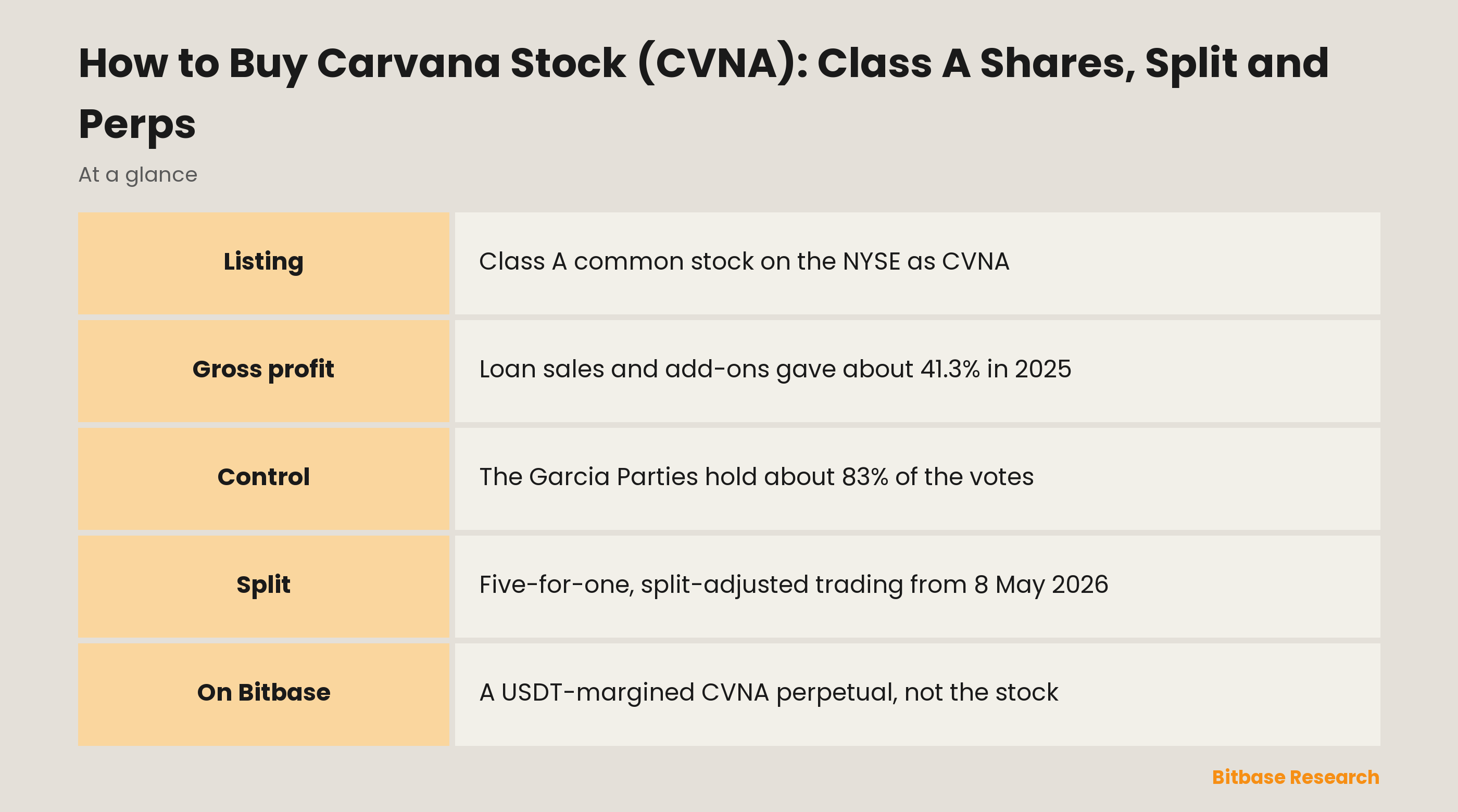
Whatever broker you use, buying Carvana stock comes down to one order for CVNA, the Class A common stock listed on the New York Stock Exchange; the Class B shares are not listed anywhere. Carvana sells used cars online and earns a substantial portion of its gross profit by selling the car loans it writes, while Ernest Garcia II and his son, chief executive Ernest Garcia III, control about 83% of the votes. On Bitbase, CVNA is a USDT-settled perpetual that tracks the price and conveys no ownership.
What Does Carvana Do?
Carvana describes itself as "the leading e-commerce platform for buying and selling used cars." The business is vertically integrated: it buys vehicles from consumers through an automated online offer, from auctions and from wholesale suppliers, reconditions them at its own sites, photographs each for a 360-degree virtual tour and sells it online with its own financing. Buyers can add a vehicle service contract (VSC), GAP waiver coverage on a Carvana loan, or auto insurance through Root. A Carvana employee typically delivers the car on a branded hauler, or the buyer collects it from one of 39 multi-story glass "vending machines", and a seven-day return policy applies.
At the end of 2025 its delivery network served more than 80% of the US population, its sites could recondition about 1.5 million cars a year at full utilization, and it had more than 23,100 employees.
Carvana began in 2012, and until 1 November 2014 Carvana, LLC was a wholly owned subsidiary of DriveTime, which Ernest Garcia II controls; the filings call him, his son and the entities they control the Garcia Parties. Carvana Co. was formed in Delaware on 29 November 2016 as the holding company for the initial public offering, which priced on 27 April 2017. Headquarters are in Tempe, Arizona.
In 2022 Carvana bought the US physical auction business of ADESA from KAR Auction Services, closing on 9 May. The deal added 56 locations, 16 of which had been fitted out to recondition retail cars by the end of 2025.
The 10-K names competitors from CarMax and CarGurus to carmakers such as Ford, Toyota and Tesla, and, citing Cox Automotive data on 2024 transactions, estimates its own share of the US used retail market at roughly 1.6%.
How Carvana Makes Money
Carvana reports one segment with three revenue lines. Retail vehicle sales are cars sold to consumers. Wholesale sales and revenues cover vehicles sold on to other buyers, including those that miss its retail standards, plus fees on a wholesale marketplace that handled 1,006,551 units in 2025. Other sales and revenues are chiefly gains on selling the loans it originates, VSC commissions, GAP waiver sales and auto insurance.
In 2025 total revenue rose 48.6%. Retail vehicle sales made up about 71.5% of it, wholesale about 19.9% and other sales about 8.5%. Retail units rose 43.3% to 596,641, and wholesale units 49.0% to 297,643.
Gross profit is split very differently. Carvana treats other sales and revenues as 100% gross margin products, so that line's revenue and gross profit are the same figure, and in 2025 it produced about 41.3% of total gross profit, against about 47.2% from retail vehicles and 11.5% from wholesale.
Loans sit at the centre of it. Carvana generally sells the loans it originates to securitization trusts it sponsors or to financing partners such as Ally. The proceeds "account for a substantial portion of our gross profit," the 10-K says, and their price depends on credit risk, the gap between the rate quoted to the customer and market rates at the time of sale, forecast losses and demand for asset-backed securities.
CVNA Stock at a Glance
| Item | Detail |
|---|---|
| Exchange | New York Stock Exchange |
| Ticker | CVNA |
| Listed share class | Class A common stock; Class B is neither listed nor traded |
| Structure | Holding company owning units of Carvana Group, LLC, the operating business |
| Voting | One vote per Class A share; ten per Class B share held by the Garcia Parties |
| Industry | Online used-car retail |
| Index membership | S&P 500, per SPY holdings on 29 October 2026 |
| Headquarters | Tempe, Arizona |
| Incorporated | Delaware, November 2016 |
| IPO | Priced on 27 April 2017 |
| Fiscal year end | 31 December |
| Dividend policy | No cash dividend; none anticipated in the foreseeable future |
| Stock split | Five-for-one, split-adjusted trading from 8 May 2026 |
Live prices and the chart are on the Carvana stock page on Bitbase.
How to Buy Carvana Stock
Through a broker, the steps are:
1. Choose a broker with NYSE access that takes clients from your country.
2. Open and verify the account. The IRS tells a foreign person to give Form W-8BEN to the withholding agent or payer when asked, so non-US residents should expect it.
3. Fund the account. Converting another currency into US dollars is part of the cost.
4. Search for CVNA. Only Class A trades, so there is no class to choose.
5. Set the order type and size. A market order executes at whatever price is available; a limit order names your maximum and can go unfilled. Fractional shares depend on the broker.
6. Let corporate actions arrive on their own. In the May 2026 split, each share was automatically subdivided into five.
Outside the US, CVNA is still a Delaware company's Class A common stock, not a depositary receipt, so there is no ADR ratio. Tax depends on where you live; this is general information, not tax advice.
Class B is not a second way in. It trades on no exchange and has no right to dividends or liquidation proceeds; pre-IPO owners can exchange it, together with 1.25 times as many Carvana Group units, for Class A shares or cash at the company's choice.
Through a fund, an S&P 500 index fund gives indirect exposure to a small slice of CVNA.
Trading CVNA on Bitbase
Bitbase lists a CVNA perpetual futures contract, margined and settled in USDT, that tracks the price of Carvana's Class A shares. It is a contract, not a stake: no share, no vote, no claim on Carvana Group.
In return it has no expiry date, so a position stays open until it is closed or liquidated; shorting works the same way as buying; leverage enlarges both outcomes; and it keeps trading while the NYSE is shut, overnight, at weekends and on US holidays.
At set intervals a funding payment flows from the more crowded side, long or short, to the other, which pulls the contract toward the stock. If losses run the margin down too far, the position is liquidated, judged on the mark price rather than the latest trade. Carvana news released while the exchange is closed can move the perpetual first, and the shares may open somewhere else. The stock perpetual futures guide explains the mechanics.
The CVNA contract rules set the funding interval and formula, the margin tiers and maximum leverage, and the handling of mark price and funding outside NYSE hours; read them before trading. Bitbase's TradFi page lists the other stock-linked markets.
What Moves CVNA Stock
Retail units. The 10-K calls retail vehicle unit sales "the foundation of our business," since each sale can bring a loan, a service contract and a trade-in.
The car-loan market. Loan-sale gains sit inside the line that produced about 41.3% of 2025 gross profit and move with interest rates, expected losses and investor appetite; the risk factors cite "widening credit spreads".
Used-car prices. Higher prices or monthly payments, "including as a result of increased interest rates," make cars harder to afford, while falling prices bring markdown risk.
The calendar. Used-car sales usually peak late in the first quarter and bottom out in the fourth, and used cars lose value faster in the fourth and first quarters.
The debt stack. Under a transaction support agreement signed on 17 July 2023 with the Garcia Parties and holders of more than 90% of its unsecured notes, Carvana swapped most of them for secured notes due in 2028, 2030 and 2031, with interest partly payable in kind. In August 2026 a senior secured term loan maturing in 2033, plus cash on hand, redeemed the 2030 notes in full.
New shares. Class A supply grows through at-the-market sales, unit exchanges and incentive plans, and such sales, or the expectation of them, "could lower our stock price." Exchanges also feed the tax receivable agreement, which pays LLC unitholders 85% of certain tax benefits Carvana realizes.
The Fine Print Behind a CVNA Position
Loan sales. "Any material decline in automotive finance receivables sold or the prices at which they are sold would result in the loss of a historically significant portion of our gross profits."
Leverage. The 10-K calls its indebtedness substantial and says it could require "a substantial portion of our cash flow from operations" for debt payments. Some of it floats with SOFR or other market rates.
Control. The Garcia Parties "have the ability to elect all of the members of our Board," and their voting majority makes Carvana a controlled company under NYSE rules, though it does not currently use the exemptions. It also relies on DriveTime for services such as VSC administration and loan servicing, under arrangements that "cannot be assumed to have been negotiated at arm's length."
Structure. Payments under the tax receivable agreement can be accelerated and "may also significantly exceed the actual tax benefits that we ultimately realize."
The stock. With no dividend, any return "is solely dependent upon the appreciation of the price of our Class A common stock on the open market, which may not occur."
The perpetual. Leverage scales up a loss, funding is charged for as long as the position stays open, and a gap at the NYSE open can carry a CVNA position past its liquidation price.
How to Research CVNA Yourself
Carvana files with the SEC under CIK 1690820. The 2025 10-K, filed on 18 February 2026, holds the business, the risk factors, the revenue and gross-profit table and a chart of who owns Carvana Group. 10-Qs update debt and split-adjusted share counts, 8-Ks carry quarterly results and the split, and the proxy statement covers the Garcia Parties' holdings and DriveTime agreements. investors.carvana.com republishes the filings.
Carvana Stock FAQ
Does Carvana pay a dividend?
No. It declared no cash dividend on its Class A stock in 2025 and does not currently anticipate paying one in the foreseeable future; any change would be the board's decision. Class B shares have no dividend right.
Has Carvana stock split?
Yes. On 5 May 2026 stockholders approved a five-for-one forward split of both share classes. Holders of record on 6 May received four extra shares per share, and CVNA began trading on a split-adjusted basis on 8 May 2026. Older filings show pre-split share counts.
Why does Carvana have Class A and Class B shares?
Because of how it went public. Carvana Co. is a holding company whose only material asset is its stake in Carvana Group, LLC: a 64.7% economic interest at the end of 2025, with other unitholders holding 35.3%. Class A is the listed stock. Class B shares, paired with units held by pre-IPO owners, carry votes but no economic rights; in the Garcia Parties' hands each has ten votes while they own at least 25% of the Class A stock on an as-exchanged basis.
Can I buy Carvana stock with crypto?
Not directly. A broker sells CVNA shares for US dollars, so crypto would have to be converted into dollars first. On Bitbase, a USDT balance can go into the CVNA perpetual, which follows the share price but as a derivative is not stock: it holds no share, has no vote and can be liquidated. A side-by-side of the options is in buying stocks with crypto.
Is Carvana in the S&P 500?
Yes, judging by fund holdings: SPY, the fund that tracks the S&P 500, listed CVNA among its holdings on 29 October 2026. Index lists change, so check a current holdings file.
Conclusion
Buying CVNA is a routine NYSE order. The listed shares sit on a holding company, a family with about 83% of the votes and a business whose gross profit depends substantially on selling car loans, with debt restructured in 2023 and partly refinanced in 2026. The Bitbase perpetual stands apart: a leveraged contract that tracks the price and owns no part of Carvana.
Related reading
Other Bitbase articles on this topic:
- How to Buy Airbnb Stock (ABNB): Class A Votes, Fees, City Rules
- How to Buy Booking Holdings Stock (BKNG): The 25-for-1 Split
- How to Buy Ferrari Stock (RACE): Dual Listing and Loyalty Votes
- How to Buy Ross Stores Stock (ROST): Off-Price, No Online Store
Disclaimer: This article is educational content from Bitbase Academy, provided for information only. It explains what a company or fund does and how the instruments referenced here differ from one another; it does not constitute investment, trading, tax, or financial advice, and it is neither a recommendation nor an endorsement of any security, token, or trading strategy. A tokenized stock is issued by a third party and is designed to give economic exposure to an underlying asset: it is not a share, it carries no shareholder rights, and it depends on the issuer's structure, eligibility rules, and redemption terms, which the issuer can change. Perpetual futures are leveraged derivatives that hold no underlying asset and can be liquidated, and trading hours, product availability, and eligibility differ by instrument and by jurisdiction and can change at any time. Written as of October 2026; verify everything yourself through company filings, the issuer's own documentation, and the product pages of the venue you trade on.
References
[1] Carvana Form 10-K for 2025 (SEC EDGAR) www.sec.gov
[2] Carvana Form 10-Q, third quarter of 2026 (SEC EDGAR) www.sec.gov
[3] Carvana Form 8-K, May 2026: five-for-one stock split (SEC EDGAR) www.sec.gov
[4] Carvana 2026 proxy statement (SEC EDGAR) www.sec.gov
[5] Carvana Form 8-K, May 2022: ADESA US auction business acquired (SEC EDGAR) www.sec.gov
[6] Carvana Form 8-K, July 2023: transaction support agreement (SEC EDGAR) www.sec.gov
[7] Carvana Form 8-K, August 2023: exchange offers settled (SEC EDGAR) www.sec.gov
[8] Carvana Form 8-K, August 2026: term loan credit agreement (SEC EDGAR) www.sec.gov
[9] Carvana Form 8-K, April 2017: IPO pricing (SEC EDGAR) www.sec.gov
[10] State Street: SPY daily holdings, 29 October 2026 www.ssga.com
[11] IRS: About Form W-8 BEN www.irs.gov





