
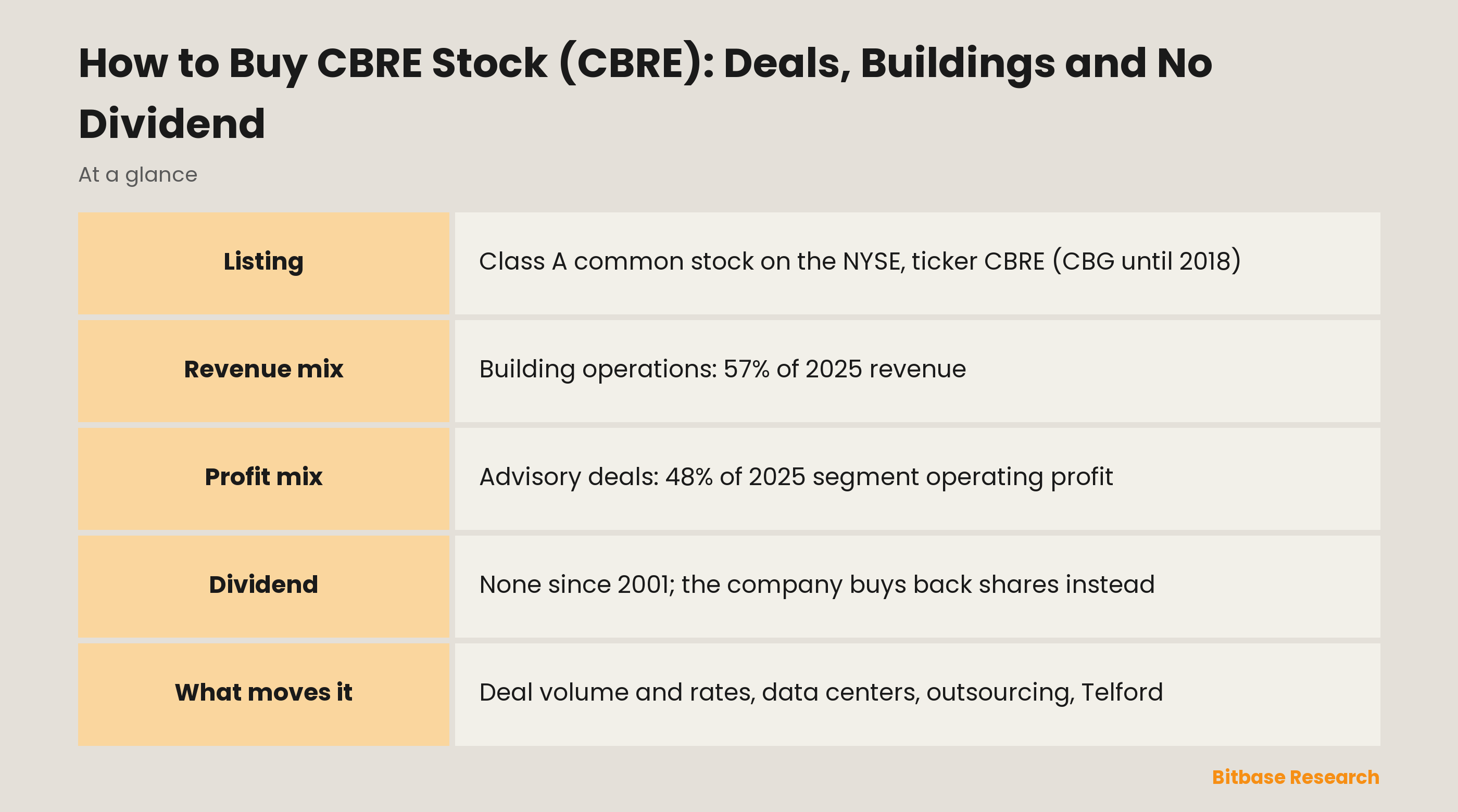
CBRE is listed on the New York Stock Exchange under the ticker CBRE, so any broker offering US shares can fill an order for its Class A common stock. The name suggests a property broker, yet in 2025 the segment that runs buildings for clients produced 57% of revenue, while the deal-making Advisory arm earned 48% of segment operating profit. Below: what the company does, the order steps, why there has been no dividend since 2001 and what its filings flag as risks.
What Does CBRE Do?
CBRE Group, Inc. calls itself "the world's largest commercial real estate services and investments firm (based on 2025 revenue)." It is a Delaware corporation based in Dallas, Texas, and its 2025 clients included "nearly 90% of Fortune 100 companies." At the end of that year it had more than 155,000 employees, Turner & Townsend staff included, in more than 100 countries.
It is not a landlord. CBRE sells services around property: finding tenants and buyers, arranging mortgages, valuing and running buildings, managing construction and investing clients' money in real estate. Since 2025 it reports this work in four business segments.
Advisory Services covers leasing, property sales, mortgage origination, loan servicing and valuation for offices, industrial and logistics, retail, multifamily and critical facilities such as data centers. Leasing and sales follow deal volume; the 10-K calls loan servicing and valuation "a smaller part of our revenue mix" that has "proven to be resilient across economic cycles."
Building Operations & Experience (BOE), created in 2025, combines facilities management, property management, digital infrastructure services and flexible workplaces. CBRE keeps client buildings running on multi-year contracts, typically performing technical services such as HVAC and electrical itself and often subcontracting cleaning and security. The flexible offices come from Industrious, fully acquired in January 2025.
Project Management runs program management, project management and cost consultancy through Turner & Townsend. CBRE bought a majority of that firm in 2021, merged its own project management business into it in January 2025 and now owns 70% of the combined entity.
Real Estate Investments (REI) holds CBRE Investment Management, which invests for pension funds, insurers and sovereign wealth funds, and Trammell Crow Company, which the 10-K calls "the largest commercial real estate developer in the U.S. for more than a decade."
Acquisitions have tilted the mix toward recurring work. Besides Turner & Townsend and Industrious, the 10-K lists J&J Worldwide Services, now CBRE Government & Defense Services; Direct Line Global, which services data centers; and Pearce Services, a technical services provider for digital and power infrastructure bought in November 2025.
How CBRE Makes Money
Revenue rose 13.4% in 2025, with double-digit growth in three segments and a decline in REI:
| Segment | 2025 revenue mix | 2025 segment operating profit mix | Main services |
|---|---|---|---|
| Advisory Services | 22% | 48% | Leasing, sales, mortgages, loan servicing, valuation |
| Building Operations & Experience | 57% | 29% | Facilities and property management, data center services |
| Project Management | 19% | 15% | Program and project management, cost consultancy |
| Real Estate Investments | 2% | 8% | Investment management, development |
Shares come from the 10-K segment note; the profit column covers the four business segments and leaves out the corporate segment.
The two columns differ because of how revenue is counted. CBRE books "pass-through costs" as revenue: subcontracted third-party work that clients reimburse. In 2025 these made up about 41% of total revenue and about 54% of BOE revenue, so BOE looks far bigger on the top line than on the profit line. The 10-K adds that the costs of about 61% of CBRE employees, excluding Turner & Townsend, are reimbursed by clients, mainly in BOE.
The company also splits revenue into "resilient" businesses (facilities, project and property management, loan servicing, valuations, recurring investment fees) and "transactional" ones (property sales, leasing, mortgage origination, development and incentive fees). In 2025 the first grew 13.4% and the second 13.6%; property sales revenue rose 20.0% and global leasing 15.5%. The 10-K says the mix "has become more weighted towards resilient revenue sources."
Geographically, 2025 revenue split roughly 56% United States, 14% United Kingdom and 30% the rest of the world.
CBRE Stock at a Glance
| Feature | CBRE |
|---|---|
| Exchange | New York Stock Exchange |
| Ticker | CBRE (CBG until 18 March 2018) |
| Security | Class A common stock; no other class is registered on an exchange |
| Sector | Commercial real estate services and investment |
| Index membership | S&P 500, as the company describes itself |
| Headquarters | Dallas, Texas |
| Incorporated | Delaware; inception 20 February 2001 |
| Fiscal year | January to December |
| Payouts | No cash dividend since inception; share repurchase program |
| SEC identifier | CIK 1138118 |
None of these rows carries a price. For the current quote and chart, open the CBRE stock page on Bitbase.
How to Buy CBRE Stock
CBRE is a US company listed at home, and what you get on the NYSE is the Class A stock itself, not a depositary receipt. A purchase breaks into six steps:
1. Find a broker with NYSE access. Outside the US this means a domestic firm that sells US equities or a global brokerage; find out which company is your counterparty and which authority supervises it.
2. Complete onboarding. Investors who are not US persons usually fill in IRS Form W-8BEN, which the IRS says to submit "when requested by the withholding agent or payer."
3. Deposit money. Anything not in dollars gets converted, and the currency margin is a fee in its own right.
4. Search the ticker. Enter CBRE and confirm the line reads CBRE Group, Inc. Class A common stock on the NYSE. Data from before 2018 may be filed under CBG.
5. Market or limit. FINRA explains that a market order "provides the most certainty that your order will be executed," while a limit order fills only "at or better than a specified price."
6. Set the amount. Fractional orders work with a dollar figure rather than a share count, but some brokers allow them for "only large-cap stocks or ETFs" or not at all, and "as a fractional share owner, you might not have shareholder voting rights."
Tax abroad. The IRS says "most types of U.S. source income received by a foreign person are subject to U.S. tax of 30%," though a tax treaty can lower or remove that rate. CBRE pays no dividend, so returns have come only through the share price; ask a tax adviser how a sale is taxed where you live.
Through funds. As an S&P 500 company, CBRE also sits inside every fund that replicates that index, diluted by hundreds of other holdings.
What Moves CBRE Stock
Deal volume and rates. Leasing, sales and mortgage origination follow credit. The 10-K recalls that in 2023 and early 2024 "commercial real estate capital markets were under significant pressure," causing "a sustained slowdown in property sales and debt financing activity." In 2025, lower borrowing costs and broader capital lifted both again. Advisory revenue has historically peaked in the fourth quarter, a pattern the company says "has decreased" as deals shrank in the mix.
Office versus industrial. In the third quarter of 2026, US leasing revenue rose 4%, with industrial up 16% and office down 2%, while global property sales revenue rose 28%.
Data centers. CBRE operates data centers for clients, manages their construction and develops sites itself. In the third quarter of 2026, critical infrastructure services revenue rose 80%, helped by data center work and by Pearce, and data center land sales lifted development profit, though such sales are periodic. In October 2026 CBRE agreed to buy Onnec, a London-based data center infrastructure firm, a deal subject to regulatory approvals and expected to close around year-end. For companies that own such property, see our Digital Realty stock guide and Prologis stock guide.
Outsourcing. BOE and Project Management depend on large occupiers' "increased desire" to "outsource and consolidate real estate services." In the third quarter of 2026, Project Management revenue grew 3%, held back by "a slowdown in corporate capital spending on real estate."
The Telford provision. Telford Homes, CBRE's UK residential developer, must fix or fund certain fire-safety work on buildings it built. In 2026 CBRE raised the estimated liability as the scope and cost of the works grew, and says the estimate hinges on surveys, regulation and construction costs.
Credit, Clients and Currencies: CBRE's Filed Risks
The third-quarter 2026 10-Q reports no material changes to the 10-K risk factors. These bear most on the shares:
The property cycle. Performance "is significantly related to general economic, political and regulatory conditions," which can cut sales, leasing and asset values.
Credit. Investment management, development, capital markets and loan servicing "are sensitive to credit cost and availability as well as financial liquidity."
Mortgage agencies. Much of origination and servicing depends on approval by Fannie Mae and Freddie Mac, including "participation in loss sharing and repurchase arrangements."
Large clients and guarantees. "We have concentrations of business with large clients." In development, CBRE may be "liable for costs to complete in excess of such timeframe or budget."
Currency and debt. About 43.6% of 2025 revenue was transacted in foreign currencies but results are reported in dollars. Credit agreements set a maximum leverage ratio each quarter, and CBRE "cannot give assurance" it will meet such ratios.
Holding the share adds two points: one stock concentrates your exposure in a single business, and no dividend cushions a price fall. Any future dividend depends on the board and on "acquisition or other opportunities to invest capital," among other factors.
How to Research CBRE Yourself
CBRE's EDGAR filings sit under CIK 1138118. The annual 10-K arrives in February, a 10-Q follows each of the first three quarters, and an 8-K carries every results release; in 2026 those came on 12 February, 23 April, 29 July and 22 October. Filings and call transcripts are also at ir.cbre.com.
Inside the annual report, the business section describes the four segments, the risk factors follow it, the section on the market for the stock states the no-dividend policy and the buybacks, and the segment note lays out revenue, pass-through costs and operating profit side by side.
Three checks help. Compare revenue net of pass-through costs. See whether a profit swing came from a one-off such as a land sale or the Telford provision. And compare CBRE with the peer group the 10-K uses for its performance graph: JLL, Colliers, Cushman & Wakefield, ISS, Marcus & Millichap, Newmark, Savills and Walker & Dunlop. For quotes, use the CBRE page mentioned in the table section; all US stock pages on Bitbase list other companies.
CBRE Stock FAQ
Can I buy CBRE stock with crypto?
Not directly. Brokers settle CBRE trades in US dollars, so any crypto has to be converted to fiat first and the cash wired to the brokerage; that conversion may itself be taxable where you live. Owning the stock makes you a part-owner with a vote, a legal position covered in our piece on what separates stocks from crypto.
Does CBRE pay a dividend?
No. CBRE has "not declared or paid any cash dividends on any class of our common stock since our inception on February 20, 2001." It buys back shares instead: in November 2024 the board enlarged the program and extended it to 31 December 2029, with no obligation to buy a set number of shares.
Why did the ticker change from CBG to CBRE?
Only the symbol changed. The Class A stock traded on the NYSE as CBG from 10 June 2004 to 18 March 2018 and as CBRE from 19 March 2018.
Is CBRE a REIT?
Its 10-K does not describe it as one. CBRE files as a Delaware corporation that earns most of its revenue from services, records a corporate income tax provision and has never paid a dividend; it invests and develops property through REI, but as a services company rather than a trust that owns rental buildings.
Who are CBRE's competitors?
The 10-K names eight companies as its current primary competitors, the same peer group listed above, with JLL the only one it describes as a global commercial real estate services company traded in the US.
Conclusion
CBRE is less a broker than a building-services firm with a large brokerage attached: most revenue comes from running buildings, much of it reimbursed subcontracted work, while deals still supply about half of segment profit. That mix, plus data center work, the Telford provision and buybacks instead of dividends, is what to understand before buying. Work through the newest annual report and results release, follow segment profit through at least one property downturn, and size any position with the knowledge that it pays nothing while you wait.
Related reading
Other Bitbase articles on this topic:
- How to Buy Crown Castle Stock (CCI): A Tower REIT, Fiber Sold
- How to Buy Extra Space Storage Stock (EXR): Rent and Reinsurance
- How to Buy Iron Mountain Stock (IRM): From Boxes to Data Centers
- How to Buy Simon Property Group Stock (SPG): Malls, Outlets, REIT
Disclaimer: This article is educational content from Bitbase Academy, provided for information only. It explains what a company or fund does and how the instruments referenced here differ from one another; it does not constitute investment, trading, tax, or financial advice, and it is neither a recommendation nor an endorsement of any security, token, or trading strategy. A tokenized stock is issued by a third party and is designed to give economic exposure to an underlying asset: it is not a share, it carries no shareholder rights, and it depends on the issuer's structure, eligibility rules, and redemption terms, which the issuer can change. Perpetual futures are leveraged derivatives that hold no underlying asset and can be liquidated, and trading hours, product availability, and eligibility differ by instrument and by jurisdiction and can change at any time. Written as of November 2026; verify everything yourself through company filings, the issuer's own documentation, and the product pages of the venue you trade on.
References
[1] CBRE Form 10-K for 2025 (SEC EDGAR) www.sec.gov
[2] CBRE 2025 Form 10-K, XBRL cover page (SEC EDGAR) www.sec.gov
[3] CBRE 2025 Form 10-K, XBRL segment data (SEC EDGAR) www.sec.gov
[4] CBRE 2025 Form 10-K, XBRL revenue by country (SEC EDGAR) www.sec.gov
[5] CBRE Form 10-Q for the third quarter of 2026 (SEC EDGAR) www.sec.gov
[6] CBRE third-quarter 2026 results release, filed with Form 8-K (SEC EDGAR) www.sec.gov
[7] CBRE announcement of the Onnec acquisition agreement, filed with Form 8-K (SEC EDGAR) www.sec.gov
[8] FINRA: Order Types www.finra.org
[9] FINRA: Investing in Fractional Shares www.finra.org
[10] IRS: NRA Withholding www.irs.gov
[11] IRS: About Form W-8 BEN www.irs.gov





