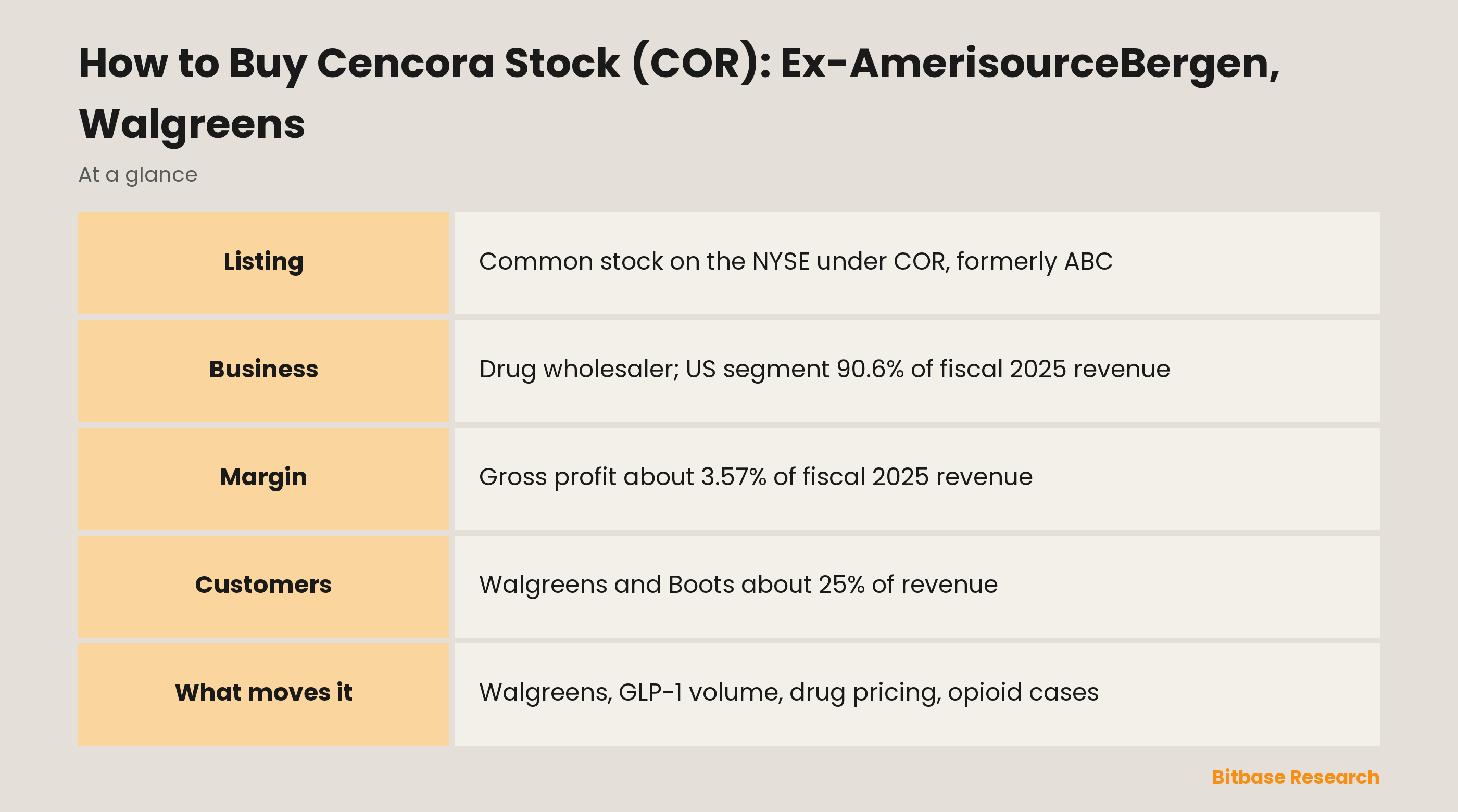
Each COR share is bought the way any New York Stock Exchange stock is: through a brokerage account, under the ticker that replaced ABC when AmerisourceBergen renamed itself Cencora on 30 August 2023. Behind the new name is a drug wholesaler that works on huge volumes and a thin margin: its US business brought in 90.6% of fiscal 2025 revenue, gross profit came to about 3.57% of sales, and Walgreens and Boots together accounted for roughly 25% of revenue. This guide covers what Cencora does, how a buyer outside the US places the order, and the risks its filings dwell on: customer concentration, drug-pricing policy and opioid litigation.
What Does Cencora Do?
Cencora sits between the companies that make medicines and the places that dispense them. It buys brand-name, specialty and generic drugs from manufacturers, stores them and delivers them to hospitals, pharmacies, clinics, physician practices and, through its animal health arm, veterinarians. In its own annual report Cencora describes itself as "one of the largest global pharmaceutical sourcing and distribution services companies."
The company dates from the August 2001 merger of AmeriSource Health and Bergen Brunswig. On 30 August 2023 it changed its name to Cencora, Inc.; the 8-K filed that day said the change "does not affect the rights of the Company's stockholders," and the stock moved from ABC to COR at the open. It is incorporated in Delaware, based in Conshohocken, Pennsylvania, and had more than 51,000 employees at the end of fiscal 2025, about 41% of them in the United States.
For fiscal 2025 the business reported two segments. U.S. Healthcare Solutions is the American distribution network, including a national distribution center in Columbus, Ohio, that gives manufacturers "a single shipping destination," and a specialty arm supplying physicians, "especially" in oncology and retina, with plasma products, injectables and vaccines. International Healthcare Solutions works mainly in Europe: its distribution operations ran in Canada, the Czech Republic, France, Lithuania, the Netherlands, Norway, Romania, Spain, Turkey and the United Kingdom, and its specialty logistics business for the biopharmaceutical industry had facilities in more than 50 countries.
The shape is changing. From the first quarter of fiscal 2026, Cencora reports three parts: U.S. Healthcare Solutions; International Healthcare Solutions, made up of Alliance Healthcare, Innomar, World Courier and the strategic parts of PharmaLex; and Other, which gathers "businesses for which we have begun to explore strategic alternatives," among them MWI Animal Health and the Brazilian distributor Profarma. U.S. Consulting Services was sold in April 2026. In February 2026 Cencora agreed to merge MWI with Covetrus, Inc.; the Federal Trade Commission asked for more information in May, and the deal was still pending in the June quarterly report.
Cencora has also moved closer to the doctors who prescribe specialty drugs. On 2 January 2025 it bought 85% of Retina Consultants of America, "a leading management services organization of retina specialists," with physicians and managers keeping 15%. On 2 February 2026 it bought most of the stake it did not already own in OneOncology, "a physician-led national platform empowering independent medical specialty practices rooted in oncology"; physicians and managers retained 8%. On 21 October 2026 it announced an agreement to acquire American Oncology Network, in which it held about 4%, subject to regulatory clearance and approval by AON's shareholders.
How Cencora Makes Money
A wholesaler earns the gap between what it pays manufacturers and what customers pay it, plus service fees. For US brand-name drugs, purchase contracts "generally use wholesale acquisition cost ("WAC") as the reference price," and some manufacturer agreements add "a price appreciation component." Generics have historically offered "a greater gross profit margin opportunity than brand-name products, although their lower prices reduce revenue growth," so revenue and profit can move apart.
Almost all of the revenue is American:
| Business line | Segment | Share of fiscal 2025 revenue | What it covers |
|---|---|---|---|
| Human health distribution | U.S. Healthcare Solutions | 88.8% | Brand, specialty and generic drugs for pharmacies, health systems and physician practices |
| Animal health | U.S. Healthcare Solutions | 1.8% | Products for companion and production animals, sold through MWI |
| Alliance Healthcare | International Healthcare Solutions | 7.6% | Pharmaceutical wholesale, mainly in Europe |
| Other Healthcare Solutions | International Healthcare Solutions | 1.9% | The segment's remaining businesses |
The percentages are computed from fiscal 2025 segment revenue, rounded to one decimal place; the US segment as a whole made up 90.6% and the international segment 9.5%.
Profit is spread less unevenly: the US segment earned 84.6% of fiscal 2025 segment operating income and the international segment 15.4%. Against its own revenue, the US segment kept about 1.23% as segment operating income and the international segment about 2.13%. Across the company, gross profit was roughly 3.57% of revenue; nearly all of what customers pay goes to cover the cost of the drugs.
Fiscal 2025 revenue rose 9.3%. The US segment grew 9.7%, which the 10-K puts down to "unit volume growth," more specialty products sold to health systems and physician practices, and a 26.9% rise in sales of products "labeled for diabetes and/or weight loss in the GLP-1 class." International revenue rose 6.1%. Gross profit grew faster, by 15.8%, and the 10-K credits the Retina Consultants of America acquisition with lifting the US segment's gross margin to 2.72%. The first nine months of fiscal 2026 were slower: revenue rose 4.8% and GLP-1 sales 19.7%, against lower prices on some brand products, two lost customers and lower sales to Cencora's "large mail order customer" because of brand conversions.
The customer list is short at the top. The ten largest customers, counting government agencies and group purchasing organizations, made up about 66% of fiscal 2025 revenue; Walgreens and Boots together were about 25%, and Evernorth Health Services, the second-largest customer, about 13%. Suppliers are spread wider: no manufacturer reached 10% of purchases, and the top ten together supplied about 57%.
COR Stock at a Glance
| Item | Detail |
|---|---|
| Exchange | New York Stock Exchange (NYSE) |
| Ticker | COR since 30 August 2023; ABC before the name change |
| Security | Common stock |
| Other listed securities | Two series of senior notes, COR28 and COR32 |
| Sector | Healthcare: pharmaceutical distribution and services |
| Index membership | S&P 500 |
| Headquarters | Conshohocken, Pennsylvania |
| Incorporated | Delaware |
| Origin | August 2001 merger of AmeriSource Health and Bergen Brunswig |
| Fiscal year | Ends on 30 September |
| Dividend policy | Quarterly cash dividend, raised each November from 2022 to 2025 |
| Stock splits | Two-for-one in December 2005 and in June 2009 |
| SEC identifier | CIK 1140859 |
Prices and yields are missing from the table on purpose, since they change by the minute; see the Cencora stock page on Bitbase for live figures.
How to Buy Cencora Stock
COR is the common stock of an American company; no depositary receipt or second share class stands between you and the shares. Through a broker, the purchase takes seven steps:
1. Pick a broker with a door to New York. Many brokers abroad pass orders on to the NYSE; find out which legal entity keeps your shares in custody and which authority licenses it.
2. Open the account and file Form W-8BEN. Non-US individuals use this IRS form to certify foreign status for withholding on US dividends.
3. Fund the account. Money sent in another currency gets converted, and the conversion rate is a cost in its own right, so compare it along with the trading fee.
4. Look up COR and confirm the issuer. You want Cencora, Inc. common stock on the NYSE. Some older charts still carry ABC, and the COR28 and COR32 lines are the company's bonds.
5. Pick an order type. According to FINRA, a market order "provides the most certainty that your order will be executed," though "you might not get the price you saw or were originally quoted"; a limit order is "an order to buy or sell a security at or better than a specified price," and it may never fill.
6. Decide how much. Brokers that sell fractions of a share let you invest a set sum instead of a whole share; FINRA cautions that "as a fractional share owner, you might not have shareholder voting rights."
7. Hold on to the paperwork. Confirmations and statements record your purchase price and the tax taken from each dividend.
Before the open and after the close, quotes can differ from the regular session; setting a limit protects you from a thin market.
Treaties and withholding. The IRS says that "most types of U.S. source income received by a foreign person are subject to U.S. tax of 30%," and that a reduced rate, including exemption, may apply under a tax treaty; Form W-8BEN is how the broker learns which rate applies. Tax at home may come on top.
Indirectly, through funds. Cencora appears in the 29 October 2026 holdings files of State Street's SPDR S&P 500 ETF Trust (SPY) and its Health Care Select Sector SPDR fund (XLV), which also holds McKesson and Cardinal Health.
What Moves COR Stock
Walgreens under new owners. Cencora is "the primary distributor of pharmaceutical products for Walgreens in the U.S. and Boots in the U.K." Sycamore Partners, a private equity firm, acquired Walgreens Boots Alliance on 28 August 2025, and the 10-K warns that the new owners "may seek changes to WBA's operations or our relationship with WBA," for instance by speeding up a plan, disclosed in October 2024, to close about 1,200 US stores over three years. The US distribution agreement and a generics purchasing arrangement each run to 2029, and the Boots agreement to 2031. On 12 August 2026 Cencora disclosed that since 1 July some Walgreens volume handled outside the prime vendor agreement had begun to move elsewhere; that agreement was unchanged and, in the company's words, "constitutes the vast majority of the Company's business with Walgreens."
GLP-1 volume. Diabetes and weight-loss drugs in the GLP-1 class grew 26.9% in fiscal 2025 and 19.7% in the first nine months of fiscal 2026, but they carry "lower gross profit margins," so they lift revenue more than profit.
Manufacturer prices and Washington. Part of gross profit depends on "the timing and extent of manufacturer price increases, which we do not control." Policy adds a second layer: Executive Order 14297 of 12 May 2025 seeks to hold certain US drug prices to the lowest paid in other developed countries and directs HHS to facilitate direct-to-consumer purchasing programs "that may bypass traditional supply chain intermediaries," a description that fits Cencora's own place in the chain.
The move into physician practices. Retina Consultants of America, OneOncology and, if it closes, American Oncology Network turn Cencora into an owner of practice-management businesses, which brings new rules: the 10-K lists regulatory issues such as "corporate practice of medicine and other forms of ownership regulation," and changes in the laws that apply to management services organizations, among the risks of these acquisitions.
Opioid litigation. The Distributor Settlement Agreement Cencora negotiated with the two other national distributors took effect on 2 April 2022; as of 30 June 2026 it covered 48 of 49 eligible states and 99% by population of their eligible political subdivisions. Still open is a civil complaint the Department of Justice filed on 29 December 2022, which, according to the 10-Q, alleges that the company "negligently failed to report suspicious orders to the Drug Enforcement Administration" and seeks civil penalties and injunctive relief. Cencora denies the allegations; fact discovery is scheduled to close on 13 November 2026.
Cencora's Thin Margin Leaves Little Room for Error
Of the Item 1A headings in the fiscal 2025 10-K, these bear most directly on a COR holder:
Losing or repricing a large customer. "Our revenue, financial position, results of operations, and cash flows may suffer upon the loss, or renewal at less favorable terms, of a key customer or group purchasing organization." With Walgreens and Boots near a quarter of revenue, this is not abstract; an oncology customer's contract already ended in June 2025 after a notice of non-renewal.
Manufacturer pricing. "Our results of operations could be adversely impacted by manufacturer pricing changes," the heading under which the WAC and policy points above sit.
Competition and consolidation. "Competition and industry consolidation may erode our profit." The 10-K names McKesson, Cardinal Health and UPS Logistics as its largest competitors.
Acquisitions. Results "may be adversely affected if we acquire or invest in businesses that do not perform as we expect or that are difficult for us to integrate." PharmaLex has already led to goodwill impairments in fiscal 2024 and fiscal 2025.
Systems and data. "The loss or disruption of information systems could disrupt our operations and have a material adverse effect on our business." In fiscal 2024 Cencora "experienced a cybersecurity event where data from our information systems was exfiltrated."
Two further risks come with owning the share itself. A single wholesaler is a concentrated bet on drug volumes, pricing rules and a few customers, and the dividend is not a promise: "the payment and amount of future dividends remain within the discretion of our Board of Directors." Holders outside the US also take currency risk on both the price and the dividend.
How to Research COR Around a September Year-End
Cencora's EDGAR identifier is CIK 1140859, the number AmerisourceBergen used, so a single search returns filings under both names. With a 30 September year-end, the 10-K arrives late in the calendar year (the fiscal 2025 report was filed on 25 November 2025), and the first fiscal quarter runs from October to December. 8-Ks carry the events in between, such as the October 2026 AON announcement, which also set the fiscal fourth-quarter 2026 earnings call for 4 November 2026.
Inside the 10-K, the business is described in Item 1 and the risks in Item 1A, while the segment note breaks revenue down by business line. Fiscal 2025 and fiscal 2026 segment figures sit on different structures; an 8-K filed on 10 February 2026 recast the earlier ones, so compare like with like. The legal note tracks the opioid settlement and the Department of Justice case each quarter.
The proxy statement adds the history of Walgreens' shareholding and board seat, and the yardstick for executives' performance shares: the S&P 500 Health Care Providers & Services index, which at 30 September 2025 put Cencora alongside McKesson and Cardinal Health as well as insurers and care providers such as UnitedHealth Group. The stock page linked earlier carries the live price, and Bitbase's list of US stock pages covers other companies.
Cencora Stock FAQ
Does Cencora pay a dividend?
Yes. Cencora pays a cash dividend four times a year; the board raised the rate each November from 2022 to 2025, and the 10-K says the company anticipates it "will continue to pay quarterly cash dividends in the future," with the amount at the board's discretion.
Can I buy Cencora stock with crypto?
Not directly. A COR purchase goes through a brokerage account and settles in US dollars, so any crypto must first be sold for cash and transferred; that sale can create a tax bill of its own. What you then own is not like a token, as how a share differs from a crypto asset explains: it is a registered stake in the company, with dividend and voting rights.
Is Cencora the same company as AmerisourceBergen?
Yes. AmerisourceBergen Corporation became Cencora, Inc. on 30 August 2023, when the shares switched from ABC to COR; the SEC identifier stayed the same.
Is COR in the S&P 500?
Yes. State Street's holdings file for SPY dated 29 October 2026 lists Cencora. Index membership can change, so check a current list.
Has Cencora stock ever split?
Yes, twice according to the filings, both times two-for-one in the form of a stock dividend: on 28 December 2005 and on 15 June 2009, under the AmerisourceBergen name. Per-share figures from before those dates need adjusting.
Does Walgreens still own a big stake in Cencora?
Not above 5%. The 2026 proxy statement says Walgreens Boots Alliance ceased to control more than 5% of Cencora's common stock in June 2025, and it no longer has the right to name a director. The commercial agreements continue.
Conclusion
Buying COR is the easy part: open a brokerage account with New York access, find Cencora's common stock and choose how to price the order. Knowing what you own takes longer. It holds a business that moves enormous volumes of medicine for less than four cents of gross profit per dollar of sales, relies on a few buyers led by Walgreens, and has been buying its way into oncology and retina practices. The next 10-K, covering the year that closed on 30 September 2026, and the 8-Ks after it are the documents to read before putting money into a single drug wholesaler.
Related reading
Other Bitbase articles on this topic:
- How to Buy Becton Dickinson Stock (BDX): Waters Deal and Dividend
- How to Buy Boston Scientific Stock (BSX): Farapulse and Watchman
- How to Buy Cardinal Health Stock (CAH): CVS, Generics, Opioids
- How to Buy McKesson Stock (MCK): Drug Wholesale, CVS, Med-Surg
Disclaimer: This article is educational content from Bitbase Academy, provided for information only. It explains what a company or fund does and how the instruments referenced here differ from one another; it does not constitute investment, trading, tax, or financial advice, and it is neither a recommendation nor an endorsement of any security, token, or trading strategy. A tokenized stock is issued by a third party and is designed to give economic exposure to an underlying asset: it is not a share, it carries no shareholder rights, and it depends on the issuer's structure, eligibility rules, and redemption terms, which the issuer can change. Perpetual futures are leveraged derivatives that hold no underlying asset and can be liquidated, and trading hours, product availability, and eligibility differ by instrument and by jurisdiction and can change at any time. Written as of October 2026; verify everything yourself through company filings, the issuer's own documentation, and the product pages of the venue you trade on.
References
[1] Cencora Form 10-K, fiscal 2025 (SEC EDGAR) www.sec.gov
[2] Cencora Form 10-Q, quarter to 30 June 2026 (SEC EDGAR) www.sec.gov
[3] Cencora 8-K on the name and ticker change, 30 August 2023 (SEC EDGAR) www.sec.gov
[4] AmerisourceBergen Form 10-K, fiscal 2006: company history (SEC EDGAR) www.sec.gov
[5] Cencora 8-K on the MWI and Covetrus merger, 18 February 2026 (SEC EDGAR) www.sec.gov
[6] Cencora 8-K recasting segment data, 10 February 2026 (SEC EDGAR) www.sec.gov
[7] Cencora 8-K on Walgreens volume, 12 August 2026 (SEC EDGAR) www.sec.gov
[8] Cencora release on American Oncology Network, 21 October 2026 (SEC EDGAR) www.sec.gov
[9] Cencora 2026 proxy statement (SEC EDGAR) www.sec.gov
[10] AmerisourceBergen 10-Q, quarter to 31 December 2005: split (SEC EDGAR) www.sec.gov
[11] AmerisourceBergen 10-Q, quarter to 30 June 2009: split (SEC EDGAR) www.sec.gov
[12] State Street, SPY daily holdings, 29 October 2026 www.ssga.com
[13] State Street, XLV daily holdings, 29 October 2026 www.ssga.com
[14] FINRA, Order Types www.finra.org
[15] FINRA, Investing in Fractional Shares www.finra.org
[16] IRS, NRA Withholding www.irs.gov





