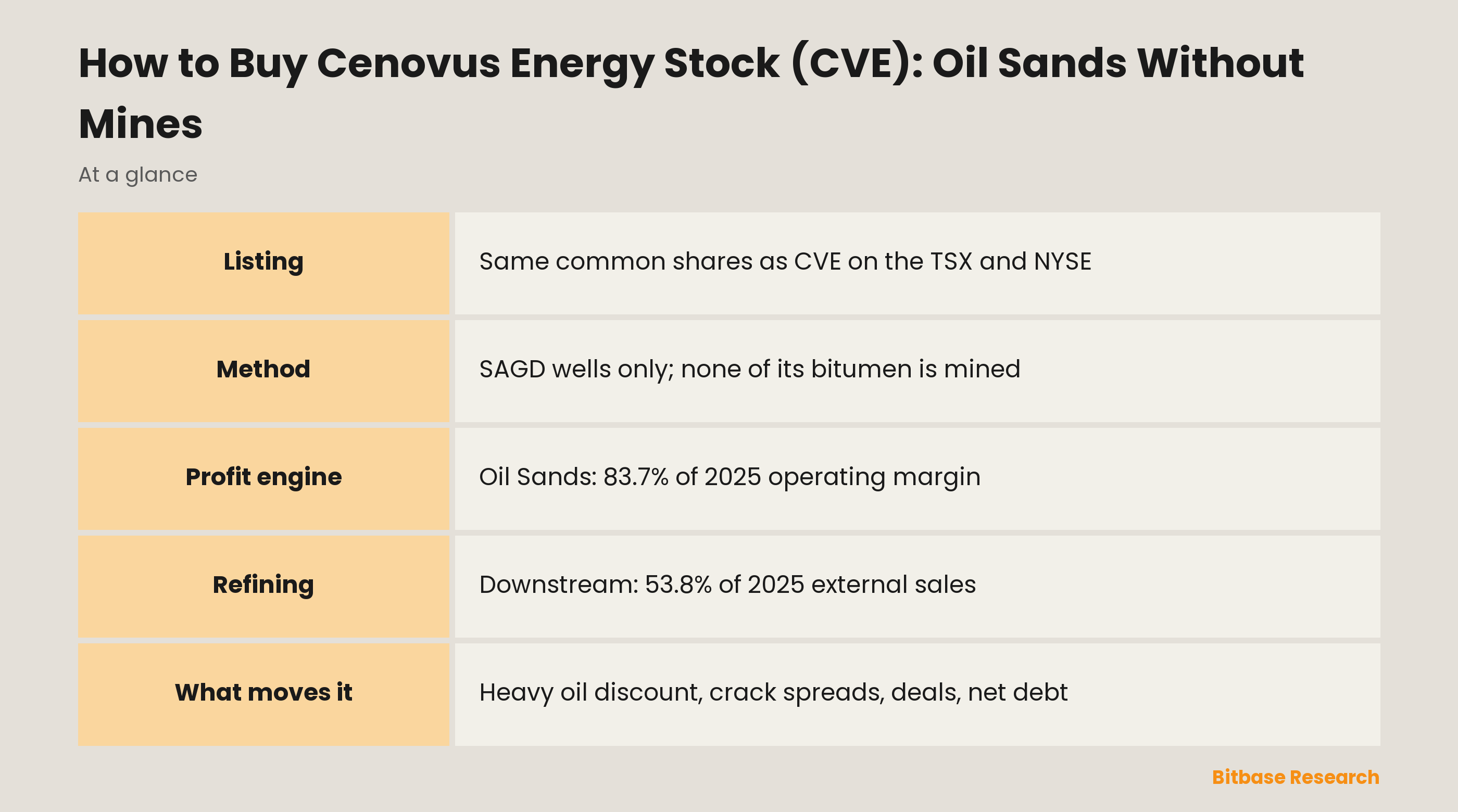
Its Toronto and New York listings are one and the same common share, quoted as CVE in both places, so buying Cenovus Energy stock takes only a brokerage account that reaches either exchange. Behind the ticker is an oil sands producer that does no mining and also refines: in 2025 the downstream business made 53.8% of external sales, while the Oil Sands segment earned 83.7% of operating margin.
What Does Cenovus Energy Do?
Cenovus Energy is an integrated oil company based in Calgary and incorporated under the Canada Business Corporations Act. It was created on 30 November 2009, when EnCana Corporation split into a natural gas producer that kept the EnCana name and an integrated oil company, Cenovus; regular trading began on the TSX on 3 December and on the NYSE on 9 December. On 1 January 2021 it combined with Husky Energy.
The business is reported in five segments. Oil Sands produces bitumen and heavy oil in northern Alberta and Saskatchewan at Foster Creek, Christina Lake, Sunrise and Lloydminster. Conventional holds gas and natural gas liquids assets in Alberta and British Columbia. Offshore covers the White Rose field it operates off Newfoundland and Labrador, a 34% interest in Terra Nova, gas fields in the South China Sea developed with CNOOC, and a 40% stake in a gas joint venture off Indonesia. Canadian Refining runs the Lloydminster upgrader and asphalt refinery, two ethanol plants and a commercial fuels network. U.S. Refining owns three refineries outright: Lima and Toledo in Ohio and Superior in Wisconsin.
The portfolio keeps moving. Cenovus sold its 50% interest in the Wood River and Borger refineries on 30 September 2025 and on 13 November 2025 completed its purchase of MEG Energy, whose oil sands assets lie next to Christina Lake and are reported as part of it.
The annual information form (AIF) is explicit about method: Cenovus "does not employ mining techniques for extraction and none of its bitumen reserves are suitable for extraction using mining techniques." It uses steam-assisted gravity drainage (SAGD), injecting steam so the heated bitumen can be pumped to the surface.
How Cenovus Energy Makes Money
Cenovus earns from crude it produces and from fuel it refines, and in 2025 sales and profit sat at opposite ends of that chain. Gross sales fell 8.6% in a year when Brent and WTI each dropped 14%, yet net earnings rose 25.1%.
| Segment | Share of 2025 external sales | Share of 2025 operating margin |
|---|---|---|
| Oil Sands | 40.8% | 83.7% |
| Conventional | 2.5% | 4.3% |
| Offshore | 2.9% | 10.0% |
| Canadian Refining | 8.1% | 3.3% |
| U.S. Refining | 45.7% | −1.4% |
Percentages come from the 2025 segment note; operating margin there is essentially revenue minus purchased product, transport, blending and operating costs.
U.S. Refining brought in close to half of external sales but a negative operating margin, in 2025 as in 2024; gasoline and distillates together made up 42.6% of external sales. The refineries matter for another reason. Lima, Toledo and Superior can run heavy crude from Cenovus's own fields, and the management's discussion and analysis (MD&A) calls the downstream business "a natural partial hedge to heavy oil differentials": when heavy crude sells at a deep discount, a refiner buying it recovers part of what a producer loses.
By geography, the United States accounted for 50.1% of 2025 revenue, Canada 47.9% and China 2.0%. Volumes lean the same way as profit: oil sands output made up 77.2% of record upstream production, which grew 4.6% on the year.
CVE Stock at a Glance
| Item | Detail |
|---|---|
| Listings | TSX (Toronto) and NYSE (New York) |
| Ticker | CVE in both markets |
| Security | Common shares, no par value, one vote each; the only Cenovus security registered on the NYSE |
| Quote currency | CAD on the TSX, USD on the NYSE |
| Sector | Energy: oil sands, conventional and offshore production, refining |
| Index funds | In XIU, an S&P/TSX 60 fund; absent from SPY's S&P 500 holdings (29 October 2026) |
| Headquarters | Calgary, Alberta |
| Fiscal year | Ends 31 December |
| Accounts | IFRS, Canadian dollars; annual Form 40-F, Form 6-K for quarters and news |
| Dividend policy | Quarterly base dividend declared by the board; variable dividends possible |
| SEC identifier | CIK 1475260 |
For the live price, see the Cenovus Energy stock page on Bitbase.
How to Buy Cenovus Energy Stock
The AIF states that "all of the outstanding Cenovus common shares are listed and posted for trading on the TSX and the NYSE under the symbol CVE." With no depositary receipt in between, what you choose is the market and the currency.
1. Choose the market. Toronto quotes CVE in Canadian dollars, New York in US dollars; pick a broker that reaches the one you want.
2. Get verified. Brokers ask for ID and your country of tax residence, which later sets how dividends are taxed.
3. Fund it. FX conversion can cost more than the trading fee; compare the rate your broker uses.
4. Pick the right line. The warrants (CVE.WT in Toronto, CVE.WS in New York) expired on 1 January 2026, and the last preferred shares (CVE.PR.A, CVE.PR.B) were redeemed on 31 March 2026. The common share is plain CVE.
5. Pick an order type. Market orders execute straight away at the best price on offer; limit orders execute only at your chosen price or a better one.
6. Decide the size. Some brokers sell fractional shares; ask whether a fraction gets the dividend.
7. File the paperwork. Keep trade confirmations and dividend statements; they record your cost and any tax taken at source.
Dividends and tax. Cenovus reports in Canadian dollars and declares its dividend in that currency. It designates common share dividends as "eligible dividends" for Canadian federal income tax purposes, a label that matters to Canadian residents. Neither the 40-F nor the 2026 quarterly releases say what is withheld for holders abroad, so ask your broker how much Canadian tax it deducts and whether a treaty rate applies.
Reinvesting. A dividend reinvestment plan turns cash dividends into more common shares, priced off the TSX volume-weighted average for the five trading days before payment or bought in the market; ask your broker whether you can join from outside Canada.
Through a fund. S&P/TSX 60 index funds, BlackRock's iShares XIU among them, own CVE; funds tracking the S&P 500 do not.
What Moves CVE Stock
The heavy oil discount. Bitumen "generally trades at a discount to the market price for light to medium crude oil and heavy crude oil," the MD&A says, and it must be thinned with condensate to move by pipeline; diluent makes up roughly 20% to 35% of a blended barrel. The gap between WTI and Western Canadian Select at Hardisty narrowed in 2025, partly, the company said, because the Trans Mountain expansion added market access.
Refining margins. U.S. Refining results swing with crack spreads, feedstock costs and seasonal demand. Adjusted market capture, Cenovus's gauge of the margin it captured against market benchmarks, was 114% in the first quarter of 2026 and 67% in the second.
Deals and new shares. After MEG, Cenovus agreed on 5 October 2026 to buy Athabasca Oil Corporation, paying mostly in cash and the rest in new Cenovus shares, in a mix set by Athabasca shareholders' elections. It expected closing in December 2026, subject to regulatory approvals and an Athabasca shareholder vote. The deal would also consolidate Duvernay Energy Corporation, in which Cenovus holds 30% and Athabasca the rest.
Debt and payouts. After MEG, Cenovus targeted returning about half of excess free funds flow while net debt was above an interim threshold, and about three-quarters between that threshold and its long-term target; it crossed the threshold in the second quarter of 2026. Its issuer bid allows buybacks of up to 120.3 million shares until 10 November 2026.
Currency and trade. The MD&A says Cenovus's "revenues are predominantly based on U.S. dollar benchmark prices," while many costs are in Canadian dollars and a significant portion of its debt is in US dollars. It also names higher US tariffs on Canadian energy as a possible trade measure.
Volume. Upstream output in the second quarter of 2026 was 26.7% above a year earlier, a comparison that includes the MEG assets. The same drivers can be set against those of ConocoPhillips or Chevron.
Warnings in the Cenovus MD&A
The risk section opens with prices: "Our financial performance is significantly dependent on prevailing commodity prices." Four more warnings bear directly on a CVE share.
Getting barrels to market. The company relies on pipelines, rail, ships and trucks, and "there can be no certainty that third-party pipeline projects for new or expanded capacity will be approved or constructed."
Trade barriers. Restrictive trade measures "could result in, among other things, a high degree of both cost and price volatility, a relative weakening of the Canadian dollar, widening differentials, and decreased demand for our products and services."
Two large holders. On 10 March 2026, Hutchison Whampoa Europe Investments, owned by CK Hutchison, held 16.39% of the common shares, and L.F. Investments, owned by a trust founded by Li Ka-shing, held 12.30%. Their standstill agreements expired on 1 January 2026, and the MD&A warns that their selling, "or market perception regarding any intention" to sell, "could adversely affect market prices for our common shares."
Discretionary payouts. "The Company can provide no assurance that it will continue to pay base or variable dividends or authorize share buybacks at the current rate, or at all."
Owning the stock adds two risks of its own: everything rides on one company, and for anyone who does not spend Canadian dollars, currency moves change the share's value and the dividend.
Primary Sources on Cenovus
Cenovus's SEC filer number (CIK) is 1475260. Its yearly Form 40-F carries the AIF, the MD&A, audited financial statements and supplementary oil and gas information; quarterly reports and news releases come on Form 6-K. Cenovus filed the 40-F for fiscal 2025 on 19 February 2026, and the same documents are on SEDAR+ and cenovus.com.
Start with the MD&A's "Risk Management and Risk Factors" and its commodity price section, then the segment note. The AIF's "Dividends" and "Market for Securities" sections cover payouts and listings, and the 2026 management information circular names holders of a tenth or more of the shares. To compare quotes across companies, browse the Bitbase stock pages.
Cenovus Energy Stock FAQ
Does Cenovus mine the oil sands?
No. Its bitumen is recovered with SAGD at Foster Creek, Christina Lake, Sunrise and the Lloydminster thermal plants, and the AIF says none of its bitumen reserves are suitable for mining.
How is Cenovus related to EnCana and Husky?
Cenovus came out of EnCana: in the 2009 split, EnCana shareholders received one share in each of the new EnCana and Cenovus. Husky Energy joined on 1 January 2021 and was amalgamated into Cenovus that March.
Does Cenovus Energy pay a dividend?
Yes. The board considers dividends quarterly and pays a base dividend, raised 11% in 2025 and 10% from the second quarter of 2026; it has also declared variable dividends, as in 2024. Neither kind is guaranteed, and both are at the board's discretion.
Who are Cenovus's largest shareholders?
The 2026 management information circular lists two holders with at least a tenth of the common shares on 10 March 2026: Hutchison Whampoa Europe Investments with 16.39% and L.F. Investments with 12.30%. The first is owned by Hong Kong-listed CK Hutchison, 30.36% of which is held by trusts founded by Li Ka-shing; the second by a trust he founded.
Can I buy Cenovus Energy stock with crypto?
Not directly. CVE trades at a broker in Canadian or US dollars, so crypto has to be sold for fiat money first, and in some countries that sale is taxable. The two are separate choices; this guide to choosing between crypto and stocks sets out how they differ.
Conclusion
Getting CVE into a portfolio is simple: a broker with TSX or NYSE access and a decision on currency. What you own is a SAGD oil sands producer whose refineries cushion the heavy oil discount, a buyer of neighbouring assets, and a company whose payouts track its net debt. Before deciding how much to hold, read the newest 40-F and 6-K filings and find out how your home country taxes dividends from Canada.
Related reading
Other Bitbase articles on this topic:
- How to Buy Baker Hughes Stock (BKR): Chart, LNG and the Rig Count
- How to Buy BP Stock (BP): Six Shares per ADS and the Dividend
- How to Buy Canadian Natural Resources Stock (CNQ): Oil Sands Owner
- How to Buy ONEOK Stock (OKE): NGLs, Fees and Apollo's Stake
Disclaimer: This article is educational content from Bitbase Academy, provided for information only. It explains what a company or fund does and how the instruments referenced here differ from one another; it does not constitute investment, trading, tax, or financial advice, and it is neither a recommendation nor an endorsement of any security, token, or trading strategy. A tokenized stock is issued by a third party and is designed to give economic exposure to an underlying asset: it is not a share, it carries no shareholder rights, and it depends on the issuer's structure, eligibility rules, and redemption terms, which the issuer can change. Perpetual futures are leveraged derivatives that hold no underlying asset and can be liquidated, and trading hours, product availability, and eligibility differ by instrument and by jurisdiction and can change at any time. Written as of October 2026; verify everything yourself through company filings, the issuer's own documentation, and the product pages of the venue you trade on.
References
[1] Cenovus Energy Form 40-F, fiscal 2025: cover page (SEC EDGAR) www.sec.gov
[2] Cenovus Energy Form 40-F, fiscal 2025: XBRL cover data (SEC EDGAR) www.sec.gov
[3] Cenovus Energy Annual Information Form 2025, filed with the 40-F (SEC EDGAR) www.sec.gov
[4] Cenovus Energy management's discussion and analysis for 2025, filed with the 40-F (SEC EDGAR) www.sec.gov
[5] Cenovus Energy 2025 financial statements: segment information (XBRL, SEC EDGAR) www.sec.gov
[6] Cenovus Energy 2025 financial statements: geographical information (XBRL, SEC EDGAR) www.sec.gov
[7] Cenovus Energy Form 40-F, fiscal 2009: the EnCana arrangement and first trading days (SEC EDGAR) www.sec.gov
[8] Cenovus Energy announces redemption of Series 1 and 2 preferred shares, 26 February 2026, Form 6-K (SEC EDGAR) www.sec.gov
[9] Cenovus Energy first quarter 2026 results, 6 May 2026, Form 6-K (SEC EDGAR) www.sec.gov
[10] Cenovus Energy second quarter 2026 results, 29 July 2026, Form 6-K (SEC EDGAR) www.sec.gov
[11] Cenovus Energy announces agreement to acquire Athabasca Oil Corporation, 5 October 2026, Form 6-K (SEC EDGAR) www.sec.gov
[12] Cenovus Energy 2026 notice of annual meeting and management information circular, Form 6-K (SEC EDGAR) www.sec.gov
[13] BlackRock, iShares S&P/TSX 60 Index ETF (XIU): fund holdings as of 29 October 2026 www.blackrock.com
[14] State Street, SPDR S&P 500 ETF Trust (SPY): daily holdings as of 29 October 2026 www.ssga.com





