
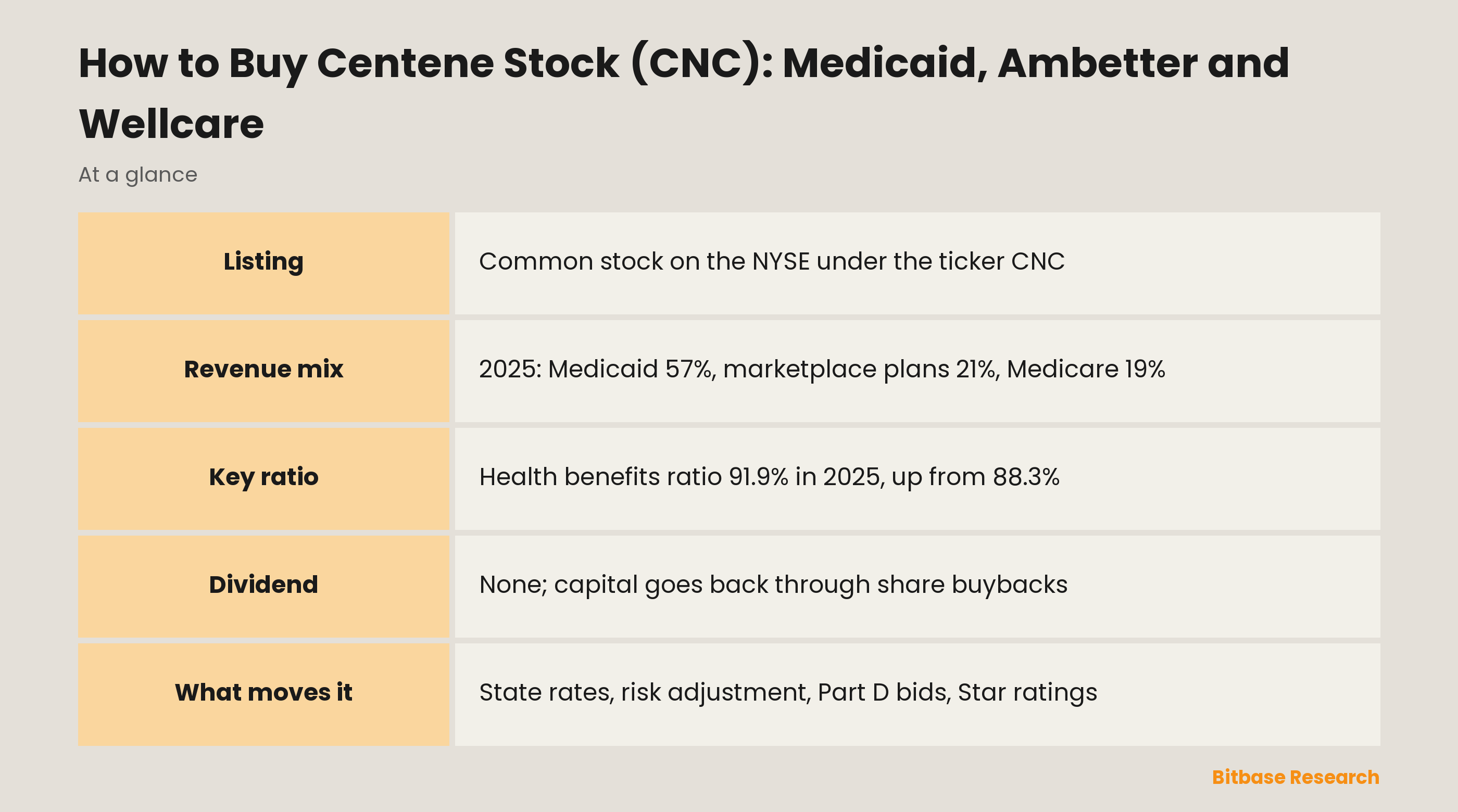
Centene, the health insurer behind the ticker CNC, lists its common stock on the New York Stock Exchange, so any broker that reaches US shares can fill the order. Most of its money comes from governments: in 2025 Medicaid supplied 57% of external revenue, Ambetter Health marketplace plans 21% and Medicare, sold as Wellcare, 19%. Below are the four segments, the steps of a purchase, and why state rates, risk adjustment and Star ratings move this share so sharply.
What Does Centene Do?
Centene runs health plans. Its 10-K calls it "the nation's largest managed care company focused on underserved populations" and says it covers "more than 1 in 15 individuals across the nation." It collects a premium per member, pays for the care members use and keeps what remains.
The business began as a single plan in Wisconsin in 1984. Centene was organized there in 1993 as a holding company for that plan, reincorporated in Delaware in 2001 and is based in St. Louis, Missouri. At the end of 2025 it had about 61,100 employees and 27.6 million members, 3% fewer than a year earlier.
It reported four segments in 2025:
Medicaid. State programs for low-income families, children and people with disabilities, funded jointly by states and Washington. Centene served 12.5 million Medicaid members in 30 states, and its Florida and New York contracts each accounted for roughly 10% or more of Medicaid premium revenue.
Medicare. Medicare Advantage plans sold as Wellcare, with 1.0 million members in 32 states, many of them in special needs plans for people eligible for both Medicare and Medicaid, plus stand-alone Part D drug plans in all 50 states and the District of Columbia, with 8.1 million members.
Commercial. Mainly individual policies bought on the Affordable Care Act exchanges under the Ambetter Health brand, with 5.5 million members in 29 states.
Other. The AcariaHealth specialty pharmacy, vision and dental benefits, clinics in Florida, and Magellan Health's behavioral health business, whose remaining operations Centene agreed to sell in December 2025.
On scale the 10-K is careful: "Based on the most recent publicly available membership data, we are the nation's largest Medicaid and Marketplace insurer, as well as the largest stand-alone PDP provider."
How Centene Makes Money
Revenue rose 19% in 2025. What each segment brought in, and what it kept after paying for care:
| Segment | Share of 2025 external revenue | Revenue change in 2025 | Share of 2025 gross margin | Gross margin change |
|---|---|---|---|---|
| Medicaid | 57% | +9% | 40% | −9% |
| Commercial | 21% | +25% | 36% | −33% |
| Medicare | 19% | +62% | 21% | +15% |
| Other | 3% | +4% | 3% | −23% |
Gross margin is the 10-K's measure, premium and service revenue minus medical costs and the cost of services; shares are calculated from the MD&A segment table.
The figure to watch is the health benefits ratio (HBR): "medical costs as a percentage of premium revenues, excluding premium tax revenues that are separately billed." It rose to 91.9% in 2025 from 88.3%, a 3.6-point jump, and the risk factors explain why that hurts: "relatively small changes in our HBR can create significant changes in our financial results." Administrative costs fell to 7.4% of premium and service revenue from 8.5%.
Medicaid revenue grew on rate increases while membership shrank, and behavioral health, home health and expensive drugs lifted costs. Medicare revenue jumped mainly because the Inflation Reduction Act moved more drug costs onto Part D plans, and premiums followed; Part D membership grew 17% while Medicare Advantage fell 10%. Commercial membership grew 26%, but in July 2025 Centene cut its expected risk adjustment revenue "as a result of significantly higher estimated aggregate market morbidity": the exchange population was sicker than priced.
The third quarter of 2025 also brought a large non-cash goodwill impairment, which the company linked to market conditions including the One Big Beautiful Bill Act (OBBBA) and its falling share price. It left Centene with a net loss for the year.
CNC Stock at a Glance
| Feature | CNC |
|---|---|
| Exchange | New York Stock Exchange, listed since 16 October 2003 |
| Ticker | CNC |
| Security | Common stock, the only class registered under Section 12(b) |
| Sector | Managed care: Medicaid, Medicare and marketplace health plans |
| Brands | Ambetter Health, Wellcare, AcariaHealth |
| Index membership | S&P 500 |
| Headquarters | St. Louis, Missouri |
| Incorporated | Delaware (reincorporated 2001) |
| Fiscal year | Calendar year, ending 31 December |
| Dividend | None; capital returned through share repurchases |
| Stock splits | Two-for-one in February 2015 and February 2019 |
| SEC identifier | CIK 1071739 |
Price and valuation change all day, so they are not in the table; for live figures, open the Centene stock page on Bitbase.
How to Buy Centene Stock
Centene has one listed class of common stock and no depositary receipt, so there is only one line to find. The usual route:
1. Pick a broker that trades NYSE stocks. Outside the US, check which entity holds your account and who regulates it.
2. Pass the account checks. People who are not US taxpayers usually complete Form W-8BEN; the IRS tells them to hand it in "when requested by the withholding agent or payer."
3. Fund the account. If your money is not in US dollars, the exchange rate can cost more than the commission.
4. Find the line. Search CNC and confirm it reads Centene Corporation common stock on the NYSE.
5. Choose an order. A market order fills at the next available price; a limit order caps what you pay and may not fill.
6. Set the amount. Brokers that sell fractional shares let you invest a fixed sum; voting rules for fractions vary by firm.
7. Keep the records. Confirmations show your cost for when you sell.
Taxes abroad. "The statutory withholding tax rate is 30%" on US dividends paid to non-residents, the IRS says, or a lower treaty rate. Centene pays no dividend, so this matters only if that changes; gains may be taxed where you live.
Through funds. Centene is in the S&P 500, so index funds such as State Street's SPY hold it as one small position among hundreds.
What Moves CNC Stock
Medical costs against rates. Premiums are mostly fixed in advance; claims arrive later. In 2025 the 10-K described "an accelerated increase in medical cost trend" from higher demand, broader state benefits and new high-cost drugs. When state rate increases lag that trend, the difference lands in the HBR.
Marketplace risk adjustment. Exchange insurers pay into or draw from a pool depending on how sick their members are. When data in mid-2025 showed a sicker market, Centene withdrew its 2025 earnings guidance on 1 July 2025, then repriced 2026 plans in states covering 95% of its marketplace members. Enhanced premium subsidies expired at the end of 2025, and by 30 September 2026 marketplace membership was 3.4 million against 5.8 million a year earlier, down 42%.
Washington's rules. The OBBBA, passed in July 2025, adds work or community engagement requirements and more frequent eligibility checks for Medicaid expansion members, effects expected "largely beginning in 2027," with changes to provider taxes and state directed payments from 2028. Medicaid membership was 11.9 million at the end of September 2026, 6% lower than a year before.
Part D bids and Star ratings. Many drug plan members are auto-assigned to plans that bid below a regional benchmark. Centene's 2026 bids were below it in all 34 CMS regions, and Part D membership reached 8.9 million by September 2026, up 12%. In Medicare Advantage, quality stars shape the next year's payments: about 60% of members were in plans rated 3.5 stars or higher for 2026, but about 42% for 2027, including 10% in four-star plans.
State contracts. Centene is protesting procurement results in Texas and Georgia, its Florida children's medical services contract ended in September 2026, and Health Net plans to stop selling commercial group coverage in 2027.
The recovery so far. The third-quarter 2026 HBR was 92.7%, level with a year earlier, but 89.9% for nine months against 91.1%, and the company raised its 2026 earnings outlook. Chief executive Sarah M. London credited "solid underlying fundamentals within our core businesses."
Where Centene's Thin Margins Can Break
From Item 1A of the 10-K, the risks closest to the shares:
Costs ahead of premiums. "If our actual medical expenses exceed our estimates for any reason, our health benefits ratio (HBR) … would increase and our profits would decline."
Retroactive revenue. Risk-adjustment systems "could result in retroactive adjustments," and actual payments "could be materially more or less than our estimates."
Losing a state. "Our reliance on operations in a limited number of states could cause our revenues and profitability to change suddenly and unexpectedly."
Drug plan bids. If Part D bids are not below CMS benchmarks, "we risk losing PDP members who were previously assigned to us."
Cash at the parent. Centene works through regulated subsidiaries, and "if state regulators do not approve payments of dividends and distributions by our subsidiaries to us, we may not have sufficient funds to implement our business strategy."
Write-downs and lawsuits. After the 2025 goodwill charge, the 10-K still warns that Centene "may have additional impairment charges." A putative securities class action filed in July 2025 in federal court in New York alleges misleading statements about the 2025 guidance; five derivative suits followed, and Centene denies wrongdoing.
The latest 10-Q reports "no material changes" to these risk factors. And a single stock rides on one company, with no dividend to soften a weak year.
How to Research Centene Yourself
EDGAR holds the filings under CIK 1071739: the 10-K, three 10-Qs a year, and 8-Ks for results and other events. In 2026 the earnings 8-Ks came on 6 February, 28 April, 28 July and 27 October.
In the 10-K, Item 1 explains each government program, Item 1A the risks, the MD&A the HBR and segment margins, and the contingencies note the litigation. Read the membership table before the totals: in 2026 marketplace, Medicaid and Part D moved in different directions. Compare HBR with the same quarter a year earlier, since costs rise later in the year as members meet deductibles, and check Star ratings each October.
For comparison, see our guides to UnitedHealth stock and Elevance Health stock. For prices, use the CNC page linked under the at-a-glance table; Bitbase's US stock directory has pages for other listed companies.
Centene Stock FAQ
Can I buy Centene stock with crypto?
Not directly. A broker settles CNC purchases in US dollars, so any crypto you hold has to be converted to cash and transferred first, and the conversion itself can create a tax bill in your country. What you then own is a registered share with voting rights; our explainer on the difference between stocks and crypto covers the rest.
Does Centene pay a dividend?
No. Its 2018 annual report stated, "We have never declared any cash dividends on our capital stock," and recent filings describe share repurchases, not dividends.
Is CNC in the S&P 500?
Yes. The 10-K includes the S&P 500 in its performance graph "because our common stock is within the index," and State Street's SPY holdings file dated 6 November 2026 lists Centene.
Has Centene stock ever split?
Twice, both two-for-one and paid as 100% stock dividends, distributed on 19 February 2015 and 6 February 2019. Later filings adjust older per-share figures for both.
Is Ambetter Health part of Centene?
Yes. Ambetter Health is the brand of Centene's marketplace plans and Wellcare its Medicare brand, while the Medicaid plans usually carry state names, such as Sunshine Health in Florida or Superior HealthPlan in Texas.
Conclusion
Owning Centene means owning a view on how well government health programs are priced: when states and Washington set rates close to real costs the narrow margin holds, and when they do not, a small rise in the HBR erases a large share of profit. Before buying, read the latest membership table and HBR trend, follow the 2027 Star ratings and state contract results, and size the position so that one bad pricing year would not force a sale.
Related reading
Other Bitbase articles on this topic:
- How to Buy Alcon Stock (ALC): Same Share on SIX and the NYSE
- How to Buy Dexcom Stock (DXCM): G7, Stelo and Medicare Bidding
- How to Buy GE HealthCare Stock (GEHC): Scanners and Imaging Agents
- How to Buy Illumina Stock (ILMN): Reagents, China and GRAIL
Disclaimer: This article is educational content from Bitbase Academy, provided for information only. It explains what a company or fund does and how the instruments referenced here differ from one another; it does not constitute investment, trading, tax, or financial advice, and it is neither a recommendation nor an endorsement of any security, token, or trading strategy. A tokenized stock is issued by a third party and is designed to give economic exposure to an underlying asset: it is not a share, it carries no shareholder rights, and it depends on the issuer's structure, eligibility rules, and redemption terms, which the issuer can change. Perpetual futures are leveraged derivatives that hold no underlying asset and can be liquidated, and trading hours, product availability, and eligibility differ by instrument and by jurisdiction and can change at any time. Written as of November 2026; verify everything yourself through company filings, the issuer's own documentation, and the product pages of the venue you trade on.
References
[1] Centene Form 10-K for 2025 (SEC EDGAR) www.sec.gov
[2] Centene 2025 Form 10-K, XBRL cover page (SEC EDGAR) www.sec.gov
[3] Centene Form 10-Q for the third quarter of 2026 (SEC EDGAR) www.sec.gov
[4] Centene third quarter 2026 results release, 27 October 2026 (SEC EDGAR) www.sec.gov
[5] Centene Form 8-K withdrawing 2025 guidance, 1 July 2025 (SEC EDGAR) www.sec.gov
[6] Centene Form 10-K for 2018 (SEC EDGAR) www.sec.gov
[7] Centene Form 10-K for 2014 (SEC EDGAR) www.sec.gov
[8] State Street SPDR S&P 500 ETF Trust (SPY), daily holdings www.ssga.com
[9] IRS, About Form W-8 BEN www.irs.gov
[10] IRS, withholding on US source income paid to nonresident aliens www.irs.gov





