
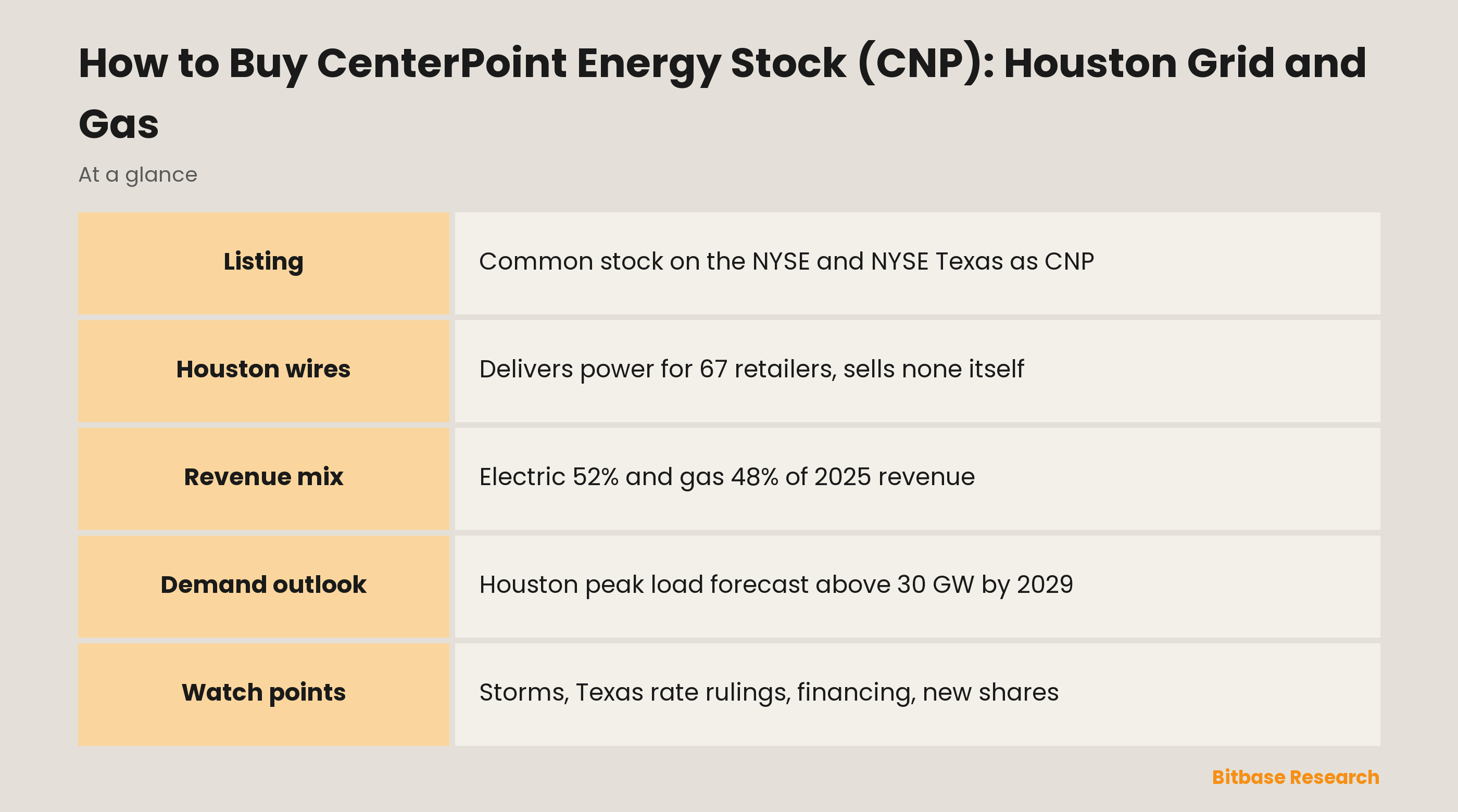
Buying a CenterPoint Energy share takes an account with a broker that can trade NYSE-listed stocks and an order for the common stock under the ticker CNP. What you get is a Houston holding company whose largest subsidiary owns the poles and wires around Houston but sells no electricity to the homes it connects, while its gas utilities brought in about 48% of its 2025 revenue. This guide covers the business, the order itself, and the factors its filings flag: a forecast surge in Houston power demand, hurricane damage and the regulators who set its rates.
What Does CenterPoint Energy Do?
CenterPoint Energy describes itself in its annual report as "a public utility holding company." Three operating subsidiaries run the wires and pipes. Only the parent is open to investors: CenterPoint Energy Houston Electric and CenterPoint Energy Resources Corp. (CERC) file with the SEC because they issue bonds, but each has just 1,000 shares, all held inside the group.
Houston Electric is the largest piece. It "is a transmission and distribution electric utility that operates wholly within the state of Texas," serving nearly all of the Houston/Galveston metropolitan area. Texas split its power market so that retail electric providers (REPs) sell electricity to households and businesses, and Houston Electric delivers it. The 10-K says Houston Electric "does not make direct retail or wholesale sales of electric energy or own or operate any power generating facilities" apart from a fleet of leased emergency generators. At the end of 2025 it delivered power for 67 REPs to 2,859,313 metered customers, and the filing states that "there are no other electric transmission and distribution utilities in Houston Electric's service area."
CERC holds most of the gas business: distribution systems in Texas and Minnesota, plus Indiana Gas. At the end of 2025 the group counted 4,029,085 gas customers, the largest metropolitan areas being Houston, Minneapolis, Evansville and Dayton. Dayton has since dropped out: on 1 October 2026 CERC completed the sale of its Ohio gas utility, Vectren Energy Delivery of Ohio, to National Fuel Gas Company. A year and a half earlier, on 31 March 2025, it had sold its gas operations in Louisiana and Mississippi.
SIGECO, the third subsidiary, is the most traditional utility of the group. Based around Evansville in southwestern Indiana, it owns power plants, supplies electricity to 154,402 metered customers as well as gas to its own gas customers, and trades in the MISO wholesale market. In March 2025 it bought Posey Solar, a 191 MW solar array then under construction in Posey County, Indiana.
SIGECO and Indiana Gas came with Vectren, their former parent, which has been a wholly owned CenterPoint subsidiary since 1 February 2019. In the 10-K for 2025, the company counted "more than seven million metered customers across four states"; with Ohio gone, the four states of 2025 have become three: Texas, Indiana and Minnesota.
How CenterPoint Energy Makes Money
State commissions decide what CenterPoint may charge, and those rates are designed to recover costs and earn a return on what it has invested in pipes, wires and substations. The 10-K notes that "approximately 85% of our rate base has been subject to a rate case since the beginning of 2023."
In 2025, revenue grew about 8% and split almost evenly between the two operating segments:
| Segment | Share of 2025 revenue | Share of 2025 net income of the two operating segments | Main subsidiaries |
|---|---|---|---|
| Electric | 52% | 55% | Houston Electric, Indiana Electric (SIGECO) |
| Natural Gas | 48% | 45% | CERC gas utilities, SIGECO gas |
Calculated from the segment note of the 2025 10-K. A third line, Corporate and Other, carries holding-company interest costs and recorded a net loss, so it is left out of the net income shares.
Gas revenue includes the cost of the gas itself, passed through to customers, so it moves with commodity prices. Houston Electric's revenue consists of delivery charges and made up about 44% of group revenue in 2025. Its distribution rates for homes and small businesses are "primarily based on amounts of energy delivered," which is why its revenue tends to be higher in the hot months, when Houston runs its air conditioners. Gas works the other way round: about 68% of 2025 gas throughput came in the first and fourth quarters.
Because Houston Electric bills REPs rather than households, a few large energy retailers stand between CenterPoint and its end customers. Affiliates of NRG accounted for about 13% of group revenue in 2025 and affiliates of Vistra for about 7%.
Expenditures on long-lived assets rose about 16% in 2025, and about 68% of that went to the Electric segment. In September 2025 the company set a 10-year capital plan covering 2026 through 2035, and it has raised it since; the October 2026 increase alone was about 6%. Approved investment enters the rate base on which future returns are calculated.
CNP Stock at a Glance
| Item | CNP |
|---|---|
| Listing | New York Stock Exchange and NYSE Texas |
| Ticker | CNP |
| Security | Common stock, the only class of shares registered for trading |
| Business | Regulated electric delivery, Indiana power generation and natural gas distribution |
| Operating subsidiaries | Houston Electric, CERC, SIGECO |
| States served | Texas, Indiana and Minnesota (Ohio gas sold 1 October 2026) |
| Index funds that hold it | S&P 500 (SPY) and Utilities Select Sector (XLU) |
| Headquarters | 1111 Louisiana Street, Houston, Texas |
| State of incorporation | Texas |
| Fiscal year | Ends 31 December |
| Dividend | Cash dividends, set at the board's discretion |
| SEC filer number | CIK 1130310 |
Price, market value and dividend yield change every trading day; the CenterPoint Energy stock page on Bitbase shows live figures.
How to Buy CenterPoint Energy Stock
CenterPoint is a Texas corporation listed in the United States, so there is no depositary receipt to think about: the ticker CNP refers to the common stock itself,. The process:
1. Choose a broker. Investors outside the US can use a local firm that offers US equities or an international broker. Check which legal entity holds your account and which regulator supervises it.
2. Complete the account checks. Identity verification comes first. Non-US individuals generally file IRS Form W-8 BEN, the "Certificate of Foreign Status of Beneficial Owner for United States Tax Withholding and Reporting (Individuals)."
3. Fund the account. If your money is in won, euros or another currency, the conversion to dollars has a cost of its own, sometimes larger than the commission.
4. Find the right security. Search for CNP and confirm that the name shows CenterPoint Energy, Inc. common stock. The subsidiaries' bonds trade too, but they are debt, not shares.
5. Decide on an order type. A market order fills at the next available price; a limit order fills only at your price or better and may not fill at all.
6. Choose the size. Some brokers sell fractional shares, which let you invest a fixed amount of money rather than buy whole shares; terms, including voting, differ from firm to firm.
7. Keep the records. Trade confirmations show your purchase cost, and annual statements list the dividends you received.
Withholding tax. According to the IRS, "most types of U.S. source income received by a foreign person are subject to U.S. tax of 30%," and a lower rate or exemption can apply under a tax treaty. Dividends are such income, which is why brokers ask for the W-8 BEN. Your home country may tax the same dividends again.
Through a fund. CNP was among the holdings of State Street's SPY, which tracks the S&P 500, and of its Utilities Select Sector fund, XLU, on 10 November 2026. Buying either fund gives you a small share of CenterPoint alongside many other companies.
What Moves CNP Stock
Houston load growth. The 10-K forecasts "a nearly 50% increase in peak electric load demand to over 30 GW by 2029 and the demand nearly doubling by the mid 2030s, as compared to 2024" in the Houston Electric territory. It names data centers, energy refining and exports, advanced manufacturing and logistics as drivers. In Texas, large new users must pass through ERCOT, the state grid operator. According to the third-quarter 2026 10-Q, Houston Electric originally submitted about 14 GW of potential large-load demand to ERCOT's "Batch Zero" process and estimates that about 10 GW of base load and about 2 GW of studied load remain in it. The company calls the amount and timing of these connections uncertain.
Size of the capital plan. Utility profits follow rate base, and rate base follows approved investment. Each time the 10-year plan grows, as it did in October 2026, the market reassesses how fast earnings could rise and how the spending will be financed. Delays to large projects work in the opposite direction.
Texas and Indiana regulators. The Public Utility Commission of Texas (PUCT) sets Houston Electric's rates and approved its system resiliency plan in November 2025, with 27 measures in the final order. The previous Houston Electric rate case, filed in March 2024, ended in a settlement that reduced annual revenue. In Indiana, the generation transition plan for SIGECO's plants needs regulatory approval and recovery of its costs.
Weather. The gas utilities in Indiana and Minnesota have rate mechanisms that "largely mitigate the impact of weather," but the 10-K says the Texas gas business and the electric operations in Texas and Indiana "do not have such mechanisms." A mild summer in Houston or a warm winter in Texas can therefore show up in results.
Asset sales. Selling the Louisiana, Mississippi and Ohio gas businesses shrank the customer base; the 10-K lists such sales as a source of cash for the capital plan, next to debt and new shares.
Hurricane Damage, Rate Cases and New Shares at CenterPoint
Of the many risk factors in Item 1A, these sit closest to a CNP shareholder:
Storms on the Gulf Coast. "In 2024, Hurricane Beryl caused significant damage to Houston Electric's electric delivery system and resulted in a substantial number of its customers being without power, many for extended periods of time." The storm made landfall on 8 July 2024. Government agencies then opened inquiries into how Houston Electric prepared and responded, including its leasing of emergency generators, and some officials argued that the company rather than its customers should pay for those leases. Lawsuits over the outages are still pending in Harris County courts, according to the third-quarter 2026 10-Q.
Rate decisions. "Rate regulation of the Registrants' electric and natural gas businesses may delay or deny their ability to earn an expected return and fully and timely recover their costs."
A handful of retailers. "Houston Electric's receivables are primarily concentrated in a small number of REPs." At the end of 2025, affiliates of NRG owed about 37% of its billed receivables from REPs and affiliates of Vistra about 23%. The 10-K recalls that "following the February 2021 Winter Storm Event, multiple REPs filed for bankruptcy."
Growth that may not arrive. The company warns of "the possibility that new large customers will be transitory and exit our service territory or otherwise delay or cancel their planned projects," and of "increasing media attention and public claims regarding the link between large load customers such as data centers and increased customer bills." It adds that volatility in shares of "technology companies involved with data centers, AI or cryptocurrency" could make utility shares more volatile as well.
Financing and dilution. A plan of this size needs debt and equity. In May 2026 CenterPoint signed a new at-the-market program to sell shares over time, and its third-quarter earnings release attributed higher financing costs to "new debt issuances and equity dilution." In addition, the parent "depends on the performance of and distributions from its subsidiaries" to pay dividends.
Cybersecurity. In September 2026 the company disclosed that an unauthorized third party had obtained personal information on some customers through "one of the Company's external facing systems." Electric and gas service was not affected, and the company did not consider a material financial impact reasonably likely; the investigation was ongoing at the time.
On top of that come the risks that apply to any single share: one company's results, and a dividend that the board can change.
How to Research CNP Yourself
Search EDGAR for CIK 1130310. One combined 10-K covers all three registrants, so check which entity a paragraph describes before you rely on it. Item 1 lists the subsidiaries, customer counts by state and, for SIGECO, its power plants and supply contracts. Item 1A holds the risk factors quoted above. The MD&A in Item 7 sets out the load forecast, the capital plan and a table of recent rate filings with their dates and outcomes, and the segment note gives revenue and net income for Electric, Natural Gas and Corporate and Other.
The 10-Qs update these figures each quarter, and the 8-Ks report earnings releases (in 2026 on 19 February, 23 April, 28 July and 27 October) and events such as the Ohio sale and the cyber incident. The company also offers the same filings free on its own website and says it may use the investor relations section to post material information.
To compare CenterPoint with another utility holding company, read our Sempra stock guide. For quotes on more listed companies, see all US stock pages on Bitbase.
CenterPoint Energy Stock FAQ
Can I buy CenterPoint Energy stock with crypto?
Not directly. CNP shares are bought in US dollars through a brokerage account, so crypto would first have to be sold for cash, which can be a taxable event depending on where you live, and the cash then sent to the broker. A share also differs from a token: it carries dividends and votes at a registered company, as explained in our guide to how stocks and crypto assets differ.
Does CenterPoint Energy pay a dividend?
Yes. CenterPoint pays a cash dividend on its common stock, and dividends declared per share rose about 7% in 2025. The 10-K states that future dividends "will be declared at the discretion of the Board," based on financial condition, results and other factors. Check the latest 10-Q for the most recent declarations.
Is CNP in the S&P 500?
Yes. On 10 November 2026, CenterPoint Energy, Inc. appeared in the daily holdings of State Street's SPY, which tracks the S&P 500, and in those of State Street's Utilities Select Sector fund, XLU. Weights change every day.
Does CenterPoint sell electricity to homes in Houston?
No. In the Houston area, households buy electricity from retail electric providers, and Houston Electric delivers it over its network and bills the providers for that service. CenterPoint does sell electricity directly in southwestern Indiana, where SIGECO runs a vertically integrated utility, and it sells gas to its gas customers in all three states.
Does CenterPoint still own the Ohio gas business?
No. CERC completed the sale of Vectren Energy Delivery of Ohio to National Fuel Gas Company on 1 October 2026, under an agreement signed in October 2025. Filings dated before that, including the 2025 10-K, still include Ohio in their customer figures.
Conclusion
CenterPoint's results hinge mostly on Houston: on how much new demand the region actually connects, and on whether Texas regulators let the company earn an adequate return on the wires it builds for it. Gas utilities in three states add a second, more weather-driven stream, and recent asset sales have made the group smaller in area. Before buying, read the latest 10-Q for changes to the load forecast and capital plan, follow the open PUCT dockets, and consider how much a single regulated utility should weigh in your portfolio.
Related reading
Other Bitbase articles on this topic:
- How to Buy Ameren Stock (AEE): Callaway, DRPlus, Data Centers
- How to Buy American Water Works Stock (AWK): Rates, PFAS, Merger
- How to Buy Atmos Energy Stock (ATO): Gas Only, Mostly in Texas
- How to Buy PG and E Stock (PCG): Wildfire Fund and Diablo Canyon
Disclaimer: This article is educational content from Bitbase Academy, provided for information only. It explains what a company or fund does and how the instruments referenced here differ from one another; it does not constitute investment, trading, tax, or financial advice, and it is neither a recommendation nor an endorsement of any security, token, or trading strategy. A tokenized stock is issued by a third party and is designed to give economic exposure to an underlying asset: it is not a share, it carries no shareholder rights, and it depends on the issuer's structure, eligibility rules, and redemption terms, which the issuer can change. Perpetual futures are leveraged derivatives that hold no underlying asset and can be liquidated, and trading hours, product availability, and eligibility differ by instrument and by jurisdiction and can change at any time. Written as of November 2026; verify everything yourself through company filings, the issuer's own documentation, and the product pages of the venue you trade on.
References
[1] CenterPoint Energy Form 10-K for 2025 (SEC EDGAR) www.sec.gov
[2] CenterPoint Energy 2025 Form 10-K, XBRL cover page (SEC EDGAR) www.sec.gov
[3] CenterPoint Energy 2025 Form 10-K, segment financial data (SEC EDGAR) www.sec.gov
[4] CenterPoint Energy 2025 Form 10-K, revenues from major customers (SEC EDGAR) www.sec.gov
[5] CenterPoint Energy Form 10-Q for the third quarter of 2026 (SEC EDGAR) www.sec.gov
[6] CenterPoint Energy Form 8-K, 1 October 2026: Ohio sale completed (SEC EDGAR) www.sec.gov
[7] CenterPoint Energy third-quarter 2026 earnings release, Exhibit 99.1 (SEC EDGAR) www.sec.gov
[8] CenterPoint Energy Form 8-K, September 2026 cybersecurity incident (SEC EDGAR) www.sec.gov
[9] State Street SPY daily holdings (as of 10 November 2026) www.ssga.com
[10] State Street XLU daily holdings (as of 10 November 2026) www.ssga.com
[11] IRS: NRA Withholding www.irs.gov
[12] IRS: About Form W-8 BEN www.irs.gov





