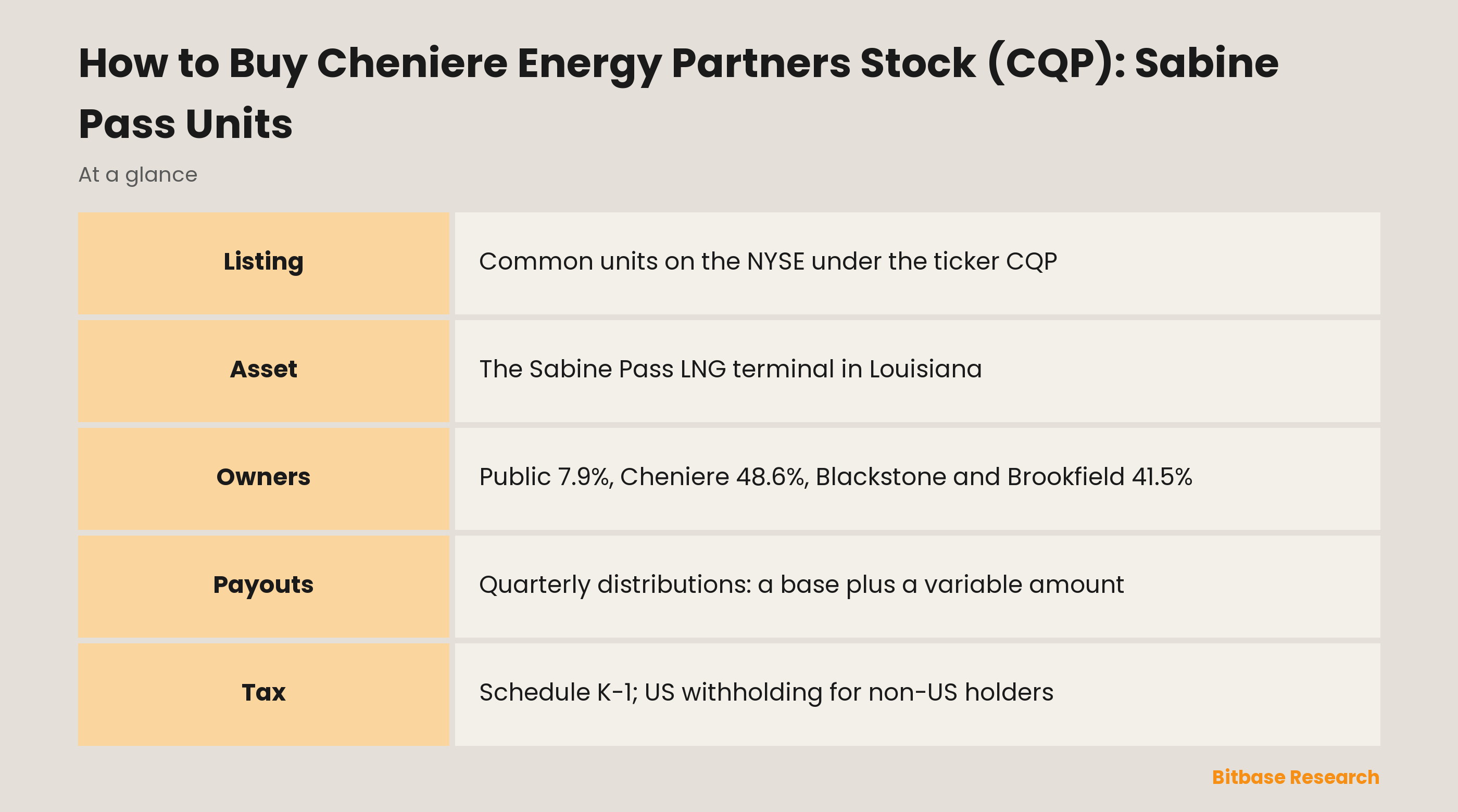
Getting CQP into a portfolio takes an ordinary order at a broker that reaches the New York Stock Exchange, where Cheniere Energy Partners' common units trade under that ticker. The partnership owns the Sabine Pass LNG terminal in Louisiana, but its 10-Q for the third quarter of 2026 puts the public's share at just 7.9%: Cheniere Energy holds 48.6% and affiliates of Blackstone and Brookfield 41.5%. Because each unit is a piece of a partnership, not stock in a corporation, the payouts, the tax forms and the rules for holders outside the US all work differently.
What Does Cheniere Energy Partners Do?
Cheniere Energy Partners, L.P. turns natural gas from US pipelines into liquefied natural gas (LNG) and loads it onto ships for buyers abroad. Its annual report calls it "a publicly traded Delaware limited partnership formed by Cheniere," and its operating business is a single site: the Sabine Pass LNG Terminal in Cameron Parish, Louisiana.
At the end of 2025 the terminal's liquefaction trains had a total production capacity of over 30 million tonnes per annum (mtpa); the third-quarter 2026 release counts six trains. Around them sit five storage tanks, three berths for LNG carriers and about 4 Bcf/d of regasification capacity for turning imported LNG back into gas. TotalEnergies has reserved 1 Bcf/d of that capacity under a long-term agreement and pays fixed monthly fees even if the space sits idle. The 94-mile Creole Trail Pipeline links the terminal to several large interstate and intrastate gas lines.
The first export cargo left in February 2016. By 23 October 2026, about 3,560 cargoes carrying over 245 million tonnes had followed.
"We have no employees," the 10-K states; Cheniere Energy, Inc., which owns the general partner, supplies the people who run the plant. The same parent owns a second plant through Corpus Christi Liquefaction in Texas, which the 10-K names as a competitor for new contracts, "primarily on the basis of price." CQP is one listed piece of a larger group; the Cheniere Energy stock guide covers the parent.
Growth is planned next door: the SPL Expansion Project would add up to about 20 mtpa in phases. For the first phase, a single train of over 6 mtpa, Bechtel signed a lump-sum, turnkey contract in May 2026, and FERC, the Federal Energy Regulatory Commission, published the final environmental impact statement for it in September 2026. Other federal approvals were still pending in October 2026.
How Cheniere Energy Partners Makes Money
Most of the money comes from long sale and purchase agreements (SPAs). Buyers generally pay a fixed fee per MMBtu, part of it indexed to inflation, plus a variable fee "generally equal to 115% of Henry Hub," the US gas benchmark. The fixed fee is owed even when a customer cancels or suspends a cargo, and the variable fee is sized to cover the gas, its transport and the fuel the plant burns. At the end of 2025 these SPAs and the producer supply deals known as IPM agreements covered about 85% of expected output through the mid-2030s, with roughly 13 years left to run on average.
The 10-K splits 2025 revenue into four lines:
| Revenue line | Share of 2025 revenue | What it is |
|---|---|---|
| LNG revenues | 76.2% | Cargoes sold to third-party buyers, mostly under long SPAs |
| LNG revenues from affiliates | 21.9% | LNG sold to Cheniere Marketing, the parent's trading arm |
| Regasification revenues | 1.3% | Fees for the import capacity, chiefly from TotalEnergies |
| Other revenues | 0.6% | Smaller items |
Each share is computed from the 10-K's 2025 statement of operations, to one decimal place.
Output not tied to a long contract goes to Cheniere Marketing for resale, so the parent is both CQP's manager and one of its biggest buyers.
The third-party book is concentrated. Five buyers each provided at least 10% of 2025 revenue from contracts with external customers: BG Gulf Coast LNG and its affiliates 22%, Korea Gas Corporation 15%, GAIL (India) 15%, Naturgy LNG GOM 14% and TotalEnergies 10%, together 76%. In all, the partnership had SPAs with about ten unrelated customers.
The pricing formula explains why sales track gas prices more than volumes. Total revenue rose 23.6% in 2025 even though the LNG loaded and recognized fell 1.3%; the 10-K credits higher Henry Hub pricing, partly offset by output lost to planned maintenance on two trains. Net income rose 19.0%, helped by gains on derivatives. For the first nine months of 2026, the partnership's release shows revenue up 12%, net income up 17% and exported volumes up 5%.
CQP Stock at a Glance
| Feature | CQP |
|---|---|
| Listing venue | New York Stock Exchange (NYSE); NYSE American from the 2007 IPO until 3 February 2024 |
| Ticker | CQP |
| Security | Common units representing limited partner interests, the only class registered under Section 12(b) |
| Legal form | Delaware limited partnership, managed by Cheniere Energy Partners GP, LLC |
| Main assets | Sabine Pass LNG Terminal and the Creole Trail Pipeline |
| Ownership (30 September 2026) | Cheniere 48.6%, Blackstone and Brookfield affiliates 41.5%, public 7.9%, plus Cheniere's 2% general partner interest |
| S&P 500 | Not a member; SPY's daily holdings file of 10 November 2026 does not list it |
| Head office | Houston, Texas |
| Financial year | Ends 31 December |
| Payouts | Quarterly cash distributions, made up of a base and a variable amount |
| Tax reporting | Schedule K-1 |
| SEC identifier | CIK 1383650 |
Prices and trading data move all day; the Cheniere Energy Partners stock page on Bitbase shows them live.
How to Buy Cheniere Energy Partners Stock
CQP is a Delaware partnership with a US listing, so no depositary receipt sits between you and the units. The order itself looks like any NYSE purchase; the differences come later, in the paperwork:
1. Pick a broker with NYSE access. Abroad, that can be a local firm with US market access or an international broker. Ask first whether your account type may hold publicly traded partnership units and how the firm applies the partnership withholding explained further down.
2. Complete the account checks. Your country of residence and tax status matter more here than for a corporate share.
3. Fund it. Converting into dollars adds a spread on top of commissions.
4. Find the right line. Search CQP and confirm the result is listed on the NYSE as common units of Cheniere Energy Partners, L.P.; the parent is a different security under LNG.
5. Choose an order type. FINRA calls the market order the type that "provides the most certainty that your order will be executed," while a limit order fills only "at or better than a specified price."
6. Decide the size. Fractional trading depends on the firm, and FINRA warns that "as a fractional share owner, you might not have shareholder voting rights."
7. Keep the records. Your cost and every distribution feed into the tax calculation when you sell.
What a unit gives you. The 10-K opens its risk factors with the point: "Limited partner interests are inherently different from the capital stock of a corporation." Unitholders cannot elect the general partner or its board, and instead of corporate dividends they share in the partnership's taxable income. That share is reported on Schedule K-1, the form a partnership "uses … to report your share of the partnership's income, deductions, credits, etc.," as the IRS puts it. Tax is owed on it whether or not cash arrives, and distributions above it lower your tax basis, which can become taxable income when you sell.
Retirement accounts. For tax-exempt holders such as IRAs, the 10-K says "virtually all" of the income allocated to them will be unrelated business taxable income.
Holders outside the United States. Here the format matters most. The 10-K treats a non-US holder's share of income, and any gain on sale, as generally "effectively connected" with a US business, which brings US tax and filing duties. Distributions are withheld at the highest applicable effective rate, and because the partnership treats every distribution as exceeding its cumulative net income, an extra 10% is withheld too. On a sale, 10% of the gross proceeds may be withheld; brokers carry out both. The IRS confirms that "a publicly traded partnership must withhold tax on actual distributions" of effectively connected income. Settle these questions with the broker and a tax professional before buying.
Through Cheniere Energy instead. The parent is a corporation whose common stock trades as LNG and pays a quarterly dividend. It owns the general partner, the incentive distribution rights and the 48.6% stake, alongside its own Corpus Christi plant: a different investment with corporate tax treatment.
Through a fund. CQP is not in the S&P 500, so a broad S&P 500 fund will not deliver it. For other funds, check the latest holdings file for CQP and how the fund itself is taxed.
What Moves CQP Stock
Distributions, base plus variable. CQP must pay out its available cash within 45 days after each quarter, after reserves set by the general partner. Recent payouts pair a fixed base amount with a variable amount. The swing can be large: distributions declared on common units for 2024 were about 21% lower than for 2023, while 2025 came in 1.5% above 2024. In October 2026 the partnership raised the low end of its full-year distribution guidance and kept the base unchanged.
Henry Hub and spot LNG. Because the variable fee follows Henry Hub, revenue moves with US gas prices even when the margin per contract barely changes. What uncontracted output earns depends on international LNG prices, and the 10-K foresees "a more ample supply landscape" in the coming years, which it says should loosen the market.
The expansion decision. A positive final investment decision on the first SPL Expansion phase would start construction and add debt; a term loan sized at about 50% of that phase's estimated cost is committed but funds only after the decision. New contracts support it: in October 2026 QatarEnergy agreed to buy up to 2 mtpa from the early 2030s through 2054, half of it conditional on the phase going ahead.
Who sells units. With the public owning only 7.9%, the large holders matter. The 10-K lists sales of units by affiliates of the general partner, Blackstone or Brookfield among the risks to the unit price.
Derivative noise in earnings. IPM agreements and similar contracts are carried at fair value, so reported net income can swing with market prices and volatility well before the related cargoes are delivered.
Customer, Control and Tax Risks in a CQP Unit
Of the 10-K's six groups of risk factors, these bear most directly on a unit:
Customers. "Our ability to generate cash is substantially dependent upon the performance by customers under long-term contracts," the filing says, and five buyers supplied 76% of 2025 revenue from external customers.
One site on the Gulf Coast. All production comes from Sabine Pass. "Weather events such as major hurricanes and winter storms have caused interruptions or temporary suspension in construction or operations at our facilities," and the partnership does not insure against every risk.
Control by the general partner. Cheniere controls the general partner, and the 10-K warns that "in resolving these conflicts, our general partner may favor its own interests." Removing it takes a vote of at least two-thirds of the units, and Cheniere is contractually barred from voting for removal. Outside holders with a 20% stake or more in any class cannot vote those units. Should Cheniere's side ever hold more than 80% of the common units, the general partner may buy out the remainder under a limited call right.
Incentive distribution rights. The general partner's share rises with the payout, up to 50% of each extra dollar above the top threshold. In 2025, 20.6% of declared distributions went to these rights and 2.0% to the general partner units, leaving 77.4% for common unitholders.
Tax status. The partnership is taxed as a partnership only while it meets the "qualifying income" requirement. "If we were treated as a corporation for federal income tax purposes," the 10-K says, cash for distribution "would be substantially reduced."
Policy and permits. US trade measures adopted in April 2025 require 1% of US LNG exports to sail on US-built ships from April 2029, rising to 15% in April 2047, while tariffs imposed in retaliation could put buyers off. Property tax incentives at Sabine Pass begin to expire in 2027.
The security. One partnership on one site is a narrow bet, and distributions carry "no assurance."
How to Research CQP Yourself
Cheniere Energy Partners files on SEC EDGAR under CIK 1383650: the annual 10-K, quarterly 10-Qs, plus 8-Ks when something material happens, such as each quarter's results. The parent files separately under CIK 3570; both released third-quarter 2026 results on 29 October.
In the 10-K, the business section (Items 1 and 2) covers Sabine Pass and the expansion, Item 1A sets out the risks, including the tax section for non-US holders, and Item 5 shows the incentive distribution schedule. A table in the MD&A splits each payment among common units, general partner units and incentive rights, and Item 10 lists the general partner's directors, including its independent conflicts committee. The XBRL cover page (R1.htm) shows one registered class: CQP's common units.
For current quotes, use the CQP page linked in the table section; Bitbase's US stock directory lists other companies.
CQP Stock FAQ
Can I buy Cheniere Energy Partners stock with crypto?
Not directly. Brokers sell CQP units for US dollars, so you would need to convert the crypto to cash first, possibly a taxable disposal in your country, and then wire the cash to the broker. A partnership unit, with its K-1 and withholding rules, is one more example of how stocks differ from crypto.
Is CQP the same as Cheniere Energy (LNG)?
No. CQP is the partnership that owns Sabine Pass; LNG is the ticker of Cheniere Energy, Inc., the corporation that controls CQP's general partner and holds 48.6% of the partnership. Buying one does not give you the other.
Does Cheniere Energy Partners pay a dividend?
Not a dividend in name: CQP makes quarterly cash distributions, its partnership equivalent. Each combines a base amount and a variable amount, and the 10-K says "there is no assurance as to the future cash distributions." Amounts and payment dates are in the quarterly releases filed on Form 8-K.
Do CQP unitholders get a K-1?
Yes. Taxed as a partnership, CQP reports each holder's share of income, deductions and credits on Schedule K-1. Holders owe tax on that share even without cash, and non-US holders also face US withholding.
Is CQP in the S&P 500?
No. Cheniere Energy Partners does not appear in State Street's SPY holdings list dated 10 November 2026, and neither does its parent.
Conclusion
The question with CQP is less which button to press than what kind of security arrives: a unit in a single-site LNG partnership whose general partner, biggest affiliated buyer and largest owner all sit within the Cheniere group. Its cash flow rests on fixed fees from a few large customers, a fifth of its distributions go to incentive rights, and its tax treatment is heavier for holders abroad. Read the 10-K's tax section, ask your broker how it handles partnership withholding, and decide how much one terminal should weigh in your portfolio.
Related reading
Other Bitbase articles on this topic:
- How to Buy Ecopetrol Stock (EC): One ADS, 20 Colombian Shares
- How to Buy EQT Stock (EQT): Range Deal, Marcellus Gas and Perps
- How to Buy Halliburton Stock (HAL): Frac Fleets and NYSE Texas
- How to Buy MPLX Stock (MPLX): Marathon's MLP, Units and K-1
- How to Buy Valero Stock (VLO): Refining, Renewable Diesel, Ethanol
Disclaimer: This article is educational content from Bitbase Academy, provided for information only. It explains what a company or fund does and how the instruments referenced here differ from one another; it does not constitute investment, trading, tax, or financial advice, and it is neither a recommendation nor an endorsement of any security, token, or trading strategy. A tokenized stock is issued by a third party and is designed to give economic exposure to an underlying asset: it is not a share, it carries no shareholder rights, and it depends on the issuer's structure, eligibility rules, and redemption terms, which the issuer can change. Perpetual futures are leveraged derivatives that hold no underlying asset and can be liquidated, and trading hours, product availability, and eligibility differ by instrument and by jurisdiction and can change at any time. Written as of November 2026; verify everything yourself through company filings, the issuer's own documentation, and the product pages of the venue you trade on.
References
[1] Cheniere Energy Partners Form 10-K for 2025 (SEC EDGAR) www.sec.gov
[2] Cheniere Energy Partners 2025 Form 10-K, XBRL cover page (SEC EDGAR) www.sec.gov
[3] Cheniere Energy Partners Form 10-Q, third quarter of 2026 (SEC EDGAR) www.sec.gov
[4] Cheniere Partners third-quarter 2026 results release, filed with Form 8-K (SEC EDGAR) www.sec.gov
[5] State Street: SPY daily holdings, 10 November 2026 www.ssga.com
[6] FINRA: Order Types www.finra.org
[7] FINRA: Investing in Fractional Shares www.finra.org
[8] IRS: Partner's Instructions for Schedule K-1 (Form 1065) www.irs.gov
[9] IRS: Partnership Withholding www.irs.gov
[10] Cheniere Energy Form 10-K for 2025 (SEC EDGAR) www.sec.gov





