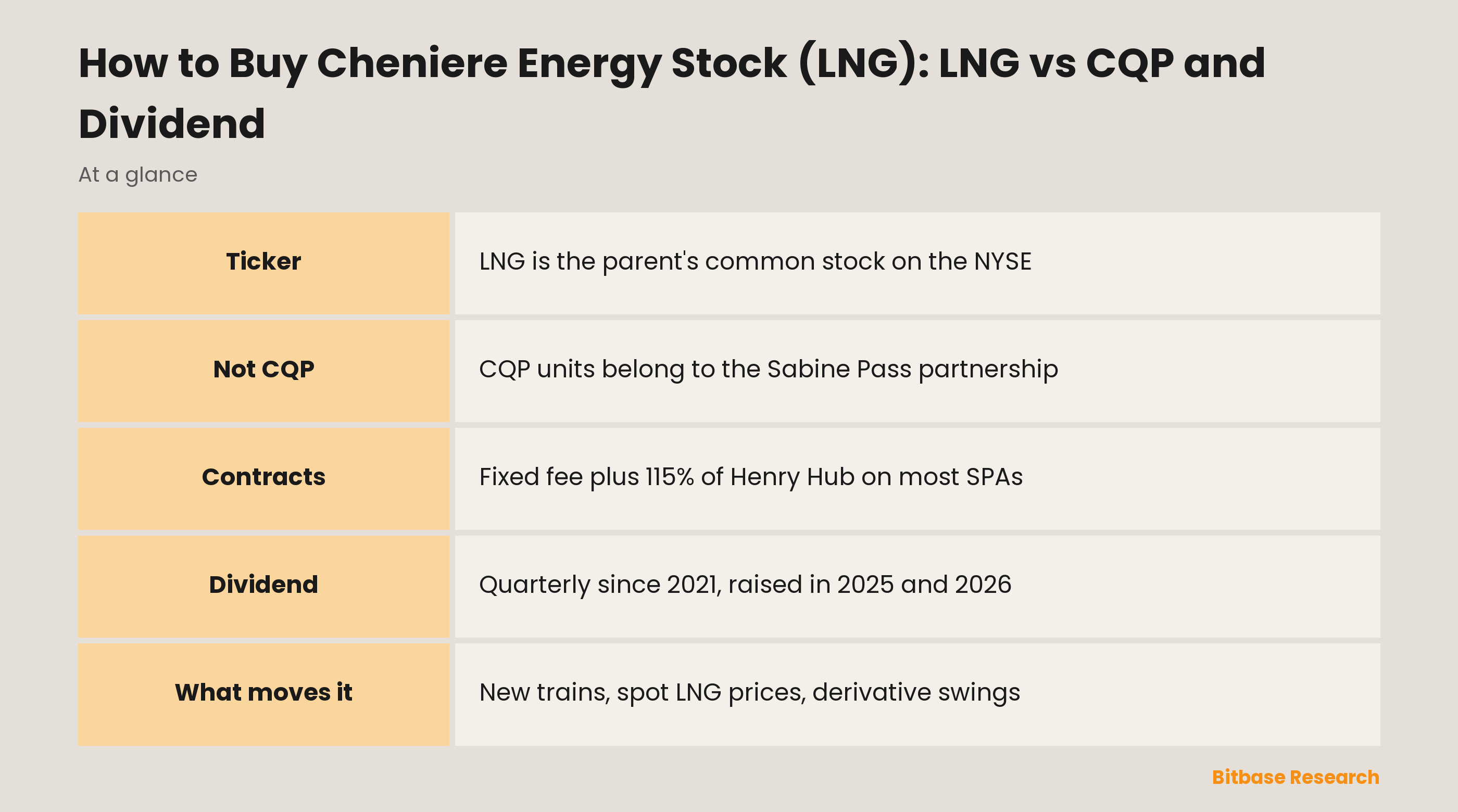
Both Cheniere Energy and its listed partnership, Cheniere Energy Partners, trade on the New York Stock Exchange, so buying Cheniere Energy stock through any broker that reaches the NYSE starts with one check: the parent's common stock is the ticker LNG, while CQP is a separate security, the units of the partnership that owns the Sabine Pass plant. Cheniere turns US natural gas into liquefied natural gas at two Gulf Coast sites and sells most of the output under long contracts that generally pay a fixed fee plus 115% of the Henry Hub gas price. This guide explains that model, the order steps and the risks its filings put first.
What Does Cheniere Energy Do?
Cheniere Energy, Inc. buys natural gas, chills it into a liquid and ships it overseas to utilities, energy companies and traders. Its annual report calls it "a Houston-based energy infrastructure company primarily engaged in LNG-related businesses." Liquefied gas takes up "approximately 1/600th" of its gaseous volume, which is what makes shipping it worthwhile; at the destination it is warmed back into gas. Cheniere is incorporated in Delaware and reports one business segment.
Sabine Pass, in Cameron Parish, Louisiana, has over 30 million tonnes per annum (mtpa) of liquefaction capacity in six trains. It also keeps about 4 Bcf/d of import (regasification) capacity, 1 Bcf/d of it reserved by TotalEnergies, which pays fixed monthly fees whether or not it uses the space. The terminal belongs to Cheniere Energy Partners (CQP), a listed partnership Cheniere formed in 2006 to own and operate it and whose general partner Cheniere still owns.
Corpus Christi, in Texas, is wholly owned. Seven midscale trains of its Stage 3 project joined three earlier liquefaction trains, and the last of them reached substantial completion in August 2026, ahead of the guaranteed schedule and within budget, "expanding Cheniere's LNG production capacity by over 20%." Midscale Trains 8 and 9, about 5 mtpa more, are being built by Bechtel; the 10-K expected them to be substantially complete in the second half of 2028.
The first cargo left in February 2016 and the 5,000th in August 2026; by 23 October 2026 the total was about 5,120. Measured by capacity, the 10-K describes Cheniere at the end of 2025 as the largest LNG producer in the United States and the second-largest LNG operator worldwide. Jack Fusco, chief executive since May 2016, also became chairman after the May 2026 annual meeting.
How Cheniere Energy Makes Money
Mainly through long contracts that pay a fixed fee even when a customer cancels a cargo. Under its sale and purchase agreements (SPAs), customers "generally purchase LNG for a price consisting of a fixed fee per MMBtu of LNG" plus a variable fee "generally equal to 115% of Henry Hub," the US benchmark gas price. The fixed fee "is the amount payable to us regardless of a cancellation or suspension of LNG cargo deliveries by the customers." The variable fee is sized to cover buying and moving the gas and the fuel the plants burn, which limits Cheniere's exposure to rising US gas prices.
Under integrated production marketing (IPM) agreements, the reverse arrangement, a gas producer sells gas to Cheniere at a global LNG or gas index price minus a fixed liquefaction fee, shipping and other costs. At the end of 2025 the two contract types covered about 90% of expected production through the mid-2030s, with a weighted average remaining life of about 15 years. About 30 third-party customers held SPAs of ten years or more, and none accounted for 10% or more of 2025 revenue. The rest goes to Cheniere Marketing, the in-house trading arm, for spot or short-term sale.
| Revenue source | Share of 2025 revenue | What it covers |
|---|---|---|
| LNG under long-term agreements | 74.1% | Third-party contracts with an initial tenor of 12 months or more |
| LNG sold by Cheniere Marketing | 19.0% | Spot and short-term sales, including gas bought under IPM agreements |
| Derivative gains and other LNG revenue | 3.1% | Net gains on derivative contracts and smaller LNG items |
| Regasification and other revenue | 2.7% | Sabine Pass import capacity fees, vessel subleases and subcharters |
| LNG bought from third parties | 1.1% | Cargoes sourced elsewhere and resold |
Shares are calculated from the fiscal 2025 results table in the 10-K and rounded to one decimal.
By volume, long-term agreements took 85.9% of the LNG delivered in 2025. Total revenue rose 27.2% from 2024, and the 10-K attributes about two-thirds of the increase to higher prices, "primarily from increased Henry Hub pricing, to which the majority of our long-term LNG sales contracts are indexed." That is the odd feature of the model: the top line follows US gas prices, while much of what the contracted business keeps comes from the fixed fee.
Reported profit is noisier. Net income attributable to Cheniere rose 63.9% in 2025, mainly, the 10-K says, because of favourable changes in the fair value of derivatives tied largely to IPM agreements. And because Cheniere consolidates CQP, its statements show all of the partnership's results and then subtract the outside owners' part, which in 2025 came to 21.5% of consolidated net income.
LNG Stock at a Glance
| Item | Detail |
|---|---|
| Exchange | New York Stock Exchange (NYSE) since 5 February 2024; NYSE American before that |
| Ticker | LNG |
| Security | Common stock; the 10-K's 12(b) cover registers nothing else |
| Legal form | Delaware corporation |
| Headquarters | Houston, Texas |
| Sector | Energy infrastructure: natural gas liquefaction and LNG export |
| Index membership | Not in the S&P 500: absent from SPY's holdings on 29 October 2026 |
| Fiscal year | Calendar year, ending 31 December |
| Dividend | Quarterly, first paid for the third quarter of 2021 |
| Related listing | Cheniere Energy Partners (CQP), a partnership in which Cheniere holds 48.6% of the limited partner interest |
| SEC identifier | CIK 3570 (CQP files separately under CIK 1383650) |
Quotes, the chart and market value change through the trading day; the Cheniere Energy stock page on Bitbase shows them live.
How to Buy Cheniere Energy Stock
Cheniere has a single class of listed shares and no depositary receipts, so the route is an ordinary US share purchase:
1. Choose a broker with access to NYSE-listed shares. Local or international, check which entity holds your account and who supervises it.
2. Open the account and confirm your tax status. Non-US individuals generally complete IRS Form W-8BEN, which lets the broker withhold US tax on dividends at a treaty rate where one applies.
3. Deposit funds. Converting into US dollars adds an exchange spread to the commission.
4. Search for LNG and read the result line. You want Cheniere Energy, Inc. common stock on the NYSE. The same letters appear in other names, such as Golar LNG (GLNG) and Flex LNG (FLNG), and CQP is the partnership, not the parent.
5. Pick an order type. According to FINRA, a market order "provides the most certainty that your order will be executed because it's not tied to any restrictions," whereas a limit order is "an order to buy or sell a security at or better than a specified price."
6. Size the position. "The availability of fractional share trading varies by brokerage firm," FINRA notes, and an owner of a fraction "might not have shareholder voting rights."
7. File the confirmations. They record your cost and, later, the dividends you receive.
Why LNG and CQP are not interchangeable. CQP units are partnership interests, and the tax treatment differs. CQP's own 10-K says unitholders owe US federal income tax on their share of its taxable income "irrespective of whether they receive cash distributions," and that distributions to non-US unitholders are withheld "at the highest applicable effective tax rate"; when a non-US holder sells, "withholding at a rate of 10% may be required on the amount realized." An LNG share is common stock in a corporation that records its own income tax.
Tax on dividends outside the US. The IRS instructs anyone paying dividends to nonresident aliens to "withhold at 30% or lesser tax treaty rate," and the owner claims the lower rate on Form W-8BEN given to the withholding agent, usually the broker. The same dividend can also be taxed where you live.
Through an index fund. Do not assume an S&P 500 fund holds Cheniere: State Street's holdings files for 29 October 2026 show it neither in SPY nor in SPTM, its S&P 1500 composite fund. Funds built on other index families may own it; their holdings files will say so.
What Moves LNG Stock
Spot LNG on uncontracted volume. Volume outside long contracts is sold by Cheniere Marketing, and output from new trains goes "at prevailing market prices" until its long-term SPAs begin. The 10-K says profitability on those short-term sales "is largely dependent on the strength of international LNG markets," and its market review expects "a more ample supply landscape" to loosen global balances over the next few years.
New trains and new contracts. After Midscale Trains 8 and 9 come two proposed expansions: up to about 20 mtpa at Sabine Pass and up to 24 mtpa at Corpus Christi. For the first Sabine Pass phase, a single train, Cheniere signed a lump-sum, turnkey contract with Bechtel in May 2026, and the Federal Energy Regulatory Commission (FERC) issued its final environmental impact statement in September 2026; the investment decision still awaits approvals and financing. Recent buyers include QatarEnergy (up to 4 mtpa from the early 2030s through 2054), Petrobras (0.8 mtpa for 22 years) and JERA (about 1 mtpa from 2029 to 2050).
Derivative swings in reported earnings. The 10-K warns that derivatives, "including our IPM agreements," could have "a significant adverse or otherwise volatile effect on our earnings reported under GAAP," because they are carried at fair value. In the first nine months of 2026, LNG exports rose 17% from a year earlier, yet net income attributable to Cheniere fell 76%, which the quarterly release attributes primarily to unfavourable fair value changes, mostly on IPM agreements. The release also gives non-GAAP measures; reading both explains much of the headline swing.
Capital returns. Dividend increases (see the FAQ) come alongside buybacks: Cheniere repurchased about 12.1 million shares in 2025, and in February 2026 the board enlarged its authorization and extended it to 2030. The 10-Q cover's share count as of 23 October 2026 was 2.9% below the 10-K cover's count as of 20 February 2026.
Seasons and maintenance. The plants produce more in cooler months than in summer, and major maintenance usually falls in the second and third quarters, so output and profit are not spread evenly across the year.
Risks Cheniere's Long-Term Contracts Don't Remove
Item 1A of the 2025 10-K, unchanged in substance according to the latest 10-Q, contains these passages most relevant to a shareholder:
Customers and their exit clauses. "Our ability to generate cash is substantially dependent upon the performance by customers under long-term contracts that we have entered into." Customers can terminate if Cheniere fails to make scheduled cargoes available, if commercial operations are delayed or, under most SPAs, in certain force majeure events.
Re-contracting later. The 10-K warns that "the LNG we produce may not remain a long term competitive source of energy internationally, particularly when our existing long term contracts begin to expire," and that new SPAs compete with other liquefaction projects mainly on price.
Building on time and on budget. The expansions depend on Bechtel and other contractors, and "although our major EPC contracts are fixed price, as construction progresses, we may decide or be forced to submit change orders." Further expansions need significant additional funding.
Cash that cannot always move up. Debt agreements at two subsidiaries restrict distributions unless reserves and coverage tests are met, and "our Board may reduce our dividend or cease declaring dividends at any time."
Gulf Coast exposure. "Weather events such as major hurricanes and winter storms have caused interruptions or temporary suspension in construction or operations at our facilities." Property tax incentives also begin to expire from 2026 at Corpus Christi and from 2027 at Sabine Pass.
Trade and permits. US Trade Representative measures require that, from April 2029, 1% of US LNG exports travel on US-built vessels, rising to 15% in April 2047, and retaliatory tariffs could deter buyers. There is "no assurance" that federal permits arrive on time.
Beyond the filings, a single stock ties your money to one company and one commodity chain, and for non-US investors every return also passes through the dollar.
Where to Verify LNG and CQP Information
Cheniere's SEC filer number (CIK) is 3570, and CQP reports separately under CIK 1383650, so the partnership's taxes and distributions are in its filings. In Cheniere's 10-K, Items 1 and 2 describe the terminals and contracts, Item 1A the risks, and Item 5 the listing history plus a performance graph against the S&P 500 and a 17-company peer group that puts ConocoPhillips alongside other producers, refiners, pipeline operators and chemical makers. Note 8 explains the CQP stake, Note 12 the SPA pricing, and the structured cover, R1.htm, lists a single registered security.
Each quarterly results release, filed on Form 8-K, reports cargo counts, construction progress and the dividend, and in 2026 each 10-Q came out the same day; cheniere.com posts both. For prices, the stock page above is the place to look; the Bitbase stock directory lists other US-listed companies.
Cheniere Energy Stock FAQ
Does Cheniere Energy pay a dividend?
Yes. It has been paid quarterly since the board introduced it in its September 2021 capital allocation plan, with a first payment on 17 November 2021. A June 2025 plan raised the annualized rate by over 10%, and the dividend declared for the third quarter of 2026 was more than 12% above the one before. Each payment is at the board's discretion; amounts and dates are in the latest quarterly release.
Can I buy Cheniere Energy stock with crypto?
Not directly. LNG is bought through a brokerage account in US dollars, so crypto must first be sold for cash, which may trigger tax in your country, and the money sent to the broker. The result is registered common stock carrying dividend and voting rights, one of the points on how listed shares differ from crypto assets.
What is the difference between Cheniere Energy and Cheniere Energy Partners?
LNG is the common stock of Cheniere Energy, Inc., which owns Corpus Christi outright, owns CQP's general partner and consolidates the partnership. CQP is the common units of Cheniere Energy Partners, L.P., which owns Sabine Pass and has been listed since 21 March 2007. On 30 September 2026 Cheniere held a 48.6% limited partner interest, the entire 2% general partner interest and all incentive distribution rights; the other 49.4% belonged to affiliates of Blackstone and Brookfield and the public. An LNG share reaches both terminals; a CQP unit covers Sabine Pass alone and is taxed as a partnership interest.
Is Cheniere Energy in the S&P 500?
No, judging by the funds that replicate it: State Street's SPY holdings file for 29 October 2026 does not list Cheniere, and nor does the file for SPTM, its S&P 1500 fund. Membership can change, so check a current file.
What exchange does LNG stock trade on?
The New York Stock Exchange, since 5 February 2024. Before that it traded on the NYSE American or its predecessors from 24 March 2003 through 3 February 2024. CQP's units also left the NYSE American after 3 February 2024 and now trade on the NYSE.
Conclusion
Buying Cheniere comes down to an NYSE-capable broker, the ticker LNG and a market or limit order, with CQP left aside unless you want the partnership. The share gives you two Gulf Coast export plants whose revenue follows Henry Hub but whose margins rest largely on fixed fees, and a reported profit that derivatives can push sharply either way. Before deciding how much belongs in one LNG exporter, read the newest 10-Q and quarterly release for construction progress, new contracts and the dividend.
Related reading
Other Bitbase articles on this topic:
- How to Buy Baker Hughes Stock (BKR): Chart, LNG and the Rig Count
- How to Buy BP Stock (BP): Six Shares per ADS and the Dividend
- How to Buy Canadian Natural Resources Stock (CNQ): Oil Sands Owner
- How to Buy Phillips 66 Stock (PSX): Midstream, CPChem and Elliott
Disclaimer: This article is educational content from Bitbase Academy, provided for information only. It explains what a company or fund does and how the instruments referenced here differ from one another; it does not constitute investment, trading, tax, or financial advice, and it is neither a recommendation nor an endorsement of any security, token, or trading strategy. A tokenized stock is issued by a third party and is designed to give economic exposure to an underlying asset: it is not a share, it carries no shareholder rights, and it depends on the issuer's structure, eligibility rules, and redemption terms, which the issuer can change. Perpetual futures are leveraged derivatives that hold no underlying asset and can be liquidated, and trading hours, product availability, and eligibility differ by instrument and by jurisdiction and can change at any time. Written as of October 2026; verify everything yourself through company filings, the issuer's own documentation, and the product pages of the venue you trade on.
References
[1] Cheniere Energy Form 10-K, fiscal 2025 (SEC EDGAR) www.sec.gov
[2] Cheniere 10-K, fiscal 2025: XBRL cover page (SEC EDGAR) www.sec.gov
[3] Cheniere Energy Form 10-Q, third quarter 2026 (SEC EDGAR) www.sec.gov
[4] Cheniere third-quarter 2026 results release (Form 8-K) www.sec.gov
[5] Cheniere 2026 proxy statement (SEC EDGAR) www.sec.gov
[6] Cheniere third-quarter 2021 results release: dividend initiation (Form 8-K) www.sec.gov
[7] Cheniere Energy Partners Form 10-K, fiscal 2025 (SEC EDGAR) www.sec.gov
[8] SEC: company tickers and exchanges file www.sec.gov
[9] State Street, SPDR S&P 500 ETF Trust (SPY): daily holdings, 29 October 2026 www.ssga.com
[10] State Street, SPDR Portfolio S&P 1500 Composite Stock Market ETF (SPTM): daily holdings, 29 October 2026 www.ssga.com
[11] FINRA: Order Types www.finra.org
[12] FINRA: Investing in Fractional Shares www.finra.org
[13] IRS: withholding on other US-source income paid to nonresident aliens www.irs.gov





