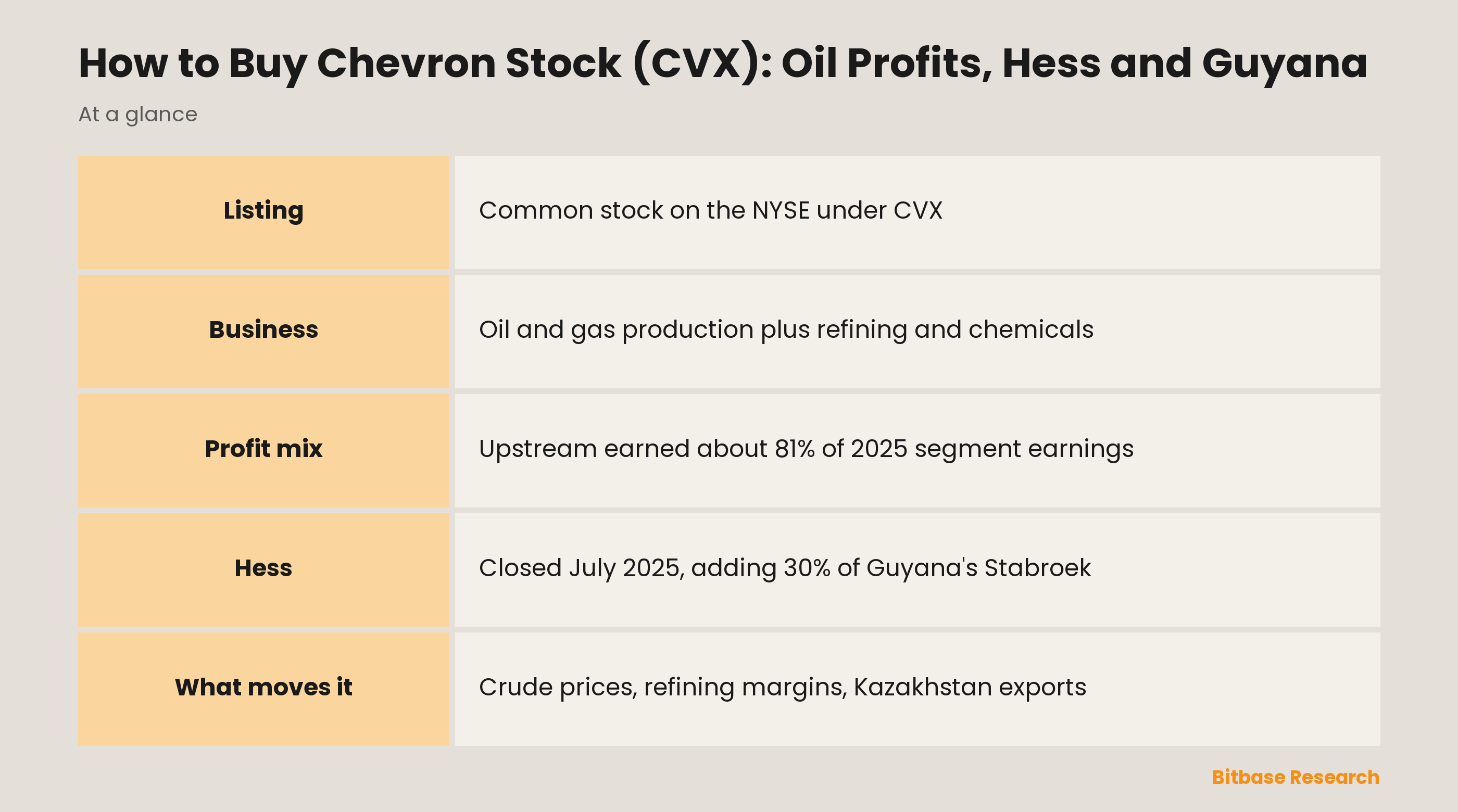
On the New York Stock Exchange, Chevron common stock trades under the ticker CVX, and any broker that reaches that market can buy it for you. Most of the company's revenue comes from selling fuels and chemicals, but most of its profit comes from producing oil and gas: in 2025 the downstream segment brought in about 71% of segment revenue while upstream delivered about 81% of segment earnings. The Hess acquisition, completed that July, added a 30% stake in Guyana's Stabroek Block. This guide explains how the business fits together, how to place the order, and which forces the company's own filings tie most closely to the share.
What Does Chevron Do?
Chevron Corporation is an integrated energy company. In the words of its annual report, the parent manages "its investments in subsidiaries and affiliates" that "engage in integrated energy and chemicals operations": it finds and produces crude oil and natural gas, and it turns crude into fuels, lubricants and petrochemicals. It was incorporated in Delaware in 1926 as Standard Oil Company of California, took the name Chevron Corporation in 1984, became ChevronTexaco in 2001 and went back to Chevron in 2005. Its filings give its headquarters as Houston, Texas.
The business reports two segments.
Upstream explores for, develops, produces and transports crude oil and natural gas, and runs the liquefied natural gas (LNG) plants, export pipelines and carbon capture operations that go with them. The 10-K's tour of its key areas shows how widely that is spread. In the Permian Basin, across West Texas and southeast New Mexico, production reached one million barrels of net oil-equivalent per day in 2025. In the deepwater Gulf of America the company calls itself the largest acreage holder following the Hess deal, which also brought the Bakken shale in North Dakota. Offshore Guyana it holds a nonoperated 30% interest in the Stabroek Block, and in Kazakhstan a 50% interest in Tengizchevroil (TCO), which operates the Tengiz and Korolev oil fields. In Australia it operates the Gorgon and Wheatstone LNG projects, and in Israel the Leviathan and Tamar gas fields.
Downstream refines crude oil and markets the products. Chevron owns five US refineries, in Pascagoula, El Segundo, Richmond, Pasadena and Salt Lake City, and a majority-owned refinery in Thailand, and holds 50% of the refining affiliates GS Caltex in South Korea and Singapore Refining Company. Fuel is sold under the Chevron, Texaco and Caltex brands. The segment also includes Chevron Oronite, which makes fuel and lubricant additives, renewable fuel plants in the US and Germany, and a 50% share of Chevron Phillips Chemical, a petrochemicals joint venture.
On competition the 10-K stays general: Chevron "competes with fully integrated, major global petroleum companies, as well as independent and national petroleum companies." Exxon Mobil is another integrated company but reports along different lines, with one Upstream segment and three manufacturing segments grouped as Product Solutions, as the Exxon Mobil profile sets out. Chevron is also adding lines beside its core: in 2026 it signed an agreement to develop a power facility in West Texas that would supply Microsoft under a 20-year purchase agreement.
How Chevron Makes Money
Upstream revenue comes "primarily from the production and sale of crude oil, natural gas and NGLs," natural gas liquids being the third product. Downstream revenue comes from gasoline, jet fuel, diesel, lubricants and other oil products, plus additives and renewable fuels. When one segment supplies the other, the transfer is priced at internal values that "approximate market prices."
Measured by sales, Chevron is mostly a fuels business. Measured by profit, it is mostly an oil and gas producer:
| Year | Upstream share of revenue | Downstream share of revenue | Upstream share of segment earnings | Downstream share of segment earnings |
|---|---|---|---|---|
| 2023 | 23.2% | 76.8% | 74.0% | 26.0% |
| 2024 | 24.2% | 75.8% | 91.5% | 8.5% |
| 2025 | 29.0% | 71.0% | 80.9% | 19.1% |
Calculated from the segment note of the fiscal 2025 10-K: revenue is sales and other operating revenues after intersegment eliminations, earnings are after-tax segment income, and each share is of the two segments combined, leaving out the corporate line, All Other.
Part of the gap is arithmetic. A refiner's revenue includes the full value of the crude it buys and resells as fuel, so its sales look large next to its margin, while a producer keeps the difference between its selling price and its own costs. The 10-K puts the dependence plainly: "Earnings of the company depend mostly on the profitability of its upstream business segment."
In 2025 net income attributable to Chevron fell 30.4% even though volumes grew; the filing puts the upstream decline down mainly to lower realized prices and higher depreciation, partly offset by higher sales volumes. Worldwide production averaged 3.7 million barrels of oil-equivalent per day, up about 12% on 2024. By the 10-K's production table, 49.9% of it came from the United States and 61.9% was liquids, meaning crude oil and natural gas liquids, rather than gas.
Proved reserves at the end of 2025 were about 10.6 billion barrels of oil-equivalent, 8% more than a year earlier, with Hess and the Permian Basin the largest additions. Of the total, 43% sat in the United States, 15% in Australia and 11% in Kazakhstan.
Some profit does not show up in sales at all. Equity-method affiliates, TCO, Angola LNG and the Caspian Pipeline Consortium in upstream and Chevron Phillips Chemical and GS Caltex in downstream, contribute their earnings as one line, "income from equity affiliates." Venezuela differs again: since 2020 those interests have been carried as non-equity investments, with income recognized only when cash is received and production and reserves left out of the reported figures.
CVX Stock at a Glance
| Item | Detail |
|---|---|
| Exchange | New York Stock Exchange (NYSE) |
| Ticker | CVX |
| Security | Common stock, the only security registered under Section 12(b) on the 10-K cover |
| Sector | Energy: integrated oil, gas and chemicals |
| Index membership | S&P 500 and Dow Jones Industrial Average; also held by the Energy Select Sector SPDR ETF (XLE) |
| Headquarters | Houston, Texas |
| Incorporated | Delaware, 1926, as Standard Oil Company of California |
| Fiscal year | Calendar year, ending 31 December |
| Reporting segments | Upstream and Downstream |
| Dividend policy | Quarterly cash dividend; 2025 was the 38th consecutive year of a higher annual payout per share |
| Share repurchases | Program authorized in January 2023, with no fixed expiration date |
| Stock split | Two-for-one, September 2004 |
| SEC identifier | CIK 93410 |
Quotes, market value and yield change with every trade; for live figures, open the Chevron stock page on Bitbase.
How to Buy Chevron Stock
Chevron is a Delaware corporation listed in New York, so no depositary receipt is involved: what trades on the NYSE is the common stock itself. You buy it through a broker.
1. Choose a broker with NYSE access. For a reader abroad, either a domestic firm with US market access or an international broker will do; check which entity will hold your account and who supervises it.
2. Pass the account checks. Brokers ask non-US individuals for IRS Form W-8BEN, the certificate of foreign status used when withholding US tax on dividends.
3. Add money. If your savings are not in US dollars, compare the exchange rate a broker offers as well as its commission.
4. Find the right security. Search for CVX and check that the result reads Chevron Corp common stock on the NYSE; in this guide CVX always means that stock. Crypto tickers are not reserved the way exchange symbols are, so the same letters can label unrelated tokens, which is how crypto tickers and stock symbols collide. Match the company name, not just the letters.
5. Pick an order type. A market order "guarantees that the order will be executed, but does not guarantee the execution price." If the price matters more than speed, use a limit: "A buy limit order can only be executed at the limit price or lower."
6. Settle on whole or fractional shares. Investor.gov warns that "not every brokerage firm offers fractional share investing." A fraction still earns dividends "based on the percentage of a whole share that you own," but "you generally cannot transfer fractional shares to another brokerage firm."
7. Keep the paperwork. Confirmations and dividend statements record your cost and income for tax purposes.
Outside the United States, dividends carry US tax at source. The IRS states that "most types of U.S. source income received by a foreign person are subject to U.S. tax of 30%," and a tax treaty between your country and the US can lower that rate, which is what Form W-8BEN is for. Your own country may tax the income again.
Through funds, Chevron can be one holding among many. State Street's S&P 500 trust (SPY), Dow Jones Industrial Average trust (DIA) and Energy Select Sector fund (XLE) all listed it in holdings files dated 16 October 2026. Its weight in each changes daily.
What Moves CVX Stock
Crude oil prices. The risk section is direct: "An investment in the company carries significant exposure to fluctuations in global prices of crude oil, natural gas, and natural gas liquids." With upstream at 80.9% of 2025 segment earnings, oil prices are the first variable to watch, and 2025 showed why: more barrels, lower realized prices, lower profit.
Refining margins. Downstream earnings "depend upon the supply and demand for refined products and the associated margins on refined product sales," and crude is the largest cost of refined products. The two segments do not move together. In 2024 upstream earnings rose 6.7% while downstream earnings fell 71.9%; in 2025 the pattern reversed, with upstream down 31.1% and downstream up 75.0%. Integration cushions a swing on either side without removing it.
Hess, Guyana and what followed. Chevron agreed to buy Hess in October 2023 and completed the deal on 18 July 2025, after what it called "a favorable arbitration outcome regarding Hess' offshore Guyana asset." Guyana is still growing: the fourth production vessel on the Stabroek Block started in August 2025, and the 10-K expects eight to be producing by 2030. The deal also brought Hess Midstream, a listed pipeline partnership. On 6 October 2026 Chevron announced it would transfer its ownership interests and general partner position in Hess Midstream to that partnership, together with its DJ Basin crude pipeline assets, in exchange for longer and improved Bakken contracts; closing is expected by the end of 2026, subject to approvals.
Kazakhstan and one export route. TCO completed its Future Growth Project at Tengiz in 2025, and its concession runs until 2033. Most of its crude leaves through the Caspian Pipeline Consortium, in which Chevron holds 15% and which the 10-K files under "Kazakhstan/Russia." The mid-2026 quarterly report warns that incidents "such as drone attacks on CPC and third-party infrastructure and vessels" could hurt results.
Sanctions and conflict. Chevron works in Venezuela only as far as US government authorizations allow, and the same report says "current geopolitical developments relating to Venezuela could have an impact" there. In the Middle East, conflict has curtailed output in the Partitioned Zone between Saudi Arabia and Kuwait and at Chevron Phillips Chemical plants in Saudi Arabia and Qatar, though the company says its "physical operations have not been materially impacted to date."
Portfolio moves and capital returns. In 2026 Chevron sold its Hong Kong fuels and lubricants businesses, agreed to sell its 50% of Singapore Refining Company with other Asia-Pacific downstream assets, a deal expected to close in 2027, and signed heads of agreements with Iraq on two oilfield developments. On shareholder returns the 10-K sets a priority: in a long downturn the company can "discontinue or curtail the stock repurchase program. This provides the flexibility to continue paying the common stock dividend." In that ordering, the buyback is the part that flexes.
Risks Chevron Itself Flags
Item 1A of the 10-K runs to several pages. Six of its headings speak most directly to someone holding CVX:
Price volatility. "Chevron is primarily in a commodities business that has a history of price volatility." Long periods of low prices can bring asset impairments and cuts to spending and reserves.
Replacing what it produces. "The scope of Chevron's business will decline if the company does not successfully develop resources." Every barrel sold has to be replaced through projects, exploration or acquisitions.
Politics and regulation. "Political instability and significant changes in the legal and regulatory environment could harm Chevron's business." The section names sanctions on Venezuela and Russia, windfall profit taxes in places including California and Australia, and climate rules that could raise costs and reduce demand.
Litigation. By mid-2026 Chevron entities were or had been codefendants in 34 climate-change lawsuits brought by US cities, counties, states and others, and defendants in 35 Louisiana coastal-erosion cases. In one of those, the US Supreme Court ruled in April 2026 that the case related to actions taken under federal direction and sent it back for further proceedings; the company does not concede the earlier jury verdict and plans to appeal any judgment based on it.
Limited insurance. Chevron is, "to a substantial extent, self-insured" against catastrophic events.
Acquisition delivery. The Hess deal "may cause Chevron's financial results to differ from the company's expectations or the expectations of the investment community."
Beyond the company sit two more. A single holding puts your outcome on one management team's choices, however many countries those choices reach. And 38 years of rising payouts describe the past: every dividend needs a board declaration, and an investor who lives outside the dollar area also carries currency risk on both the share price and the income.
How to Check Chevron's Filings Yourself
Chevron files with the SEC under CIK 93410. Annual reports come as 10-Ks, quarterly ones as 10-Qs, and anything material between them as an 8-K, such as the July 2025 Hess completion and the October 2026 Hess Midstream announcement. Inside the 10-K, Item 1 walks through upstream activity country by country, Item 1A lists the risks, Note 14 holds the segment income statements behind the shares above, Note 15 covers equity affiliates such as TCO, and the litigation note tracks the climate and Louisiana cases.
Two checks save mistakes. The structured cover of the annual report, R1.htm, lists a single security registered under Section 12(b): the common stock trading as CVX on the NYSE. And fund holdings files identify that share by CUSIP 166764100 as well as by ticker, which pins down the security itself rather than just its letters. For quotes, use the stock page linked above; for other companies, see the full list of US stock pages on Bitbase.
Chevron Stock FAQ
Does Chevron pay a dividend?
Yes, every quarter. The 10-K calls 2025 "the 38th consecutive year that the company increased its annual per share dividend payout," and the board raised the quarterly dividend again in January 2026. The same report says "there are no restrictions on the company's ability to pay dividends," yet each payment remains a board decision.
Can I buy Chevron stock with crypto?
Not directly. A broker needs cash in the account before it buys CVX, so any crypto has to be sold first and the money transferred; in many countries that sale is itself a taxable event. The two holdings are also different in kind: the share is a registered piece of the company that pays dividends and votes, which is how a share differs from a crypto asset.
Is CVX in the S&P 500 and the Dow?
It is in both. Chevron appears in State Street's SPY and DIA holdings files dated 16 October 2026, and in the file for the energy sector fund XLE. Index weights are not fixed and move every trading day.
What did Chevron get from buying Hess?
Mainly Guyana: a 30% interest in the Stabroek Block, alongside Bakken acreage, Gulf of America fields and natural gas in Southeast Asia. The deal closed on 18 July 2025 and was paid largely in Chevron shares issued to Hess stockholders. The midstream piece is on its way out under the October 2026 agreement.
Has Chevron stock ever split?
Yes. Its 2004 annual report records a two-for-one split in September 2004, carried out as a stock dividend. Adjust per-share figures from before then before comparing them with later years.
Conclusion
The purchase itself is routine: an NYSE-capable broker, the Chevron Corp common stock line, a market or limit order. Understanding the company behind it takes longer: a fuels business that brings in most of the revenue, an oil and gas business that earns most of the profit, and an upstream portfolio reshaped by Hess around Guyana, the Permian and Kazakhstan. Before sizing a position in one energy stock, go through the newest annual and current reports with three things in view: crude prices, refining margins and the export route out of Kazakhstan.
Related reading
Other Bitbase articles on this topic:
- How to Buy Baker Hughes Stock (BKR): Chart, LNG and the Rig Count
- How to Buy BP Stock (BP): Six Shares per ADS and the Dividend
- How to Buy Canadian Natural Resources Stock (CNQ): Oil Sands Owner
- How to Buy SLB Stock (SLB): Schlumberger Renamed, ChampionX Added
Disclaimer: This article is educational content from Bitbase Academy, provided for information only. It explains what a company or fund does and how the instruments referenced here differ from one another; it does not constitute investment, trading, tax, or financial advice, and it is neither a recommendation nor an endorsement of any security, token, or trading strategy. A tokenized stock is issued by a third party and is designed to give economic exposure to an underlying asset: it is not a share, it carries no shareholder rights, and it depends on the issuer's structure, eligibility rules, and redemption terms, which the issuer can change. Perpetual futures are leveraged derivatives that hold no underlying asset and can be liquidated, and trading hours, product availability, and eligibility differ by instrument and by jurisdiction and can change at any time. Written as of October 2026; verify everything yourself through company filings, the issuer's own documentation, and the product pages of the venue you trade on.
References
[1] Chevron Corporation Form 10-K, fiscal 2025: business, segment results and risk factors (SEC EDGAR) www.sec.gov
[2] Chevron Corporation Form 10-Q for the quarter ended 30 June 2026: developments, risks and litigation (SEC EDGAR) www.sec.gov
[3] Chevron press release, 18 July 2025: completion of the Hess acquisition (Form 8-K, Exhibit 99.1) www.sec.gov
[4] Chevron press release, 6 October 2026: divestment of its Hess Midstream interests (Form 8-K, Exhibit 99.1) www.sec.gov
[5] ChevronTexaco Corporation Form 10-K, fiscal 2004: two-for-one stock split of September 2004 (SEC EDGAR) www.sec.gov
[6] State Street SPDR S&P 500 ETF Trust (SPY): fund page and daily holdings www.ssga.com
[7] State Street SPDR Dow Jones Industrial Average ETF Trust (DIA): fund page and daily holdings www.ssga.com
[8] State Street Energy Select Sector SPDR ETF (XLE): fund page and daily holdings www.ssga.com
[9] Investor.gov (SEC): Types of Orders www.investor.gov
[10] Investor.gov (SEC): Investor Bulletin on fractional share investing www.investor.gov
[11] IRS: NRA Withholding www.irs.gov





