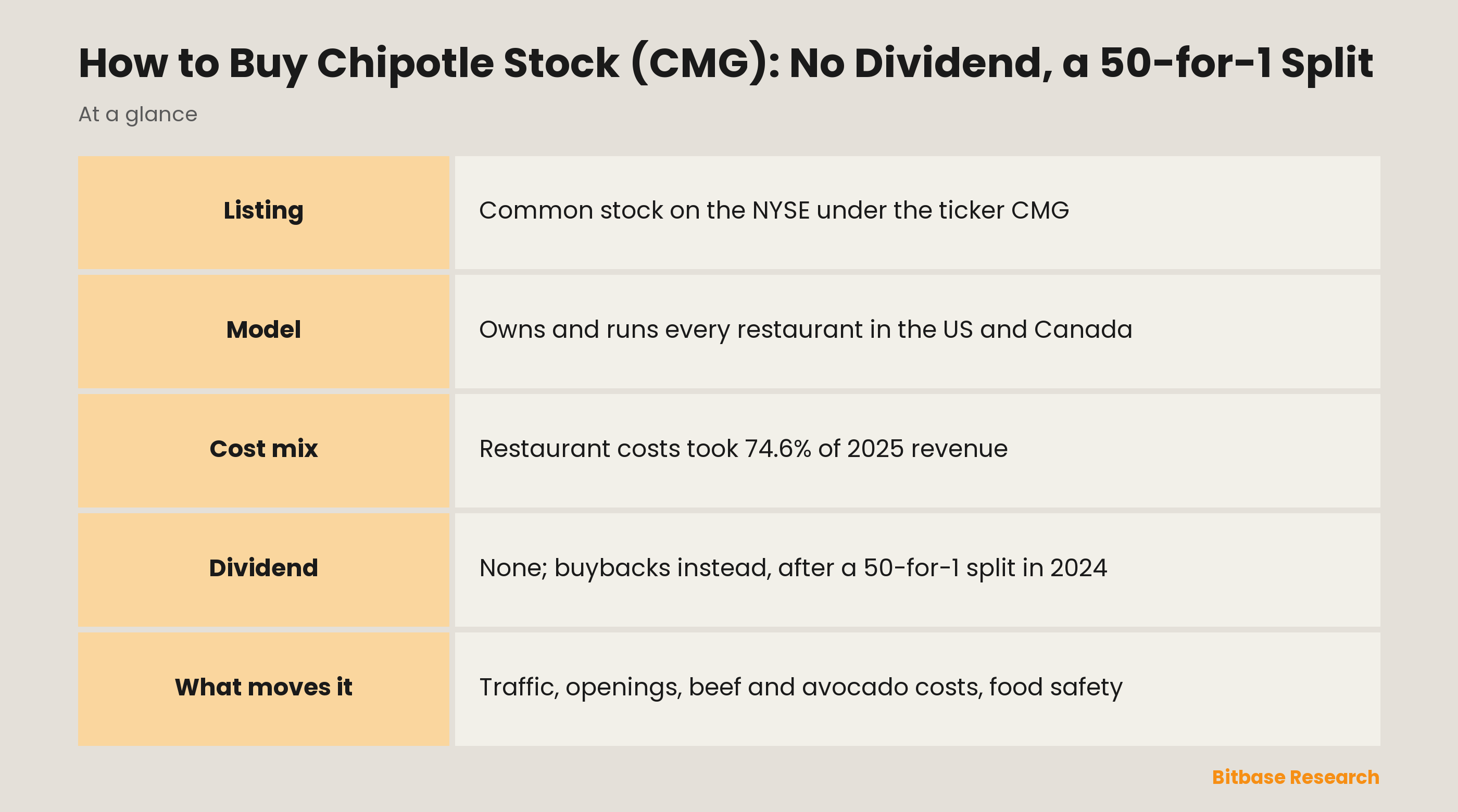
The shortest route to Chipotle stock runs through a brokerage account that can trade New York Stock Exchange shares: search for the ticker CMG, choose an order type and buy. Chipotle Mexican Grill pays no cash dividend, owns and operates every restaurant it has in the United States and Canada, and split its shares 50-for-1 in June 2024. Below: how the company makes its money, the steps of an order, and what has driven the stock, from restaurant openings and food costs to food safety.
What Does Chipotle Do?
Chipotle runs fast-casual Mexican restaurants. Its annual report describes a "relevant menu of burritos, burrito bowls (a burrito without the tortilla), quesadillas, tacos, and salads," served "without artificial colors, flavors or preservatives." The first restaurant opened in Denver, Colorado in 1993. The company is incorporated in Delaware and has its headquarters in Newport Beach, California.
Scale is the first thing to know. At the end of 2025 Chipotle owned 3,938 restaurants in the United States and 104 outside it, 4,042 in total, and its international employees worked in Canada, France, Germany and the United Kingdom. A further 14 restaurants in the Middle East were run by a partner, the Alshaya Group. By 30 September 2026 the company-owned count had reached 4,146 in the US and 121 abroad, with 20 partner-operated restaurants. In the third quarter of 2026 Chipotle entered Mexico, Saudi Arabia and South Korea, opening its first partner-operated restaurant in each.
The ownership model sets it apart from much of the industry. The 10-K calls Chipotle "one of the largest restaurant companies that owns and operates all our restaurants in the U.S. and Canada," which means it employs the crews itself: 130,301 people at the end of 2025. Many large chains franchise some or most of their restaurants and collect royalties instead. Chipotle's partner-operated restaurants abroad are the exception; the company defines them as restaurants it does not control, including those run under license or franchise agreements.
The brand is built on sourcing. Chipotle calls its standard "Food with Integrity" and markets its meats as "Responsibly Raised," raised without non-therapeutic antibiotics or added growth hormones.
Two formats matter for growth. Digital orders come through the Chipotle website and app or through third-party delivery aggregators, and the Chipotlane is "our drive through format for guest pick-up of digital orders." Of the 334 company-owned restaurants opened in 2025, 257 had one.
How Chipotle Makes Money
Chipotle reports one segment, and the 10-K puts its income model in one line: "Our revenue is derived from sales by our restaurants." In 2025 food and beverage sales made up 99.5% of revenue and delivery service fees the other 0.5%. There are no royalties or franchise fees of any size.
So the analysis comes down to what each restaurant sells and what it costs to run. The 10-K gives each cost as a share of revenue:
| 2025 cost line | Share of revenue | What drives it |
|---|---|---|
| Food, beverage and packaging | 29.6% | Beef, chicken, avocados, dairy and tariffs, offset by menu prices |
| Labor | 25.1% | Wages, benefits, staffing levels and sales volume |
| Occupancy | 5.2% | Rent for leased restaurants |
| Other operating costs | 14.7% | Marketing, delivery fees, utilities |
| General and administrative | 5.5% | Head office, stock-based pay, legal costs |
| Depreciation and amortization | 3.0% | Restaurant buildouts and equipment |
The first four lines together took 74.6% of 2025 revenue, all of it spent inside the restaurants. Because labor and occupancy are partly fixed, a restaurant that sells less carries a higher cost ratio, and the 10-K cites "lower sales volumes" as a reason labor and occupancy rose as a share of revenue in 2025.
Revenue grows in two ways. The first is comparable restaurant sales, the change at restaurants open for at least 13 full calendar months. In 2025 that figure fell 1.7%, as transactions dropped 2.9% while the average check rose 1.2%. The year before it had risen 7.4%. The second is new restaurants. In the 10-K's revenue bridge, restaurants opened in 2024 and 2025 that were not yet in the comparable base added about 7.1% to revenue, which is why total revenue still rose 5.4% in a year when comparable sales declined.
Digital ordering is a large share of the mix. Digital sales were 36.7% of food and beverage revenue in 2025, up from 35.1% in 2024, and "over 16%" of 2025 food and beverage revenue came from delivery orders that depend on third-party delivery companies.
The 2026 numbers show the same levers. In the third quarter revenue rose 9.6% and comparable sales 2.1%, with a 1.3% higher average check and 0.8% more transactions; the company called it a "third consecutive quarter of positive transaction growth." Digital sales reached 38.8%. Costs moved the other way: the operating margin was 13.7% against 15.9% a year earlier, and diluted earnings per share fell 6.9%.
CMG Stock at a Glance
| Feature | CMG |
|---|---|
| Exchange | New York Stock Exchange (NYSE) |
| Ticker | CMG |
| Security | Common stock; no other class is registered under Section 12(b) |
| Sector | Restaurants: fast-casual Mexican food |
| Business model | Company-owned restaurants in the US and Canada; partner-operated restaurants in some markets abroad |
| Index membership | S&P 500 |
| Headquarters | Newport Beach, California |
| Incorporated | Delaware |
| Fiscal year | Ends 31 December (calendar year) |
| Dividend | None; capital returned through share repurchases |
| Stock split | 50-for-1, effective 26 June 2024 |
| SEC filer number | CIK 1058090 |
Quotes, market value and volume move all session long; the Chipotle stock page on Bitbase shows them live.
How to Buy Chipotle Stock
Chipotle is a Delaware corporation listed in New York, so there is no depositary receipt and no second share class: the common stock trading on the NYSE is the one security to buy. At a broker, the purchase breaks into six steps:
1. Find a firm that reaches the NYSE. Investors outside the United States can use a local firm selling US equities or a global brokerage. Check which legal entity holds your account and who supervises it.
2. Complete the account checks. Brokers usually ask non-US individuals for IRS Form W-8BEN, the Certificate of Foreign Status, which sets how US withholding applies to them.
3. Fund it. Paying in with a currency other than the US dollar means a currency conversion, so the exchange rate matters as much as the commission.
4. Find the right line. Search CMG and confirm the result reads Chipotle Mexican Grill common stock on the NYSE; the 10-K cover lists that single registered class.
5. Set the order. According to FINRA, a market order "provides the most certainty that your order will be executed," whereas a limit order fills just "at or better than a specified price."
6. Decide the size, then keep the records. Fractional shares let you invest a fixed amount, though FINRA says some firms limit them to "large-cap stocks or ETFs" and warns that "you might not have shareholder voting rights." File the trade confirmations, since they document your cost basis.
The split changed the unit, not the company. Since 26 June 2024 each pre-split share has counted as 50, and the 10-K restates all earlier per-share figures for it. If you compare an old price chart or an old earnings-per-share figure with a new one, check that both use the post-split basis.
Taxes for investors abroad. The IRS says that "most types of U.S. source income received by a foreign person are subject to U.S. tax of 30%," with a lower rate or exemption possible under a tax treaty. Chipotle pays no dividend, so that withholding has no CMG dividend to apply to for now; how a sale is taxed depends on where you live.
Through funds. CMG was listed among the holdings State Street published on 6 November 2026 for SPY, an S&P 500 fund, so any S&P 500 index fund holds it as one small position among about 500. It trades on the NYSE rather than Nasdaq, so it is not part of the Nasdaq-100.
What Moves CMG Stock
Comparable sales and traffic. Management lists comparable restaurant sales first among the metrics it says drive its results. Within that number, transactions and average check can pull in opposite directions: in 2025 a 2.9% decline in transactions outweighed a 1.2% rise in check, and in the third quarter of 2026 both turned positive. Because so much of the cost base is fixed at the restaurant, small changes in traffic show up in margins.
New restaurants and Chipotlanes. Growth leans on openings. The 10-K sets a long-term goal of "7,000 restaurants in the U.S. and Canada," and says a new restaurant can take "around 36 months to ramp up the sales and profitability." The company opened 334 restaurants in 2025, and its October 2026 earnings release said it expected 340 to 360 new company-owned restaurants in the US and Canada in 2027, plus around 15 to 25 outside them.
Food costs and tariffs. Beef, chicken, dairy, avocados, tortillas and pork are the ingredients the 10-K names as most critical, and some of them, including avocados, tomatoes, beef, pork and limes, come partly from Mexico, Canada and China. Tariffs enacted in 2025 lifted food, beverage and packaging costs by 0.2% of revenue that year, an effect the company then estimated at "about 15 basis points on an ongoing basis." In the third quarter of 2026 the direction reversed: tariff relief lowered the ratio by 0.5%, while beef and freight inflation pushed it up by 0.7%.
Labor. Wages are among Chipotle's largest costs, and because it owns its US restaurants, minimum-wage laws, scheduling rules and benefit costs land directly on its income statement. Labor rose to 25.7% of revenue in the third quarter of 2026 from 25.2% a year earlier. Menu prices, up 2.1% in 2025, are the main offset.
Food safety news. For a brand built on fresh ingredients, a single report can move traffic. In August 2026 Chipotle said in an 8-K that health authorities were investigating a salmonella outbreak in the supply chain affecting several food service retailers; it used its ingredient traceability system to identify jalapeños from a common lot as a potential common ingredient, removed them and switched growers, and said "The Minnesota Department of Health has confirmed it has no ongoing concerns with Chipotle." The third-quarter 10-Q traced "low-single-digit headwinds" to comparable sales from July to "recent U.S. food safety concerns and geopolitical developments," with trends back near earlier levels "by the end of August."
Buybacks and guidance. With no dividend, share repurchases are the company's main way of returning cash, and the authorization has no expiration date. The 10-K is also blunt that results measured against forecasts matter: failure to meet "any announced guidance will likely adversely affect the market price and increase the volatility of our stock."
Food Safety, Labor and Expansion Risks at Chipotle
Of the risk factors in Item 1A of the 10-K, these weigh most on CMG holders. The third-quarter 2026 10-Q reported no material changes to them.
Food safety. "Food safety and food-borne illness concerns may have an adverse effect on our business by negatively impacting our brand, decreasing sales and increasing costs." The company adds that it may face "higher risk for food safety incidents than some of our competitors because we use fresh, unprocessed produce, handle raw chicken in our restaurants" and avoids artificial preservatives and frozen ingredients.
Labor and employment law. Because Chipotle employs its crews instead of franchising, "our potential liability for these employment laws and regulations may be higher than our restaurant peers." The 10-K lists wage and hour lawsuits, fair workweek rules and a continuing New York City audit among the exposures.
Ingredient costs and supply. "Any increase in the prices of the ingredients most critical to our menu, such as chicken, beef, dairy (for cheese, sour cream and queso), avocados, tortillas and pork, would have a particularly adverse effect on our operating results." If costs spike, the company may suspend items such as guacamole rather than absorb them, and for some ingredients, including lemon and lime juice, tomatoes and adobo, it has only a limited number of suppliers.
Delivery partners. "Our use of third-party delivery services may not be profitable and substandard service may negatively impact our reputation." A late or incomplete order can be blamed on Chipotle.
Growth execution. Openings depend on sites, permits, construction costs and staffing, and the 10-K warns that new restaurants "may not be as profitable as our existing restaurants" and can draw sales from nearby ones.
Litigation. A shareholder class action, Stradford v. Chipotle, alleged that statements about portion sizes were misleading. On 17 August 2026 the court dismissed it with prejudice, and the plaintiffs have appealed to the Ninth Circuit; a related derivative case is stayed until that matter is resolved.
Beyond operations, two further points apply. Holding one stock concentrates your money in a single company, and here in a single cuisine. And the 10-K notes that the company "has in the past failed, and may in the future fail, to meet our forecasted guidance," and that a sharp fall in the share price "could entice an activist shareholder."
How to Research CMG Yourself
Every Chipotle filing is listed under CIK 1058090 on EDGAR: an annual 10-K each February, a 10-Q after each of the first three quarters, and 8-Ks whenever events such as quarterly earnings releases and management changes need reporting. The same reports, along with webcasts of the earnings calls, are free at ir.chipotle.com.
In the 10-K, Item 1 explains the business and the store count, Item 1A the risks, and Item 5 the dividend policy, repurchases and a five-year return comparison with the S&P 500 and the S&P 500 Restaurants Index. The MD&A gives the operating data that matters most: comparable sales split into transactions and average check, each cost line as a share of revenue with the reasons it moved, restaurant openings and closures, and a bridge showing how much revenue came from new restaurants. Legal proceedings sit in the commitments and contingencies note.
Three checks help. Compare comparable sales with total revenue, since openings can make revenue rise while existing restaurants sell less. Read the cost explanations, which separate menu price increases from inflation and tariffs. And use post-split figures throughout. To compare business models, see our guides to McDonald's stock and Starbucks stock. For prices, use the CMG page linked above; other companies are on Bitbase's index of US stock pages.
Chipotle Stock FAQ
Can I buy Chipotle stock with crypto?
Not directly. A broker sells CMG for US dollars, so any crypto first has to be converted to cash and transferred, and that sale may be taxed, depending on the rules in your country. Owning a share also carries rights in a registered company that no crypto asset gives you; our explainer covers the differences between shares and crypto.
Does Chipotle pay a dividend?
No. The 10-K says Chipotle has never declared or paid a cash dividend on its common stock and does "not anticipate paying any cash dividends on our common stock in the foreseeable future." It uses cash to open restaurants and to repurchase shares instead.
Did Chipotle stock split?
Yes, once. The board approved a 50-for-1 split in March 2024, and on 26 June 2024 the shares began trading on a split-adjusted basis, with holders receiving 49 additional shares for each one they held. The company's finance chief called it "the first stock split in Chipotle's 30-year history."
Is CMG in the S&P 500?
Yes. Chipotle Mexican Grill was listed among the holdings State Street published on 6 November 2026 for SPY, its S&P 500 fund. Its weight changes daily.
Does Chipotle franchise its restaurants?
Not in the United States or Canada, where it owns and operates every restaurant. Abroad it also works with partners: in the Middle East with the Alshaya Group, and since the third quarter of 2026 in Mexico, Saudi Arabia and South Korea, where partner-operated restaurants are run under agreements such as licenses or franchises.
Conclusion
Traffic at existing restaurants, the cost of beef, avocados and labor, and the record on food safety decide Chipotle's results, because the company owns its restaurants, pays no dividend and grows mainly by opening new ones. Those are the things worth studying first and tracking over time; placing the order takes only a few minutes. Work through the newest 10-K and 10-Q, compare comparable sales with total revenue, and decide how much one restaurant chain should weigh in your portfolio.
Related reading
Other Bitbase articles on this topic:
- How to Buy AutoZone Stock (AZO): Mega Hubs, Buybacks, No Dividend
- How to Buy Carnival Stock (CCL): One Listing, Eight Cruise Lines
- How to Buy Copart Stock (CPRT): Salvage Auctions, ACV and Splits
- How to Buy PACCAR Stock (PCAR): Kenworth, Peterbilt and DAF
Disclaimer: This article is educational content from Bitbase Academy, provided for information only. It explains what a company or fund does and how the instruments referenced here differ from one another; it does not constitute investment, trading, tax, or financial advice, and it is neither a recommendation nor an endorsement of any security, token, or trading strategy. A tokenized stock is issued by a third party and is designed to give economic exposure to an underlying asset: it is not a share, it carries no shareholder rights, and it depends on the issuer's structure, eligibility rules, and redemption terms, which the issuer can change. Perpetual futures are leveraged derivatives that hold no underlying asset and can be liquidated, and trading hours, product availability, and eligibility differ by instrument and by jurisdiction and can change at any time. Written as of November 2026; verify everything yourself through company filings, the issuer's own documentation, and the product pages of the venue you trade on.
References
[1] Chipotle Form 10-K for 2025 (SEC EDGAR) www.sec.gov
[2] Chipotle 2025 Form 10-K, XBRL cover page (SEC EDGAR) www.sec.gov
[3] Chipotle Form 10-Q for the third quarter of 2026 (SEC EDGAR) www.sec.gov
[4] Chipotle third-quarter 2026 earnings release, Exhibit 99.1 to Form 8-K (SEC EDGAR) www.sec.gov
[5] Chipotle Form 8-K of 5 August 2026: salmonella investigation (SEC EDGAR) www.sec.gov
[6] Chipotle press release of 19 March 2024: 50-for-1 stock split (SEC EDGAR) www.sec.gov
[7] State Street SPDR S&P 500 ETF Trust (SPY): fund page and daily holdings www.ssga.com
[8] FINRA: Order Types www.finra.org
[9] FINRA: Investing in Fractional Shares www.finra.org
[10] IRS: NRA Withholding www.irs.gov





