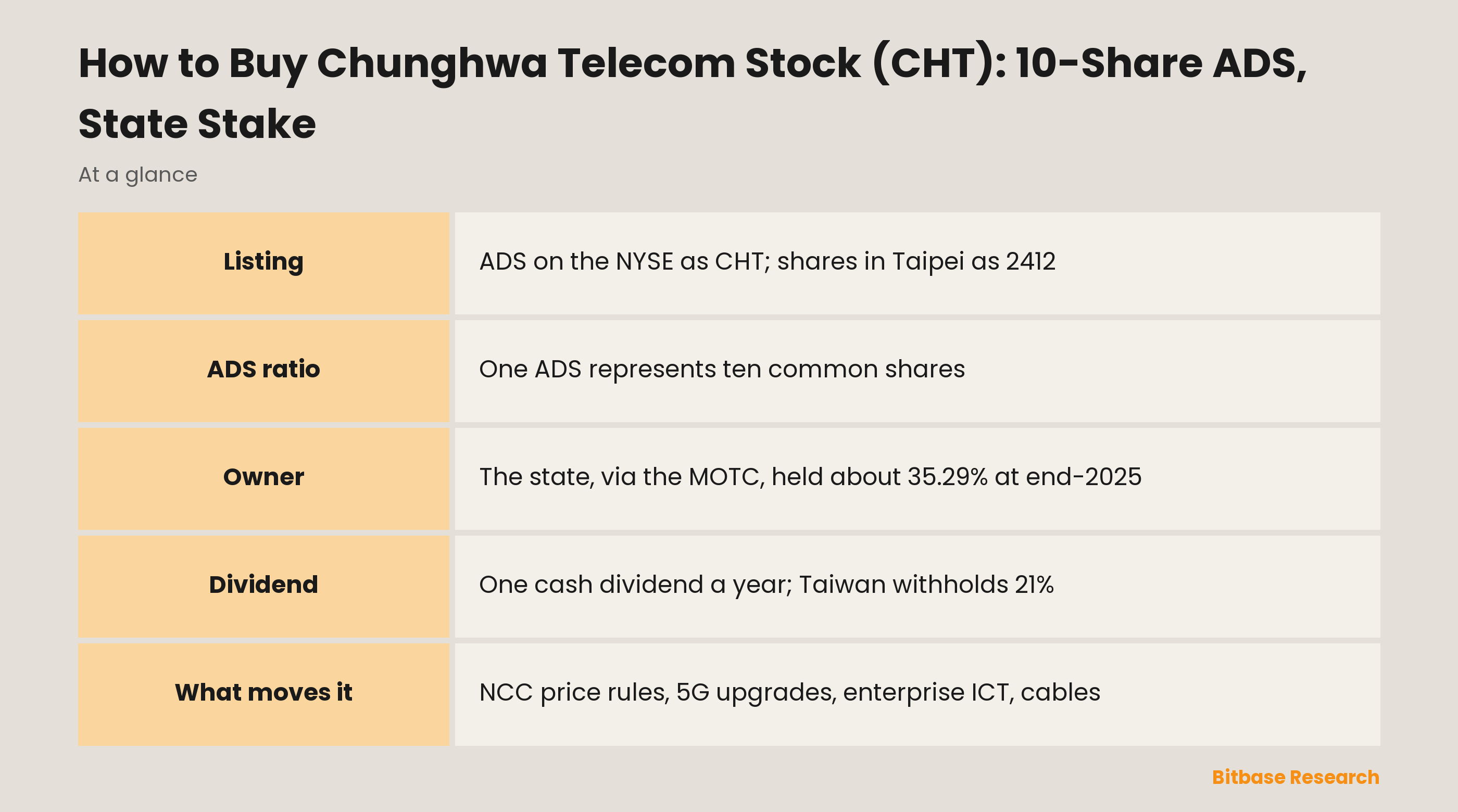
Ten Taiwanese common shares sit behind every CHT unit on the New York Stock Exchange, and that American depositary share is what a broker outside Taiwan normally sells you, in dollars and during New York hours. Chunghwa Telecom is Taiwan's largest telecom operator and still has the state as its biggest owner: the Ministry of Transportation and Communications held about 35.29% of its shares at the end of 2025 and appoints every non-independent director.
What Does Chunghwa Telecom Do?
Chunghwa Telecom runs most of the wires and a large share of the radio spectrum that Taiwan relies on. Until 1996 these operations sat inside the Directorate General of Telecommunications, an agency the Ministry of Transportation and Communications (MOTC) set up in 1943. On July 1, 1996 the operating side was spun off as Chunghwa, and the directorate stayed on as regulator, a role now held by the National Communications Commission (NCC). The common shares joined the Taiwan Stock Exchange (TWSE) in October 2000, the ADSs reached New York in July 2003, and in August 2005 a second international ADS offering and a domestic share auction took the government's stake below 50%, which the company treats as the date of its privatization. Its annual report calls it "the largest full telecommunication service provider in Taiwan."
The scale shows in the 2025 market data. Chunghwa had about 11.2 million mobile subscribers, not counting IoT SIM cards, for roughly 39.7% of Taiwan's mobile customers and 40.8% of mobile service revenue. Its HiNet brand is the island's largest internet service provider, with 52.2% of subscribers. In local telephone service it held an average subscriber share of about 91.4%, and its MOD platform is Taiwan's largest video service by number of customers. In data centers it claims more than 70% of the market.
Competition narrowed in December 2023, when two mergers cut the number of mobile network operators in Taiwan from five to three. The 20-F names Far EasTone among its rivals in fixed lines and data centers; in home broadband, cable operators bundle internet and TV and price below Chunghwa.
Senao, a handset retailer that Chunghwa consolidates despite owning a minority stake, sells phones and Chunghwa SIM cards in its stores, and Chunghwa Precision Test Tech (CHPT) makes semiconductor testing components. Chunghwa also resells OneWeb low Earth orbit satellite service, launched commercially in June 2025, and in April 2025 signed with Astranis for dedicated satellite capacity over Taiwan.
How Chunghwa Telecom Makes Money
Chunghwa reports three business groups plus a small "others" line. The 20-F gives each one's share of revenue:
| Segment | Share of 2025 revenue | Main revenue lines |
|---|---|---|
| Consumer Business | 60.7% | Mobile plans, fixed broadband, home phone lines, MOD video, handset sales |
| Enterprise Business | 32.7% | Mobile and fixed services for companies, ICT projects such as data centers, cloud, cybersecurity and big data |
| International Business | 4.0% | Leased circuits on submarine cables, international data center and cloud services, roaming, international voice |
| Others | 2.6% | Mainly CHPT's semiconductor testing products |
Total revenue rose about 2.7% in 2025. In the consumer group, mobile service revenue grew 3.2% on more postpaid subscribers and steady migration to 5G, which 46.4% of its smartphone users had reached by year end. Fixed-line revenue barely moved, as faster broadband plans offset falling voice calls; local telephone service is down to 8.1% of total revenue.
Growth sits in the enterprise group. Its ICT revenue climbed 9.2% in 2025 on data center, cloud, cybersecurity and big data work, while fixed-line services to companies slipped. International revenue fell, mainly because Chunghwa is withdrawing from low-margin international voice. The "others" line expanded on higher sales at CHPT. On the cost side, personnel was 27.4% of operating costs and expenses in 2025, up from 26.7%, and most employees belong to the Chunghwa Telecom Workers' Union.
In its November 4, 2026 release, Chunghwa reported third-quarter revenue up 16.7% from a year earlier, helped by a one-off gain from what it calls asset revitalization. Beyond that gain, ICT revenue rose 19%, and revenue from international private leased circuits, mostly carried on submarine cables, rose 33%.
CHT Stock at a Glance
| Item | Detail |
|---|---|
| Issuer | Chunghwa Telecom Co., Ltd., incorporated in Taiwan (Republic of China) on July 1, 1996 |
| US listing | American depositary shares on the NYSE, ticker CHT, since July 17, 2003 |
| ADS ratio | One ADS represents ten common shares |
| Home market | Common shares on the Taiwan Stock Exchange, code 2412, in New Taiwan dollars |
| Depositary | JPMorgan Chase Bank, N.A. |
| Largest holder | The government, through the MOTC, about 35.29% at December 31, 2025 |
| Foreign ownership caps | 49% direct; 60% direct and indirect combined |
| Share classes | One class of common shares, one vote per share |
| Fiscal year | Calendar year |
| 20-F accounting | IFRS as issued by the IASB; dividends are calculated under Taiwan IFRSs |
| Dividends | One cash dividend a year, proposed by the board and approved at the annual meeting |
| SEC filer | CIK 1132924; files Form 20-F and Form 6-K |
Only a small slice of the company trades in New York. On April 1, 2026, 18,485,793 ADSs were outstanding, which works out to about 2.4% of the common shares. Live CHT quotes and a chart are on the Chunghwa Telecom stock page on Bitbase.
How to Buy Chunghwa Telecom Stock
Chunghwa trades in two places: the ADS in New York and the common share in Taipei. Outside Taiwan the ADS is the practical choice, since it settles like any US-listed security.
1. Choose a broker that offers NYSE securities. The security listed there is an ADS of Chunghwa Telecom Co., Ltd.
2. Fund the account in dollars. Converting from another currency adds its own cost.
3. Enter the ticker CHT. Check the exchange before you confirm.
4. Pick an order type. A limit order names the highest price you accept, while a market order fills against whatever is offered at that moment; read how a market order actually fills before relying on one in a quiet session.
5. Size the position in ADSs. Each unit equals ten Taipei shares, so multiply the Taipei price by ten and convert the currency before comparing. Not every broker sells fractions of an ADS.
The ADS and the Taipei share. JPMorgan Chase Bank, N.A. holds the underlying common shares under a deposit agreement last amended and restated on December 27, 2023. Getting into the program is harder than getting out. Under Taiwanese law nobody, the company included, may deposit common shares into the ADS facility unless the Securities and Futures Bureau has not objected within a set period after an application is filed, with limited exceptions. Withdrawing shares is open, but holding them afterwards means registering as a foreign investor, holding through a Taiwanese brokerage or custody account, and appointing a local tax guarantor before profits can be sent abroad.
Voting. The deposit agreement requires the shares behind the ADSs to be voted collectively in the same way on every matter except director elections, which use cumulative voting. If the depositary receives no instructions, the 20-F says, the chairman or his designee may vote those shares at his discretion, "which may not be in your interest."
Taxes on dividends. Chunghwa's dividends come from Taiwan, which withholds 21% on cash dividends paid out of retained earnings. Tax treaties can lower that rate for holders of common shares, but the 20-F warns that it is unclear whether ADS holders count as shareholders for treaty purposes. The depositary converts the New Taiwan dollars and may deduct its fees. On the other side, selling ADSs in New York does not attract Taiwan's securities transaction tax, which takes 0.3% of the proceeds when common shares are sold on the TWSE.
Indirect exposure. Some Taiwan and emerging market funds hold Chunghwa; check a fund's published holdings first.
What Moves CHT Stock
Monthly numbers. Chunghwa announces consolidated revenue, operating income and net income every month and files the announcement on Form 6-K. Together with annual guidance, published voluntarily since 2013 and updated during the year, that gives the market a checkpoint every few weeks.
What the regulator allows it to charge. Since June 2023 the NCC has treated Chunghwa as having significant market power in five fixed-line and wholesale markets, which brings price caps, accounting separation and non-discrimination rules. The cap on mobile voice termination rates is being lowered year by year from 2025 to 2028, about 19% in total.
5G upgrades and a three-player market. With three operators left, growth comes from moving existing subscribers to pricier 5G plans. The 20-F expects rivals to gain from integrating their merged networks, and warns that cheaper unlimited data offers could limit growth in mobile broadband revenue.
Enterprise ICT and AI. Project revenue is lumpier than phone bills. ICT order intake in the third quarter of 2026 was 84% higher than a year earlier, according to the company, and management linked its plans to new AI services and a collaboration with Google.
Cables and satellites. Taiwan depends on submarine cables for international bandwidth, and Chunghwa sells that capacity to other companies. New systems such as SJC2 and the first phase of Apricot lifted international leased line revenue slightly in 2025, but the 20-F says permitting delays pushed full completion of APRICOT to 2028. Satellite capacity, from OneWeb and Astranis, is the backup the company is now selling to government and enterprise clients.
Dividend payout. The board approved a 2025 dividend in February 2026 at a payout ratio of 104.2%. Taiwanese law allows special cash dividends from capital surplus, and Chunghwa's legal reserve already equals its paid-in capital, so it no longer has to set profits aside for it.
The New Taiwan dollar. Most of Chunghwa's revenue is earned in Taiwan, yet the ADS is priced in dollars, so currency moves pass through to CHT even on a day the Taipei shares do not change.
Chunghwa Telecom's Regulatory, Ownership and Taiwan Risks
The state as controlling shareholder. The filing says the government, "through its control over our board, as all non-independent board members were appointed by the MOTC, may continue to have the ability to control our business," including asset sales, the annual operating budget and senior management. It adds that the largest shareholder may "take actions that conflict with our public stockholders' best interests."
Regulation and price controls. "Extensive regulation of our industry may limit our flexibility to respond to market conditions and landscape, and our business and revenues may suffer." Beyond tariffs, Chunghwa depends on licenses and spectrum rights that the government can decline to renew, and on the Fair Trade Commission, which has investigated and fined it before.
Foreign ownership limits. Foreigners may hold no more than 49% of the shares directly and 60% directly and indirectly combined. Direct foreign holdings were about 17.69% on April 1, 2026. Because the company cannot control who buys its shares or ADSs, a breach could cost it its network establishment approval, a consequence it says could hurt the business and the price of the ADSs.
Taiwan itself. The filing notes that past developments in relations between Taiwan and mainland China "have on occasion depressed the market prices of the securities of companies in the ROC." Natural hazards add to the list: cables can be cut by sand dredgers, Taiwan is exposed to earthquakes and typhoons, and Chunghwa states that it does not carry insurance against damage from them.
Cyberattacks and new technology. As the island's main carrier, Chunghwa faces mixed attacks on its networks, cloud and data services, and it relies on third-party AI models for parts of customer service, which it cannot fully control.
For the shares themselves, one company concentrates your risk, a payout above earnings cannot run indefinitely, and results "may differ materially from our published guidance."
Checking Chunghwa's Numbers in the 20-F and 6-Ks
Chunghwa's US filings live on SEC EDGAR under CIK 1132924. The annual report for 2025 is the Form 20-F filed on April 15, 2026, which contains the segment table, the risk factors, the deposit agreement terms and the tax summary for ADS holders. Form 6-K carries the rest: quarterly results, monthly revenue, dividend decisions and other announcements first made in Taipei.
Two traps are worth avoiding. The first is accounting: the 20-F uses IFRS as issued by the IASB, while quarterly press releases, guidance and dividend calculations use Taiwan IFRSs, so a profit figure can differ depending on the document. The 6-Ks that carry quarterly statements include a reconciliation between the two. The second is units: the Taipei share and the New York ADS differ by a factor of ten, so per-share figures such as earnings or dividends need multiplying by ten before you compare them with an ADS price.
Live quotes for the ADS are on the stock page above, and Bitbase's list of US stock pages covers other listings. For a US carrier with a different ownership structure, see our Verizon stock guide; for another Taiwanese ADR, our TSM explainer.
Chunghwa Telecom Stock FAQ
Can I buy Chunghwa Telecom stock with crypto?
No. CHT ADSs are bought through a brokerage account in US dollars, and the Taipei shares cost New Taiwan dollars, so crypto would first have to be sold for cash and moved to the broker. That sale may be taxable where you live.
How many shares does one CHT ADS represent?
Ten. Each ADS represents the right to receive ten Chunghwa common shares, which trade on the Taiwan Stock Exchange under the code 2412.
Does Chunghwa Telecom pay a dividend?
Yes, once a year in cash. The board proposes the dividend early in the year, shareholders approve it at the annual meeting, and it is paid in the year after the one it relates to. The dividend per share has risen every year from 2021 to 2025. ADS holders receive it in dollars after Taiwan's 21% withholding tax and depositary fees.
Is Chunghwa Telecom owned by the government of Taiwan?
Partly. The company has been classed as privatized since August 2005, when the state's holding fell below 50%, but the government, through the MOTC, still owned about 35.29% of the shares at the end of 2025. All non-independent directors are MOTC representatives, and the chairman also serves as chief executive.
Can foreigners buy Chunghwa Telecom shares in Taiwan?
Yes, within limits. Foreign investors must register in Taiwan and hold the shares through a local brokerage or custody account, and foreign ownership is capped at 49% directly and 60% in total. For most investors abroad, the NYSE-listed ADS avoids that paperwork.
Conclusion
Chunghwa Telecom is a mature carrier, with revenue up about 2.7% in 2025, and an unusual set of owners: the state still holds about a third of it, foreigners face a hard cap, and only a few percent of the shares sit in the New York program. Its returns depend on how the NCC sets prices, how quickly subscribers move to 5G, whether enterprise ICT keeps growing, and how much of each year's profit the board chooses to pay out. Before buying, read the latest 20-F and the monthly and quarterly 6-Ks, check how the dividend will be taxed in your case, and decide how much of your portfolio one Taiwanese carrier should take up.
Related reading
Other Bitbase articles on this topic:
- How to Buy EchoStar Stock (ECHO): Spectrum Sales, SpaceX Deal
- How to Buy Formula One Stock (FWONK): F1, MotoGP and No Vote
- How to Buy Live Nation Stock (LYV): Ticketmaster and the DOJ Case
- How to Buy TKO Group Stock (TKO): UFC, WWE and Two Share Classes
Disclaimer: This article is educational content from Bitbase Academy, provided for information only. It explains what a company or fund does and how the instruments referenced here differ from one another; it does not constitute investment, trading, tax, or financial advice, and it is neither a recommendation nor an endorsement of any security, token, or trading strategy. A tokenized stock is issued by a third party and is designed to give economic exposure to an underlying asset: it is not a share, it carries no shareholder rights, and it depends on the issuer's structure, eligibility rules, and redemption terms, which the issuer can change. Perpetual futures are leveraged derivatives that hold no underlying asset and can be liquidated, and trading hours, product availability, and eligibility differ by instrument and by jurisdiction and can change at any time. Written as of November 2026; verify everything yourself through company filings, the issuer's own documentation, and the product pages of the venue you trade on.
References
[1] Chunghwa Telecom Form 20-F for 2025 (SEC EDGAR) www.sec.gov
[2] Chunghwa Telecom 2025 Form 20-F, XBRL cover page (SEC EDGAR) www.sec.gov
[3] Chunghwa Telecom third-quarter 2026 results, Form 6-K (SEC EDGAR) www.sec.gov
[4] Chunghwa Telecom September 2026 operating results, Form 6-K (SEC EDGAR) www.sec.gov
[5] Chunghwa Telecom nine-month 2026 statements under Taiwan IFRSs and IFRS, Form 6-K (SEC EDGAR) www.sec.gov





