
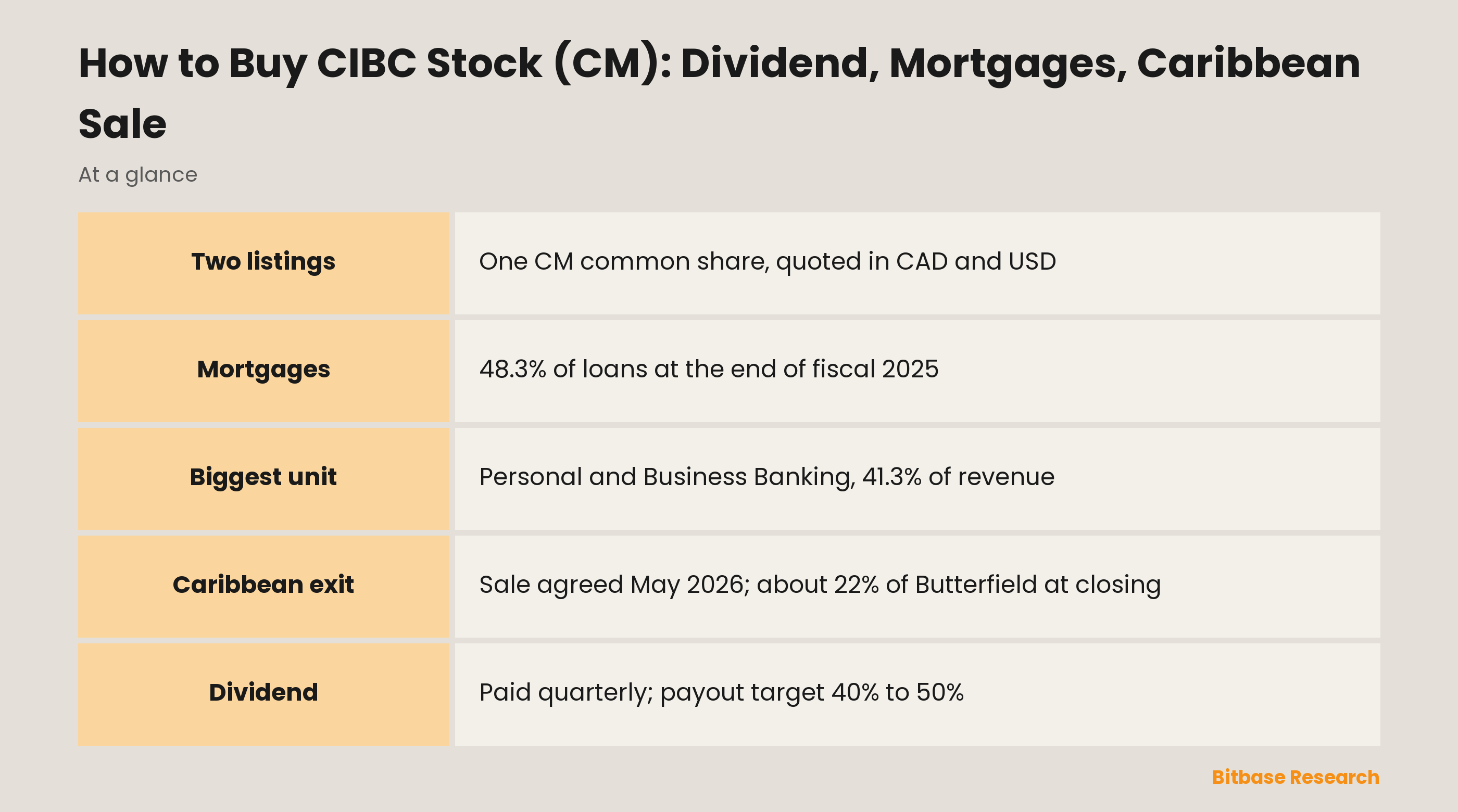
Under one ticker, CM, on both the Toronto Stock Exchange and the New York Stock Exchange, CIBC stock can be bought through any brokerage account that reaches either market, and in both places you get the bank's own common shares, not a depositary receipt. Behind the ticker is a lender whose residential mortgages were 48.3% of its loan book on 31 October 2025, and which agreed in May 2026 to sell its Caribbean bank for cash plus a stake of about 22% in Butterfield.
What Does CIBC Do?
Canadian Imperial Bank of Commerce, or CIBC, is a financial institution governed by the Bank Act (Canada), which serves as its charter. It was formed in 1961 by the amalgamation of The Canadian Bank of Commerce, which opened under that name in 1867, and Imperial Bank of Canada, founded in 1875. Its head office is at CIBC Square, 81 Bay Street, Toronto.
The bank reports four strategic business units and a fifth segment for the rest:
Canadian Personal and Business Banking serves individuals and small businesses through banking centres, contact centres and digital channels; since 2025 it also includes Simplii Financial, CIBC's direct bank.
Canadian Commercial Banking and Wealth Management serves middle-market companies, entrepreneurs and high-net-worth families, and includes the Investor's Edge online brokerage.
U.S. Commercial Banking and Wealth Management does the same for American clients through CIBC Bank USA in Chicago, formerly The PrivateBank; CIBC completed its purchase of the parent, PrivateBancorp, on 23 June 2017.
Capital Markets covers trading, investment and corporate banking and research.
Corporate and Other holds treasury, support functions and CIBC Caribbean Bank, which CIBC has agreed to sell.
How CIBC Makes Money
In fiscal 2025, the year to 31 October 2025, net interest income, the margin between interest on loans and securities and the cost of funding them, accounted for 54.1% of revenue, and non-interest income from fees and trading for 45.9%. Revenue grew 13.8% on fiscal 2024 and net income 18.2%.
| Segment | Share of 2025 revenue | Revenue growth vs 2024 | Net income growth vs 2024 |
|---|---|---|---|
| Canadian Personal and Business Banking | 41.3% | 10.0% | 7.0% |
| Canadian Commercial Banking and Wealth Management | 23.7% | 14.7% | 13.5% |
| U.S. Commercial Banking and Wealth Management | 11.0% | 14.0% | 92% |
| Capital Markets | 21.1% | 28.1% | 39.5% |
| Corporate and Other | 2.9% | Lower | Loss |
Source: 2025 segment note, Canadian dollars.
The personal bank is still the earnings anchor, with 36.9% of the profit attributable to shareholders. Growth came faster elsewhere: Capital Markets revenue rose 28.1%, and the US unit nearly doubled its profit, which the MD&A attributes mainly to "higher revenue and a lower provision for credit losses." Market-linked fees matter too: investment management, custodial and mutual fund fees made up 14.6% of revenue.
By geography, as the segment note allocates it, 66.2% of 2025 revenue was booked in Canada and 20.4% in the United States. Because CIBC reports in Canadian dollars, the exchange rate changes what its US earnings are worth.
CM Stock at a Glance
| Feature | CM |
|---|---|
| Listed on | TSX in Toronto and NYSE in New York |
| Symbol | CM on both |
| What you own | CIBC common shares, the bank's one NYSE-registered security, with no depositary receipt |
| Also listed | Class A preferred shares, on the TSX only |
| Quoted in | CAD on the TSX, USD on the NYSE |
| Industry | Banking, wealth management and capital markets |
| Index funds | Inside iShares S&P/TSX 60 Index ETF (XIU), outside SPY (28 October 2026 holdings) |
| Head office | Toronto |
| Financial year | 1 November to 31 October |
| Filings | IFRS accounts in CAD; Form 40-F once a year, Form 6-K each quarter |
| Dividends | Every quarter, aiming to pay out 40% to 50% of adjusted earnings |
| SEC CIK | 1045520 |
For the current price in either currency, open the live CIBC quote on Bitbase before you trade.
How to Buy CIBC Stock in Toronto or New York
Toronto and New York trade one class of common share, so the real choices are where to trade and in which currency.
1. Pick the market. A TSX order is priced in Canadian dollars, an NYSE order in US dollars; check which exchange your broker reaches and who regulates it.
2. Open and verify the account. The tax residence you declare is what the broker applies to your dividends.
3. Fund it. If your cash is in another currency, compare the conversion rate with the commission; the conversion can cost more.
4. Find the right line. Search CM and confirm it reads Canadian Imperial Bank of Commerce common shares; in Toronto, CIBC preferred shares carry symbols such as CM.PR.S.
5. Choose an order type. A limit order names the most you will pay, a market order takes the best offer at that moment; see how market orders execute and fill. Fractions depend on the broker.
Tax on the dividend. CIBC's 40-F does not say how dividends paid outside Canada are taxed; its only tax note designates them "eligible dividends" for Canadian income tax purposes. Ask your broker what is withheld at source and whether a treaty applies, and check how your own country taxes the payment.
Reinvesting. CIBC's commission-free Shareholder Investment Plan lets registered holders in Canada reinvest dividends and those in the US elect stock dividends; shares held at a broker need the broker's help to enrol.
Ownership caps. The Bank Act makes any stake above 10% of a class of CIBC shares subject to the Minister of Finance's approval, and bars anyone from owning over 20% of a voting class at a bank this large.
Through a fund. BlackRock's iShares S&P/TSX 60 Index ETF (XIU) held CM on 28 October 2026; S&P 500 funds are no route to it (see the FAQ).
What Moves CIBC Stock
Mortgages in Ontario and British Columbia. Residential mortgages were 48.3% of loans at 31 October 2025. Of the Canadian mortgage book, 86% was uninsured, and that uninsured part had an average loan-to-value ratio of 55%; Ontario accounted for 56.7% of the book, British Columbia and the territories for 18.8%. The MD&A warns that "mortgage service ratios could remain elevated as mortgages continue to renew at higher rates and income growth decelerates from a slowing labour market."
Credit costs. Provisions for credit losses, money set aside for loans expected to go bad, rose 17.0% in fiscal 2025 and 43.1% in Canadian Personal and Business Banking, while in the US unit they fell 70% in US-dollar terms.
Interest rates. By CIBC's estimate, an immediate, sustained 100-basis-point rise would add roughly 1.0% of fiscal 2025 net interest income over the next year, and an equal fall would subtract about 1.6%, before further hedging: cuts hurt more than rises help.
The US franchise. U.S. Commercial Banking and Wealth Management's net income rose 92% in 2025. On 6 July 2026 CIBC added a 19.15% equity interest, with 4.99% of the votes, in &Partners, a US private wealth firm.
Leaving the Caribbean. On 27 May 2026 CIBC agreed to sell its 91.67% interest in CIBC Caribbean Bank to The Bank of N.T. Butterfield & Son, for cash and Butterfield shares expected to equal about 22% of Butterfield at closing, plus two board seats. It booked a charge in the third quarter of fiscal 2026; closing is expected in the first half of 2027, subject to Butterfield shareholder and regulatory approvals.
Capital and buybacks. CIBC ended fiscal 2025 with a common equity tier 1 (CET1) ratio of 13.3%, and stood at 13.4% on 31 July 2026, against an OSFI target of 11.0% including buffers, set after OSFI cut its Domestic Stability Buffer from 3.5% to 3.0% on 19 June 2026. After completing a 20-million-share buyback in May 2026, CIBC began one for up to 30 million, about 3.3% of its shares, that can run until 7 June 2027. In December 2025 it raised the quarterly dividend by 10.3%.
What Could Go Wrong for CIBC Shareholders
Three of the top risks in CIBC's MD&A bear directly on the shares; two more come from how Canadian bank capital works.
Tariffs. "The ongoing uncertainty on the ultimate level and extent of tariffs could diminish consumer and business confidence in Canada and around the globe, increasing credit, market, liquidity, strategic and operational (including third-party) risks." The 2026 outlook assumed the Canada-U.S.-Mexico trade deal would be extended.
Jobs. "Unemployment rates in fiscal 2025 are at the highest level since 2016 (excluding the increase in 2020 and 2021 resulting from the COVID-19 pandemic)," the report notes, adding that this has raised payment pressure on unsecured loans.
Cyber attacks. Threats "are growing in frequency and sophistication," and the bank concedes that "it is not possible for us to identify all cyber risks or implement measures that prevent all potential cyber incidents."
Dividends come last. The Bank Act bars CIBC from declaring dividends that would breach capital or liquidity rules, and common dividends wait until preferred dividends are paid or set apart.
Dilution in a failure. CIBC's preferred shares, limited recourse capital notes and some subordinated debentures convert into common shares if OSFI deems the bank non-viable, and under the bail-in regime the Canada Deposit Insurance Corporation "determines the timing of the bail-in conversion, the portion of the specified eligible shares and liabilities to be converted and the terms and conditions of the conversion."
Holding one bank's stock also concentrates your exposure on a single balance sheet and, if you live on another currency, on the Canadian dollar's exchange rate.
Reading CIBC's Filings Yourself
As a Canadian issuer, CIBC files under CIK 1045520 on Form 40-F each year and Form 6-K for quarterly results and press releases; the fiscal 2025 40-F, filed on 4 December 2025, bundles the annual information form, the MD&A and the audited statements, also on SEDAR+. In the MD&A, read "Top and emerging risks," the mortgage tables by province, the structural interest rate sensitivity table and capital management; Note 29 splits results by segment and region. US taxpayers adjusting cost basis for the 2022 split will find Form 8937 on CIBC's common share information page.
For peers, set CIBC beside our Royal Bank of Canada guide and our TD Bank guide, or browse Bitbase's stock pages for other listed companies.
CIBC Stock: Questions Investors Ask
Does CM trade as the same share on the TSX and NYSE?
Yes. The annual report says CIBC's common shares, symbol CM, are listed in Toronto and New York, and they are the one class the 40-F cover registers for the NYSE. No depositary receipt sits in between and no conversion ratio applies; the currency is the only difference.
Does CIBC pay a dividend?
Yes. The board declares one each quarter. On a reported basis CIBC paid out 45.0% of fiscal 2025 earnings, within its 40% to 50% range, and in December 2025 it lifted the quarterly payment by 10.3%. Its investor relations site adds that CIBC "hasn't missed a regular dividend since its first dividend payment in 1868."
Has CIBC stock ever split?
CIBC lists four splits: five-for-one on 9 August 1967, two-for-one on 31 January 1986 and 27 March 1997, and two-for-one by way of a 100% stock dividend on 13 May 2022. Halve unadjusted per-share figures from before May 2022 before comparing them with later ones.
Is CIBC in the S&P 500?
No: the SPY holdings file State Street published for 28 October 2026 has no CIBC line. Canadian index funds such as iShares' XIU hold it instead.
Can I buy CIBC stock with crypto?
Not directly. CM is priced and settled in Canadian or US dollars, so you would first sell the crypto, wait for the cash to reach your brokerage account and only then buy; in some countries that sale is itself taxable. Treat it as two decisions, not one.
Conclusion
The mechanics are simple: one share class, two exchanges, a currency to pick. The harder part is the bank itself, which leans on Canadian mortgages, earns a growing slice of profit in the US, is selling its Caribbean arm and returns capital only as far as OSFI's rules allow. Work through the most recent 40-F and quarterly 6-K, and find out what tax a Canadian dividend will cost you, before deciding how much to own.
Related reading
Other Bitbase articles on this topic:
- How to Buy Barclays Stock (BCS): ADS Ratio and the Ring-Fence
- How to Buy BBVA Stock (BBVA): Spanish ADS, Mexican Profits
- How to Buy BMO Stock (BMO): Canada's First Chartered Bank
- How to Buy U.S. Bancorp Stock (USB): Payments, Union Bank, BTIG
Disclaimer: This article is educational content from Bitbase Academy, provided for information only. It explains what a company or fund does and how the instruments referenced here differ from one another; it does not constitute investment, trading, tax, or financial advice, and it is neither a recommendation nor an endorsement of any security, token, or trading strategy. A tokenized stock is issued by a third party and is designed to give economic exposure to an underlying asset: it is not a share, it carries no shareholder rights, and it depends on the issuer's structure, eligibility rules, and redemption terms, which the issuer can change. Perpetual futures are leveraged derivatives that hold no underlying asset and can be liquidated, and trading hours, product availability, and eligibility differ by instrument and by jurisdiction and can change at any time. Written as of October 2026; verify everything yourself through company filings, the issuer's own documentation, and the product pages of the venue you trade on.
References
[1] Canadian Imperial Bank of Commerce Form 40-F, fiscal 2025: cover page and securities registered under Section 12(b) (SEC EDGAR) www.sec.gov
[2] CIBC Annual Information Form, 3 December 2025: incorporation, share capital, Bank Act ownership limits and market for securities www.sec.gov
[3] CIBC 2025 management's discussion and analysis: segments, top and emerging risks, mortgages, interest rate sensitivity and capital www.sec.gov
[4] CIBC 2025 audited consolidated financial statements: income statement, balance sheet, segmented and geographic information www.sec.gov
[5] CIBC 2025 Annual Report, shareholder information: listings, eligible dividends and the shareholder investment plan www.sec.gov
[6] CIBC third quarter 2026 results news release, 27 August 2026: CET1 ratio and items of note (Form 6-K) www.sec.gov
[7] CIBC report to shareholders for the third quarter of 2026: Caribbean sale, &Partners stake, buybacks and the Domestic Stability Buffer (Form 6-K) www.sec.gov
[8] CIBC press release, 4 December 2025: increase in the quarterly common share dividend (Form 6-K) www.sec.gov
[9] CIBC press release, 4 June 2026: TSX acceptance of a normal course issuer bid for up to 30 million common shares (Form 6-K) www.sec.gov
[10] CIBC 2017 management's discussion and analysis: completion of the PrivateBancorp acquisition and the CIBC Bank USA name www.sec.gov
[11] CIBC Investor Relations, Common Share Description: listings, ownership and dividend restrictions, stock splits www.cibc.com
[12] CIBC Investor Relations, Common Dividends: dividend history since the first payment in 1868 www.cibc.com
[13] CIBC Investor Relations, Common Share Information: Form 8937 for US shareholders on the 2022 stock split www.cibc.com
[14] BlackRock Canada, iShares S&P/TSX 60 Index ETF (XIU): fund holdings as of 28 October 2026 www.blackrock.com
[15] State Street, SPDR S&P 500 ETF Trust (SPY): daily holdings as of 28 October 2026 www.ssga.com





