
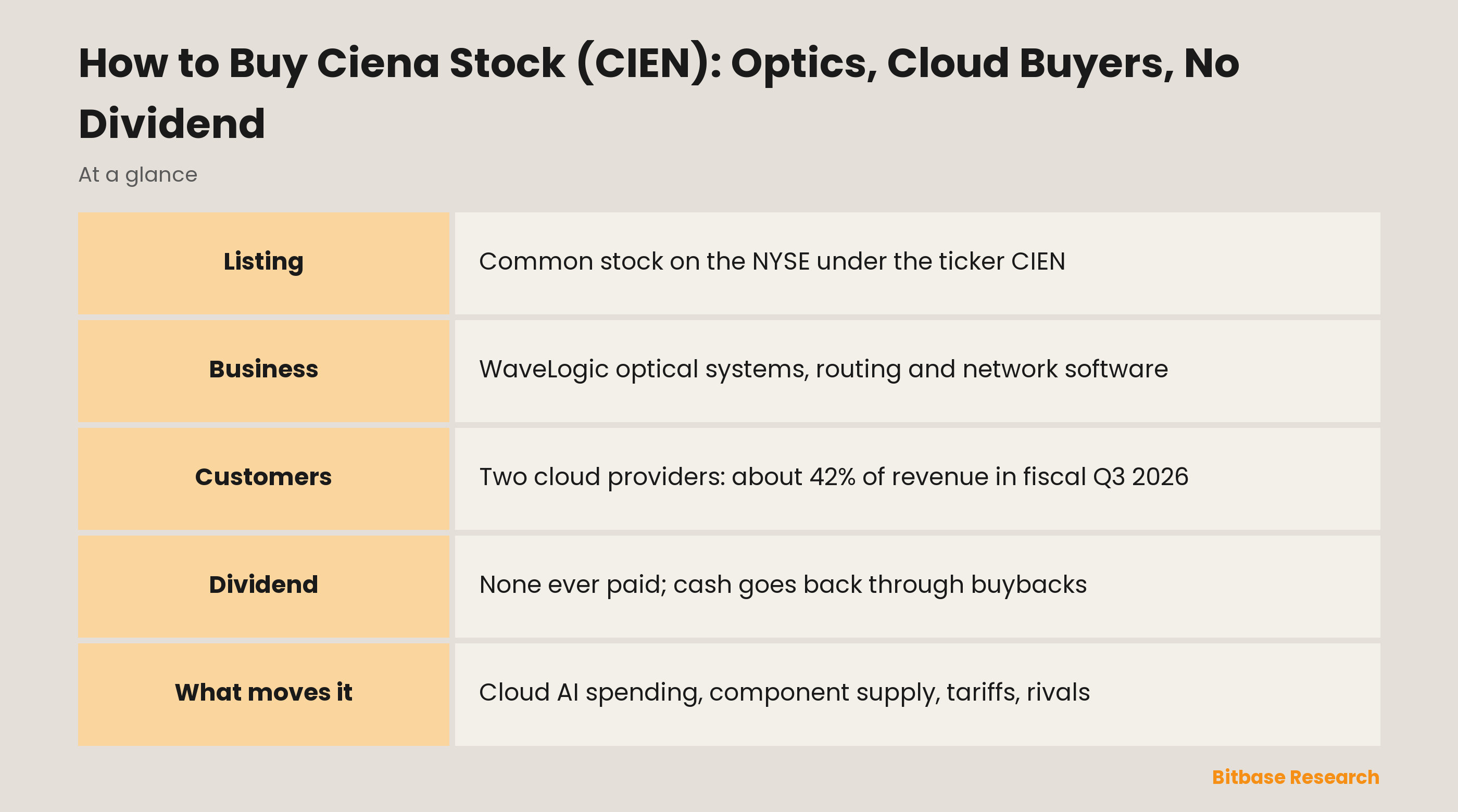
In any brokerage account with access to the New York Stock Exchange, you can buy Ciena's common stock under the ticker CIEN, the only class of shares the company registers there. Ciena builds the optical equipment that moves traffic between data centers and across telecom networks, and in the quarter to 1 August 2026 two cloud providers accounted for about 42% of its revenue. This guide explains what the company sells, how an order goes through, why there is no dividend to collect, and which filings show where the business stands.
What Does Ciena Do?
Ciena calls itself "a network technology company, providing hardware, software, and services to a wide range of network operators." In practice it makes the systems that push data through optical fiber, from the terminals at each end of a long-haul or undersea link to the software that runs them. The company was incorporated in Delaware in November 1992 and went public on 7 February 1997. Gary Smith joined in 1997 and has been president and chief executive since May 2001.
The technical core is WaveLogic, Ciena's own family of coherent modems. A coherent modem encodes data on laser light so one fiber carries more traffic over longer distances. WaveLogic sits inside the products that make up most of the revenue: the 6500 Packet-Optical Platform for core, regional, metro and submarine networks; the compact Waveserver systems used between data centers; the 6500 Reconfigurable Line System (RLS), a programmable photonic layer; and coherent pluggable transceivers that fit into Ciena's own gear and into equipment from other vendors.
Around that core sit routers and switches for the network edge, such as the 3000, 5000 and 8100 families, and two software lines: Navigator NCS, which controls Ciena networks, and Blue Planet, which automates service orders and inventory across vendors. A services arm installs and maintains networks.
The customer list falls into three groups. Cloud providers, which the 10-K says are also called "web-scale, hyper-scale or neo-scale providers," buy directly and also lease capacity on carriers' submarine and land networks. Service providers include wireline and wireless carriers and submarine cable operators. The rest are cable operators, governments, research networks and enterprises.
Two deals shaped today's company. In 2010 Ciena bought Nortel's optical business. In October 2025 it completed the purchase of Nubis Communications, which brings co-packaged optics and electronics for active copper cables, both aimed at links inside AI data centers. Contract manufacturers in Canada, Mexico, Thailand, Vietnam and the United States build its products, and its largest sites are research centers in Ottawa, Canada and Gurgaon, India. At the end of fiscal 2025 it had 9,080 employees in 39 countries and held about 2,400 issued patents, with 800 more applications pending.
How Ciena Makes Money
Ciena reports four operating segments. Fiscal 2025, which ended on 1 November 2025, breaks down as follows:
| Segment | What it covers | Share of fiscal 2025 revenue | Growth vs fiscal 2024 |
|---|---|---|---|
| Networking Platforms | Optical Networking systems and modules, plus Routing and Switching | 77% | 21% |
| Platform Software and Services | Navigator NCS and related software services | 8% | 2% |
| Blue Planet Automation Software and Services | Multi-vendor network automation software | 2% | 49% |
| Global Services | Implementation, maintenance, support and advisory work | 13% | 14% |
Optical Networking alone produced 68% of revenue, and its sales rose 23%, "primarily driven by increases in sales of our RLS to cloud providers." Total revenue grew 19%, and the company says orders "significantly" exceeded revenue, and its backlog of products and services more than doubled over the year.
Profit looks different from revenue. Of the four segments' combined segment profit, Networking Platforms supplied 62%, but Platform Software supplied 19% from only 8% of sales, because its segment margin was about 65% against roughly 21% for the hardware. Global Services added 17%. Gross margin slipped to 42.0% from 42.8%, mainly on lower services margin.
The money comes from a short list of buyers. According to the 10-K, the five largest customers produced about 50% of fiscal 2025 revenue, one cloud provider about 18%, and AT&T, the only large customer the filing names, about 11%. The Americas generated 76% of revenue, EMEA 15% and Asia Pacific 9%; the United States alone about 72%.
The pattern sharpened in fiscal 2026. In the third quarter, which ended on 1 August 2026, revenue rose 37% from a year earlier and Optical Networking 46%, reaching 71% of sales. Gross margin climbed to 45.4% from 41.3%, which the 10-Q attributes to "cost reduction, pricing optimization, product mix, and tariff refunds." The company's largest customer, listed only as Cloud provider A, accounted for about 28.5% of quarterly revenue, up from about 17.9% a year earlier, and a second cloud provider for 13.1%.
CIEN Stock at a Glance
| Feature | CIEN |
|---|---|
| Exchange | New York Stock Exchange |
| Ticker | CIEN |
| Security | Common stock, the only class registered under Section 12(b) |
| Listing history | Nasdaq after the 1997 IPO; NYSE since December 2013 |
| Sector | Communications equipment: optical networking, routing and network software |
| Index membership | S&P 500 |
| Headquarters | Fulton, Maryland (earlier filings list Hanover, Maryland) |
| Incorporated | Delaware, November 1992 |
| Fiscal year | 52 or 53 weeks, ending on the Saturday nearest 31 October |
| Dividends | None ever paid |
| Share history | One-for-seven reverse split on 22 September 2006 |
| SEC identifier | CIK 936395 |
Quotes, market value and trading volume change throughout the day; check the Ciena stock page on Bitbase for live figures.
How to Buy Ciena Stock
Ciena is a US company with a single listed class, so there is no depositary receipt or second share line to choose between. The process at a broker runs like this:
1. Find a broker that offers NYSE stocks. Abroad, that may be a local broker with US market access or an international platform; check which entity holds your account and who regulates it.
2. Complete the account checks. Non-US investors are usually asked for IRS Form W-8BEN; the IRS tells people to submit it "when requested by the withholding agent or payer."
3. Fund the account in dollars or convert. A currency conversion spread can cost more than the commission.
4. Search for CIEN. Confirm the result reads Ciena Corp common stock on the NYSE.
5. Choose the order type. FINRA notes that "brokerage firms typically enter your order as a market order unless you specify otherwise," and that limit orders "are for investors who know the price they want." A limit order sets the most you will pay.
6. Decide the amount. If you want to invest a fixed sum, fractional shares can help, but FINRA warns that some firms offer them only for "large-cap stocks or ETFs" and that "as a fractional share owner, you might not have shareholder voting rights."
Tax for investors outside the US. The IRS says that "most types of U.S. source income received by a foreign person are subject to U.S. tax of 30%," with lower rates possible under a tax treaty. Because Ciena pays no dividend, that rule has no Ciena dividend to apply to for now; how a gain on the shares is taxed depends on where you live, so check the rules at home.
Holding it through a fund. CIEN appears in the daily holdings of State Street's SPY, the S&P 500 fund, as of 6 November 2026, while the same day's holdings of the S&P MidCap 400 fund MDY do not include it. An S&P 500 index fund holds it as one small position among many.
What Moves CIEN Stock
Cloud spending on AI. The 10-K puts it directly: "Unprecedented AI workloads are driving substantial changes in how compute and networking infrastructure are designed and operated, and creating greater demands for high-speed connectivity." AI sites spread across regions need high-capacity links between buildings, which is what the RLS and Waveserver sales to cloud providers supply, so cloud capital budgets drive Ciena's order book.
A few customers getting bigger. The 10-Q says that "a small number of those customers become a larger portion of our business across multiple revenue segments." One cloud provider went from about 18% of revenue in fiscal 2025 to about 28.5% in the third quarter of fiscal 2026. A pause in its orders would show up quickly.
Supply as well as demand. Orders outran shipments, leaving what the 10-Q calls a "historically high backlog," partly because components across the industry are scarce. Ciena has signed multi-year supply agreements, some with prepayments, so supplier capacity limits how much revenue it can book each quarter.
The move inside the data center. WaveLogic Nano modules and the Nubis technology take Ciena into links within and between server racks. There, the 10-K expects to meet new competitors, including Marvell Technology Group, Credo Technology Group and Broadcom; our Marvell stock guide covers one of them. Ciena calls these markets "nascent or dynamic."
Tariffs and trade. With about 72% of revenue in the United States and much of its product made or shipped from Mexico, Ciena is exposed to US duties on Canada, Mexico, China, Thailand and Vietnam; tariff refunds helped its third-quarter margin.
Financing and buybacks. In June 2026 Ciena sold convertible senior notes due 2031 and used most of the proceeds to repay its whole term loan. A buyback program approved in October 2024 continues, but it "may be modified, suspended, or discontinued at any time."
Where Ciena's Annual Report Sees Trouble
These passages from Item 1A of the fiscal 2025 10-K matter most for a CIEN holder; the latest 10-Q reports no material change.
Lumpy quarters. Part of each quarter's revenue comes from orders taken in that same quarter, and "our customer contracts generally do not include minimum or guaranteed purchases and may allow customers to modify or cancel purchase orders."
Customer concentration. "Our revenue is concentrated among a small number of customers and reductions in their spending could materially adversely impact our results of operations."
Bigger rivals. The named competitors are Nokia, Huawei, Cisco, Hewlett Packard Enterprise and ZTE, and "many of these competitors have substantially greater financial, operational and marketing resources." Our Cisco stock guide covers one.
Scarce parts and forecasting. "Our products include optical and electronic components for which reliable, high-volume supply is often available only from sole or limited sources." Many supply commitments are "non-cancellable," so a sudden drop in demand could leave excess inventory.
Geopolitics and security. "Increasing tensions between the United States and China—including tariffs, export controls, investment restrictions, and evolving data security or technology transfer requirements—could disrupt our supply chain." Communications gear has also "frequently been the target of threat actors, including nation states."
Dilution and debt. When the 2031 notes convert, Ciena pays the principal in cash and may settle anything above it in cash, shares or both. Warrants sold alongside the notes would dilute earnings per share if the stock rose above their strike price, unless settled in cash.
Two risks apply to the share itself. "Our stock price has experienced significant fluctuations in the past and may continue to do so." And because Ciena pays no dividend, any return depends on what someone else will pay for the stock later.
How to Research CIEN Yourself
Ciena files with the SEC under CIK 936395. The 10-K usually arrives in December, shortly after the fiscal-year results, and three 10-Qs cover the other quarters. Each results release comes as an 8-K: in 2026, on 5 March, 4 June and 3 September, while the two previous fiscal-year releases came on 12 December 2024 and 11 December 2025.
In the 10-K, Item 1 covers products and competitors, Item 1A the risks, the MD&A revenue by segment and region and the five largest customers' share, and the segment note segment profit, where the software margin shows. In each 10-Q, look for the table of customers above 10% of revenue: it shows quarter by quarter how much depends on Cloud provider A and B.
Two checks help. Fiscal 2024 had 53 weeks, one more than the years around it. And the stock performance chart in Item 5 compares Ciena with the S&P North American Technology-Multimedia Networking Index and the Russell 1000 Index. For quotes, use the stock page linked above; the full list of US stock pages on Bitbase covers other listed companies.
Ciena Stock FAQ
Can I buy Ciena stock with crypto?
Not directly. CIEN shares are bought in US dollars through a brokerage account, so any crypto has to be sold for cash and the money sent to the broker first, a sale that may be taxable. A share is a claim on a registered company with voting rights, which is how stocks differ from crypto assets.
Does Ciena pay a dividend?
No. The 10-K states: "We have never paid cash dividends on our capital stock," and the company does "not anticipate paying any cash dividends in the foreseeable future." It returns cash through buybacks instead.
Is CIEN in the S&P 500?
Yes. Ciena Corp appeared in the daily holdings file of State Street's SPY, which tracks the S&P 500, as of 6 November 2026. It was not among the holdings of the S&P MidCap 400 fund MDY on the same date.
Has Ciena stock ever split?
The only split in its filings is a reverse one: on 22 September 2006 Ciena combined every seven shares into one. Adjust older per-share data before comparing it.
Who are Ciena's biggest customers?
The filings name only AT&T, which bought about 11% of fiscal 2025 revenue and buys from all four segments. The largest customer is a cloud provider that Ciena does not name; in the third quarter of fiscal 2026 it and a second cloud provider together made up about 42% of revenue.
Conclusion
Ciena's results now rise and fall with a handful of cloud companies building AI networks, and the third quarter of fiscal 2026 showed both sides of that: faster growth and wider margins, with more revenue in fewer hands. The questions are whether that demand lasts, whether suppliers keep up, and how the push inside the data center fares against larger rivals. The fiscal 2026 10-K, due in December, will add the full-year segment and customer figures; read it before deciding how much of a portfolio one optical equipment maker should take.
Related reading
Other Bitbase articles on this topic:
- How to Buy Celestica Stock (CLS): From IBM Unit to AI Racks
- How to Buy Ericsson Stock (ERIC): B Shares, ADS and 5G Gear
- How to Buy Everpure Stock (P): Formerly Pure Storage, PSTG
- How to Buy HP Stock (HPQ): PCs, Ink and the 2015 Split
Disclaimer: This article is educational content from Bitbase Academy, provided for information only. It explains what a company or fund does and how the instruments referenced here differ from one another; it does not constitute investment, trading, tax, or financial advice, and it is neither a recommendation nor an endorsement of any security, token, or trading strategy. A tokenized stock is issued by a third party and is designed to give economic exposure to an underlying asset: it is not a share, it carries no shareholder rights, and it depends on the issuer's structure, eligibility rules, and redemption terms, which the issuer can change. Perpetual futures are leveraged derivatives that hold no underlying asset and can be liquidated, and trading hours, product availability, and eligibility differ by instrument and by jurisdiction and can change at any time. Written as of November 2026; verify everything yourself through company filings, the issuer's own documentation, and the product pages of the venue you trade on.
References
[1] Ciena Form 10-K for fiscal 2025 (SEC EDGAR) www.sec.gov
[2] Ciena fiscal 2025 Form 10-K, XBRL cover page (SEC EDGAR) www.sec.gov
[3] Ciena Form 10-Q for the third quarter of fiscal 2026 (SEC EDGAR) www.sec.gov
[4] Ciena fiscal third-quarter 2026 results release, filed with Form 8-K (SEC EDGAR) www.sec.gov
[5] Ciena convertible notes pricing release, June 2026 (SEC EDGAR) www.sec.gov
[6] Ciena Form 8-K, October 2025: Nubis acquisition completed (SEC EDGAR) www.sec.gov
[7] Ciena Form 8-K, December 2013: listing transfer to the NYSE (SEC EDGAR) www.sec.gov
[8] Ciena Form 8-K, September 2006: one-for-seven reverse stock split (SEC EDGAR) www.sec.gov
[9] Ciena Form 10-K for fiscal 2007: incorporation and IPO dates (SEC EDGAR) www.sec.gov
[10] State Street: SPY daily holdings, 6 November 2026 www.ssga.com
[11] State Street: MDY daily holdings, 6 November 2026 www.ssga.com
[12] FINRA: Order Types www.finra.org
[13] FINRA: Investing in Fractional Shares www.finra.org
[14] IRS: NRA Withholding www.irs.gov
[15] IRS: About Form W-8 BEN www.irs.gov





