
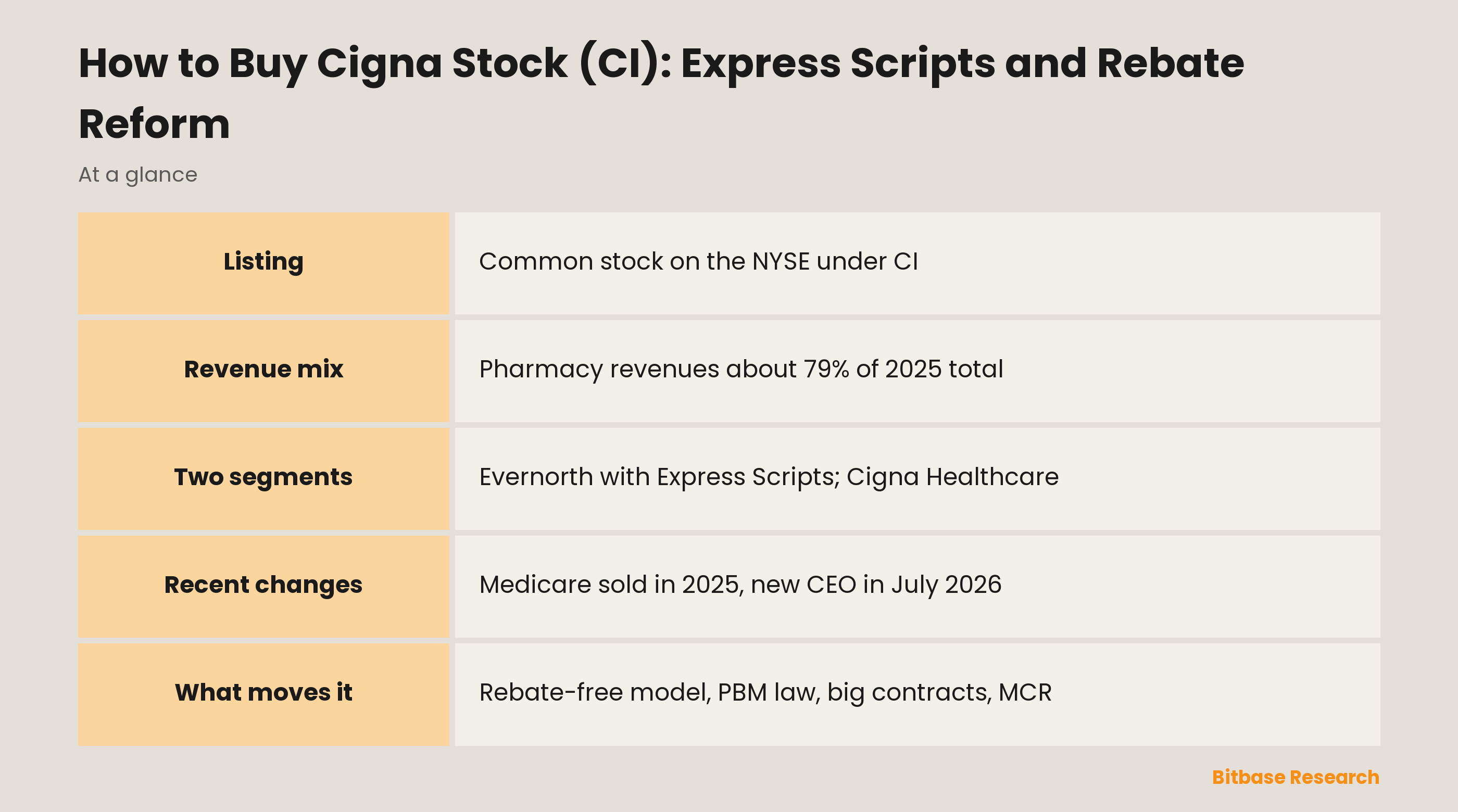
Anybody can buy Cigna stock through a brokerage account that reaches the New York Stock Exchange, where The Cigna Group's common shares trade under the ticker CI. The business behind the ticker is mostly pharmacy rather than insurance: about 79% of its 2025 revenues were pharmacy revenues, booked by Evernorth Health Services, the unit that runs Express Scripts. Since early 2025 Cigna has sold its Medicare plans, changed chief executive and committed to a rebate-free pharmacy benefit model. This guide covers how each half of the company earns money, how to place an order and which risks its annual report spells out.
What Does Cigna Do?
The Cigna Group calls itself "a global health company" and reports two segments: Evernorth Health Services, which sells pharmacy and care services to health plans, employers and government programmes, and Cigna Healthcare, which insures or administers medical plans. A small third unit, Other Operations, holds corporate-owned life insurance and run-off businesses.
Evernorth has two operating segments. Pharmacy Benefit Services is essentially Express Scripts: it administers retail pharmacy networks, processes drug claims, manages formularies (the lists of drugs a plan covers) and handles clients' rebate arrangements with manufacturers, and its Express Scripts Pharmacy ships medicines to patients' homes, usually as 90-day supplies. Specialty and Care Services contains Accredo, a specialty pharmacy for costly drugs that treat complex and rare diseases, the specialty distributor CuraScript SD, MD Live virtual care and EviCore benefits management.
Cigna Healthcare has a U.S. Healthcare arm offering employer medical plans, stop-loss cover, dental and behavioural health, and an International Health arm serving multinational employers and globally mobile people, with local businesses in China, Singapore, Hong Kong, Spain, India and parts of the Middle East. Many employers keep the medical risk and pay Cigna to run the plan: these administrative services only (ASO) arrangements brought in about 32% of the segment's 2025 revenues but covered nearly four in five of its medical customers.
The insurer Connecticut General Life traces its origins to 1865, and the predecessor CIGNA Corporation was incorporated in Delaware in 1981. The present group took shape on 20 December 2018, when Cigna acquired Express Scripts through a series of mergers that put both under a new holding company; the old Cigna stock was delisted and the new shares were listed on the NYSE. On 13 February 2023 that company renamed itself The Cigna Group and kept the CI ticker.
Three later changes reshape what a share holds. On 19 March 2025 Cigna completed the sale of its Medicare Advantage, stand-alone Part D, Medicare supplemental and CareAllies businesses to Health Care Service Corporation. In April 2026 it announced a planned exit from the Individual and Family Plans medical business as of 1 January 2027. And on 1 July 2026 Brian Evanko, previously chief operating officer, succeeded David Cordani as chief executive; Cordani, CEO since December 2009, became executive chair.
How Cigna Makes Money
Revenue and profit sit in different places. Pharmacy revenues were 78.8% of total 2025 revenues, premiums 14.6%, fees and other revenues 6.2% and net investment income 0.4%. Total revenues rose 11%, while premiums fell 12% as the Medicare businesses left.
| Business | What it sells | 2025 revenue growth | 2025 pre-tax margin |
|---|---|---|---|
| Pharmacy Benefit Services (Evernorth) | Express Scripts networks, claims, formularies, home delivery | 18% | 2.7% |
| Specialty and Care Services (Evernorth) | Accredo, CuraScript SD, MD Live, EviCore | 14% | 3.6% |
| Cigna Healthcare | Employer, individual, stop-loss and international plans | Down 11% | 8.8% |
Growth is in adjusted revenues; margin is pre-tax adjusted income from operations over adjusted revenues, calculated from the 10-K's segment figures.
Evernorth's adjusted revenues were roughly five times Cigna Healthcare's, but the money mostly passes through: pharmacy and other service costs absorbed 94.9% of Evernorth's 2025 revenues, so its pre-tax margin was only 3.1%. Volume still makes it the larger earner, with about 63% of the pre-tax adjusted income of the three operating units, and within it Specialty and Care Services earned slightly more than Pharmacy Benefit Services on smaller revenues, growing 8% while the benefit side slipped.
Rebates from drug makers largely flow back to clients: the 10-K says Express Scripts shared over 95% of the formulary rebates it received with integrated clients in 2025, and more than two-thirds of clients received 100%. A few contracts carry great weight. One pharmacy benefit client, which the filing does not name, accounted for about 19% of revenues from external customers in 2025, up from 16% a year earlier. Three clients each drive significant revenues for Evernorth: Centene, under an agreement that began on 1 January 2024; Prime Therapeutics; and TRICARE, the military health programme. Contracts with the three largest have been renewed or extended through the end of the decade.
Cigna Healthcare's results hinge on the medical care ratio (MCR), medical costs as a share of premiums in the insured business: 81.3% in 2023, 83.2% in 2024 and 84.4% in 2025, so each year less of every premium was left over. The segment's pre-tax adjusted income slipped 2% in 2025, which the company put down mainly to Individual and Family Plans, the business it is now leaving; those plans supplied about 8.5% of the segment's 2025 premiums.
CI Stock at a Glance
| Item | Detail |
|---|---|
| Exchange | New York Stock Exchange (NYSE) |
| Ticker | CI |
| Security | Common stock, the only security registered under Section 12(b) on the 10-K cover |
| CUSIP | 125523100, unchanged by the 2023 name change |
| Sector | Health care: pharmacy and care services (Evernorth) and health benefits (Cigna Healthcare) |
| Index membership | S&P 500, per State Street's SPY holdings file for 29 October 2026; not in the Dow Jones Industrial Average |
| Headquarters | Bloomfield, Connecticut |
| Incorporated | Delaware; the holding company dates from 2018, its predecessor from 1981 |
| Former name | Cigna Corporation, until February 2023 |
| Fiscal year end | 31 December |
| Dividend policy | Quarterly since 2021, yearly before that; each payment needs board approval |
| Share buybacks | Board-authorised programme with no expiration date |
| Stock split | Three-for-one, effective 4 June 2007 |
| SEC identifier | CIK 1739940; filings from before the 2018 merger sit under CIK 701221 |
Filings hold what rarely changes. Quotes, market value and yield move with every trade, and those live on the Cigna stock page on Bitbase.
How to Buy Cigna Stock
CI is a US company's common stock, with no depositary receipt or second share class to weigh. The steps:
1. Choose a broker with NYSE access. Check which legal entity will hold your shares and who regulates it in your country.
2. Open the account and pass the identity checks. Non-US individuals are normally asked for IRS Form W-8BEN, which a foreign person gives "to the withholding agent or payer" as the beneficial owner of income subject to withholding.
3. Fund it. A deposit in another currency is converted at the broker's rate, a cost on top of any commission.
4. Search for CI and read the name. The result should say The Cigna Group, common stock, NYSE. Evernorth, Express Scripts and Cigna Healthcare are parts of the group with no listing of their own.
5. Pick an order type. A market order buys at the price available; a limit order names your maximum and may not fill.
6. Think about fractions. FINRA notes that "the availability of fractional share trading varies by brokerage firm," that a fractional owner "might not have shareholder voting rights," and that at present you "can't transfer fractional shares to another brokerage firm."
7. Keep the confirmations. They record your cost basis and every dividend credited.
Outside the United States, CI dividends count as US-source income. The IRS states that "most types of U.S. source income received by a foreign person are subject to U.S. tax of 30%," and a tax treaty between your country and the US can reduce that rate; your home country may tax the same dividend again. This is general information, not tax advice.
Through funds, you can hold Cigna without picking it. On 29 October 2026 it appeared in State Street's holdings files for SPY, which tracks the S&P 500, and for XLV, the Health Care Select Sector SPDR ETF. Like other funds that track the S&P 500, they hold it as one position among many.
What Moves CI Stock
The rebate-free model. In October 2025 Cigna announced a pharmacy benefit model meant to "make discounts negotiated with drug companies available upfront to customers buying their medications" instead of paying them out later as rebates. Cigna Healthcare is to adopt it for fully insured customers from 2027, and it becomes Evernorth's standard model for pharmacy benefit clients from 2028. The cost is already visible: in the first half of 2026, pre-tax adjusted income at Pharmacy Benefit Services fell 27%, mainly because of "client- and customer-focused initiatives" that include "proactive renewals or extensions of large client contracts" and investment in the new model.
PBM legislation. The Consolidated Appropriations Act, 2026, enacted in February 2026, requires PBMs serving employer plans governed by ERISA to remit 100% of certain rebates, fees and other remuneration to plan sponsors from August 2028. From January 2028 it bars PBM pay in Medicare Part D that is linked to a drug's list price, and from January 2029 Part D plans must contract with any pharmacy willing to meet standard terms. Cigna says the full effect "cannot be determined at this time."
Large contracts. With one client at about 19% of outside revenues, any renewal or repricing shows up in group results, and Express Scripts contracts "generally have three-year terms."
Specialty pharmacy. Specialty and Care Services, the home of Accredo, lifted pre-tax adjusted income by 21% in the first half of 2026 while the benefit side fell, so the balance between the two now sets much of Evernorth's margin. In the third quarter of 2025 Cigna also bought preferred stock in Shields Health Solutions, a specialty pharmacy management company.
Medical costs and plan mix. Premiums in Cigna Healthcare are "generally set for a one-year period and are priced well in advance," so when medical costs run ahead of plan, the MCR rises before prices can follow. Leaving Individual and Family Plans removes the business blamed for the 2025 squeeze, and in the first half of 2026 the segment's pre-tax adjusted income rose 17%, mainly on a better margin in the US employer business.
A portfolio in motion. The Medicare sale, the 2024 write-down that left the VillageMD investment fully impaired, a cost programme begun in early 2025 and the new chief executive all fall between 2024 and 2026.
Cigna's Exposure to Rebates, Regulators and Debt
Price competition. "Clients can easily move between our competitors and us," the 10-K warns. The filing says competition has pushed PBMs, Cigna among them, to cut prices and share more of the rebates they receive, and that failing to respond, including through the rebate-free model, could cost it clients.
Drug makers. Manufacturer contracts "are typically nonexclusive and terminable on relatively short notice by either party," and the company acknowledges that its rebate-free commitment "may alter manufacturer contracting dynamics." Medicare price negotiation under the Inflation Reduction Act can shift the economics as well.
Regulators and courts. The FTC's September 2024 complaint over insulin rebate practices ended in a February 2026 settlement "without a monetary penalty, finding of fault or admission of liability," but it requires changes to Express Scripts' practices on medication affordability. One state has passed a law barring PBMs from owning pharmacies there, now in litigation. Cigna is also being sued over its use of AI in evaluating claims, and it self-insures "a significant portion of our litigation risks."
Goodwill and debt. Goodwill and other intangible assets were 47% of total consolidated assets at the end of 2025, so an impairment would hit earnings and equity, and the 10-K says the group's debt could divert operating cash flow to debt service.
The share itself. The 10-K's performance graph puts CI's five-year total return to the end of 2025, with dividends reinvested, at about 45%, against about 96% for the S&P 500 and 48% for the S&P 500 Health Care Index.
Researching Cigna Before You Buy
Cigna's filings since the 2018 merger sit on SEC EDGAR under CIK 1739940; earlier annual reports, including the one that records the 2007 split, are under CIK 701221. In the 10-K, Item 1 describes the two segments and the rebate-free model, Item 1A the risk factors, Item 5 dividends and buybacks, and Item 7 segment margins and the MCR; Note 23 carries segment detail and the largest-client disclosure. Each 10-Q updates those tables, and 8-Ks report results and events such as the chief executive change. The investor site, thecignagroup.com, holds earnings calls and the 30 September 2026 investor day materials.
Cigna Stock FAQ
Does Cigna pay a dividend?
Yes, every quarter. The board declared the first quarterly cash dividend on 6 January 2021 and paid it on 25 March; in 2019 and 2020 Cigna had paid once a year. The per-share amount was higher in 2024 than in 2023, higher again in 2025 and higher still in 2026. The company "currently intends to pay regular quarterly dividends," each subject to board approval; the latest amount is in the most recent filing.
Can I buy Cigna stock with crypto?
Not directly. CI shares are bought through a broker in US dollars, so crypto must first be sold for cash and the cash moved into the brokerage account, and that sale can be taxable where you live. The routes are compared in the guide to buying stocks with crypto.
Does Cigna own Express Scripts?
Yes. Cigna acquired Express Scripts on 20 December 2018, and Express Scripts shareholders received 0.2434 of a Cigna share plus cash for each share they held. Express Scripts was merged into a wholly owned subsidiary and has no stock of its own; it now runs the pharmacy benefit business inside Evernorth.
Is Cigna in the S&P 500?
Yes. State Street's holdings file for SPY, which tracks the S&P 500, listed The Cigna Group on 29 October 2026, as did the file for XLV. The same day's file for DIA, the fund that tracks the Dow Jones Industrial Average, did not include it, so CI is not a Dow stock. Membership can change, so the date on a holdings file matters.
Has Cigna stock ever split?
Yes. The board of the former CIGNA Corporation approved a three-for-one split on 25 April 2007, effective 4 June 2007. The 2018 merger swapped old Cigna shares one for one, so it left holders' share counts unchanged.
Does Cigna still sell Medicare Advantage plans?
No. Cigna sold its Medicare Advantage, stand-alone Part D, Medicare supplemental and CareAllies businesses to Health Care Service Corporation, completing the sale on 19 March 2025. Through its subsidiaries it still serves Medicare Part D plan sponsors, which is why the Part D rules in the 2026 law matter to the group.
Conclusion
A CI purchase needs one order at an NYSE-capable broker; judging it means reading two businesses at once. Most of the revenue is pharmacy money moving through Express Scripts and Accredo on thin margins, while the higher-margin health plan narrows towards employer and international customers. The next few years bring a rebate-free pharmacy model, PBM rules that start in 2028 and the exit from individual plans in 2027, under a chief executive who took over in July 2026. Check the Pharmacy Benefit Services results and the medical care ratio in each filing before deciding how much of your money, if any, belongs in one company.
Related reading
Other Bitbase articles on this topic:
- How to Buy Becton Dickinson Stock (BDX): Waters Deal and Dividend
- How to Buy Boston Scientific Stock (BSX): Farapulse and Watchman
- How to Buy Cardinal Health Stock (CAH): CVS, Generics, Opioids
- How to Buy Medtronic Stock (MDT): MiniMed Split and Irish Tax
Disclaimer: This article is educational content from Bitbase Academy, provided for information only. It explains what a company or fund does and how the instruments referenced here differ from one another; it does not constitute investment, trading, tax, or financial advice, and it is neither a recommendation nor an endorsement of any security, token, or trading strategy. A tokenized stock is issued by a third party and is designed to give economic exposure to an underlying asset: it is not a share, it carries no shareholder rights, and it depends on the issuer's structure, eligibility rules, and redemption terms, which the issuer can change. Perpetual futures are leveraged derivatives that hold no underlying asset and can be liquidated, and trading hours, product availability, and eligibility differ by instrument and by jurisdiction and can change at any time. Written as of October 2026; verify everything yourself through company filings, the issuer's own documentation, and the product pages of the venue you trade on.
References
[1] Cigna Form 10-K for 2025 (SEC EDGAR) www.sec.gov
[2] Cigna Form 10-Q for the quarter to 30 June 2026 www.sec.gov
[3] Cigna Form 8-K, 3 March 2026: CEO succession www.sec.gov
[4] Cigna Form 8-K, 13 February 2023: name change www.sec.gov
[5] Cigna Form 10-K for 2018: Express Scripts merger www.sec.gov
[6] Cigna Form 10-K for 2020: quarterly dividend www.sec.gov
[7] CIGNA Corporation Form 10-K for 2007: stock split www.sec.gov
[8] State Street: SPY daily holdings, 29 October 2026 www.ssga.com
[9] State Street: XLV daily holdings, 29 October 2026 www.ssga.com
[10] State Street: DIA daily holdings, 29 October 2026 www.ssga.com
[11] FINRA: Investing in Fractional Shares www.finra.org
[12] IRS: NRA Withholding www.irs.gov
[13] IRS: About Form W-8 BEN www.irs.gov





