
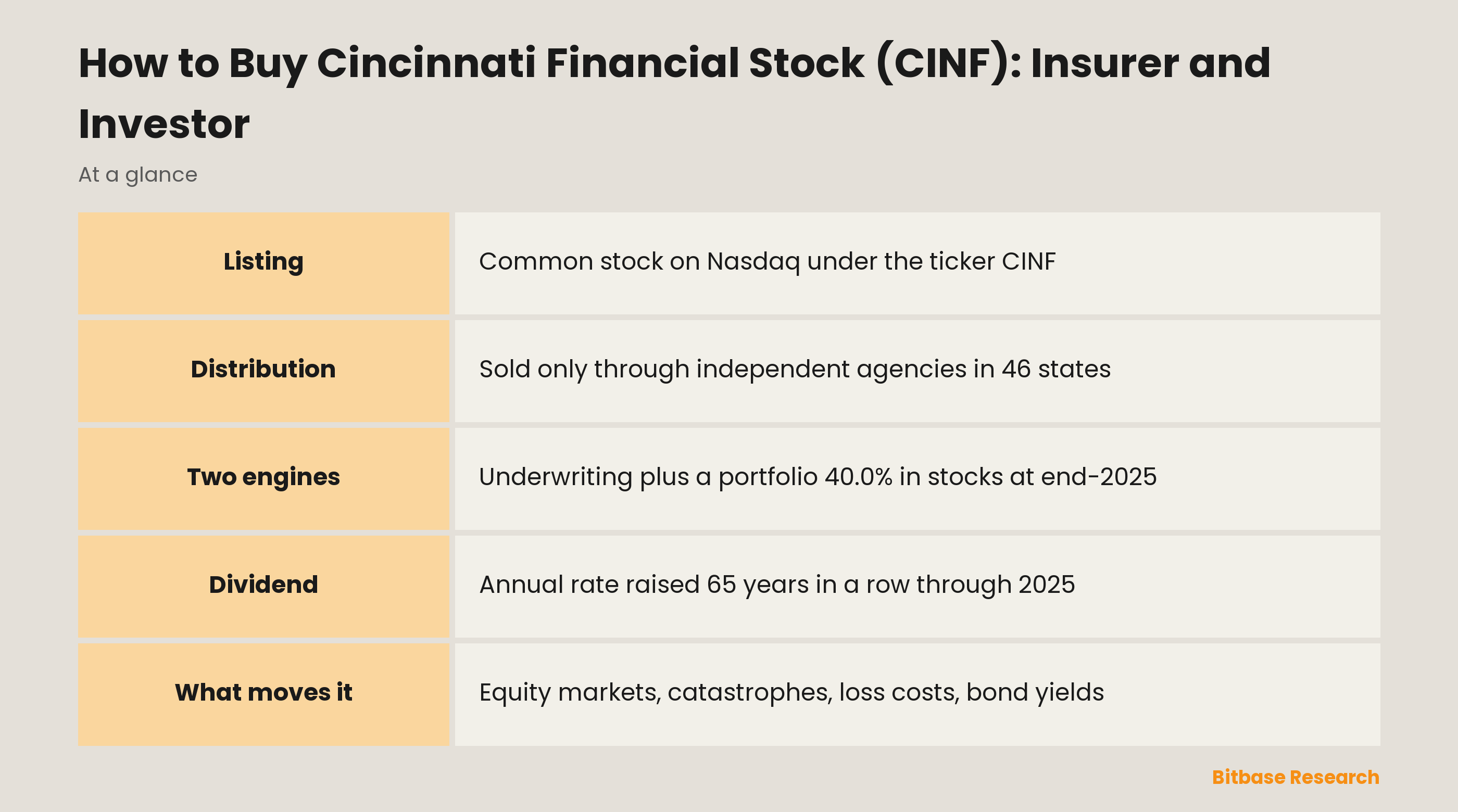
Cincinnati Financial has its common stock listed on Nasdaq under the ticker CINF, so buying it takes a brokerage account that reaches that exchange. The Ohio company sells property and casualty insurance only through independent agencies, yet in 2025 its investments segment earned more than five times as much before tax as its four insurance segments together, partly because gains on stocks it still holds run through net income. Below: the business, the order, and why this share can react to the stock market almost as much as to storms.
What Does Cincinnati Financial Do?
Cincinnati Financial is an insurance holding company. Its lead subsidiary, The Cincinnati Insurance Company, was founded in 1950 by four independent insurance agents; the holding company was formed as an Ohio corporation in 1968 and is based in Fairfield, Ohio.
The defining choice is distribution. The 10-K says the main business is "property casualty insurance marketed through independent insurance agencies in 46 states," and that the company is "fully committed to the independent agency channel." Those agencies also sell competing carriers' policies, so Cincinnati must win each account from people who do not work for it. Citing industry studies, the filing says independent agents and brokers handle about 60% of US property casualty premiums and about 80% of commercial ones.
The group's insurers have distinct jobs. The standard market companies write business, homeowner and auto policies. Cincinnati Specialty Underwriters writes excess and surplus lines, cover for business risks that standard insurers find hard to price. Cincinnati Life sells term, whole and universal life insurance and fixed annuities. Cincinnati Re assumes reinsurance from other insurers, and Cincinnati Global is a London-based specialty underwriter for Lloyd's Syndicate 318. A leasing and financing arm and an in-house brokerage complete the group.
In personal lines the company prefers to insure the whole household: at the end of 2025 about 86% of its homeowner policies came with a personal auto policy in the same account, and its high net worth offering, Cincinnati Private Client, made up approximately 60% of personal lines premiums.
The 10-K reports five segments: commercial lines, personal lines, excess and surplus lines, life insurance, and investments. Cincinnati Re and Cincinnati Global are reported as Other.
How Cincinnati Financial Makes Money
An insurer has two engines. Underwriting earns money when premiums exceed claims and expenses; investing earns money on premiums held until claims are paid. In 2025 the second engine was much larger.
| Business | Share of 2025 net written premiums | 2025 result before tax |
|---|---|---|
| Commercial lines | 47.9% | Profit |
| Personal lines | 32.8% | Loss |
| Excess and surplus lines | 7.0% | Profit |
| Life insurance | 3.4% | Profit |
| Other: Cincinnati Re and Cincinnati Global | 8.9% | Underwriting profit |
| Investments | No premiums | Largest profit of any segment |
Earned premiums were about 79% of 2025 total revenues, investment income about 9% and net investment gains about 11%.
Underwriting. The yardstick is the combined ratio, claims and expenses as a share of premiums; below 100% means an underwriting profit. Cincinnati's statutory combined ratio was 94.7% in 2025 after 92.9% in 2024. Commercial lines ran at 90.3%, personal lines at 102.8%, with catastrophes adding 21.0 percentage points there; the 10-K attributes the year's higher catastrophe losses primarily to the January 2025 wildfires in southern California. Personal lines earned premiums still rose 22%, commercial lines 8% and excess and surplus lines 13%.
Investing. At the end of 2025 bonds made up 58.5% of the portfolio's fair value and common stocks 40.0%. That equity share matters for reported profit because, in the 10-K's words, "the change in fair value for equity securities still held is reported in net income." A rising market lifts net income even when nothing is sold; a falling one cuts it.
CINF Stock at a Glance
| Feature | CINF |
|---|---|
| Exchange | Nasdaq Global Select Market |
| Ticker | CINF |
| Security | Common stock, the only class registered under Section 12(b) |
| Sector | Property and casualty insurance, with life insurance and reinsurance |
| Index membership | S&P 500 |
| Headquarters | Fairfield, Ohio |
| Incorporated | Ohio, 1968 |
| Fiscal year | Calendar year, ending 31 December |
| Payouts | Quarterly cash dividend; annual rate raised for 65 consecutive years through 2025, raised again in January 2026 |
| SEC identifier | CIK 20286 |
Quotes, market value and yield move all day; the Cincinnati Financial stock page on Bitbase shows them live.
How to Buy Cincinnati Financial Stock
Cincinnati Financial is an Ohio corporation filing a 10-K, so no depositary receipt is involved: the line on Nasdaq is the common stock itself.
1. Pick a broker that lists Nasdaq shares. Outside the US that can be a local bank or broker with a US market service, or an international broker; check which legal entity holds your account and who regulates it.
2. Complete the account checks. Non-US residents normally provide IRS Form W-8BEN, which the IRS says to submit "when requested by the withholding agent or payer."
3. Fund the account. Depositing in another currency adds a conversion cost on top of any commission.
4. Find the right line. Search CINF and confirm it reads Cincinnati Financial Corporation common stock; the company registers no other class.
5. Choose the order type. A market order fills at the prices available when it arrives; a limit order sets the worst price you accept and may not fill.
6. Decide the amount. Some brokers sell fractional shares for a fixed sum, though terms and voting arrangements vary by firm.
Tax for buyers abroad. The IRS says that "most types of U.S. source income received by a foreign person are subject to U.S. tax of 30%," and a tax treaty may lower the rate. Dividends fall under that rule, and your home country may tax them too.
Through a fund. On 9 November 2026 State Street's daily holdings file for SPY listed Cincinnati Financial Corp, so S&P 500 index funds hold it among hundreds of companies.
What Moves CINF Stock
The equity market. Because unrealized stock gains go through net income, headline profit swings with share prices. In the third quarter of 2026 net income fell 59% from a year earlier, while non-GAAP operating income, which excludes investment gains and losses, fell only 1%. At the parent company, 91.4% of cash and invested assets sat in common stocks at the end of 2025; no single holding exceeded 7.8% of the public stock portfolio, but information technology made up 35.4% of it.
Catastrophe years. Over ten years catastrophes added an average of 8.6 points a year to the combined ratio, in uneven bursts. In the third quarter of 2026 the combined ratio rose to 90.9% from 88.2% as catastrophe losses grew by 7.0 points, which chief executive Stephen M. Spray described as "moving closer to historical averages." From January 2026, Cincinnati added reinsurance funded by catastrophe bonds through a Bermuda vehicle, Skyline Re II Ltd.
Price against loss costs. Premiums are set before claims arrive, so inflation in repairs, medical care and lawsuits erodes margins, and the 10-K notes that three-year rates on some commercial policies magnify swings in inflation. Management's long-term target is a combined ratio of 92% to 98%; for the first nine months of 2026 it was 95.8%.
Agencies and new business. In the third quarter of 2026 new business written premiums fell 12%, mainly in personal lines, while agencies appointed since the start of 2025 supplied 10% of new business.
Bond yields. Higher yields raise investment income, up 10% in the third quarter of 2026, but lower the value of bonds already held, which moves book value per share.
Reserves, Storms and the Stock Portfolio
The 10-K states its risk factors as plain headlines. These bear most directly on a CINF holder:
| Risk factor in the 10-K | What it means here |
|---|---|
| "Loss reserves, our largest liability, are based on estimates and could be inadequate to cover actual losses." | If old claims cost more than reserved, current earnings absorb it. |
| "We could experience an unusually high level of losses due to natural or man-made catastrophe, terrorism or epidemic events or risk concentrations." | Storms and wildfires at home, and worldwide exposure through Cincinnati Re and Cincinnati Global. |
| "We rely primarily on independent insurance agents to distribute our products." | The agents are nonexclusive and can place clients elsewhere, for instance after a ratings downgrade. |
| "Financial disruption or a prolonged economic downturn could affect our investment performance." | The stock portfolio feeds both net income and book value. |
| "Our status as an insurance holding company with no direct operations could affect our ability to pay dividends in the future." | Shareholder dividends depend on subsidiary dividends, which Ohio insurance law limits. |
| "Elevated inflation negatively impacts profit and the value of investments." | Including "social inflation of litigation costs, jury awards and settlement expectations." |
Beyond the filing sits the ordinary risk of one stock: nothing offsets a single company's setbacks in a concentrated position. And a long dividend record is history, not a promise.
How to Research CINF Yourself
Cincinnati Financial files with the SEC under CIK 20286: the 10-K each February, 10-Qs for the first three quarters, and 8-Ks for events, including the earnings releases, which in 2026 came on 9 February, 27 April, 27 July and 26 October. The same reports are on investors.cinfin.com, with a detailed portfolio listing updated each quarter.
In the 10-K, Item 1 explains the segments and agency data, the MD&A breaks the combined ratio down by segment and shows the catastrophe points, and Item 7A covers market risk on bonds and stocks. Each earnings release reconciles net income to non-GAAP operating income. The company's own headline measure is the value creation ratio, growth in book value per share plus dividends: 18.8% in 2025, against a target averaging 10% to 13% over five years.
For contrast, see our Travelers stock guide, another insurer selling through independent agents, and our Allstate stock guide, a personal lines carrier with its own agents. Other companies are on Bitbase's US stock pages.
Cincinnati Financial Stock FAQ
Can I buy Cincinnati Financial stock with crypto?
No, not directly. CINF shares are bought through a brokerage account funded in US dollars, so crypto would first have to be sold for cash, possibly a taxable event where you live, and the money moved to the broker. A share is a legal stake with dividend and voting rights, one of the points in how stocks differ from crypto assets.
Does Cincinnati Financial pay a dividend?
Yes, quarterly. Through 2025 it had raised the annual rate for 65 consecutive years, "a record we believe is matched by only seven other publicly traded U.S. companies," and the board raised it again in January 2026. Over the past ten years the company paid out an average of 25% of net income as dividends.
Is CINF in the S&P 500?
Yes. Cincinnati Financial Corp appeared in State Street's SPY holdings file dated 9 November 2026. Index weights change daily.
Why does Cincinnati Financial's net income swing so much?
Because changes in the fair value of stocks it still holds are reported in net income, a strong quarter for equity markets can lift earnings sharply and a weak one can cut them, even when underwriting is steady. Non-GAAP operating income excludes those gains and losses.
Is Cincinnati Financial the same company as Cincinnati Insurance?
Not quite. Cincinnati Financial Corporation is the listed holding company; The Cincinnati Insurance Company is its lead insurance subsidiary and owns the life, specialty and other standard market insurers. Buying CINF gives you a share of the whole group.
Conclusion
Cincinnati Financial is two businesses in one share: an agency-based insurer whose underwriting stayed profitable in 2025 despite the California wildfires, and a large equity investor whose gains and losses flow straight into net income. Read the latest 10-K and quarterly release side by side, compare net income with operating income over several years, and judge how much of what you are buying is insurance and how much is the stock market.
Related reading
Other Bitbase articles on this topic:
- How to Buy AIG Stock (AIG): Commercial Insurance After Corebridge
- How to Buy Arch Capital Stock (ACGL): Reinsurance and Mortgages
- How to Buy Prudential Financial Stock (PRU): Not Prudential plc
- How to Buy Prudential plc Stock (PUK): Asia and Africa, Not the US
Disclaimer: This article is educational content from Bitbase Academy, provided for information only. It explains what a company or fund does and how the instruments referenced here differ from one another; it does not constitute investment, trading, tax, or financial advice, and it is neither a recommendation nor an endorsement of any security, token, or trading strategy. A tokenized stock is issued by a third party and is designed to give economic exposure to an underlying asset: it is not a share, it carries no shareholder rights, and it depends on the issuer's structure, eligibility rules, and redemption terms, which the issuer can change. Perpetual futures are leveraged derivatives that hold no underlying asset and can be liquidated, and trading hours, product availability, and eligibility differ by instrument and by jurisdiction and can change at any time. Written as of November 2026; verify everything yourself through company filings, the issuer's own documentation, and the product pages of the venue you trade on.
References
[1] Cincinnati Financial Form 10-K for 2025 (SEC EDGAR) www.sec.gov
[2] Cincinnati Financial 2025 Form 10-K, XBRL cover page (SEC EDGAR) www.sec.gov
[3] Cincinnati Financial 2025 Form 10-K, XBRL income statement (SEC EDGAR) www.sec.gov
[4] Cincinnati Financial 2025 Form 10-K, XBRL segment results (SEC EDGAR) www.sec.gov
[5] Cincinnati Financial third-quarter 2026 results release (SEC EDGAR) www.sec.gov
[6] Cincinnati Financial Form 10-Q for the third quarter of 2026 (SEC EDGAR) www.sec.gov
[7] State Street, SPY fund page and daily holdings www.ssga.com
[8] IRS, NRA withholding www.irs.gov
[9] IRS, About Form W-8 BEN www.irs.gov





