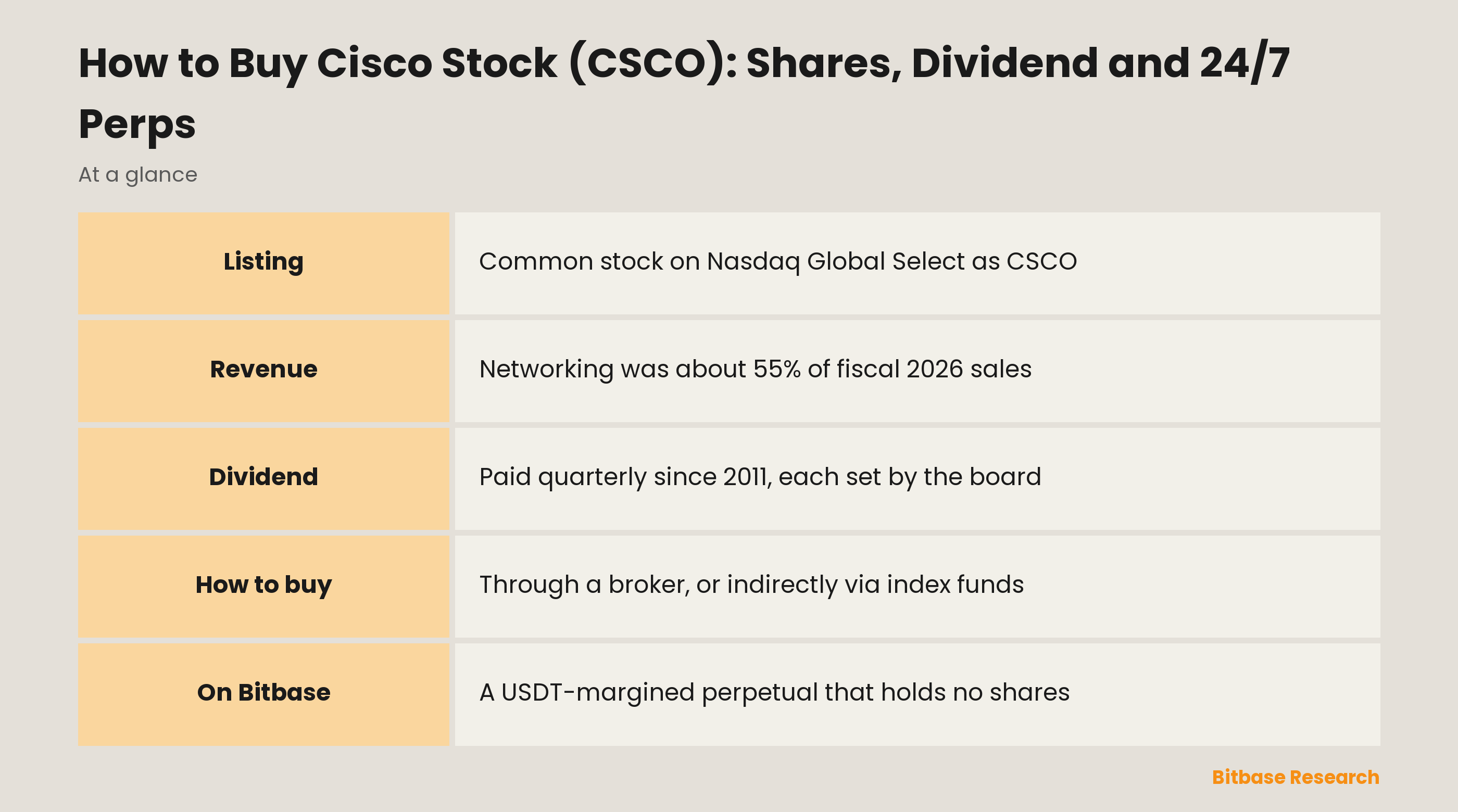
Cisco stock trades on the Nasdaq Global Select Market under the ticker CSCO, and you buy it like any US share: through a broker with Nasdaq access. Behind the ticker is a networking-equipment maker that has paid a quarterly dividend since 2011 and now sells AI data-centre networking to hyperscale cloud operators. Bitbase does not sell the shares; it lists a USDT-margined CSCO perpetual that tracks the price and holds nothing.
What Does Cisco Do?
Cisco makes the hardware and software that carry data across networks: switches, routers, wireless access points and the security and monitoring tools on top. In its own words, it "designs and sells a broad range of technologies including hardware, software, and artificial intelligence (AI) powered digital infrastructure to power, help secure, and draw insights from the Internet."
Its products fall into four categories. Networking is switching, routing, wireless and servers, plus Acacia optics, with high-performance systems "predominantly powered by Cisco Silicon One", Cisco's own chip architecture. Security covers network security, identity and access management, and secure access delivered from the cloud. Collaboration is Webex, meeting-room devices and contact-centre software. Observability is Splunk Observability and ThousandEyes. Services, meaning support and professional services, run alongside.
Cisco was incorporated in California in 1984, went public in February 1990 and reincorporated in Delaware in 2021. It sells to "businesses of all sizes, public institutions, governments, and service providers, including hyperscalers," a substantial portion through channel partners, and relies on contract manufacturers rather than its own factories. The Splunk acquisition, completed on 18 March 2024, accelerated its shift toward recurring software. Rivals named in the filing, each for some products, include Arista Networks, Hewlett-Packard Enterprise, Huawei and Palo Alto Networks.
How Cisco Makes Money
Products bring in most of the revenue. In fiscal 2026, which ended on 25 July 2026, Networking made up about 55% of revenue, Security about 13% and Collaboration about 7%, with Observability the smallest category; Services added about 24%. Software is reported across every category and across services, and it came to about 37% of total revenue.
The mix moves. Security rose from about 9% of revenue in fiscal 2024 to about 14% in fiscal 2025, the first full year after the Splunk deal closed. Networking slipped to about 50% that year, then grew its product revenue 22% in fiscal 2026, "particularly within our AI Infrastructure and Campus Networking solutions." Total revenue rose 12%, with products up 16% and services flat.
One slice grew quickly: AI infrastructure for hyperscalers, at approximately 6% of fiscal 2026 revenue, against less than 2% in fiscal 2025. By region, the Americas produced about 60%. One concentration stands out: a global channel partner accounted for approximately 11% of fiscal 2026 revenue, while no single customer reached 10% in fiscal 2025 or 2024.
CSCO Stock at a Glance
| Item | Detail |
|---|---|
| Exchange | Nasdaq Global Select Market |
| Ticker | CSCO |
| Share class | Common stock, one listed class |
| Industry | Networking and communications equipment |
| Index membership | S&P 500, Nasdaq-100 and Dow Jones Industrial Average, per tracking-fund holdings on 16 October 2026 |
| Headquarters | San Jose, California |
| Incorporated | California in 1984, Delaware since 2021 |
| Public since | February 1990 |
| Fiscal year end | Last Saturday in July |
| Dividend policy | Quarterly cash dividend, first paid in 2011, each approved by the board |
| Share buybacks | Programme announced in September 2001, no termination date |
For the live quote and chart, see the Cisco stock page on Bitbase.
How to Buy Cisco Stock
At a broker, the steps are:
1. Pick a broker that offers US-listed shares. Check that it accepts residents of your country.
2. Open and verify the account. If you are not a US person, expect to be asked for Form W-8BEN.
3. Fund it. If you deposit in a currency other than US dollars, the conversion is part of your cost.
4. Search for CSCO and choose an order type. A market order fills at the prevailing price; a limit order caps the price and may not fill.
5. Choose the size. Whole shares, or a fraction of one if your broker offers fractional trading.
6. Hold and track. Dividends arrive as cash, after any tax withheld.
Outside the US, the instrument is the same: CSCO is Cisco's own common stock, not a depositary receipt, so there is no ADR ratio to track. Tax is what varies. The IRS states that "Most types of U.S. source income received by a foreign person are subject to U.S. tax of 30%," with a reduced rate possible under a tax treaty, and Form W-8BEN is how a foreign individual certifies that status, "whether or not you are claiming a reduced rate." This is general information, not tax advice.
Through a fund, the route is indirect: a fund tracking one of the three indices in the table holds a slice of Cisco alongside every other constituent, and that slice changes daily.
Trading CSCO on Bitbase
Bitbase lists a CSCO perpetual futures contract, margined and settled in USDT. It tracks Cisco's share price and is not the stock: you hold no share, receive no dividend and have no vote. In exchange, the position can be long or short, uses leverage, and keeps trading through nights and weekends while Nasdaq is closed.
A periodic funding payment passes between longs and shorts to hold the contract near Cisco's price, and a position is liquidated on a mark price when its margin runs out. Because Nasdaq is shut for most hours of the week, the contract can drift overnight while the share opens somewhere else. The stock perpetual guide covers the mechanics in full.
The funding interval, margin tiers, maximum leverage and the mark price used while Nasdaq is closed are set in the contract's rules on Bitbase; read them before opening a position. Other stocks, and the form each one takes, are in Bitbase's TradFi listings.
What Moves CSCO Stock
Hyperscaler orders have become a swing factor. Its risk factors say AI infrastructure sales to hyperscalers "may involve large and concentrated purchases," and that these customers "may delay, reduce or cancel planned deployments or purchases."
Memory costs reach the margin directly. Product gross margin fell in fiscal 2026, "primarily driven by negative impacts from product mix and higher memory costs," and the company expects continued pressure from "currently constrained memory components."
Upgrade cycles drive the largest line. Networking, about 55% of revenue, is sales of switches, routers and wireless gear, so it rises and falls with enterprise, carrier and data-centre refreshes.
Capital returns follow a stated policy: Cisco targets returning at least half of its free cash flow each year through dividends and buybacks.
Price competition from Asia is a named pressure: the filing reports "price-focused competition from competitors in Asia, especially from China."
Risks to Weigh
Concentrated demand. One risk factor says AI infrastructure sales to large cloud and hyperscaler customers "are especially volatile and may be concentrated among a limited number of customers." Some of those customers "have the technical and financial resources to design their own networking equipment, semiconductors and software."
Supply. "Certain components are presently available only from limited or single sources," and the fiscal 2026 memory shortage showed how fast that reaches margins.
Channel, currency and geopolitics. Cisco warns that "disruption of or changes in our distribution model could harm our sales and margins," that a stronger dollar can raise the real cost of its products abroad, and it lists tariffs and China-Taiwan relations among its geopolitical risks.
The stock itself. Shares can fall, and "Future dividends will be subject to the approval of our Board of Directors."
The perpetual's extra layer. Leverage magnifies losses, funding accrues while a position stays open, and a gap at the Nasdaq open can carry it through its liquidation price. Read how margin and liquidation work on a stock perpetual before the first trade.
How to Research CSCO Yourself
Start with SEC EDGAR, where Cisco files under CIK 858877. The 10-K holds the business in Item 1, the risk factors in Item 1A and revenue by product category in the notes; 10-Qs cover each quarter, 8-Ks carry quarterly results and other material events, and the DEF 14A proxy covers the annual meeting. Cisco's investor site, investor.cisco.com, publishes the dividend history and the full stock split table.
Cisco Stock FAQ
Does Cisco pay a dividend?
Yes, quarterly. The board approved the first cash dividend in the company's history on 17 March 2011, and it was paid on 20 April 2011. Each payment still needs board approval, and the current amount per share is listed on Cisco's investor site.
Has Cisco stock ever split?
Nine times, all between 1991 and 2000: seven 2-for-1 splits and two 3-for-2 splits. Compounded, that is a 288-fold increase in share count since the 1990 IPO. The last split in Cisco's own table is the 2-for-1 distributed in March 2000.
Is Cisco in the S&P 500?
Yes. On 16 October 2026, Cisco was among the holdings of SPY, which tracks the S&P 500, as well as QQQ (Nasdaq-100) and DIA (Dow Jones Industrial Average). Index membership can change, so the date matters.
Can I buy Cisco stock with crypto?
The shares come from a broker, priced in money, so a crypto balance has to be converted first. On Bitbase, USDT can trade the CSCO perpetual, which tracks Cisco's price but is a derivative, not stock: no dividend, no vote, and it can be liquidated. The wider comparison is in buying stocks with crypto.
When does Cisco report earnings?
Four times a year, on a fiscal year that ends on the last Saturday in July. Fiscal 2026 ended on 25 July 2026; its quarterly results came on Form 8-K in November, February, May and August, and the annual report followed on 2 September 2026.
Conclusion
Buying Cisco stock is an ordinary broker trade; the work is in what you read first. Revenue rests on networking at about 55%, a security line that has grown since the Splunk deal and a hyperscaler AI slice that grew quickly from a small base, each with its own risk factors. For a view on the price rather than a stake in the company, the Bitbase perpetual is a separate instrument with its own costs, and it owns no part of Cisco.
Related reading
Other Bitbase articles on this topic:
- How to Buy Corning Stock (GLW): Gorilla Glass and AI Fiber
- How to Buy Fortinet Stock (FTNT): FortiGate, ASICs, No Dividend
- How to Buy Hewlett Packard Enterprise Stock (HPE): After Juniper
Disclaimer: This article is educational content from Bitbase Academy, provided for information only. It explains what a company or fund does and how the instruments referenced here differ from one another; it does not constitute investment, trading, tax, or financial advice, and it is neither a recommendation nor an endorsement of any security, token, or trading strategy. A tokenized stock is issued by a third party and is designed to give economic exposure to an underlying asset: it is not a share, it carries no shareholder rights, and it depends on the issuer's structure, eligibility rules, and redemption terms, which the issuer can change. Perpetual futures are leveraged derivatives that hold no underlying asset and can be liquidated, and trading hours, product availability, and eligibility differ by instrument and by jurisdiction and can change at any time. Written as of October 2026; verify everything yourself through company filings, the issuer's own documentation, and the product pages of the venue you trade on.
References
[1] Cisco Systems fiscal 2026 Form 10-K (SEC EDGAR) www.sec.gov
[2] Cisco investor relations: dividend history and stock splits investor.cisco.com
[3] Cisco press release, May 1999: two-for-one stock split newsroom.cisco.com
[4] Cisco press release, March 2011: first cash dividend (SEC EDGAR) www.sec.gov
[5] State Street: SPY daily holdings, 16 October 2026 www.ssga.com
[6] Invesco QQQ: fund overview and holdings (tracks the Nasdaq-100) www.invesco.com
[7] State Street: DIA daily holdings, 16 October 2026 www.ssga.com
[8] IRS: NRA withholding www.irs.gov
[9] IRS: About Form W-8 BEN www.irs.gov





