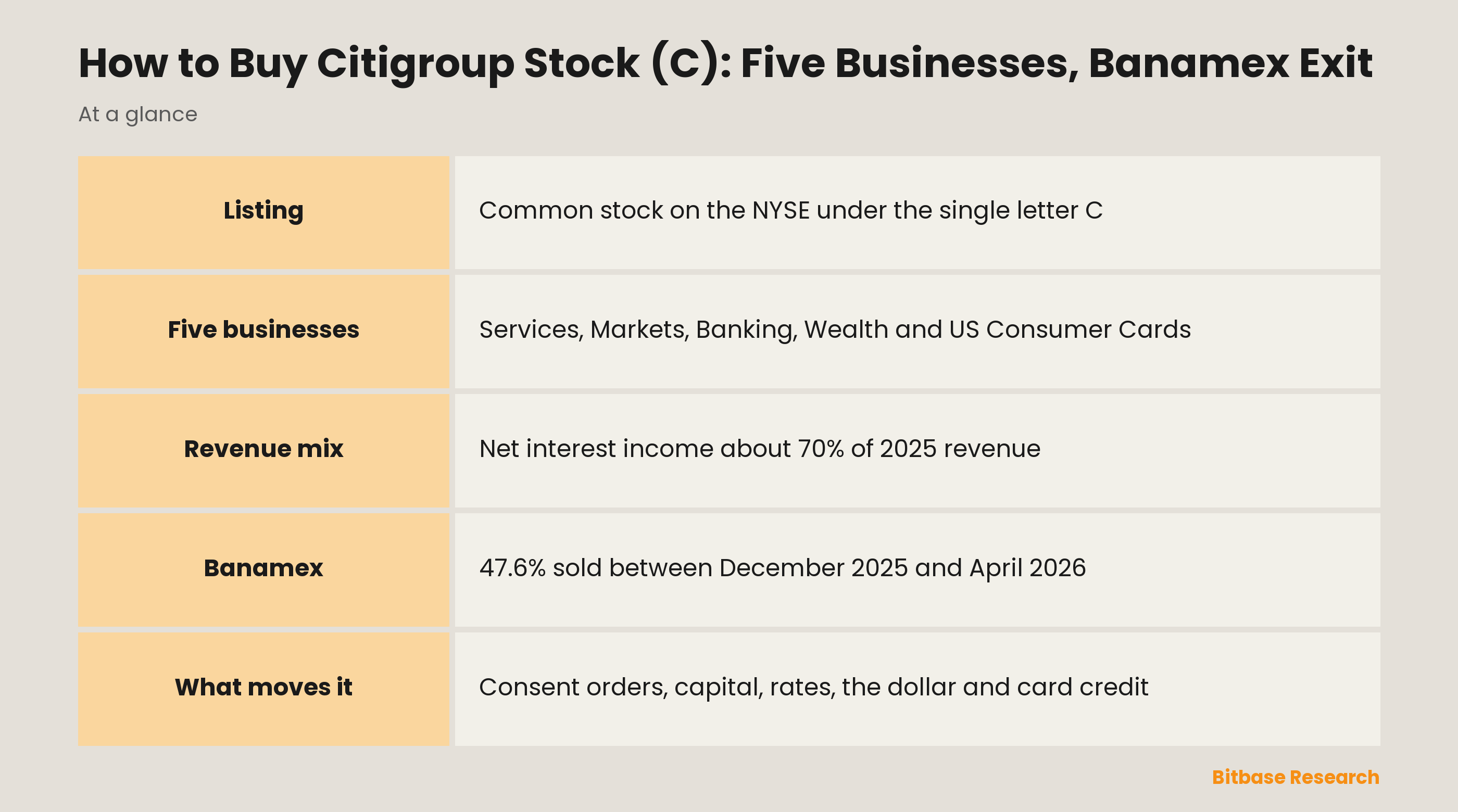
A single letter, C, is how the New York Stock Exchange lists Citigroup's common stock, and an account with a broker that trades NYSE shares is all it takes to buy it. The bank behind that letter has been getting smaller on purpose: it has finished most of its exits from consumer banking in 14 international markets, sold 47.6% of its Mexican bank, Banamex, between December 2025 and April 2026, and now reports five businesses, from corporate payments to US credit cards. This guide covers what each earns, how to place the order without landing on the wrong security, and what Citi's filings say drives the share price.
What Does Citigroup Do?
Citigroup Inc. describes itself as "a global diversified financial services holding company" serving consumers, corporations, governments and institutions, and says it does business in nearly 160 countries and jurisdictions. It is incorporated in Delaware and based at 388 Greenwich Street in New York. Its main bank is Citibank, N.A.; the Federal Reserve supervises the holding company and the Office of the Comptroller of the Currency (OCC) its national banks.
The annual report traces the history to the City Bank of New York, founded in 1812. The listed company took its present form on 8 October 1998, when Citicorp merged into a subsidiary of Travelers Group and Travelers renamed itself Citigroup Inc. The new stock began trading on the NYSE that day as CCI; today the common stock trades simply as C.
Citi's stated aim is "to be the preeminent banking partner for institutions with cross-border needs, a global leader in wealth management and a valued personal bank in the U.S." Since the first quarter of 2026 it has reported five segments, after moving Retail Banking into Wealth and putting the remaining consumer lending into a new cards segment:
Services combines Treasury and Trade Solutions (TTS), which runs cash management, payments and trade finance for multinationals, financial institutions and public bodies, with Securities Services, which earns fees on assets held in custody. It offers products in more than 90 countries.
Markets makes markets in equities, currencies, rates, spread products and commodities for corporate, institutional and public sector clients, and provides financing and prime brokerage, from trading floors in nearly 80 countries.
Banking pairs Investment Banking (debt and equity capital markets plus advisory) with Corporate Lending.
Wealth covers Citigold and Retail Banking, the Private Bank and Wealth at Work, which serves professional firms such as law practices. Its US branches are concentrated in six metropolitan areas, and its wealth centers abroad are in Singapore, Hong Kong, London and the UAE.
U.S. Consumer Cards (USCC) issues Citi-branded and co-branded cards, including Costco and American Airlines, store cards such as The Home Depot's, and personal installment loans. In April 2026 it bought a further American Airlines portfolio; Citi is the airline's exclusive card issuer.
All Other holds Corporate/Other and the leftovers of a plan Citi calls its strategic refresh: leaving consumer banking in 14 markets across Asia, Europe, the Middle East and Mexico. By mid-2026 the exits were largely done everywhere except Mexico; Poland's consumer business was sold in June 2026, and a separate sale in February 2026 ended Citi's operations in Russia. What remains is Banamex.
How Citigroup Makes Money
Citi earns most of its money on spread. In 2025 net interest income (interest earned on loans and securities, minus interest paid to depositors and lenders) supplied about 70% of revenue, and fees, trading gains and other income the remaining 30%. By the company's figures, revenue grew 6% on the year and net interest income 11%.
Recast to the 2026 structure, 2025 revenue split like this:
| Business | Share of 2025 revenue | Main sources of revenue |
|---|---|---|
| Services | 26.6% | Spread on client deposits, payment and custody fees |
| Markets | 26.3% | Market making, financing and trading |
| Banking | 7.5% | Underwriting and advisory fees, corporate loans |
| Wealth | 13.2% | Deposit and lending spread, advisory fees |
| U.S. Consumer Cards | 21.4% | Interest on card balances, interchange net of rewards |
| All Other | 5.0% | Mexican consumer banking, remaining exits, treasury |
Shares are of total 2025 revenue, from the recast history Citi furnished on 3 April 2026, rounded to one decimal.
Services, Markets and Banking together brought in about 60%, which makes Citi more institutional than its name on US credit cards suggests. Services moves money and holds securities for clients across borders and earns on the deposits they keep with it.
Card economics are less obvious. In 2025, under the old U.S. Personal Banking segment that then held the cards, fee revenue was negative: cardholder rewards and payments to partner retailers and airlines outweighed interchange fees, so interest on balances carried the business. The 10-K adds that the five largest co-brand and private label relationships accounted for about 12% of Citi's revenues in 2025.
Geography is the other distinctive feature. On Citi's own split, about half of 2025 revenue came from international activities. The company calls its operations "highly integrated" and says the split rests on estimates, but the direction is plain: exchange rates and conditions abroad run straight through its results.
C Stock at a Glance
| Fact | Citigroup |
|---|---|
| Listed on | New York Stock Exchange (NYSE) |
| Symbol | C |
| Share class | Common stock |
| Other NYSE listings | Eight more on the 2025 10-K cover: a preferred depositary share, two trust preferred securities and medium-term notes, with symbols such as C PR R, C N and C/28 |
| Sector | Financials: global banking, markets, wealth and US credit cards |
| Indexes | In the S&P 500; not a Dow Jones Industrial Average stock (State Street fund holdings, 16 October 2026) |
| Headquarters | New York, New York |
| Incorporated | Delaware |
| Main supervisors | Federal Reserve for the holding company; OCC for Citibank |
| Dividend policy | Quarterly common dividend approved by the board; buybacks under board-authorized programs |
| Share history | Began trading as CCI in October 1998; 1-for-10 reverse split in May 2011 |
| Financial year | January to December |
| EDGAR number | CIK 831001 |
Quotes and market value change by the second, so this guide leaves them out; the Citigroup quote page on Bitbase shows them live.
How to Buy Citigroup Stock
No depositary receipt sits between you and the company: Citigroup is incorporated in the US, and the shares trading on the NYSE are its common stock.
1. Pick a broker with access to US exchanges. Readers outside the US can use a domestic firm that offers US markets or a global one; ask which company actually keeps your account and which supervisor covers it.
2. Open and verify the account. Non-US individuals usually file IRS Form W-8BEN, which certifies foreign status so the broker can apply a treaty rate to US dividends.
3. Fund it in a way you can price. A currency conversion is part of the cost, so look at the rate the broker quotes for it, not just the trading fee.
4. Confirm that "C" really is Citigroup common stock. A one-letter symbol is easy to mistype. Citi's preferred shares, trust preferred securities and notes also trade under symbols starting with C, and sources write them differently: the 10-K cover shows C PR R and C N, while SEC ticker records use C-PR and C-PN. Off the stock exchange it gets worse, because a crypto token can carry any ticker its creator picks; this explainer on why crypto tickers collide and stock symbols do not covers the difference. The line you want reads Citigroup Inc. common stock, NYSE.
5. Pick the order type. FINRA warns that with a market order "you might not get the price you saw or were originally quoted, especially in fast-moving markets." With a limit order, "A buy limit order can be executed only at or below the limit price," though "there's a chance your order doesn't get executed at all."
6. Decide on the amount. To invest a fixed sum rather than whole shares, ask whether the broker offers fractional shares and which order types it accepts for them.
7. Save the paperwork. Trade confirmations and account statements prove what you paid and what you were paid.
Tax outside the US. Dividends paid to foreign holders are withheld at source. In the IRS's words, "Most types of U.S. source income received by a foreign person are subject to U.S. tax of 30%." Treaties can cut that rate, and your home country may also tax the income.
Through a fund. Index funds can hold it for you: on 16 October 2026 Citigroup appeared among the holdings of State Street's S&P 500 trust (SPY) and of XLF, its Financial Select Sector fund, each time as a small slice of the whole.
What Moves C Stock
The Banamex endgame. Citi sold 25% of Banamex to a company owned by Fernando Chico Pardo and his family on 15 December 2025, and 22.6% to institutional investors and family offices on 29 April 2026. Once its stake falls below 50% and it holds no substantive participating rights, it will stop consolidating Banamex; the June 2026 quarterly report says that may happen in early 2027, together with moving the accumulated currency translation losses on Banamex into earnings. Citi calls the cumulative effect regulatory capital neutral, but the 10-K says it will hit earnings per share in the quarter it lands. Further sales and the proposed IPO depend, in Citi's words, on "financial considerations, market conditions and receipt of regulatory approvals."
The consent orders. In October 2020 the Federal Reserve and the OCC issued consent orders requiring Citigroup and Citibank to fix risk management, compliance, data quality and internal controls; the OCC order also requires approval before any significant acquisition. Both regulators imposed civil money penalties in 2024, citing data quality problems and slow progress, and the OCC amended its order that year, then ended the amendment on 18 December 2025. At the end of 2025 Citi said over 80% of its transformation programs were at or nearly at their target state, while transformation spending rose 14% in the year. The work, it warns, "is a multiyear endeavor that is not linear," and regulators "may also identify additional risk and control issues."
Capital. At the end of 2025 Citi's common equity tier 1 (CET1) ratio was 13.2%, against a requirement of 11.6%, with 4.5% as the floor, 3.6% for the stress capital buffer and 3.5% as the charge on global systemically important banks. With buybacks continuing, the ratio stood at 12.8% at the end of June 2026 and, on a preliminary basis, at the end of September. On 24 June 2026 the Federal Reserve confirmed the buffer would stay at 3.6% until 1 October 2027. The room above the requirement is what pays for dividends and repurchases; a 10-K risk heading says Citi's ability to return capital "Substantially Depends on Regulatory Capital Requirements, Including the Results of the FRB's Stress Testing and CCAR Regimes."
Rates, mostly outside the dollar. Citi's balance sheet is "asset sensitive (assets reprice faster than liabilities)." The 10-K estimates that an instant, parallel rise of one percentage point, with no management response, would lift net interest income over 12 months by roughly 2.3% of its 2025 level, and the gain comes entirely from other currencies, since the US dollar part was slightly negative. An equal fall would cost about 2.9%. The company stresses the measure "does not represent a forecast."
The dollar itself. Citi has capital invested in many currencies, so a stronger dollar shrinks it in translation: a 5% rise against all of them at once would cut tangible common equity by about 1.0%, mostly through the euro, the Mexican peso and the Singapore dollar. This guide to what the dollar index and Treasury yields measure keeps the labels apart.
Card credit. In 2025 net credit losses were 3.68% of average loans in Branded Cards, close to 3.71% a year earlier, and 5.73% in Retail Services, down from 6.27%. Those ratios rise when borrowers come under strain, and the 10-K lists "potential changes to U.S. laws or regulations with respect to credit cards, including a possible cap on interest rates" among its regulatory uncertainties.
Risks to Weigh Before Buying C
These Item 1A headings and passages matter most to someone holding the common stock:
Execution. "Citi May Be Unable to Achieve Its Objectives from Its Simplification, Transformation and Enhanced Business Performance Priorities." Falling short would mean higher costs for longer and, possibly, more regulatory action.
Regulatory outcomes. Proceedings and consent orders could "Result in Large Monetary Penalties, Supervisory or Enforcement Orders, Business Restrictions, Limitations on Dividends."
Card partnerships. The agreements "generally have a fixed term," and "Competition among credit card issuers, including Citi, for these relationships is significant." Losing or repricing one of the largest would show in revenue.
The holding company. "As a holding company, Citigroup Inc. relies on interest, dividends, distributions and other payments from its subsidiaries to fund dividends," and regulators can restrict those payments.
New competitors. Citi names "financial technology and digital asset companies" among its rivals, and says its own digital asset work, "including custody, asset tokenization and facilitation of clients' digital assets activities," adds operational risk. Deposits, its "most stable and lowest cost source of long-term funding," face stiffer competition.
Two more come with any bank stock. One bank concentrates your money in one balance sheet. And the common dividend comes last: the board approves it each quarter, a buffer breach would limit it, and "Any dividend on Citi's outstanding common stock would also need to be in compliance with Citi's obligations on its outstanding preferred stock."
How to Research C Yourself
Citigroup's filings are on EDGAR (CIK 831001): a 10-K every year, three quarterly 10-Qs and 8-Ks in between, including each quarter's results; the third-quarter 2026 release came out on 13 October 2026. The same documents sit on citigroup.com under "SEC Filings" in the Investors section.
In the 10-K, "Citi's Multiyear Transformation" tracks the consent orders, "Capital Resources" sets out the CET1 requirement and buffers, "Banking Book Interest Rate Risk" holds the rate-shock tables by currency, and "All Other—Managed Basis" follows Banamex.
Two checks prevent common errors. Because the segments changed in 2026, line up years using the recast five-year history Citi furnished on 3 April 2026, not older reports. And R1.htm, the structured cover of the 2025 report, names all nine NYSE listings and their symbols, so you can see at once which one is the common stock. The Bitbase stock pages cover other US-listed names too.
Citigroup Stock FAQ
Does Citigroup pay a dividend?
Yes. The common stock pays cash every quarter, and the board approves each payment. In the second quarter of 2026 Citi announced plans to raise it, and, according to its June quarterly report, declared the higher dividend on 21 July 2026. Payments depend on staying above the capital buffers, and preferred stock obligations come first.
Can I buy Citigroup stock with crypto?
Not directly. A broker is the only route to C shares, and the NYSE settles trades in dollars, so crypto would have to be sold and the cash moved to the brokerage first; selling crypto may itself be taxable in your country. Keep the two decisions apart: a share gives you a registered stake in Citigroup with dividend and voting rights, and this comparison of stocks and crypto assets shows how far the two differ.
Is Citigroup in the S&P 500 or the Dow?
The S&P 500, yes; the Dow Jones Industrial Average, no. On 16 October 2026 the daily holdings of State Street's SPY and XLF funds included Citigroup, while the 30 stocks held by its Dow fund, DIA, did not.
What is happening to Banamex?
Citi is letting go in stages. The April 2026 sale of 22.6% was part of a 24% stake that a group of investors committed to buy, and the June 2026 quarterly report expected the remaining 1.4% to close in the third quarter. Until deconsolidation, Banamex's results sit in All Other; an IPO remains among the proposed routes.
Has Citigroup stock ever split?
Yes, in reverse. A 1-for-10 reverse split took effect on 6 May 2011, and the shares traded on a split-adjusted basis from 9 May 2011, according to the company's 8-K. Every ten shares became one, so per-share figures from before then need adjusting.
Conclusion
The purchase itself is simple; the care goes into choosing the right C line on the order screen and an order type that fits. What you get is a bank partway through a long reshaping, earning about 60% of revenue from institutional clients, running a large US card business and selling down a Mexican bank. The filings date the milestones, from a possible Banamex deconsolidation in early 2027 to a stress capital buffer fixed until October 2027; check the latest 10-Q and 8-K filings first, then decide what weight one bank deserves in your portfolio.
Related reading
Other Bitbase articles on this topic:
- How to Buy BNY Stock (BNY): Custody Bank Formerly Traded as BK
- How to Buy Capital One Stock (COF): Card Lender, Discover Network
- How to Buy CIBC Stock (CM): Dividend, Mortgages, Caribbean Sale
Disclaimer: This article is educational content from Bitbase Academy, provided for information only. It explains what a company or fund does and how the instruments referenced here differ from one another; it does not constitute investment, trading, tax, or financial advice, and it is neither a recommendation nor an endorsement of any security, token, or trading strategy. A tokenized stock is issued by a third party and is designed to give economic exposure to an underlying asset: it is not a share, it carries no shareholder rights, and it depends on the issuer's structure, eligibility rules, and redemption terms, which the issuer can change. Perpetual futures are leveraged derivatives that hold no underlying asset and can be liquidated, and trading hours, product availability, and eligibility differ by instrument and by jurisdiction and can change at any time. Written as of October 2026; verify everything yourself through company filings, the issuer's own documentation, and the product pages of the venue you trade on.
References
[1] Citigroup Form 10-K for 2025 (SEC EDGAR) www.sec.gov
[2] Citigroup 10-K for 2025: structured cover page (R1) www.sec.gov
[3] Citigroup Form 10-Q, second quarter 2026 (SEC EDGAR) www.sec.gov
[4] Citigroup Form 8-K, 3 April 2026: recast segment history www.sec.gov
[5] Citigroup third-quarter 2026 results, 13 October 2026 (Form 8-K) www.sec.gov
[6] Citigroup Form 8-K, 8 October 1998: Citicorp and Travelers Group merger www.sec.gov
[7] Citigroup Form 8-K, 9 May 2011: reverse stock split www.sec.gov
[8] SEC company tickers and exchanges file www.sec.gov
[9] State Street SPY: daily holdings, 16 October 2026 www.ssga.com
[10] State Street XLF: daily holdings, 16 October 2026 www.ssga.com
[11] State Street DIA: daily holdings, 16 October 2026 www.ssga.com
[12] FINRA: Order Types www.finra.org
[13] IRS: NRA Withholding www.irs.gov





