
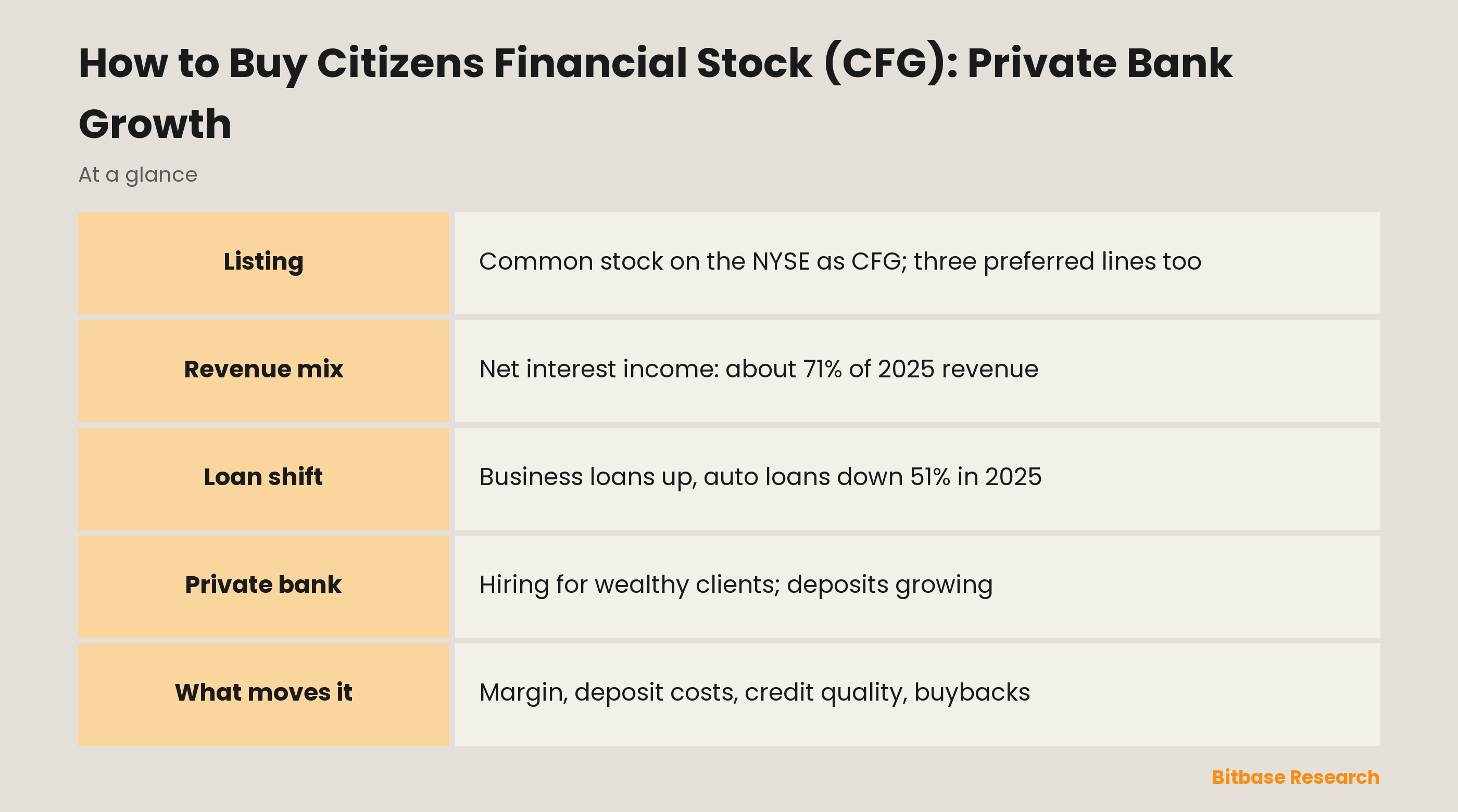
Its ticker on the New York Stock Exchange is CFG, so owning a piece of Citizens Financial Group takes a brokerage account with NYSE access and an order for the common stock rather than one of the three preferred lines listed beside it. The Providence, Rhode Island, lender has been reshaping itself: auto loans have shrunk by half, corporate lending has grown, and a private bank aimed at wealthy families now drives much of its deposit growth.
What Does Citizens Financial Do?
Citizens Financial Group, Inc. is a bank holding company incorporated in Delaware in 1984. Its main subsidiary is Citizens Bank, National Association, supervised by the Office of the Comptroller of the Currency, while the holding company itself answers to the Federal Reserve. The annual report describes the group as "one of the nation's oldest and largest financial institutions."
At the end of 2025 Citizens ran more than 1,000 branches in 14 states and the District of Columbia, including 117 inside stores, plus about 3,100 ATMs. Its 17,398 full-time equivalent employees work mainly in New England and the Mid-Atlantic.
The company reports two segments, with treasury and community development work grouped under Other:
Consumer Banking serves households and small businesses. Inside the 14-state footprint it offers deposits, residential mortgages, home equity lines, credit cards, small business loans and wealth management. Nationally it sells education loans, point-of-sale finance and some digital deposit products. This segment also holds Citizens Private Bank & Wealth, which the 10-K says serves "high- and ultra-high-net-worth individuals and families, as well as investors, entrepreneurs, and businesses." The private bank has offices in California, Florida, New York and Massachusetts.
Commercial Banking works with middle-market and mid-corporate companies and institutions. Its teams cover commercial and industrial lending, commercial real estate finance, capital markets and advisory work such as loan syndication, underwriting and M&A advice, currency and interest rate hedging, and treasury and payments services.
Management summarises the plan as a "three-legged stool": "a transformed Consumer Bank, best-positioned Commercial Bank, and premier Private Bank." A third segment, Non-Core, stopped being reported separately in the fourth quarter of 2025 and now sits inside Other.
Rivals range from community banks and credit unions to national banks, brokerages, hedge funds and private equity firms, plus private credit lenders, fintech companies and digital-only banks, which the 10-K says can typically pay more on deposits because their costs are lower.
How Citizens Financial Makes Money
Two revenue streams carry the bank. In 2025 net interest income (what loans and securities earn minus the cost of deposits and borrowings) was about 71% of combined revenue, and fees and other noninterest income made up the remaining 29%. Net interest income grew 4% on 2024 and the net interest margin widened from 2.84% to 2.97%. The 10-K credits lower funding costs, partly because higher-cost funding fell away as the auto book ran off and a block of education loans was sold.
The fee side grew faster, up 10%. Capital markets fees were the largest category, at about 21% of noninterest income, up 9% thanks to "higher loan syndication and equity underwriting fees, partially offset by lower M&A fees." Wealth fees jumped 22% as assets under management rose, and wealth now accounts for about 15% of fees. Mortgage banking fees rose 11% and service charges 6%, while card fees fell 6%.
The loan book shows the shift in mix most clearly:
| Loan category, end of year | 2025 | 2024 |
|---|---|---|
| Commercial and industrial | 35% | 31% |
| Commercial real estate | 17% | 20% |
| Residential mortgages | 25% | 24% |
| Home equity | 13% | 12% |
| Education | 6% | 8% |
| Automobile | 2% | 3% |
| Other retail | 3% | 3% |
Commercial and industrial loans grew 16% during 2025 and home equity 16%, while commercial real estate fell 10%, education 22% and auto 51%. Total loans rose 3%.
By segment, Consumer Banking produced about 69% of the two segments' combined revenue in 2025, and its revenue grew 9%. Commercial Banking revenue slipped 3% as its margin narrowed. Group net income rose 21% and diluted earnings per share 27%, the gap reflecting a share count that fell by eleven million over the year.
Expenses rose mainly on salaries and benefits "reflecting hiring related to the Private Bank and Private Wealth build-out," yet the efficiency ratio, expenses as a share of revenue, improved from 67.03% to 64.40%.
CFG Stock at a Glance
| Item | CFG |
|---|---|
| Exchange | New York Stock Exchange |
| Ticker | CFG (common stock, one-cent par value) |
| Preferred lines on the same exchange | CFG PrE, CFG PrH and CFG PrI: depositary shares, each a 1/40th interest in a preferred share |
| Sector | Banking: regional retail, commercial and private bank |
| Index membership | S&P 500 |
| Headquarters | One Citizens Plaza, Providence, Rhode Island |
| Incorporated | Delaware, 1984 |
| Fiscal year | Ends 31 December |
| Shareholder returns | Board-declared quarterly cash dividend; share repurchase program |
| Bank subsidiary | Citizens Bank, National Association |
| SEC identifier | CIK 759944 |
Quotes, market value and yield change through the trading day; the Citizens Financial stock page on Bitbase shows the current figures.
How to Buy Citizens Financial Stock
Citizens is a US company with a single class of common stock, so no depositary receipt stands between a buyer and the shares. The route looks like this:
1. Choose a brokerage with US market access. Any broker that offers NYSE stocks will do; check which entity holds your assets and who regulates it.
2. Complete the account opening. Investors outside the United States usually sign IRS Form W-8BEN; the IRS says to give it "to the withholding agent or payer" when you are the foreign beneficial owner of income subject to withholding.
3. Move money in. Funds in euros, yen or another currency get converted to dollars, and the conversion spread can cost more than the trading commission.
4. Type CFG into the order screen and check the name. You want Citizens Financial Group common stock. The three preferred lines are depositary shares of non-cumulative perpetual preferred stock, a different security that pays its own fixed or reset dividend.
5. Set the order type. In FINRA's words, market orders "typically receive the highest priority, followed by limit orders," while limit orders "are often used when obtaining the right price is more important than quick execution."
6. Size the position. Some brokers sell fractions of a share, which FINRA explains "allows you to buy or sell specific dollar amounts rather than whole shares." It adds that "as a fractional share owner, you might not have shareholder voting rights."
7. File the paperwork. Trade confirmations and dividend statements form the record of your cost basis.
Dividend tax abroad. The IRS says most US-source income paid to a foreign person "is subject to U.S. tax of 30%," usually withheld at the source, unless the tax code or a treaty sets a lower rate. Your own country may tax the same dividend.
Owning it through a fund. State Street's SPY holdings list for 10 November 2026 includes Citizens Financial Group, so an S&P 500 index fund gives indirect exposure to it alongside hundreds of other companies.
What Moves CFG Stock
The margin recovery. With net interest income at roughly 71% of revenue, small moves in the net interest margin matter. In the third quarter of 2026 the margin reached 3.18%, up from 2.99% a year earlier, and net interest income rose 13%. The 10-Q points to "lower terminated swap impacts, fixed-rate asset repricing, and improved funding costs."
Payoff from the private bank. Hiring for the private banking and wealth arm has pushed expenses up. Results so far show deposit growth: the 10-Q says deposits rose in 2026 "reflecting growth in the Private Bank," and wealth fees led noninterest income higher. The question is whether it keeps adding deposits and fees fast enough to cover its cost.
A commercial tilt. Commercial and industrial loans grew another 9% in the first nine months of 2026 while commercial real estate shrank 5% and auto loans almost halved again. The 10-Q names higher C&I balances as the main reason risk-weighted assets grew, so loan growth uses up capital.
Office and other property loans. Office loans of both kinds were about 3% of total loans at the end of 2025, and the 10-K says "approximately 96% of commercial real estate loans remain current on payments." Net charge-offs fell to 0.38% of average loans in the third quarter of 2026 from 0.51% a year earlier; commercial real estate and other retail accounted for most of the improvement.
Capital returned to shareholders. Citizens bought back 10,090,578 common shares in the first nine months of 2026, and in October the board enlarged the repurchase program and raised the quarterly dividend by 13%. Buybacks and dividends, together with risk-weighted asset growth, took the common equity tier 1 ratio from 10.6% at the end of 2025 to 10.5% at 30 September 2026, against a 9.0% requirement including the stress capital buffer.
What Could Go Wrong for Citizens Shareholders
Item 1A of the 10-K is long; five of its passages bear most on a CFG holder:
Strategy execution. "Our future success and the value of our stock depends, in part, on our ability to effectively implement our business strategy and achieve our financial performance goals across our Consumer and Commercial businesses, including our Private Bank."
Interest rates. Asset yields and funding costs "may not rise or fall in parallel in response to changes in interest rates," the 10-K says, so the margin can contract as easily as it expanded.
Concentration in credit. Credit losses can rise "to the extent our loans are concentrated by loan type, industry segment, collateral type, borrower type, or location of the collateral or borrower." A heavier weight in corporate lending changes where that concentration sits.
Deposit and funding confidence. Customer deposits are, in the 10-K's words, the "primary stable and low-cost source of funding," and a loss of confidence in the industry or in Citizens itself, or a ratings cut, could make funding harder. Insured or secured deposits made up 63% of the total at the end of 2025, down from 67%, as private bank and corporate operating accounts grew.
Dividends depend on the bank. "The Parent Company typically receives substantially all of its revenue from dividends from CBNA," and regulators limit those payments. The 10-K also says Citizens is "not required" to declare dividends and "may reduce or eliminate" them.
A one-bank position also ties your result to a single balance sheet, and the 10-K warns that trouble at other financial institutions can spill over to Citizens.
How to Research CFG Yourself
Citizens files with the SEC under CIK 759944. The annual 10-K came out on 12 February 2026; quarterly results arrived by 8-K on 21 January, 16 April, 16 July and 16 October 2026, each followed by a 10-Q for the first three quarters. Other 8-Ks record preferred stock changes, such as the Series J issue in July 2026 whose proceeds redeemed all of Series G on 6 October.
Item 1 of the 10-K explains the segments and strategy, and Item 1A gives the full risk list. The MD&A holds the loan composition, the fee table and the deposit mix, and the commercial real estate table breaks loans down by property type and state. Item 5 gives the five-year return chart: with dividends reinvested, CFG rose 102% from the end of 2020 to the end of 2025, while the S&P 500 and the KBW Nasdaq Bank Index each returned 96% and an average of nine peer regional banks 63%. The same chart shows the path was uneven, with CFG only slightly above its 2020 level at the end of 2023.
Note one governance change: an 8-K of 30 October 2026 says PricewaterhouseCoopers will replace Deloitte as auditor from fiscal 2027, with no disagreements reported.
For comparison, set loan mix, fee share and charge-off ratios against two larger regional lenders, using the PNC stock guide and the Truist stock guide. Live prices sit on the CFG page linked above, and the full list of US stock pages on Bitbase covers other names.
Citizens Financial Stock Questions
Can I buy Citizens Financial stock with crypto?
Only in a roundabout way. Brokers settle CFG purchases in dollars, so you would convert your coins to cash, send that cash to the brokerage, then place the order; the conversion itself can be a taxable event in many countries. What you end up holding is equity in a supervised bank, which sits on the other side of the line drawn in our guide to how crypto and stocks differ.
Does Citizens Financial pay a dividend?
Yes, every quarter in which the board declares one. In October 2026 it raised the quarterly amount by 13% over the previous quarter, payable on 13 November 2026. Each future payment depends on earnings and capital rules; the 8-K for each declaration has the details.
Which CFG ticker is the common stock?
Plain CFG. The 10-K cover lists four NYSE lines: the common stock as CFG and depositary shares of the Series E, H and I preferred stock as CFG PrE, CFG PrH and CFG PrI. Each depositary share represents a 1/40th interest in a share of preferred stock.
Is CFG in the S&P 500?
Yes. Citizens Financial Group appears in State Street's SPY holdings file dated 10 November 2026. Its weight in the index changes every day.
How many people own Citizens stock?
The 10-K counted 6,410 holders of record on 4 February 2026, including Cede & Co., and about 723,000 beneficial shareholders whose shares sit in "street name" with a broker or bank.
Conclusion
Citizens is a Northeast and Midwest retail franchise trying to earn more from corporate clients and wealthy families. Lending spreads still supply about 71% of its revenue, so the margin and deposit costs set the tone, while the private bank decides whether the extra spending pays off. Credit in commercial real estate and the pace of buybacks round out the picture. Before buying, read the latest 10-Q with those threads in mind, and remember that a CFG holding rides on how one bank carries out its plan.
Related reading
Other Bitbase articles on this topic:
- How to Buy Bradesco Stock (BBD): Two ADSs and Monthly Payouts
- How to Buy Credicorp Stock (BAP): BCP, Yape and Dividends in Soles
- How to Buy Fifth Third Stock (FITB): Comerica Deal and NYSE Move
- How to Buy KB Financial Stock (KB): One ADS Equals One Seoul Share
Disclaimer: This article is educational content from Bitbase Academy, provided for information only. It explains what a company or fund does and how the instruments referenced here differ from one another; it does not constitute investment, trading, tax, or financial advice, and it is neither a recommendation nor an endorsement of any security, token, or trading strategy. A tokenized stock is issued by a third party and is designed to give economic exposure to an underlying asset: it is not a share, it carries no shareholder rights, and it depends on the issuer's structure, eligibility rules, and redemption terms, which the issuer can change. Perpetual futures are leveraged derivatives that hold no underlying asset and can be liquidated, and trading hours, product availability, and eligibility differ by instrument and by jurisdiction and can change at any time. Written as of November 2026; verify everything yourself through company filings, the issuer's own documentation, and the product pages of the venue you trade on.
References
[1] Citizens Financial Group Form 10-K for 2025 (SEC EDGAR) www.sec.gov
[2] Citizens Financial Group 2025 Form 10-K, XBRL cover page (SEC EDGAR) www.sec.gov
[3] Citizens Financial Group Form 10-Q for the third quarter of 2026 (SEC EDGAR) www.sec.gov
[4] Citizens Financial Group Form 8-K: change of auditor, 30 October 2026 (SEC EDGAR) www.sec.gov
[5] Citizens Financial Group Form 8-K: Series J preferred stock, 31 July 2026 (SEC EDGAR) www.sec.gov
[6] Citizens Financial Group Form 8-K: Series G preferred stock redeemed, 8 October 2026 (SEC EDGAR) www.sec.gov
[7] State Street SPDR S&P 500 ETF Trust (SPY): fund page and daily holdings www.ssga.com
[8] FINRA: Order Types www.finra.org
[9] FINRA: Investing in Fractional Shares www.finra.org
[10] IRS: NRA Withholding www.irs.gov
[11] IRS: About Form W-8 BEN www.irs.gov





