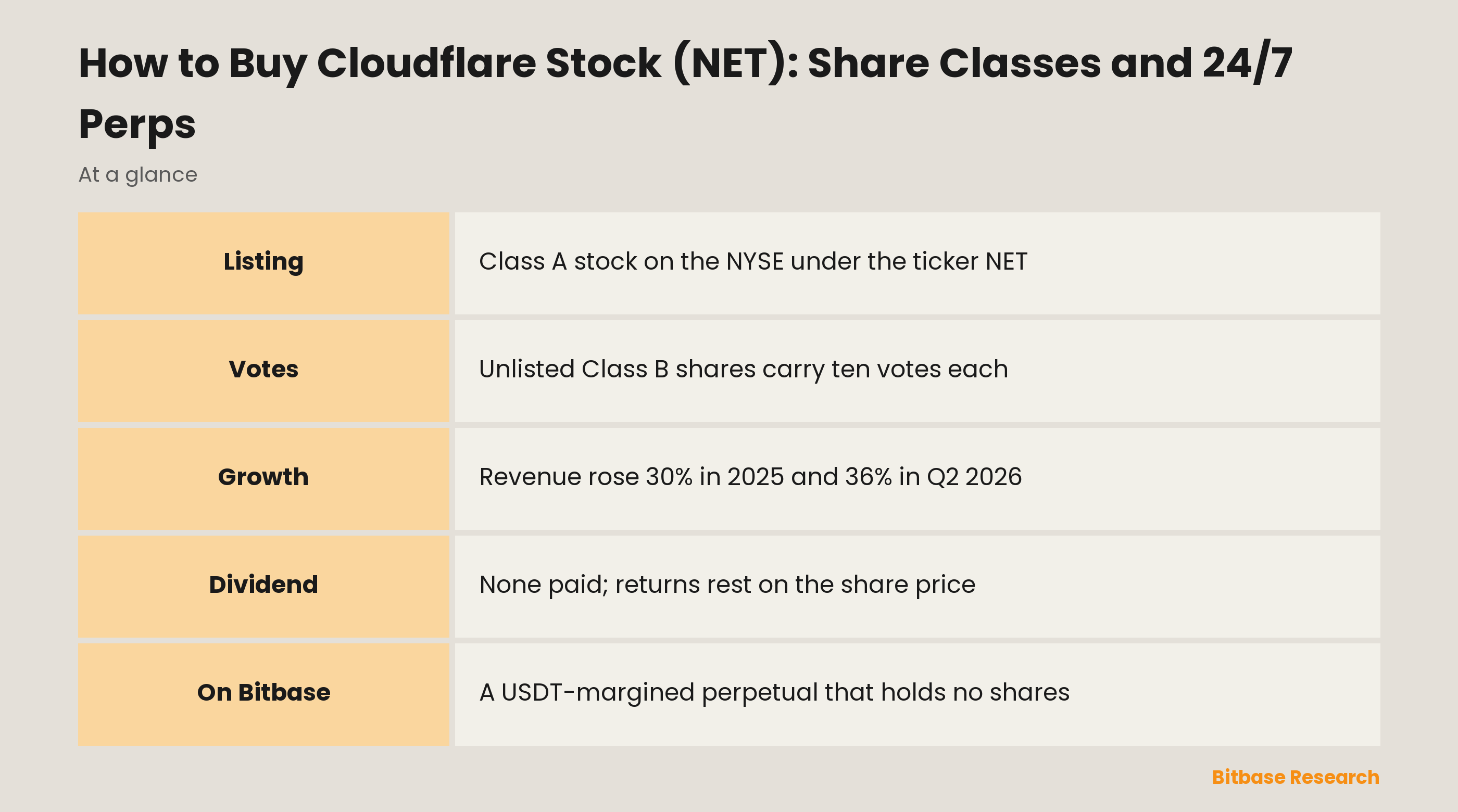
Three letters, NET, identify Cloudflare's Class A common stock on the New York Stock Exchange, and an ordinary brokerage account that reaches US exchanges is all it takes to buy it. The company runs a global network that sits in front of websites, apps and corporate networks to protect them and speed them up, and its voting is split: unlisted Class B shares carry ten votes each, and stockholders approved a non-voting Class C in June 2026. On Bitbase there is no share to buy, only a NET perpetual margined in USDT that follows the price without holding stock.
What Does Cloudflare Do?
Cloudflare runs a network that traffic passes through on its way to a customer's website, application or office. The nearest Cloudflare server can block an attack, serve a cached copy or run the customer's own code before anything reaches the customer's servers. The 10-K gives the mission as "to help build a better Internet," and the company calls itself a "Connectivity Cloud": one control plane for security, performance and reliability across on-premises, cloud and software-as-a-service systems.
According to the filing, the network "spans more than 330 cities in over 125 countries worldwide and interconnects with over 13,000 networks globally." Every server in every city is built to run every service on commodity hardware. Spare capacity feeds a free tier, and the traffic it attracts makes Cloudflare a useful partner for internet service providers, which lowers its co-location and bandwidth costs.
The products fall into four groups:
1. Application services protect and accelerate anything exposed to the internet: a web application firewall, bot management, DDoS mitigation, API security, content delivery, load balancing and DNS. The same tools now identify and control AI crawlers and agents, and the 10-K ties them to "newly announced efforts to allow content creators to monetize their work by controlling how bots, crawlers, and agents access their work."
2. The SASE platform secures a company's own staff and offices: Zero Trust access, a secure web gateway and email security, plus network services such as Magic WAN and Magic Transit that replace on-premises network hardware.
3. Developer services let customers build on the network itself: Workers for running code, R2 and D1 for storage and databases, and Workers AI, which runs machine learning models on GPUs being deployed across the network.
4. Consumer products include the 1.1.1.1 DNS resolver, the WARP app and a domain registrar.
Cloudflare was incorporated in Delaware in July 2009 and is based in San Francisco. Its co-founders, Matthew Prince, chief executive since July 2009, and Michelle Zatlyn, president since December 2020, are co-chairs of the board. It reports one operating segment and had 5,156 full-time employees at the end of 2025; in May 2026 a move to what it calls "an agentic AI-first operating model" cut about 20% of the workforce. Recent acquisitions point the same way: Replicate, a platform for running AI models, in December 2025, and VoidZero, a developer toolchain business paid for partly in Class A shares, in June 2026.
The 10-K names no rivals; it groups them as on-premises network hardware vendors, point-solution vendors in areas such as CDN, DNS and email security, and parts of the large public clouds. For a listed security company of a different shape, see our guide to buying Palo Alto Networks stock. Inside China, the network runs through an arrangement with JD Cloud, extended to March 2032 for network services.
How Cloudflare Makes Money
Revenue comes primarily from subscriptions, sold to three kinds of customer.
Contracted customers sign Enterprise agreements that typically run one to three years, billed monthly or annually, with a base subscription and sometimes a usage-based part; large customers can commit a "pool of funds" to spend on any products during the term. The 10-K says "a substantial majority" of 2025 revenue came from contracted customers won by its sales teams.
Pay-as-you-go customers buy Pro or Business plans on the website and pay by credit card. Zero Trust products are sold per seat, and developer products are metered by requests and execution time.
Free customers pay nothing but bring traffic, threat data and developers onto the network. Fixed fees are recognized evenly over the contract term, usage charges when the usage happens.
Growth comes from new and existing customers alike. Revenue rose 29% in 2024 and 30% in 2025, when paying customers grew 40% to about 332,000. Large customers, those above a six-figure annualized revenue threshold, went from 2,756 at the end of 2023 to 4,298 at the end of 2025 and 4,698 by mid-2026. A metric Cloudflare calls dollar-based net retention compares what a group of customers pays now with what it paid four quarters earlier: 111% in the last quarter of 2024, 120% a year later. In the second quarter of 2026 revenue grew 36%, 35% for the first half, and retention held at 120%.
Revenue is widely spread. No single customer accounted for more than 10% of revenue in 2023, 2024 or 2025, and international markets supplied 51% in 2025. Share of revenue by customer billing address:
| Billing region | 2025 | 2024 |
|---|---|---|
| United States | 49% | 51% |
| EMEA | 28% | 28% |
| Asia-Pacific | 15% | 13% |
| Rest of world | 8% | 8% |
At the end of 2025, Cloudflare expected to recognize 63% of its remaining performance obligations within twelve months. Cost of revenue is rising faster than revenue, though: gross margin slipped from 77% in 2024 to 75% in 2025, which the filing puts down to third-party technology services, co-location and bandwidth, and depreciation on new servers, and it was 72% in the first half of 2026. Spending on property and equipment reached 15% of revenue in 2025, up from 11%. Cloudflare has reported a loss in every period since it began operations.
NET Stock at a Glance
| Fact | Cloudflare (NET) |
|---|---|
| Listing venue | New York Stock Exchange (NYSE) |
| Symbol | NET |
| Listed security | Class A common stock, one vote per share, the only class registered on the 10-K cover |
| Other share class | Class B common stock, ten votes per share, not listed or publicly traded |
| Approved change | Non-voting Class C stock and a share distribution, approved in June 2026 (see the FAQ) |
| Sector | Cloud networking and security: application services, Zero Trust, developer platform |
| Index membership | Not in SPY's S&P 500 holdings file dated 28 October 2026 |
| Headquarters | San Francisco, California |
| Incorporated | Delaware, July 2009 |
| Listed since | 13 September 2019 |
| Financial year | January to December |
| Dividends | Never paid; none expected for the foreseeable future |
| SEC filer number | CIK 1477333 |
Price, market value and volume move all day; Bitbase's Cloudflare quote page tracks them in real time.
How to Buy Cloudflare Stock
Cloudflare is a Delaware company, so NET is its own common stock rather than a depositary receipt for shares listed elsewhere. To buy NET stock through a broker:
1. Find a broker with NYSE access. Readers abroad can use a local broker that routes orders to American exchanges or an international one; ask which firm holds the shares on your behalf and which regulator licenses it.
2. Open and verify the account. For non-US individuals this usually includes IRS Form W-8BEN, which certifies foreign status for US withholding purposes.
3. Deposit money. If your account currency is not the dollar, the conversion spread is a cost alongside the commission.
4. Search with care. "Net" is an everyday word, and several other US-listed companies carry it in their names. Select Cloudflare, Inc. Class A common stock on the NYSE, ticker NET.
5. Set the order. A market order fills at about the best price available at that moment; a limit order names the most you will pay and may never fill. FINRA's guide to order types explains both.
6. Whole or fractional? According to FINRA, "the availability of fractional share trading varies by brokerage firm"; fractions often cannot be traded outside regular hours, and not every broker passes proxy votes through to fractional holders.
7. Keep your trade records. If the approved Class C distribution takes effect while you hold NET, the proxy statement says Cloudflare believes that, for US federal tax purposes, each share's basis would be apportioned between Class A and Class C by market value on the distribution date.
For non-US residents, the IRS says "most types of U.S. source income received by a foreign person are subject to U.S. tax of 30%," a rate a treaty may lower. Because Cloudflare pays no dividend, that withholding currently has nothing to bite on, and capital gains follow the rules of your home country. This is general information, not tax advice.
Through a fund, check first. The S&P 500 tracker SPY did not hold Cloudflare in State Street's daily file for 28 October 2026. Wider funds may, and each publishes its holdings.
Trading NET on Bitbase
Bitbase offers no Cloudflare shares. What it lists is a NET perpetual futures contract with USDT as both margin and settlement currency, and it follows the stock's price. A position carries no share, no vote and no claim on Cloudflare's assets; in exchange, you can go short as easily as long, apply leverage, and keep trading overnight and over weekends while the NYSE is shut.
Funding and liquidation are what tie it to the stock. At regular intervals one side pays the other, with the more crowded side paying, which pulls the contract toward the share price; and when a position's margin is used up, it is closed at the mark price, not at the last traded price. News that arrives after the closing bell reaches the contract before the stock, so the two can diverge until trading resumes. Our stock perpetual guide walks through each mechanism.
The funding schedule and formula, margin tiers, the leverage cap, and the treatment of the mark price and funding during NYSE closures are all set in Bitbase's contract rules, worth reading before the first order. The TradFi page lists the other stocks on offer and the form each takes.
What Moves NET Stock
Large customers and retention. Cloudflare treats the large-customer count as a gauge of its reach into big enterprises and retention as a measure of how much existing customers expand. Because subscription revenue is recognized over the contract term, the 10-K cautions that a change in new business can take time to show up in reported results.
The cost of the AI build-out. Cloudflare is adding servers with storage and GPUs to its network; their depreciation, along with third-party technology services and bandwidth, sits in cost of revenue, and the filing ties the slide in gross margin from 77% in 2024 to 72% in the first half of 2026 to such costs. Whether Workers AI and the AI crawler controls earn that spending back is an open question.
Network reliability. Customer traffic passes through Cloudflare, so an outage is felt widely. The 10-K says software updates "resulted in widespread service unavailability on our network in November and December 2025," and Enterprise and Business terms "include up to a 100% uptime guarantee," which can mean service credits or refunds; the company says those outages had no material impact on results.
The share-class overhaul. The changes approved in June 2026 would create a non-voting Class C, give every Class A and Class B holder one Class C share per share held, and swap substantially all of the co-founders' Class B stock for a new preferred stock with nine votes per share and no economic interest plus an equal number of Class A shares. Cloudflare expects the Class A price to reflect the effect of a two-for-one split. Its August 2026 10-Q said it anticipated implementing the changes "as early as September 2026," subject to stockholder lawsuits seeking to block them; eight had been filed by 5 August 2026.
Convertible notes. Cloudflare has raised money through zero-coupon convertible notes, including notes due 2030 issued in June 2025 and notes due 2031 issued in August 2026. Conversions can add Class A shares; capped calls are "expected generally to offset potential dilution," but only up to a cap.
Execution of the AI-first reorganization. The 2026 10-Q added a risk factor that the shift to an agentic AI-first operating model and the related workforce cut "may not achieve the benefits we expect in the time we expect, if at all."
Risks Cloudflare Lists in Its Filings
Item 1A runs long; these risks are the most specific to Cloudflare.
Losses. The company has incurred losses in every period since it began operations and "may not achieve or maintain profitability in the future."
What customers put on the network. Activities of paying and free customers, or the content of their websites, "could cause us to experience significant adverse political, business, and reputational consequences with customers, employees, suppliers, government entities, and others," and Cloudflare's response to them can do the same.
The free plan. Free service is central to the strategy, yet "the costs and other detriments associated with our free plan could outweigh the benefits we receive from our free customers."
Concentrated control. Class B shares carry ten votes to Class A's one, and at the end of 2025 the two co-founders held about 50.5% of the voting power. Class A holders have little say over directors, mergers or charter changes, and the 10-K warns the structure "may depress the trading price of our Class A common stock."
Digital assets on the balance sheet. Cloudflare expects "to hold periodically certain types of cryptocurrency and similar types of digital assets," which carry "volatile market prices, and risks of loss."
The stock itself. "The trading price of our Class A common stock may be volatile, and you could lose all or part of your investment." With no dividend, any return depends on the share price.
The perpetual's added layer. Leverage works in both directions, funding keeps accruing while the position is open, and if the stock opens far from its previous close, the jump can carry a position through its liquidation price.
How to Research NET Yourself
Cloudflare's SEC filer number is CIK 1477333, and searching EDGAR by it avoids the clutter a search for "net" brings. The 10-K covers the business in Item 1, the risks in Item 1A and the key metrics in Item 7. Quarterly results arrive on Form 8-K, most recently in February, May and August 2026, and the 10-Q follows within days. The 2026 proxy statement, filed in June, sets out the Class C plan in full; later filings will show whether it has been carried out. The investor relations site is at cloudflare.net, the quote page in the table section carries live prices, and more US stock pages on Bitbase list other companies.
Cloudflare Stock FAQ
Does Cloudflare pay a dividend?
It does not. According to the 10-K, "We have never declared nor paid cash dividends on our capital stock," and the company does "not expect to declare or pay any dividends in the foreseeable future." It adds that stockholders "must rely on sales of their Class A common stock after price appreciation as the only way to realize any future gains."
Can I buy Cloudflare stock with crypto?
Not as such. Brokers sell NET shares for dollars, so crypto must first be sold and the cash moved to the brokerage, a sale that may be taxable where you live. On Bitbase, USDT can trade the NET perpetual instead: it follows Cloudflare's price but is a derivative, not stock, with no ownership or vote and a risk of liquidation. The wider comparison is in buying stocks with crypto.
Is Cloudflare in the S&P 500?
Not as of 28 October 2026. The daily list of holdings State Street published that day for SPY, an S&P 500 tracker, has no Cloudflare entry, although it includes Palo Alto Networks, CrowdStrike and Akamai. The 10-K notes that S&P stopped excluding companies with multiple share classes in 2023, so the dual-class structure does not by itself make it ineligible. Index membership changes, so check a current holdings file.
What are Cloudflare's Class A, Class B and Class C shares?
Class A, ticker NET, is the listed stock with one vote per share. Class B, with ten votes per share, is held mainly by holders from before the 2019 listing and converts to Class A when sold or transferred, with limited exceptions. Class C is the non-voting class stockholders approved in June 2026: each Class A and Class B share would receive one Class C share, Cloudflare intends to apply to list Class C on the NYSE, and afterwards no Class B would remain. Check the latest filings to see whether, and when, it has taken effect.
When did Cloudflare go public?
Its Class A stock has traded on the NYSE under NET since 13 September 2019; before that there was no public market for it. The company itself dates to July 2009, when it was incorporated in Delaware and Matthew Prince became chief executive.
Conclusion
Buying NET is a routine broker order once you have picked the right listing among the many search results for "net". What you own is less routine: one vote per share in a company the co-founders control, no dividend, and a business that keeps growing customers while spending heavily on AI and network capacity. The approved Class C change could alter how the shares trade, so check its status in the filings first. For price exposure without ownership, the Bitbase perpetual is a different product, with funding charges and the risk of liquidation.
Related reading
Other Bitbase articles on this topic:
- How to Buy Accenture Stock (ACN): Irish Plc, Dividends and Perps
- How to Buy ADP Stock (ADP): Payroll Fees and Client Fund Interest
- How to Buy Cadence Design Systems Stock (CDNS): Chip Design Tools
Disclaimer: This article is educational content from Bitbase Academy, provided for information only. It explains what a company or fund does and how the instruments referenced here differ from one another; it does not constitute investment, trading, tax, or financial advice, and it is neither a recommendation nor an endorsement of any security, token, or trading strategy. A tokenized stock is issued by a third party and is designed to give economic exposure to an underlying asset: it is not a share, it carries no shareholder rights, and it depends on the issuer's structure, eligibility rules, and redemption terms, which the issuer can change. Perpetual futures are leveraged derivatives that hold no underlying asset and can be liquidated, and trading hours, product availability, and eligibility differ by instrument and by jurisdiction and can change at any time. Written as of October 2026; verify everything yourself through company filings, the issuer's own documentation, and the product pages of the venue you trade on.
References
[1] Cloudflare, Inc. Form 10-K for fiscal 2025 (SEC EDGAR) www.sec.gov
[2] Cloudflare, Inc. Form 10-Q for the quarter ended 30 June 2026 (SEC EDGAR) www.sec.gov
[3] Cloudflare, Inc. 2026 proxy statement, DEF 14A (SEC EDGAR) www.sec.gov
[4] Cloudflare, Inc. Form 8-K, 30 June 2026: annual meeting results (SEC EDGAR) www.sec.gov
[5] Cloudflare, Inc. Form 8-K, 13 August 2026: convertible notes due 2031 (SEC EDGAR) www.sec.gov
[6] State Street: SPDR S&P 500 ETF Trust (SPY) fund page and holdings www.ssga.com
[7] FINRA: Order Types www.finra.org
[8] FINRA: Investing in Fractional Shares www.finra.org
[9] IRS: NRA Withholding www.irs.gov





