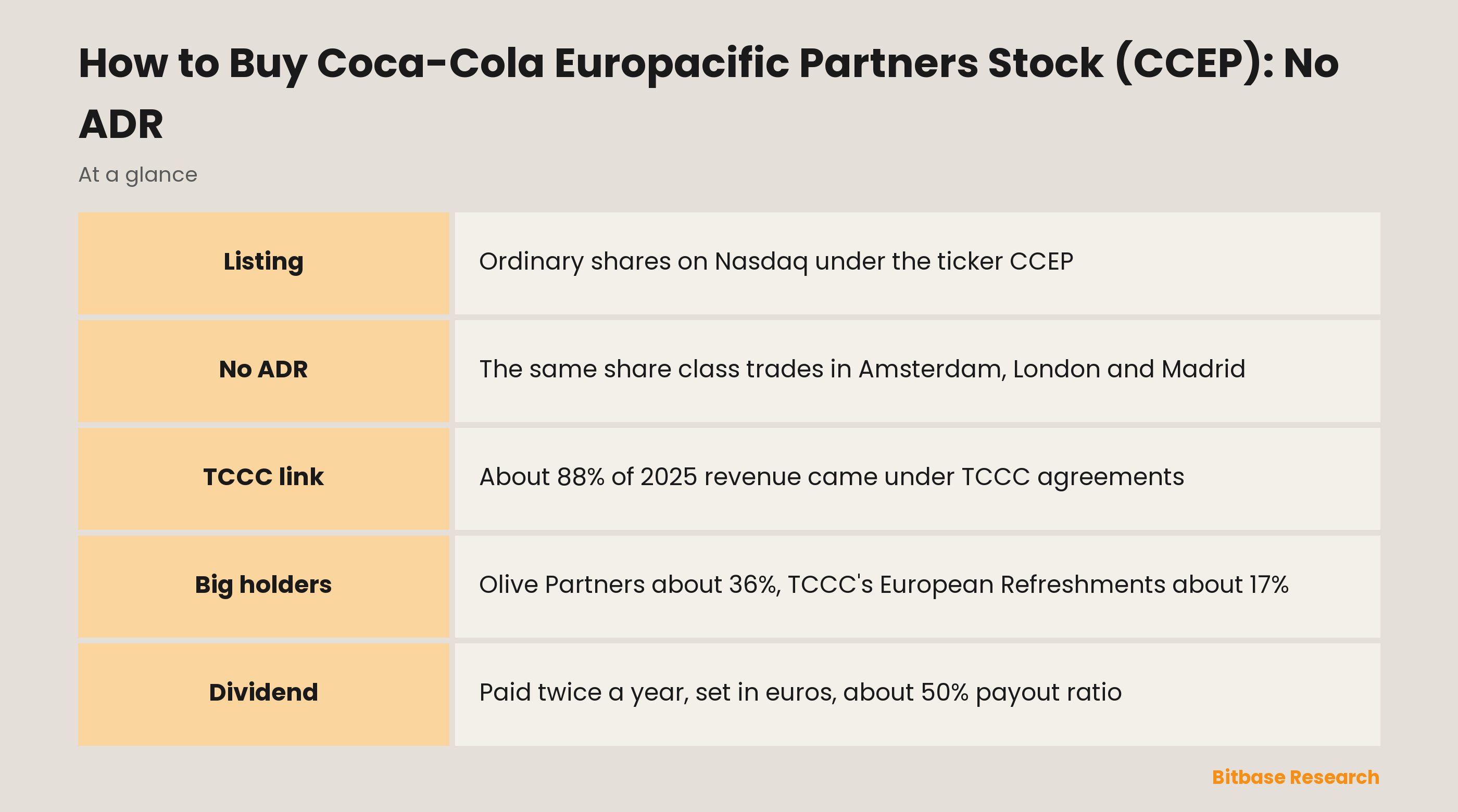
The ordinary shares of Coca-Cola Europacific Partners trade on Nasdaq under the ticker CCEP, so any broker that offers US stocks can take the order, and no depositary receipt sits between you and the company. What you would own is a UK-incorporated bottler that makes and sells Coca-Cola drinks in 31 markets from Iceland to Indonesia, reports in euros, and has two shareholders, Olive Partners and The Coca-Cola Company, that together held around 53% of its shares in February 2026. Below: how the bottling business works, how an order goes through, and what its 20-F says can move the share.
What Does Coca-Cola Europacific Partners Do?
Coca-Cola Europacific Partners, usually shortened to CCEP, is a bottler. It does not own the Coca-Cola recipe or the trademark; The Coca-Cola Company (TCCC) does. CCEP buys concentrate and syrups, turns them into finished drinks in its own plants, and sells and delivers them to customers, from supermarkets and wholesalers to vending partners, in the territories its bottling agreements cover. The annual report describes the job in three verbs: the company makes, moves and sells "some of the world's most loved brands."
The scale is set out on the first pages of the 2025 Annual Report and Form 20-F: nearly 600 million consumers, more than four million customers, 31 countries and about 39,000 colleagues. The countries fall into two regions. Europe covers Great Britain, Iberia (Spain, Portugal and Andorra), Germany, France and Monaco, Belgium and Luxembourg, the Netherlands, Norway, Sweden and Iceland. APS, short for Australia, Pacific and South East Asia, covers Australia, New Zealand and the Pacific Islands, Papua New Guinea, Indonesia and the Philippines.
Three deals built the company. On 28 May 2016 the businesses of three bottlers, Coca-Cola Enterprises, Coca-Cola Iberian Partners and the German Coca-Cola Erfrischungsgetränke, were combined into Coca-Cola European Partners plc. On 10 May 2021 it completed the acquisition of Coca-Cola Amatil, which brought in the Australian, New Zealand, Pacific, Papua New Guinea and Indonesian businesses, and changed its name the same day to Coca-Cola Europacific Partners plc. On 23 February 2024 it bought Coca-Cola Beverages Philippines from TCCC together with Aboitiz Equity Ventures; CCEP holds 60% of the Philippine business and Aboitiz the remaining 40%.
The portfolio goes beyond Coca-Cola itself. In its volume tables CCEP sorts drinks into four groups: Coca-Cola trademark drinks, flavours and mixers such as Fanta and Sprite, a group of water, sports drinks and ready-to-drink tea and coffee, and "other," which includes energy drinks. Monster is distributed under a separate partnership with Monster Energy Corporation, and the 20-F names it alongside TCCC as a strategic partner. Local brands sit next to the global ones: Aquarius sports drinks in Spain, Chaudfontaine water in Europe, Wilkins Pure water in the Philippines.
Volume is counted in unit cases. A unit case equals approximately 5.678 litres or 24 eight-ounce servings, the measure the company uses for every country it reports.
How Coca-Cola Europacific Partners Makes Money
CCEP earns money on the gap between what a drink sells for and what it costs to make and deliver: concentrate, sugar, packaging, energy, plants, trucks and people. Two numbers from the 20-F frame the model. Around 88% of 2025 revenue came from beverages sold under agreements with TCCC. And under those agreements, TCCC sets the price of concentrate "at its sole discretion," with "no limits on the prices that TCCC may charge."
In practice the two sides tie the concentrate bill to what the bottler earns. The 20-F says the companies operate "under an incidence based concentrate pricing model" across most territories, while certain APS territories use a fixed price with marketing support. The third-quarter 2026 trading update puts it in one line: concentrate is "directly linked to revenue per UC through incidence pricing." When CCEP raises prices or sells a richer mix, its concentrate bill rises with it.
The 2025 split by region and by drink group, from the 20-F segment note and the business review:
| Measure for 2025 | Europe | APS |
|---|---|---|
| Share of revenue | 74% | 26% |
| Share of comparable operating profit | 76% | 24% |
| Largest markets by revenue | Great Britain 17%, Iberia 16%, Germany 15% of group revenue | Australia 11%, Philippines 9% of group revenue |
| Drink group | Share of 2025 volume |
|---|---|
| Coca-Cola trademark | 59.2% |
| Flavours and mixers | 21.5% |
| Water, sports, RTD tea and coffee | 11.7% |
| Other, including energy | 7.6% |
Percentages of revenue and profit are calculated from the 20-F figures; comparable operating profit is the company's own adjusted measure, before items it treats as one-off.
Reported revenue rose 2.3% in 2025, while adjusted comparable volume, which counts the Philippines as if it had been owned for all of 2024, rose only 0.2%. The difference came from revenue per unit case: the business review credits headline price increases "across all our markets" and a favourable mix. Coca-Cola Zero Sugar volume grew 5.3% and energy volume 18.8%, led by Monster, while Coca-Cola Original Taste fell 2.1%.
APS behaves differently from Europe. On an adjusted comparable basis its revenue fell 4.1% in euros, yet at constant exchange rates it grew 2.0%; the 20-F attributes the gap of 6.1% to foreign exchange translation. CCEP also stopped distributing Beam Suntory alcohol, in Australia from June 2025 and in New Zealand from December 2025, which the company flags as a drag on revenue into 2026.
Cash flows back to shareholders in two ways: a dividend set at a payout ratio of about 50% of comparable earnings, paid twice a year, and share buybacks, with programmes running in both 2025 and 2026.
CCEP Stock at a Glance
| Feature | CCEP |
|---|---|
| US exchange | Nasdaq Global Select Market (also Euronext Amsterdam, London Stock Exchange and the Spanish Stock Exchanges) |
| Ticker | CCEP on every exchange |
| Security | Ordinary shares, the company's only class, one vote per share; not an ADR |
| ISIN | GB00BDCPN049 |
| Sector | Non-alcoholic ready-to-drink beverages, Coca-Cola bottling |
| Index membership | Nasdaq-100 and FTSE 100 (FTSE since March 2025) |
| Registered office | Uxbridge, England |
| Incorporated | England and Wales, 2015, as a public limited company |
| Reporting | IFRS, in euros; annual report on Form 20-F, updates on Form 6-K |
| Fiscal year | Ends 31 December |
| Payouts | Two interim dividends a year, targeting about 50% of comparable earnings; share buybacks |
| Main holders | Olive Partners around 36%, TCCC's European Refreshments around 17% (February 2026) |
| SEC identifier | CIK 1650107 |
Prices, market value and dividend yield change every trading day; for live figures, open the Coca-Cola Europacific Partners stock page on Bitbase.
How to Buy Coca-Cola Europacific Partners Stock
The shares you buy on Nasdaq are the same ordinary shares that trade in Amsterdam, London and Madrid. The 20-F says the company "has one class of ordinary shares," and its cover lists that class with the CCEP symbol on all four venues, so there is no depositary bank, ADR ratio or ADR fee to look up. Buying it takes seven steps at a broker:
1. Pick a broker that reaches Nasdaq. Outside the US, that means a local broker with access to US shares or an international one; check which legal entity holds your account and who regulates it. If you live in Europe, your broker may offer the Amsterdam, London or Madrid line instead, which is the same share quoted on another exchange.
2. Open and verify the account. Expect identity checks and a tax residence form.
3. Fund it. On Nasdaq the share is quoted in US dollars, so paying in from another currency adds a conversion cost; compare exchange rates as well as commissions.
4. Find the right line. Search CCEP and confirm the name reads Coca-Cola Europacific Partners plc. Do not confuse it with KO, the ticker of The Coca-Cola Company, which is a different company and CCEP's franchisor.
5. Choose an order type. A market order fills at the next available price; a limit order fills only at your price or better. FINRA's investor pages explain both.
6. Size the position. Fractional shares let you invest a fixed sum, but not every broker offers them, and fractional owners may not get voting rights.
7. Keep your records. Trade confirmations and dividend statements document your cost basis and any tax withheld.
Dividends and tax. CCEP declares its dividend in euros. For each payment it pays euros to holders on Euronext Amsterdam, the Spanish exchanges and the London Stock Exchange, and converts the amount into US dollars for other public holders, which covers shares held through Nasdaq. The company is resident in the UK for tax purposes, and the tax section of the 20-F says "No UK tax is required to be withheld from cash distributions on Shares paid to US holders." Investors elsewhere should check how their own country taxes foreign dividends, and whether their broker withholds anything.
Stamp duty. The 20-F explains that, while the shares are held through the Depository Trust Company's clearance system, electronic transfers "should not be subject to UK stamp duty." Shares taken out of that system can be treated differently.
Through index funds. CCEP says it is a constituent of both the Nasdaq-100 and the FTSE 100, so a fund that tracks either index holds it among many other names.
What Moves CCEP Stock
Price against volume. In 2025 most of CCEP's growth came from charging more per unit case rather than from selling many more cases: revenue rose 2.3% while adjusted comparable volume rose 0.2%. Each round of price increases is tested against consumers watching what they spend; the business review notes "increased consumer focus on affordability" in Germany, for example. In the third quarter of 2026, reported revenue rose 6.5% and volume 3.5% on a days-adjusted basis, helped by what the company called favourable summer weather in Europe.
The concentrate bill. Because concentrate is priced on incidence, the bill moves with CCEP's own pricing, and the 20-F leaves the setting of concentrate prices to TCCC. In 2025 comparable operating profit rose 5.4%, faster than revenue.
Weather and big events. The 20-F says sales are "significantly influenced by weather conditions," and that cold or wet weather during the summer months can reduce demand. Trading updates often cite weather and big sporting events when explaining a quarter.
Energy drinks and zero sugar. The fastest-growing pieces of the portfolio are not the original cola. Energy, led by Monster, grew volume 18.8% in 2025 and 17.3% in the third quarter of 2026, and Coca-Cola Zero Sugar kept growing in 2026.
Asia-Pacific and the currencies behind it. The company lists faster growth in the Philippines and Indonesia among its priorities, and its board approved a new greenfield plant in North Luzon in 2025. But APS revenue is translated into euros, and in 2025 that translation took 6.1% off APS revenue growth. The 20-F also mentions typhoon-related flooding in the Philippines and weaker consumer spending in Indonesia as volume pressures.
Sugar and packaging taxes. Governments in several CCEP markets tax sugar or sweeteners in drinks, or the use of non-recycled plastic, and the 20-F warns that "Many countries in which we operate are looking to implement or increase such taxes." A new levy can raise costs or cut demand in a single country.
Bottler Risks Behind a CCEP Share
These are the risks from the 20-F's risk factors that bear most directly on the share.
Dependence on TCCC. "Our business success, including our financial results, depends on our relationship with TCCC and other strategic partners, for example Monster." Marketing support from TCCC is "at its discretion," and "Disagreements with TCCC concerning business issues may lead TCCC to act adversely to our interests." The bottling agreements run for initial ten-year terms with ten-year renewals; the company says TCCC has never terminated one for non-performance or at the end of a term, but the dependence is structural.
Two large shareholders. "TCCC and Olive Partners, S.A. (Olive Partners) hold significant shareholdings in CCEP, and their views may differ from those of our public shareholders." As of 28 February 2026, around 17% and 36% of the shares were owned by European Refreshments, a TCCC subsidiary, and Olive Partners. Five directors, including the chairman, were nominated by Olive Partners and two by European Refreshments, so public shareholders have less say than the free float suggests.
Retail buying power. "A significant amount of our volume is sold through large retail chains, including supermarkets and wholesalers," and many of them are consolidating or forming buying groups. The 20-F adds that customers sometimes "temporarily or permanently stop selling some of our products as a result of disputes," and the third-quarter 2026 update separately put a September volume decline in Germany down to temporary customer disruption.
Imports from other bottlers. "When these imports come from members of the European Economic Area, we are prohibited from taking action to stop such imports." Cheaper product bought elsewhere in the single market can undercut local prices.
Economy, tariffs and currency. The 20-F says performance "is closely tied to global economic cycles," that tariffs and trade frictions "can alter sourcing economics," and that currency depreciation in Australia and New Zealand "could also negatively impact our revenue and earnings reported in our functional currency."
Acquisitions. Growth by acquisition, such as the Philippine deal, brings integration risk and "joint venture partner disputes," and "There is no guarantee that these investments will ultimately be accretive."
Reporting status. CCEP files as a foreign private issuer, and it warns that it "may lose our foreign private issuer status," which would force it onto the US domestic reporting system at higher cost.
Beyond the business, two more points apply. Holding one stock concentrates your money in one company, and this one depends on another company's brands. And dividends depend on earnings and board approval: the third-quarter 2026 release states that dividends are "subject to Board approval," and in euros the payout a dollar investor receives also moves with the exchange rate.
Reading CCEP's 20-F and Trading Updates
As a foreign private issuer, CCEP does not file 10-K or 10-Q reports. Everything sits under CIK 1650107 on SEC EDGAR: the combined Annual Report and Form 20-F once a year, and Form 6-K for everything else, including the full-year results, the first- and third-quarter trading updates, the half-year report, director changes and weekly buyback notices. In 2026 the full-year results came on 17 February, the 20-F on 13 March, the first-quarter update on 28 April, the half-year report on 4 August and the third-quarter update on 3 November.
Three habits help. Read quarters by date: they do not end on calendar month-ends (the third quarter of 2026 ended on 2 October), and volume is adjusted for selling days. Keep reported, comparable and "FX-neutral" figures apart, because they can point in different directions in the same year. And read the "Relationship with TCCC" risk factors together with the shareholder section, since they explain who can influence the company.
For comparison with other drink makers, see our PepsiCo stock guide and, for the energy brand CCEP distributes, our Monster Beverage stock guide. Live quotes are on the stock page linked above, and the full list of stock pages on Bitbase includes many other companies.
CCEP Stock FAQ
Can I buy Coca-Cola Europacific Partners stock with crypto?
Not directly. CCEP shares are bought through a brokerage account, in US dollars on Nasdaq or in local currency on the European exchanges, so crypto has to be sold for cash and moved to the broker first, and that sale may be taxable where you live. A share also works differently from a token: it carries dividend and voting rights in a registered company, which is how a share differs from a crypto asset.
Is CCEP an ADR?
No. The shares that trade on Nasdaq are the company's ordinary shares, the same class listed in Amsterdam, London and Madrid under the same CCEP ticker and the same ISIN. There is no depositary receipt and no conversion ratio.
Is Coca-Cola Europacific Partners the same company as Coca-Cola?
No. The Coca-Cola Company, ticker KO, owns the brands and sells concentrate; CCEP is an independent bottler that buys that concentrate and makes, sells and distributes the drinks in its territories. The two are linked by bottling agreements and by ownership: TCCC's subsidiary European Refreshments held around 17% of CCEP's shares in February 2026 and nominates two directors.
Does CCEP pay a dividend?
Yes. CCEP pays two interim dividends a year, one in the first half and one in the second, and aims for a payout ratio of about 50% of comparable earnings. The dividend is set in euros; holders of Nasdaq shares receive a US dollar amount converted at a published exchange rate. Each payment needs board approval, so check the latest trading update for the amount and dates.
Is CCEP in the Nasdaq-100?
Yes. In its third-quarter 2026 trading update the company describes itself as a constituent of both the Nasdaq-100 and the FTSE 100, and its 2025 annual report says it joined the FTSE 100 in March 2025. Index weights change every day.
Conclusion
What sets CCEP apart from most consumer stocks is who sits on both sides of it: its biggest supplier sets the concentrate price and also owns a large stake in the company. Beyond that, this is a bottler whose 2025 growth came mostly from price and mix, whose results arrive in euros from markets as different as Germany and the Philippines, and whose Nasdaq line is the plc share itself, with no ADR in between. Read the latest 20-F and trading update, follow volume and revenue per unit case separately, and decide how much one bottler should weigh in your portfolio.
Related reading
Other Bitbase articles on this topic:
- How to Buy ADM Stock (ADM): Grain, Biofuels and Dividends
- How to Buy Ambev Stock (ABEV): Skol, Brahma and AB InBev Control
- How to Buy Church and Dwight Stock (CHD): Baking Soda to Waterpik
- How to Buy Haleon Stock (HLN): Sensodyne, Advil and the GSK Split
Disclaimer: This article is educational content from Bitbase Academy, provided for information only. It explains what a company or fund does and how the instruments referenced here differ from one another; it does not constitute investment, trading, tax, or financial advice, and it is neither a recommendation nor an endorsement of any security, token, or trading strategy. A tokenized stock is issued by a third party and is designed to give economic exposure to an underlying asset: it is not a share, it carries no shareholder rights, and it depends on the issuer's structure, eligibility rules, and redemption terms, which the issuer can change. Perpetual futures are leveraged derivatives that hold no underlying asset and can be liquidated, and trading hours, product availability, and eligibility differ by instrument and by jurisdiction and can change at any time. Written as of November 2026; verify everything yourself through company filings, the issuer's own documentation, and the product pages of the venue you trade on.
References
[1] Coca-Cola Europacific Partners 2025 Annual Report and Form 20-F (SEC EDGAR) www.sec.gov
[2] CCEP 2025 Form 20-F, XBRL cover page (SEC EDGAR) www.sec.gov
[3] CCEP 2025 Form 20-F, XBRL revenue by country (SEC EDGAR) www.sec.gov
[4] CCEP 2025 Form 20-F, XBRL results by segment (SEC EDGAR) www.sec.gov
[5] CCEP third-quarter 2026 trading update, Form 6-K (SEC EDGAR) www.sec.gov
[6] CCEP 2026 half-year report, Form 6-K (SEC EDGAR) www.sec.gov
[7] FINRA: Order Types www.finra.org
[8] FINRA: Investing in Fractional Shares www.finra.org





