
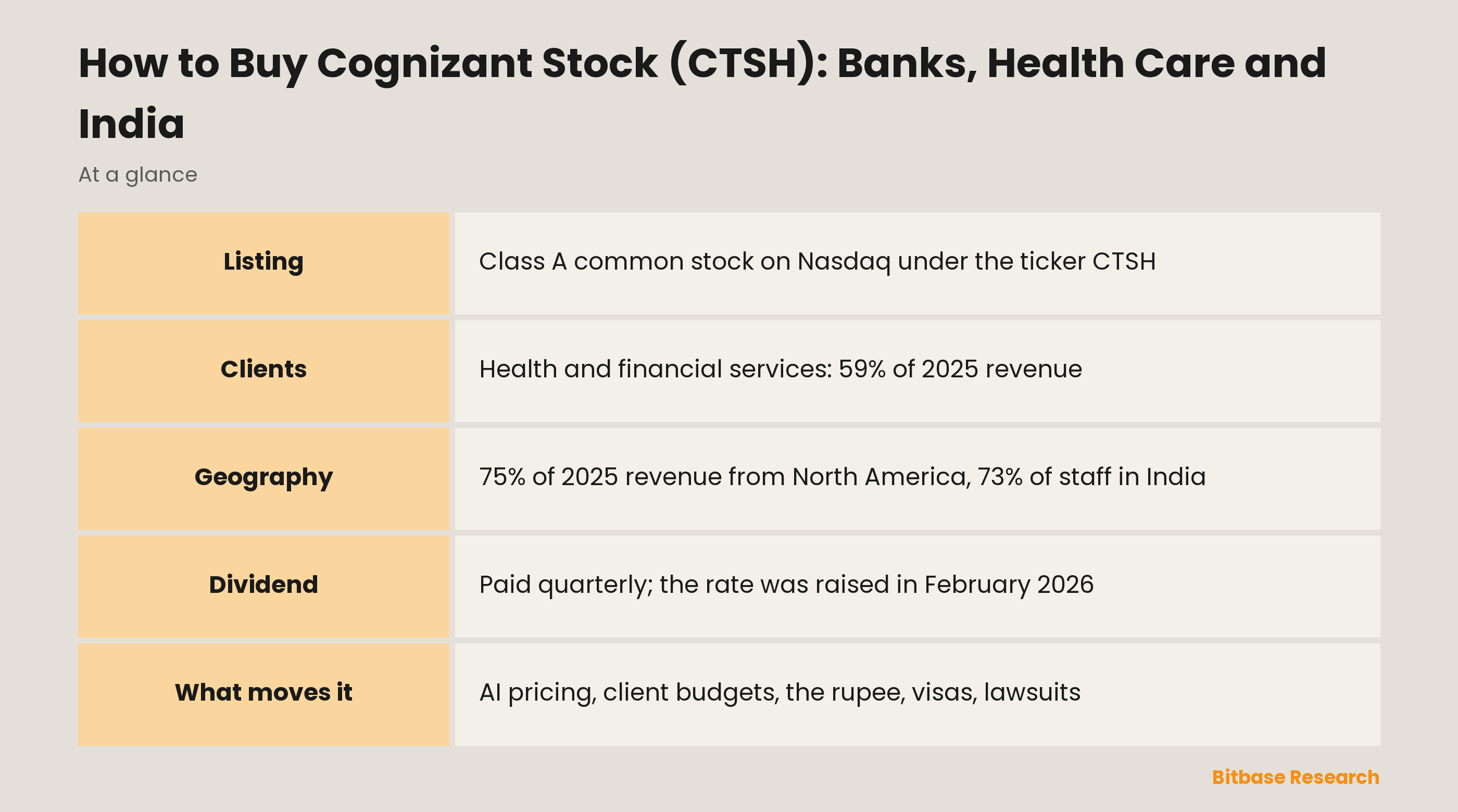
Your Cognizant shares can come from any broker that reaches Nasdaq, where the company's Class A common stock trades under the ticker CTSH. Behind the ticker is an IT services firm based in Teaneck, New Jersey, that earned about 75% of its 2025 revenue from North American clients while keeping roughly 73% of its workforce in India. Below: how that model earns money, how an order works, and what its filings keep returning to, from AI and the rupee to US work visas and long-running court cases.
What Does Cognizant Do?
Cognizant sells the time and know-how of its engineers and consultants to large companies. Its 10-K calls it "one of the world's leading professional services companies" and describes it as "an AI builder." The work runs from consulting, application development and systems integration to quality engineering, application maintenance, infrastructure, security and business process services.
The business started inside another company. According to the 10-K for 2021, Cognizant began in early 1994 "as an in-house technology development center for The Dun & Bradstreet Corporation and its operating units," was spun off in 1996 and went public in 1998. Today it is a Delaware corporation headquartered in Teaneck, with operations across nearly 50 countries.
Clients fall into four industry segments, which are also the reporting segments. Health Sciences serves healthcare providers and payers and pharmaceutical, biotech and medical device companies. Financial Services covers banking, capital markets, payments and insurance. Products and Resources spans manufacturers, retailers, aerospace and defense, travel, logistics, energy and utilities. Communications, Media and Technology takes in telecoms, media, education, publishing and technology companies. Across them, the work is organized into seven practices, the newest of which, Security, was set up in 2026, and much of it runs on partners' products from companies such as Microsoft, Google, Amazon Web Services, Salesforce, SAP and ServiceNow.
Cognizant also owns software. TriZetto, now Cognizant Technology Software Group, makes the Facets and QNXT platforms that health plans use to administer claims and membership, and the October 2026 results release reported a new feature that lets AI agents process eligible routine pending claims while complex cases go to human reviewers.
Acquisitions keep adding capacity. Belcan, bought in August 2024, supplies engineering research and development to aerospace, defense and industrial clients. On 1 January 2026 Cognizant took over 3Cloud, "one of the largest independent Microsoft Azure services providers," and on 22 June 2026 it acquired Astreya, an AI-first IT managed services provider. On 21 October 2026 it agreed to buy DyFlex Solutions, an Australian SAP firm, a deal not yet reported as completed.
The workforce is the product. Cognizant had about 351,600 employees at the end of 2025, roughly 73% of them in India, which also holds approximately 90% of its delivery-center floor space. Chief executive Ravi Kumar S took over in January 2023 after serving as President of Infosys.
How Cognizant Makes Money
Revenue is fees for people's work. In 2025 it rose 7.0%, with the Belcan acquisition contributing 260 basis points of that growth. The four segments were close in size:
| Segment | Share of 2025 revenue | Change from 2024 | Typical clients |
|---|---|---|---|
| Health Sciences | 30% | 7.0% | Health plans, hospitals, drug and device makers |
| Financial Services | 29% | 7.3% | Banks, insurers, payment and capital markets firms |
| Products and Resources | 25% | 10.5% | Manufacturers, retailers, aerospace, utilities |
| Communications, Media and Technology | 16% | 1.0% | Telecoms, media groups, technology companies |
Products and Resources grew fastest because Belcan counted for a full year, while Communications, Media and Technology barely moved as weakness among communications and media customers offset gains with technology clients.
Contract terms shape how revenue arrives. In 2025 about 47% came from fixed-price contracts, 43% from time-and-materials work and 9% from transaction or volume-based fees. Fixed-price projects are booked as labor costs accrue against an estimated total, so an underestimated job hits margins directly; the auditor treated those estimates as a critical audit matter.
The geography is lopsided. North American clients produced about 75% of 2025 revenue, the United Kingdom and continental Europe about 19%, and the rest of the world about 6%. Costs point the other way: rupee-denominated costs in India were approximately 23% of global operating costs.
Operating margin widened to 16.1% from 14.7% in 2024, helped by savings from the NextGen cost program, efficiencies and currency movements, partly offset by higher pay and the dilutive effect of Belcan. Net income still fell 0.4% while income from operations rose 17.2%, because a one-time, non-cash tax expense followed the One Big Beautiful Bill Act's repeal of the rule to capitalize US research and experimental costs.
Cash goes out in a set pattern: the capital allocation framework anticipates using approximately 50% of free cash flow for acquisitions and 50% for share repurchases and dividends.
CTSH Stock at a Glance
| Feature | CTSH |
|---|---|
| Exchange | Nasdaq (The Nasdaq Stock Market) |
| Ticker | CTSH |
| Security | Class A common stock, the only class registered under Section 12(b) |
| Sector | IT services and consulting |
| Index membership | S&P 500 |
| Headquarters | Teaneck, New Jersey |
| Incorporated | Delaware |
| Fiscal year | Calendar year, ending 31 December |
| Dividend policy | Quarterly cash dividend |
| Buybacks | Open-ended repurchase program, first adopted in 2017 |
| SEC identifier | CIK 1058290 |
Quotes, market value and yield move all day; the Cognizant stock page on Bitbase shows live figures.
How to Buy Cognizant Stock
No depositary receipt is involved: Cognizant is a US company, and what trades on Nasdaq is its Class A common stock. The 10-K cover lists no other registered class, so "Class A" is a name, not a choice between share types. The purchase runs like this:
1. Find a broker that can route to Nasdaq. Outside the US that may be a local bank with a US-shares service or an international broker; check which legal entity holds your account and who regulates it.
2. Complete onboarding. Non-US individuals usually file IRS Form W-8BEN, which the IRS says to submit "when requested by the withholding agent or payer."
3. Move money in. If your account is not in US dollars, the conversion rate can cost more than the commission.
4. Search for CTSH and confirm the result reads Cognizant Technology Solutions Corporation, Class A common stock, on Nasdaq.
5. Choose how the order executes. FINRA explains that a market order "provides the most certainty that your order will be executed," while a limit order trades only "at or better than a specified price," which gives more control around quarterly results.
6. Decide the size. If your broker sells fractions, you can invest a fixed sum instead of whole shares; check whether fractions carry voting rights and can be moved to another broker.
7. Keep the records. Statements show your cost and each quarterly dividend, including any tax withheld.
Taxes when you live abroad. The IRS states that "most types of U.S. source income received by a foreign person are subject to U.S. tax of 30%," and a tax treaty can lower that rate; the W-8BEN is how a broker applies it. Your home country may tax the same dividends again.
Holding it through a fund. State Street's SPY listed Cognizant in its daily holdings on 9 November 2026, so funds tracking the S&P 500 carry it as one small position. It was not among the holdings of Invesco's QQQ, which tracks the Nasdaq-100, that day.
What Moves CTSH Stock
AI and the work it replaces. The 10-K is blunt: "Some services that we historically performed for our clients have been and will continue to be replaced by AI or other forms of automation, including our own AI-enabled client offerings." Pricing is the open question, since the company may fail to recoup its AI spending "if our clients do not accept new pricing models." In October 2026 Ravi Kumar S said "over 50% of our code now AI-assisted," and earlier that year the company launched Project Leap, a program that includes headcount reductions to fund AI capabilities and partnerships.
Client budgets and large deals. Demand depends on discretionary projects, which some clients cut "in response to economic and geopolitical uncertainty." In the third quarter of 2026, revenue rose 4.6% from a year earlier, led by Financial Services at 12.0%, while Health Sciences slipped 1.1%. Trailing twelve-month bookings rose 4%, a book-to-bill of about 1.3x, though bookings in the quarter alone fell 7%.
The rupee and Indian wages. With most staff in India and most contracts billed in clients' currencies, each additional 1.0% move in the rupee against the dollar shifts operating margin by approximately 17 basis points before hedges. India's new labor codes, effective 21 November 2025, raised the company's defined benefit liability.
Visas and offshore politics. The principal US subsidiary "utilizes a high number of skilled workers holding H-1B and L-1 visas," so tighter rules, higher fees or slower processing can raise costs or leave projects understaffed. The 10-K also flags US proposals to limit offshore outsourcing.
Acquisitions and buybacks. Deals bought in 2026 added about 210 basis points to third-quarter growth. In May 2026 the board enlarged the buyback authorization, and the company drew on its revolving credit facility with the Astreya closing approaching.
Tax fights in India. The Indian Income Tax Department says the Indian subsidiary owes more tax on a 2016 share repurchase. To pursue its appeal before the Madras High Court, the company has deposited the disputed sum and recorded no reserve; a second dispute over a 2013 repurchase is also in litigation.
Visas, Rupees and Court Cases in Cognizant's 10-K
These passages from the 10-K and the latest 10-Q bear most directly on a CTSH holding:
Short contracts. Consistent with industry practice, "many of our contracts with clients are short-term or can be terminated by our clients with short notice and without significant early termination cost."
Two industries carry a lot. "Many of our clients are in the financial services and healthcare industries," and together those two segments made up 59% of 2025 revenue.
People and pay. The company "may not be successful in recovering through price increases or other mechanisms" the raises it gives. Voluntary attrition in tech services was 13.9% in 2025, down from 15.9%.
Cyber incidents. In April 2020 Cognizant announced a Maze ransomware attack that "caused significant disruption to our business." For 2025, it says no cybersecurity threat materially affected its strategy, results or financial condition.
A discrimination class action. In October 2024 a federal jury in California found for a class of approximately 2,300 former US employees terminated from the "bench," the pool of staff not assigned to a project, in a case alleging discrimination against non-South Asian and non-Indian employees. Individual damages are still to be decided, and Cognizant has recorded no accrual because it cannot estimate the loss.
A win that is not yet cash. In its trade-secret case against Syntel, judgment for TriZetto and Cognizant was entered in April 2026; Syntel appealed, and the company will not record a gain until it becomes realizable.
Restructuring. The third-quarter 10-Q adds that Project Leap "could disrupt our business, may not result in anticipated savings, and could result in total costs and expenses that are greater than expected."
Beyond the business, one stock concentrates your money in one company, and dividends and buybacks depend on cash flow, liquidity and acquisition needs, so neither is promised.
How to Research CTSH Yourself
Cognizant's filings sit on SEC EDGAR under CIK 1058290: the annual 10-K, 10-Qs and 8-Ks, including the quarterly results releases, which in 2026 came on 4 February, 29 April, 29 July and 29 October. In the 10-K, the business section lists segments, practices and named competitors; the notes on commitments and contingencies and on income taxes hold the court cases and the Indian tax dispute; and the revenue note splits sales by segment, region, contract type and service line.
Two cautions help when you compare years. Since the first quarter of 2025, segment operating profit includes an allocation of corporate costs, and 2024 was restated but 2023 was not. And bookings, book-to-bill and attrition are company-defined figures from the releases, not audited accounts. Live quotes are on the stock page linked above, and Bitbase's US stock pages cover other listed companies.
Cognizant Stock FAQ
Can I buy Cognizant stock with crypto?
Not directly. You need a brokerage account for CTSH, so crypto would first have to be sold and the cash sent to the broker, a sale that may be taxable where you live. Owning the share itself brings dividends and a vote at shareholder meetings, part of how stocks and crypto differ.
Does Cognizant pay a dividend?
Yes. It paid a cash dividend in each quarter of 2025, raised the rate in February 2026, and in October 2026 declared another quarterly dividend payable on 25 November 2026. Future payments depend on cash flow, liquidity and other uses of cash such as acquisitions.
Is CTSH in the S&P 500 or the Nasdaq-100?
It is in the S&P 500: State Street's SPY held it on 9 November 2026. That day it was not in the holdings of Invesco's QQQ, which tracks the Nasdaq-100. Membership can change, so check current fund holdings.
Who are Cognizant's main competitors?
The 10-K names Accenture, Atos, Capgemini, CGI, Deloitte Digital, DXC Technology, EPAM Systems, Genpact, HCL Technologies, IBM Consulting, Infosys, Tata Consultancy Services and Wipro, plus clients' own in-house technology centers. Two have their own guides here: Accenture stock and IBM stock.
How did Cognizant start?
As a technology development center inside Dun & Bradstreet in early 1994. It was spun off in 1996 and went public in 1998.
Conclusion
Cognizant's appeal and its central question are the same thing: it sells skilled labor at scale, and the AI tools it now builds for clients can shrink the very work it bills for. Its results also lean on two industries, one region of clients and one country of staff, with court cases and an Indian tax dispute still open. Read the latest 10-K and quarterly release, follow bookings and Financial Services growth alongside the margin, and decide how much one IT services company should weigh in your portfolio.
Related reading
Other Bitbase articles on this topic:
- How to Buy Atlassian Stock (TEAM): Jira, Cloud Shift and Perps
- How to Buy Autodesk Stock (ADSK): AutoCAD, Revit and MaintainX
- How to Buy Baidu Stock (BIDU): Search, AI Cloud and Apollo Go
- How to Buy Sea Limited Stock (SE): Shopee, Monee and Free Fire
Disclaimer: This article is educational content from Bitbase Academy, provided for information only. It explains what a company or fund does and how the instruments referenced here differ from one another; it does not constitute investment, trading, tax, or financial advice, and it is neither a recommendation nor an endorsement of any security, token, or trading strategy. A tokenized stock is issued by a third party and is designed to give economic exposure to an underlying asset: it is not a share, it carries no shareholder rights, and it depends on the issuer's structure, eligibility rules, and redemption terms, which the issuer can change. Perpetual futures are leveraged derivatives that hold no underlying asset and can be liquidated, and trading hours, product availability, and eligibility differ by instrument and by jurisdiction and can change at any time. Written as of November 2026; verify everything yourself through company filings, the issuer's own documentation, and the product pages of the venue you trade on.
References
[1] Cognizant Form 10-K for 2025 (SEC EDGAR) www.sec.gov
[2] Cognizant 2025 Form 10-K, XBRL cover page (SEC EDGAR) www.sec.gov
[3] Cognizant 2025 Form 10-K, segment information note (SEC EDGAR) www.sec.gov
[4] Cognizant 2025 Form 10-K, XBRL revenue breakdown (SEC EDGAR) www.sec.gov
[5] Cognizant Form 10-K for 2021, corporate history (SEC EDGAR) www.sec.gov
[6] Cognizant Form 10-Q for the third quarter of 2026 (SEC EDGAR) www.sec.gov
[7] Cognizant third-quarter 2026 results release, Exhibit 99.1 to Form 8-K (SEC EDGAR) www.sec.gov
[8] Cognizant press release on share repurchases, 18 May 2026, Exhibit 99.1 to Form 8-K (SEC EDGAR) www.sec.gov
[9] State Street: SPDR S&P 500 ETF Trust (SPY) holdings www.ssga.com
[10] Invesco: About Invesco QQQ www.invesco.com
[11] FINRA: Order Types www.finra.org
[12] IRS: NRA Withholding www.irs.gov
[13] IRS: About Form W-8 BEN www.irs.gov





