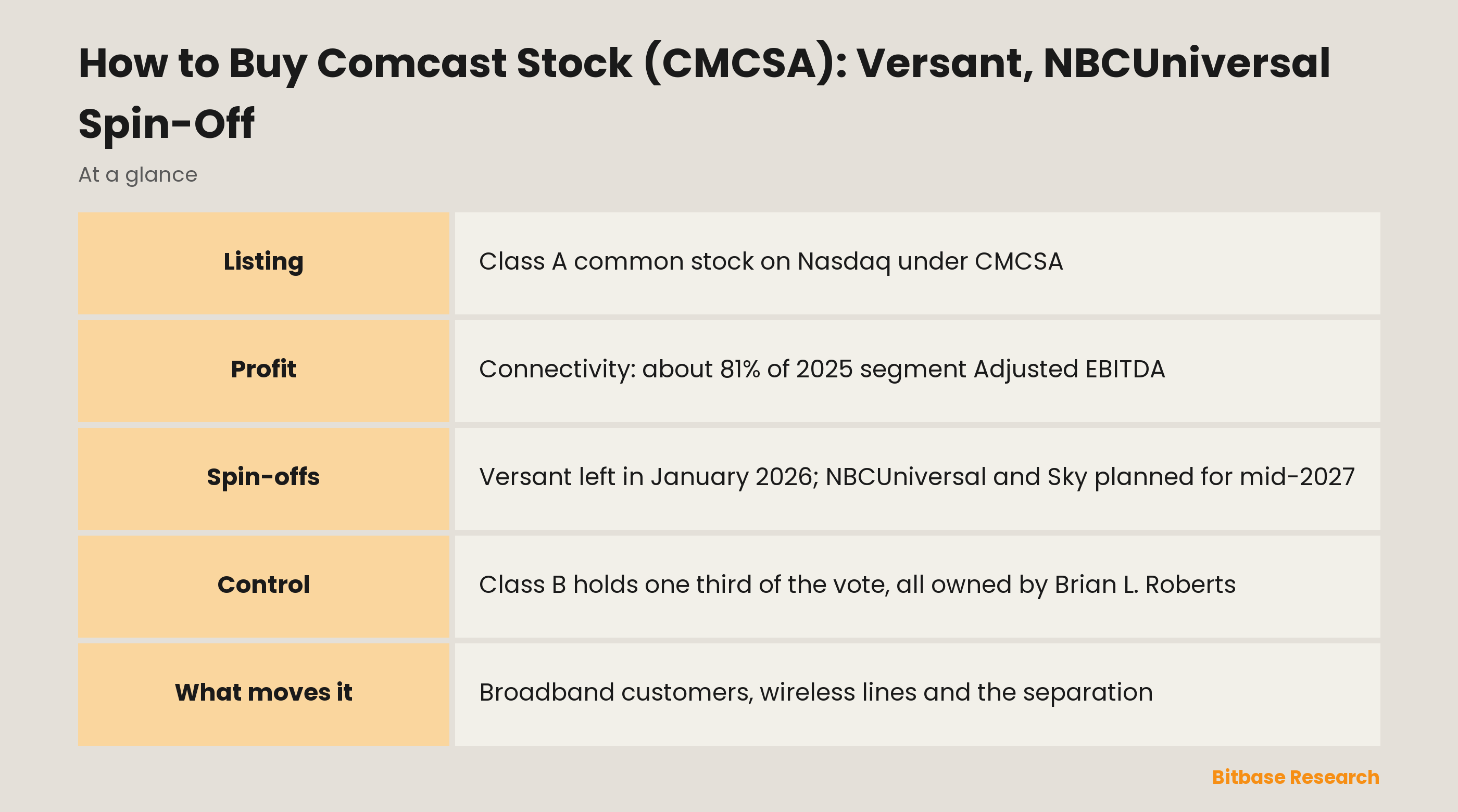
Four steps, all of them taken at a brokerage, get you a Comcast share: open an account that can trade Nasdaq stocks, fund it, search for the ticker CMCSA and place the order. The company behind that ticker is splitting itself up. CNBC, MS NOW and other cable networks left as Versant on 2 January 2026, and Comcast expects to spin off NBCUniversal and Sky in mid-2027, which would leave mainly broadband, wireless and business connectivity in the CMCSA share. This guide covers how Comcast earns its revenue, how to buy the stock, what could move it and how its two share classes differ.
What Does Comcast Do?
Its annual report describes Comcast as "a global media and technology company that reaches customers, viewers and guests worldwide through the connectivity and platforms services we provide and the content and experiences we create." Broadband, wireless and video go out under the Xfinity, Comcast Business, Sky and NOW brands; programming comes from NBC, Telemundo, Universal, Peacock and Sky; and the company runs the Universal theme parks.
The filings split this into two businesses and five segments. Connectivity & Platforms covers the United States, the United Kingdom and Italy, reported as Residential Connectivity & Platforms and Business Services Connectivity. Its US network offers multigigabit download speeds to about 60% of residential customers. The mobile service rides on Verizon's network, and from 2026 business lines also use T-Mobile's. Content & Experiences reports as Media (the NBC and Telemundo networks, remaining cable channels, Peacock and Sky Sports), Studios (Universal Pictures, Illumination, DreamWorks Animation) and Theme Parks (Orlando, where Epic Universe opened in May 2025, plus Hollywood, Osaka and Beijing).
Acquisitions built that shape. The protected Class B vote is pegged to the share count on the date of the 2002 acquisition of AT&T Corp.'s cable business, and the 10-K refers to "the NBCUniversal transaction in 2011 and the Sky transaction in 2018." Chairman and co-chief executive Brian L. Roberts is "a son of our late founder, Mr. Ralph J. Roberts."
Now the group is shrinking. It sold its Hulu interest in June 2025. On 2 January 2026 it completed the spin-off of Versant Media Group, which took MS NOW (formerly MSNBC), CNBC, USA Network, Golf Channel, E!, SYFY and Oxygen. Holders on the 16 December 2025 record date received one Versant share for every 25 Comcast shares, and Comcast "does not beneficially own any equity interest in Versant." Sky's German operations were sold on 31 May 2026, and on 29 June 2026 Comcast announced the plan to spin off NBCUniversal and Sky.
How Comcast Makes Money
The five segments divided their 2025 revenue like this:
| Segment | Business | Share of 2025 segment revenue | Change from 2024 | What it sells |
|---|---|---|---|---|
| Residential Connectivity & Platforms | Connectivity & Platforms | 54.7% | −1.2% | Broadband, wireless, video and advertising under Xfinity and Sky |
| Business Services Connectivity | Connectivity & Platforms | 7.9% | +5.5% | Comcast Business connectivity for small firms and enterprises |
| Media | Content & Experiences | 21.0% | −3.8% | NBC, Telemundo, cable networks, Peacock, Sky Sports |
| Studios | Content & Experiences | 8.7% | +1.7% | Films and series from Universal, Illumination, DreamWorks Animation |
| Theme Parks | Content & Experiences | 7.6% | +14.1% | Universal parks in Orlando, Hollywood, Osaka and Beijing |
Shares are of the five segments' combined revenue before eliminations, rounded to one decimal; the segments sell to one another, so consolidated revenue, essentially unchanged from 2024, is smaller than their sum.
Connectivity carries the profit. The two connectivity segments brought in about 63% of segment revenue but about 81% of segment Adjusted EBITDA, the profit measure the 10-K reports for each segment. Business Services had an Adjusted EBITDA margin of 55.9% in 2025, against 37.7% for Residential.
Inside Residential, the mix is shifting. Domestic broadband and video each brought in roughly a fifth of segment revenue, but in 2025 broadband rose 0.7% as higher average rates offset a smaller customer base, video fell about 5% as customers left, and domestic wireless grew 16.2%.
Content earns in several ways. Media sells advertising, collects distribution fees from pay-TV providers and charges for Peacock, which ended 2025 with 44 million paid subscribers, up 8 million. Studios licenses films and series and takes a share of cinema ticket sales; Theme Parks lives on admissions, food and merchandise.
Geography. The United States produced 76.9% of 2025 revenue and the United Kingdom, mostly through Sky, 12.3%, so exchange rates run through the reported numbers.
CMCSA Stock at a Glance
| Fact | CMCSA |
|---|---|
| Exchange | Nasdaq Stock Market |
| Ticker | CMCSA |
| Security you buy | Class A common stock |
| Class B common stock | Not listed; 15 votes per share and one third of the combined vote, all beneficially owned by Brian L. Roberts |
| Other listed securities | Eleven series of notes and one of exchangeable debentures, under symbols such as CMCS27 and CCZ |
| Sector | Communications and media (SEC industry code 4841) |
| Index membership | S&P 500 and Nasdaq-100 |
| Headquarters | Philadelphia, Pennsylvania |
| Incorporated | Pennsylvania |
| Fiscal year | January to December |
| Dividends | Paid quarterly; each one needs board approval |
| Share buybacks | Suspended from the start of the third quarter of 2026 through the planned separation |
| SEC identifier | CIK 1166691 |
None of these facts depends on the day's trading. For the quote, market value and yield, which do, see the Comcast stock page on Bitbase.
How to Buy Comcast Stock
Nothing about the listing is foreign: Comcast is a Pennsylvania corporation on a US exchange, so no depositary receipt sits in between, and the only class you can buy is A, since the 10-K says "there is no established public trading market" for Class B. The order goes through a broker:
1. Pick a broker that reaches Nasdaq. Investors abroad can use a home-market firm with US access or an international broker; find out which legal entity keeps custody of the shares and which regulator oversees it.
2. Pass the account checks. Brokers usually ask non-US individuals for IRS Form W-8BEN, explained below.
3. Deposit funds. If your account currency is not the dollar, the conversion rate can cost more than the commission, so look at both.
4. Confirm the line. Type CMCSA and make sure the result says Comcast Class A common stock on Nasdaq. CMCS27 or CCZ are Comcast debt, and VSNT is Versant, a separate company since January 2026.
5. Set the order. In FINRA's words, a market order "provides the most certainty that your order will be executed," whereas "a buy limit order can be executed only at or below the limit price."
6. Size the position. Where your broker allows fractions, you can invest a cash amount, but FINRA notes that "you can't transfer fractional shares to another brokerage firm" and that "you might not have shareholder voting rights" on them.
7. Hold on to the confirmations. They fix your cost basis, and account statements record dividends and withholding.
A share bought today carries no Versant stock: that distribution went to holders on the December 2025 record date. An NBCUniversal distribution, if it happens, would likewise go to whoever holds CMCSA on the record date the board sets.
For investors abroad, the dividend is taxed at source first. According to the IRS, "most types of U.S. source income received by a foreign person are subject to U.S. tax of 30%," though a treaty between your country and the US may reduce that; W-8BEN is where the treaty rate is claimed, and your home tax authority may want its share as well.
Index funds hold Comcast for you as part of a basket. State Street's S&P 500 fund SPY included Comcast Class A in its 29 October 2026 holdings file, and Invesco's Nasdaq-100 fund, the QQQ Trust, reported the stock in its portfolio as of 30 June 2026.
What Moves CMCSA Stock
Broadband customer counts. Comcast ended 2025 with 31.3 million domestic broadband customers after losing about 0.7 million in the year, and penetration of the homes and businesses it passes slipped to 47.6% from 49.8%. The 10-K names the rivals: fiber from AT&T, Lumen and Verizon, and 5G fixed wireless from AT&T, T-Mobile and Verizon. In 2025 Comcast simplified its broadband pricing and began offering a free mobile line for a year, which it expects to help retention but to "negatively impact average domestic broadband revenue per customer." Domestic broadband revenue fell 5.1% in the first nine months of 2026.
Wireless growth. Mobile is the offset. Domestic wireless lines rose by 1.5 million in 2025 to 9.3 million and reached 10.6 million by 30 September 2026, nearly 18% of domestic residential broadband customers. Wireless service revenue rose 14.6% in the first nine months of 2026. Because the service runs on Verizon's network, Comcast is Verizon's wholesale customer and its rival at once, a relationship the Verizon stock guide sees from the other side.
Video losses and programming costs. Domestic video customers fell by 1.3 million in 2025 to 11.3 million. The 10-K warns that programming expenses for video are "increasing on a per subscriber basis": fewer customers shrink the total bill, but each remaining one costs more. Named streaming competitors include Disney+ and Netflix.
The sports calendar and Peacock. Media revenue swings with big events. It fell in 2025 mainly because the Paris Olympics had lifted 2024, then rose 32.7% in the first nine months of 2026 with the Milan Cortina Winter Olympics, the Super Bowl and the FIFA World Cup. NBA rights began with the 2025-26 season and run to 2035-36, the NFL agreement to 2033-34 and US Olympic rights to 2036. Peacock had 48 million paid subscribers at 30 September 2026, against 41 million a year earlier, and that quarter was its second in a row with positive Adjusted EBITDA.
Theme park attendance. Epic Universe lifted Theme Parks revenue by 14.1% in 2025, but the segment depends on leisure spending. In the third quarter of 2026 its revenue fell 4.4% on lower admissions, "including from the impact of increased promotional activity," leaving the nine-month gain at 5.7%.
The separation. The NBCUniversal and Sky spin-off is expected in mid-2027, subject to conditions including regulatory approvals, and Comcast says there is no assurance it will happen. It plans to keep up to 19.9% of NBCUniversal for up to a year, and it expects buybacks to stay paused until the separation is done.
Trade-Offs and Risks in a CMCSA Share
Of the risk factors in Item 1A, four speak most directly to someone holding CMCSA:
Competition. "Our businesses operate in highly competitive and dynamic industries, and our businesses and results of operations could be adversely affected if we do not compete effectively."
Changing habits. "Changes in consumer behavior continue to adversely affect our businesses and challenge existing business models." The filing counts its own Peacock among the streaming services that disrupt traditional distribution.
Tax on the separations. "If the Separation does not qualify as non-taxable, we and/or holders of our common stock could be subject to significant tax liability." That covers Versant; the latest quarterly report repeats the warning for NBCUniversal and says the company "cannot predict" whether the two Class A stocks will together be worth more or less than CMCSA before the spin-off.
Concentrated control. Class B has "substantial voting rights and separate approval rights over several potentially material transactions," and the 10-K notes Mr. Roberts' "potential ability to transfer effective control by selling the Class B common stock, which could be at a premium." A Class A buyer gets a vote, but not a decisive one.
Beyond the company itself, owning one stock means one set of outcomes decides your result, and this set is about to split: each successor company, the quarterly report says, may become "more vulnerable to changing market conditions." Dividends, meanwhile, are declared quarter by quarter, did not rise in 2026 and arrive in dollars, which investors abroad then convert.
Researching CMCSA From the Source
Everything Comcast publishes for investors sits on EDGAR under CIK 1166691. The annual 10-K and quarterly 10-Qs carry the numbers; 8-Ks carry events, from the 29 June 2026 separation announcement to each earnings release; and the annual proxy statement states exactly how many votes each Class A share has.
Inside the 10-K, Item 1 names competitors business by business, Item 1A holds the risks, Item 5 deals with the market for the stock, down to 286,748 holders of record of Class A in January 2026 against one of Class B, and the segment note breaks out revenue and Adjusted EBITDA. The shareholder return graph compares Class A with the S&P 500 and a peer group that includes AT&T, Charter, Verizon, T-Mobile and The Walt Disney Company, chosen by Comcast itself.
Two traps await anyone comparing periods. From the first quarter of 2026 Comcast changed the make-up of its segments, taking Versant's history out of Media and moving the regional sports networks to corporate, so 2026 reports restate 2025 and no longer match the original annual report. And the fiscal 2025 10-K cover lists thirteen registered securities with their own symbols, of which only CMCSA is the stock. Bitbase's US stock pages cover other listed companies.
Comcast Stock FAQ
Does Comcast pay a dividend?
It does, every quarter, and the 10-K says it expects to continue, "although each dividend is subject to approval by our Board of Directors." The January 2026 decision left the annual rate where it was in 2025, and the per-share amounts declared through the third quarter of 2026 were the same as a year earlier.
Can I buy Comcast stock with crypto?
Not directly. A broker sells CMCSA for US dollars, which means turning crypto into cash first and moving that cash into the brokerage account; the sale itself can carry tax consequences. It helps to see two separate choices: leaving a crypto position, then owning a registered Class A share with its dividend and its vote.
What is the difference between Comcast Class A and Class B shares?
Listing and voting power. Class A is the share that trades. Class B is not listed, carries 15 votes per share and holds one third of the combined voting power, a stake the articles of incorporation generally protect from dilution; Brian L. Roberts beneficially owns all of it. For the April 2026 annual meeting each Class A share carried 0.07949 votes. Class B also has separate approval rights over mergers and certain other major transactions, and NBCUniversal will have "the same dual-class share structure."
What happens to my CMCSA shares if NBCUniversal is spun off?
You would keep them and receive NBCUniversal shares too: the June 2026 announcement says "Comcast shareholders will own shares in both Comcast and NBCUniversal." The filings so far give no distribution ratio or record date. The spin-off is intended to be tax-free and still needs final board approval, tax opinions, regulatory approvals and financing.
Is CMCSA in the S&P 500 and the Nasdaq-100?
It is in both. Comcast Class A appears in the 29 October 2026 holdings file of SPY, an S&P 500 fund, and in the 30 June 2026 portfolio report of the Invesco QQQ Trust, a Nasdaq-100 fund. Its weight in each moves every day.
Has Comcast stock ever split?
Yes. In January 2017 the board approved a two-for-one split, paid in February 2017 as one additional Class A share for every share held. Per-share data from before February 2017 has to be halved to line up with later figures.
Conclusion
The mechanics are short: a broker with Nasdaq access, the Class A line, a market or limit order. The harder question is what CMCSA will be a year from now. Today it combines broadband, wireless, NBCUniversal, Sky and the Universal parks; if the separation completes, CMCSA would be mainly the US connectivity business, with NBCUniversal shares received alongside. Broadband customers, wireless lines and the spin-off timetable are the milestones; each new 10-Q and 8-K shows which way they are moving, and that is the evidence to weigh before sizing a position.
Related reading
Other Bitbase articles on this topic:
- How to Buy América Móvil Stock (AMX): One ADS Equals 20 B Shares
- How to Buy Spotify Stock (SPOT): Direct Listing, Founder Votes
- How to Buy ATT Stock (T): Dividend, Fiber Push and Mexico Sale
Disclaimer: This article is educational content from Bitbase Academy, provided for information only. It explains what a company or fund does and how the instruments referenced here differ from one another; it does not constitute investment, trading, tax, or financial advice, and it is neither a recommendation nor an endorsement of any security, token, or trading strategy. A tokenized stock is issued by a third party and is designed to give economic exposure to an underlying asset: it is not a share, it carries no shareholder rights, and it depends on the issuer's structure, eligibility rules, and redemption terms, which the issuer can change. Perpetual futures are leveraged derivatives that hold no underlying asset and can be liquidated, and trading hours, product availability, and eligibility differ by instrument and by jurisdiction and can change at any time. Written as of October 2026; verify everything yourself through company filings, the issuer's own documentation, and the product pages of the venue you trade on.
References
[1] Comcast Corporation Form 10-K for fiscal 2025 (SEC EDGAR) www.sec.gov
[2] Comcast Form 10-Q for the quarter ended 30 September 2026 (SEC EDGAR) www.sec.gov
[3] Comcast release on Form 8-K, 29 June 2026: plan to separate into two public companies (SEC EDGAR) www.sec.gov
[4] Comcast release on Form 8-K, 22 October 2026: third quarter 2026 results (SEC EDGAR) www.sec.gov
[5] Comcast proxy statement for the 2026 annual meeting (SEC EDGAR) www.sec.gov
[6] Comcast Form 10-K for 2016: two-for-one stock split (SEC EDGAR) www.sec.gov
[7] State Street: SPY daily holdings, 29 October 2026 www.ssga.com
[8] Invesco QQQ Trust: portfolio report as of 30 June 2026 (Form N-PORT, SEC EDGAR) www.sec.gov
[9] FINRA: Order Types www.finra.org
[10] FINRA: Investing in Fractional Shares www.finra.org
[11] IRS: NRA Withholding www.irs.gov
[12] IRS: About Form W-8 BEN www.irs.gov





