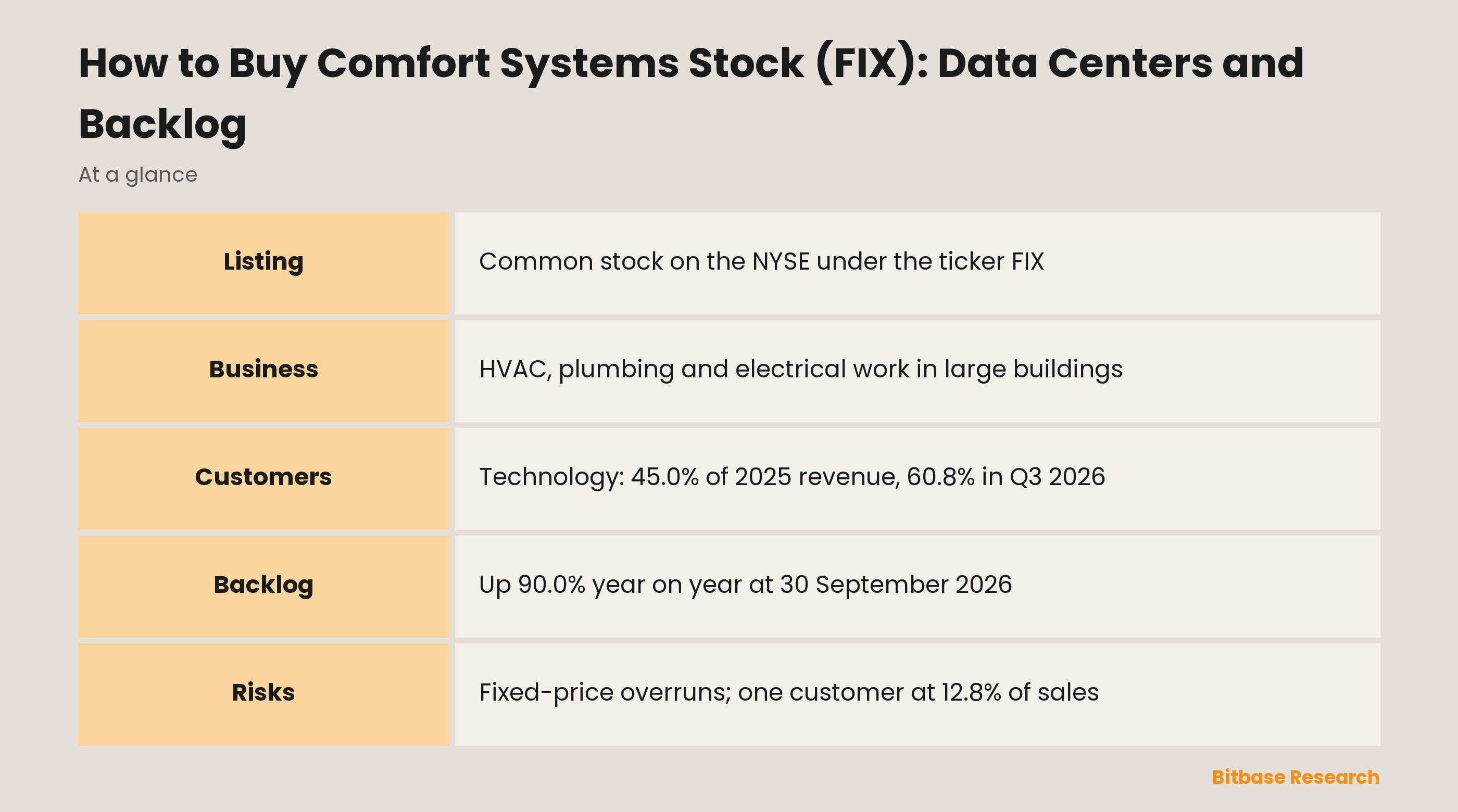
Before you can own a share of Comfort Systems USA, you need a brokerage account that reaches the New York Stock Exchange, where the company's common stock trades under the ticker FIX (the letters are a symbol here, not the verb). What you get is a Houston contractor that installs the air handling, piping and electrical systems inside large buildings, and in 2025 technology customers, data centers above all, produced 45.0% of its revenue, up from 21.4% two years earlier. The sections below cover how the business earns its margin, how an order works, and what its 10-K warns could go wrong.
What Does Comfort Systems Do?
Comfort Systems USA, Inc. is a Delaware corporation established in 1997. Its 10-K describes the work in one line: "We provide mechanical and electrical contracting services." In trade language that is MEP, short for mechanical, electrical and plumbing. It installs, maintains and replaces the heating, ventilation and air conditioning (HVAC), plumbing, piping, controls and electrical systems that make a building usable.
It does not build the shell of a building. A developer or a general contractor hires Comfort Systems for its trade package, and crews then fit chillers, boilers, air handlers, cooling towers, ductwork and switchgear on site. Some of that work moves off site: the company fabricates ductwork, conduit and piping in its own shops and builds modular assemblies away from the job, a capability it has expanded through acquisitions and calls "unmatched" in mechanical off-site construction.
The customers are commercial, industrial and institutional. Substantially all 2025 revenue came from those buildings and from multi-family residential projects; single homes are not the market. At the end of 2025 the company ran 50 operating units with 190 locations in 142 US cities, and by its third-quarter 2026 earnings release the network had grown to 211 locations in 155 cities. The workforce stood at about 22,700 people at the end of 2025, up from about 18,300 a year earlier.
Comfort Systems buys the big equipment rather than making it. Among the manufacturers its 10-K names are Trane, Carrier and Daikin for chillers, Schneider Electric and Eaton for switchgear, Caterpillar and Cummins for generators, and Johnson Controls and Siemens for building automation. For one of those suppliers, see our Trane Technologies stock guide.
How Comfort Systems Makes Money
The company reports two segments, mechanical and electrical. Shares below are calculated from the 2025 segment note:
| Segment (2025) | Share of revenue | Share of segment operating income | Revenue growth vs 2024 | What it covers |
|---|---|---|---|---|
| Mechanical | 73.3% | 72.1% | 20.7% | HVAC, plumbing, piping, controls, off-site construction, monitoring, fire protection |
| Electrical | 26.7% | 27.9% | 61.9% | Installation and servicing of electrical systems |
The electrical side is smaller but grew three times as fast, and its operating income was 16.0% of its revenue against 15.0% for mechanical. Most of that jump came from existing operations rather than purchases, and one site stands out: the 10-K ties about 75% of the electrical segment's same-store gain to a single Texas electrical operation, working in the technology sector.
Projects, not subscriptions. About 92.7% of 2025 revenue was earned on a project basis. New construction supplied 63.2%, work on existing buildings 23.3%, service projects 6.2% and service calls, maintenance and monitoring 7.3%. An average project takes six to nine months, and at the end of 2025 there were 8,427 of them in progress.
Who the customers are. Technology took 45.0% of 2025 revenue, manufacturing 22.1%, healthcare 8.9%, education 7.3%, government and office buildings 5.0% each, and retail, restaurants and entertainment 3.7%. In 2023 the order was different: manufacturing led with 33.6% and technology had 21.4%. The tilt kept going in 2026; in the third quarter technology customers accounted for 60.8% of revenue.
How the margin is made. Most work is bid at a fixed contract price. The company estimates labor, materials and overhead, adds a margin, and absorbs any overrun that change orders do not recover. It estimates that commodities and finished products bought directly make up between 40% and 45% of the average project's cost. Revenue on long contracts is recognized as costs are incurred, the cost-to-cost method, so profit estimates can be revised later in a job. In 2025 gross margin rose to 24.1% from 21.0%, and net income grew 95.7%.
FIX Stock at a Glance
| Item | FIX |
|---|---|
| Exchange | New York Stock Exchange |
| Ticker | FIX |
| Security | Common stock, par value one cent, the only class registered under Section 12(b) |
| Business | Mechanical and electrical (MEP) contracting for commercial, industrial and institutional buildings |
| Index membership | S&P 500 |
| Headquarters | Houston, Texas |
| Incorporated | Delaware, 1997 |
| Fiscal year | Calendar year, ending 31 December |
| Dividend | Paid quarterly; the credit agreement may cap it when net leverage exceeds 2.75 to 1 |
| Buybacks | Program running since March 2007, topped up in November 2026 |
| SEC identifier | CIK 1035983 |
Price, market value and yield move all day; the Comfort Systems stock page on Bitbase shows the live price.
How to Buy Comfort Systems Stock
Comfort Systems is a US company that files 10-K and 10-Q reports, and the shares traded on the NYSE are its ordinary common stock. No depositary receipt sits in between. The route looks like this:
1. Pick a broker with NYSE access. Outside the United States, check which entity holds your account and who regulates it.
2. Open and verify the account. For non-US individuals that usually includes IRS Form W-8BEN, which the IRS says to submit "when requested by the withholding agent or payer."
3. Add money. Converting into US dollars adds a currency spread on top of any commission.
4. Look up FIX. Check that the result reads Comfort Systems USA, Inc. on the NYSE. Because fix is also an everyday English word, confirm the company name, not just the three letters.
5. Set the order type. In FINRA's words, a market order "generally will execute at or near the current bid or ask prices in the marketplace during normal trading hours, 9:30 a.m. to 4 p.m. Eastern Time." A limit order instead names the most you will pay and may not fill.
6. Size the position. If one share costs more than you planned to invest, you do not have to buy a whole one. Many brokers sell fractions of a share for a set amount of money; FINRA cautions that such fractions currently cannot be moved to another brokerage firm, so a later transfer means selling them.
7. File the paperwork. Trade confirmations and statements record your cost and the dividends paid, which you will need at tax time.
Tax on dividends for non-US holders. The IRS states that "most types of U.S. source income received by a foreign person are subject to U.S. tax of 30%," and a tax treaty may reduce that rate, which is what the W-8BEN is for. Your home country may tax the dividend as well.
Holding it through a fund. Comfort Systems is in the S&P 500: the daily holdings file of State Street's SPY, dated 6 November 2026, lists Comfort Systems USA Inc under FIX. In such a fund it is one small position among about five hundred.
What Moves FIX Stock
Data center demand. The 10-K says demand has been "especially strong in the technology sector, particularly for data centers." That is the main reason revenue rose 29.5% in 2025 and 53.7% in the third quarter of 2026. It also means one customer type now carries most of the business. Our AI infrastructure stocks guide shows where builders like this sit in the wider spending chain.
Backlog. The company defines backlog as revenue still to be recognized on contracted or committed project work, and says it mostly turns into revenue within six to twelve months. At 30 September 2026 backlog was 90.0% higher than a year before, and 85.4% higher on a same-store basis. The electrical segment held 31.5% of it, up from 24.4% at the end of 2025. The company warns that its predictive value is "limited to indications of general revenue direction over the near term."
Execution on fixed-price jobs. With most contracts priced up front, profit depends on estimating well and running crews efficiently. Operating margin was 14.4% in 2025 and 16.6% in the third quarter of 2026, and single large jobs can swing it: in the third quarter of 2025 a customer emerging from bankruptcy let the company book revenue it had not recognized before.
Equipment and labor. Lead times for commercial HVAC equipment, electrical switchgear and large generators can exceed six months, according to the 10-K, and the company buys some commodities early or writes escalation clauses into bids to limit tariff and price risk. Skilled craft labor is the other constraint; the company calls it "increasingly scarce and valuable."
Acquisitions. Comfort Systems keeps adding regional contractors. It bought Century Contractors, Right Way Plumbing & Mechanical, Feyen-Zylstra and Meisner Electric in 2025, then R.C. Hunt Electric, Boys Electrical Contractors and a Texas modular company in 2026, ending September with 52 operating locations.
Seasons. Winter slows construction, so the 10-K expects revenue and results to be lower in the first quarter.
Cost Overruns and Other Risks in the Comfort Systems 10-K
Item 1A of the 10-K, to which the third-quarter 10-Q refers readers back, lists many risks. These five matter most for a FIX holder:
Overruns on fixed prices. "Because we bear the risk of cost overruns in most of our contracts, we may experience reduced profits or, in some cases, losses under these contracts if costs increase above our estimates."
Reversed profits. Under cost-to-cost accounting, the company could report a profit on a contract for several periods and later find, "usually near contract completion," that part of it was overstated, with the whole correction landing in one period.
Customer concentration. In 2025 one customer, not named, made up about 12.8% of revenue, and "the loss of one or a few customers could adversely affect" results. With technology at 60.8% of third-quarter 2026 revenue, results are now tied closely to how long the data center building wave lasts.
A late-cycle business. Much of the company's work comes late in a building's life cycle, so it "generally" feels a recession after it begins and keeps feeling it after the economy recovers.
Surety bonds. "A significant portion of our business depends on our ability to provide surety bonds," and tight surety markets could limit how much work it can take on.
Then there are the risks of owning one stock. The 10-K notes that the share price has "from time to time experienced significant price and volume fluctuations." A dividend is declared quarter by quarter and is not a promise.
How to Research FIX Yourself
All filings sit on SEC EDGAR under CIK 1035983. Third-quarter 2026 results came out on 22 October 2026 in an 8-K with the earnings release, and the 10-Q followed the same day; a later 8-K dated 5 November 2026 reported the buyback top-up.
In the 10-K, Item 1 covers services and suppliers, Item 1A the risks and Item 7 revenue, backlog and margins by segment. The revenue note, split by customer type, shows the technology shift most clearly.
Each quarter, compare same-store growth with the acquired part, watch the backlog split between mechanical and electrical, and read the gross profit paragraph for one-off gains or charges on large jobs. Management also changes: chief financial officer William George plans to retire after the 10-K for 2026 is filed, with chief accounting officer Julie Shaeff named to succeed him. For the live price, use the FIX page linked under the table above; Bitbase's US stock pages list other companies.
Comfort Systems Stock FAQ
Can I buy Comfort Systems stock with crypto?
Not directly. FIX is bought in US dollars through a broker, so crypto would have to be sold first and the cash deposited, and that sale may be taxable where you live. A share is also a different asset from a token: it carries dividends and a vote in a regulated company, as our article on how stocks differ from crypto explains.
Does Comfort Systems pay a dividend?
Yes, quarterly. The 10-K says the company expects to keep paying cash dividends each quarter but gives "no assurance," and its credit agreement can limit them when net leverage is above 2.75 to 1. The most recent declaration came on 22 October 2026, for holders of record on 12 November 2026.
Is FIX in the S&P 500?
Yes. State Street's SPY, a fund that tracks the S&P 500, listed Comfort Systems USA in its holdings file dated 6 November 2026. Its weight in the index changes every day.
Does Comfort Systems install home air conditioning?
Not as a core business. Its revenue comes from commercial, industrial and institutional buildings and multi-family projects, and multi-family and residential together made up 1.4% of 2025 revenue.
Does Comfort Systems buy back its shares?
Yes. The board approved a repurchase program in March 2007 and has enlarged it repeatedly. Through 4 November 2026 the company had bought back 11,752,570 shares under it, and on that date the board topped it up so that up to 1,000,000 more can be bought.
Conclusion
Comfort Systems is a contractor whose fortunes now follow data center construction: technology customers rose from about a fifth of revenue in 2023 to about three fifths in the latest quarter, and backlog almost doubled in a year. The other side is concentration, fixed-price risk and a single customer above a tenth of sales. Before you buy, track how backlog converts into revenue, whether margins hold as large jobs finish, and how much of your portfolio one building contractor should carry.
Related reading
Other Bitbase articles on this topic:
- How to Buy AerCap Stock (AER): Jet Leasing and Dividend Tax
- How to Buy Agilent Stock (A): CrossLab, Ticker A and Dividends
- How to Buy Carrier Stock (CARR): HVAC, Viessmann and Data Centers
- How to Buy Mettler-Toledo Stock (MTD): Balances and Buybacks
Disclaimer: This article is educational content from Bitbase Academy, provided for information only. It explains what a company or fund does and how the instruments referenced here differ from one another; it does not constitute investment, trading, tax, or financial advice, and it is neither a recommendation nor an endorsement of any security, token, or trading strategy. A tokenized stock is issued by a third party and is designed to give economic exposure to an underlying asset: it is not a share, it carries no shareholder rights, and it depends on the issuer's structure, eligibility rules, and redemption terms, which the issuer can change. Perpetual futures are leveraged derivatives that hold no underlying asset and can be liquidated, and trading hours, product availability, and eligibility differ by instrument and by jurisdiction and can change at any time. Written as of November 2026; verify everything yourself through company filings, the issuer's own documentation, and the product pages of the venue you trade on.
References
[1] Comfort Systems USA Form 10-K for 2025 (SEC EDGAR) www.sec.gov
[2] Comfort Systems USA 2025 Form 10-K, XBRL cover page (SEC EDGAR) www.sec.gov
[3] Comfort Systems USA Form 10-Q for the third quarter of 2026 (SEC EDGAR) www.sec.gov
[4] Comfort Systems USA third-quarter 2026 earnings release (SEC EDGAR) www.sec.gov
[5] Comfort Systems USA Form 8-K of 22 October 2026: results and quarterly dividend (SEC EDGAR) www.sec.gov
[6] Comfort Systems USA Form 8-K of 22 October 2026: chief financial officer succession (SEC EDGAR) www.sec.gov
[7] Comfort Systems USA Form 8-K of 5 November 2026: share repurchase program (SEC EDGAR) www.sec.gov
[8] State Street SPDR S&P 500 ETF Trust (SPY): fund page and daily holdings www.ssga.com
[9] FINRA: Order Types www.finra.org
[10] FINRA: Investing in Fractional Shares www.finra.org
[11] IRS: NRA Withholding www.irs.gov
[12] IRS: About Form W-8 BEN www.irs.gov





