
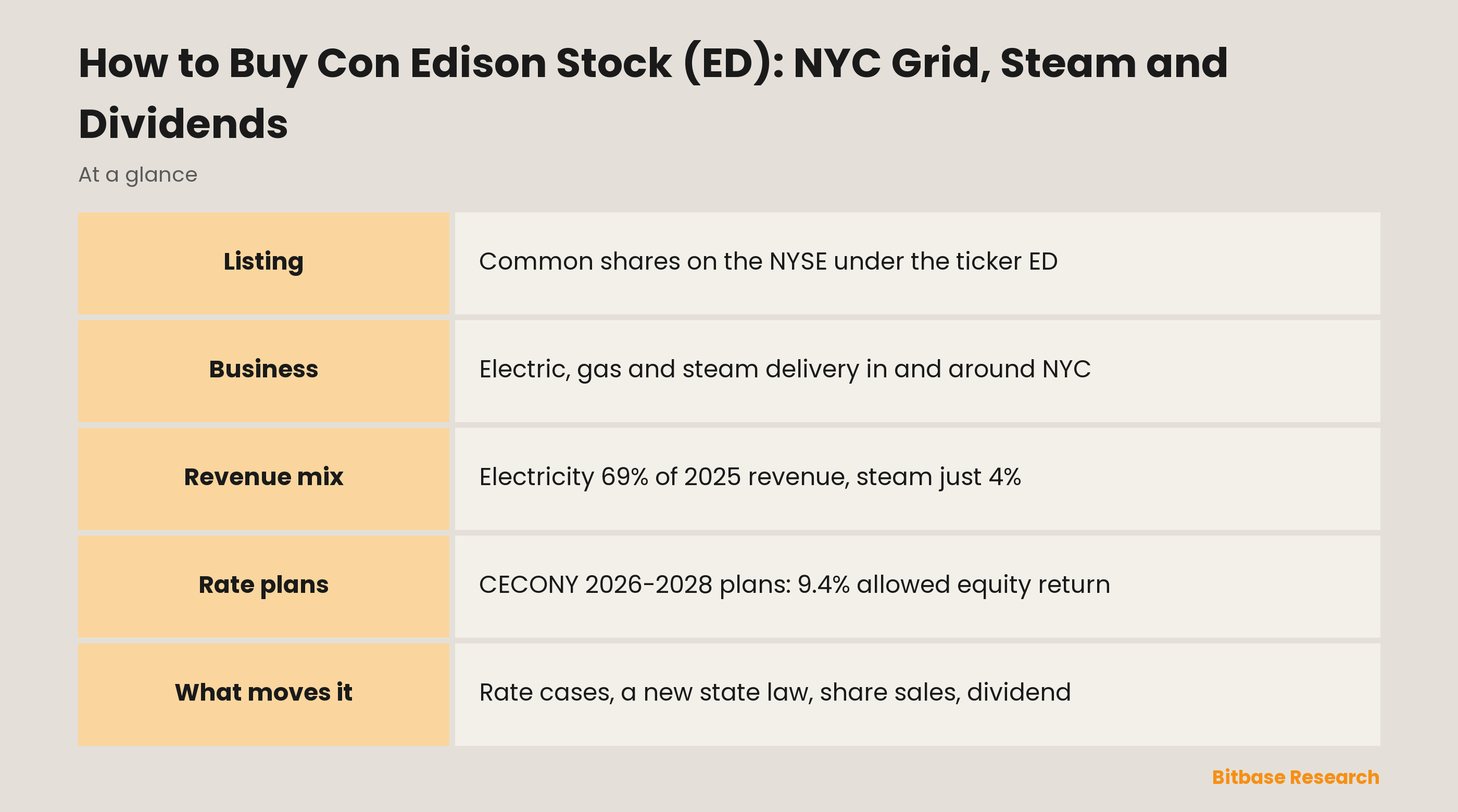
As the parent of New York City's main electric, gas and steam utility, Consolidated Edison, Inc. trades on the New York Stock Exchange as ED, and its common shares can be bought through any brokerage account that offers US stocks. One detail sets it apart: its main utility runs the largest steam distribution system in the United States, yet in 2025 steam accounted for about 4% of revenue and almost none of the operating income, while electricity delivered in New York City and Westchester produced about 69% of revenue. Below: the business, the steps of an order, the rate plans behind its earnings and the risks its filings list.
What Does Con Edison Do?
Consolidated Edison, Inc. is a holding company. Its 10-K says it was "incorporated in New York State in 1997" and that it owns all of the common stock of three businesses: Consolidated Edison Company of New York (CECONY), Orange and Rockland Utilities (O&R) and Con Edison Transmission. The utility at the center is far older than the parent: CECONY was incorporated in New York State in 1884.
CECONY delivers three kinds of energy. It provides electric service to about 3.7 million customers in all of New York City except a part of Queens and in most of Westchester County, a service area of roughly 660 square miles with a population of more than nine million. It delivers gas to about 1.1 million customers in Manhattan, the Bronx, parts of Queens and most of Westchester. And it "operates the largest steam distribution system in the United States," serving about 1,490 customers in parts of Manhattan.
O&R, together with its New Jersey subsidiary Rockland Electric Company, provides electricity to about 0.3 million customers in southeastern New York and northern New Jersey, and gas to over 0.1 million customers in southeastern New York.
Con Edison Transmission invests in electric transmission projects, mainly through its stake in New York Transco, and has been shedding its gas holdings. It sold its interest in the Mountain Valley Pipeline in the first quarter of 2026, and in October 2026 it and CECONY sold their interests in Honeoye Storage Corporation, a gas storage company.
What it does not do matters as much. After New York restructured the industry in the 1990s, the utilities sold their power plants except those that also produce steam for CECONY. Customers can buy the energy itself from other suppliers: in 2025, 56% of the electricity and 33% of the gas CECONY delivered was bought from someone else. CECONY still owns the wires, pipes and meters and charges everyone for delivery. It has also left renewables: on 1 March 2023 it sold its Clean Energy Businesses to a subsidiary of RWE, a sale made "to allow for continued focus on the Utilities and their clean energy transition."
The company says it "anticipates that the Utilities, which are subject to extensive regulation, will continue to provide substantially all of its earnings over the next few years." At the end of 2025 Con Edison and its subsidiaries had 15,407 employees, all based in the United States.
How Con Edison Makes Money
A regulated utility does not set its own prices. The New York State Public Service Commission (NYSPSC) approves multi-year rate plans, in which the utility's rate base, roughly its net plant and certain other assets, is multiplied by an approved cost of capital that includes an allowed return on common equity.
The segment note of the 2025 10-K splits the business this way:
| Segment | Share of 2025 revenue | Share of 2025 operating income | What it delivers |
|---|---|---|---|
| CECONY electric | 69% | 70% | Electricity in New York City and Westchester |
| CECONY gas | 19% | 26% | Gas in Manhattan, the Bronx, parts of Queens and Westchester |
| CECONY steam | 4% | almost none | Steam in parts of Manhattan |
| O&R (electric and gas) | 7% | 5% | Electricity and gas north of the city and in New Jersey |
Shares are calculated from the segment note and rounded; Con Edison Transmission and the parent reported small operating losses.
Two mechanisms keep the earnings steadier than usage. First, the electric and gas rate plans in New York include revenue decoupling, which reconciles revenue to the amount set in the plan when sales come in higher or lower; the steam plan uses a weather normalization adjustment instead. Second, the cost of the energy itself is passed through: the utilities "recover from their full-service customers … generally on a current basis, the cost the Utilities pay for energy." A spike in gas prices therefore shows up mainly in customer bills, although the 10-K notes that higher bills can slow the collection of what customers owe.
In 2025 total operating revenues rose about 11%, and net income for common stock also rose about 11%. In January 2026 the NYSPSC approved new electric and gas rate plans for CECONY covering 2026 through 2028, with an allowed return on common equity of 9.4%. The increases are spread so that the total bill impact is the same each year: 2.80% for electric customers and 2.01% for gas customers. For steam, CECONY and other parties signed a joint proposal on 4 September 2026 for a plan running from November 2026 through October 2029 with an allowed return of 9.5%; it still needs NYSPSC approval.
ED Stock at a Glance
| Feature | ED |
|---|---|
| Exchange | New York Stock Exchange |
| Ticker | ED |
| Security | Common shares, the only class of common equity and the only security registered under Section 12(b) |
| Sector | Regulated electric, gas and steam delivery |
| Main subsidiaries | CECONY, O&R, Con Edison Transmission |
| Index membership | S&P 500 |
| Headquarters | 4 Irving Place, New York, New York |
| Incorporated | New York State, 1997 (CECONY: 1884) |
| Fiscal year | Ends 31 December (calendar year) |
| Dividend policy | Cash dividend paid quarterly |
| SEC identifier | CIK 1047862 |
Share price, market value and yield move throughout the trading day; the Con Edison stock page on Bitbase shows them live.
How to Buy Con Edison Stock
Con Edison is a US company listed at home, so there is no depositary receipt to think about:
1. Choose a broker with NYSE access. Check who regulates it and where your shares will be held.
2. Pass the account checks. Non-US individuals are usually asked for IRS Form W-8BEN, the certificate of foreign status for tax withholding.
3. Fund the account. If you deposit another currency, the conversion adds a spread on top of any commission.
4. Search for ED and check the name. The line you want reads Consolidated Edison, Inc. common shares.
5. Choose how to order. According to FINRA, a market order "provides the most certainty that your order will be executed," although the price can differ from the quote, while with a limit order "you're guaranteed to get your limit price or a better price if your order is executed. However, there's a chance your order doesn't get executed at all."
6. Decide between whole and fractional shares. "The availability of fractional share trading varies by brokerage firm," says FINRA; fractions usually cannot be moved to another firm, and "as a fractional share owner, you might not have shareholder voting rights."
7. Keep the trade confirmations for your tax records.
Dividends for non-US holders. According to the IRS, "most types of U.S. source income received by a foreign person are subject to U.S. tax of 30%" although "a reduced rate, including exemption, may apply" if a treaty provides for one, and the W-8BEN is how your broker applies it. Your home country may tax the dividend as well. None of this is tax advice.
Owning it indirectly. On 6 November 2026, State Street's daily holdings files listed Consolidated Edison in both SPY, its S&P 500 fund, and XLU, its utilities sector fund. Any fund that tracks the S&P 500, such as the one described in our VOO explainer, gives you a small slice of ED along with hundreds of other companies.
What Moves ED Stock
Rate cases and New York politics. Because the regulator sets the allowed return, the outcome of each rate case matters more than any single quarter. In May 2026 New York enacted Chapter 58 of the Laws of 2026, which applies to base rate filings submitted after 1 January 2027. Among other things, utilities must file a "budget-constrained" alternative that limits revenue increases to average inflation over the prior three years, must return revenue earned above the allowed return (keeping up to 0.25 percentage points if certain criteria are met), and may see their cases suspended for up to 14 months. The company says it is "continuing to assess the impact of the new law and the timing of their upcoming rate case filings."
The size of the building program. The utilities invested heavily in 2025, and the 10-K plans for their annual investment in 2030 to be about 73% higher. More approved investment means a larger rate base to earn on, but it has to be financed. Con Edison plans to issue new common shares in every year from 2026 through 2030, including through an at-the-market program, on top of shares issued through its dividend reinvestment and employee plans.
Demand from new loads. CECONY expects its electric peak demand to grow by only about 0.7% a year over the next five years and its steam peak demand to shrink by about 0.9% a year. O&R expects electric peak demand to grow about 4.1% a year, "primarily due to anticipated load growth from commercial customers, including data centers, and electric vehicles." Climate rules pull in both directions: New York State's Climate Leadership and Community Protection Act (CLCPA) and New York City's Climate Mobilization Act are expected to raise electric use and reduce gas and steam use, which shifts where investment goes.
Financing costs and the dividend. The utilities borrow every year to fund their programs, so financing costs feed into rate cases and into what is left for shareholders. The company ties its case to the dividend: it "seeks to provide shareholder value through continued dividend growth, supported by earnings growth in regulated utilities and electric transmission projects." In its third-quarter 2026 earnings presentation it calls itself a "Dividend King," citing 52 consecutive years of dividend growth and a 4.4% annualized increase in 2026.
How it compares. The 10-K's own scorecard shows a mixed record. Over the five years 2021 through 2025, total return to Con Edison shareholders was 64.48%, against 95.98% for the S&P 500 and 59.06% for the S&P 500 Utilities Index. In 2025 alone it returned 15.16%, behind both indexes at 17.86% and 16.04%.
Rate Plans, Outages and Other Risks Con Edison Lists
The 10-K sorts its risks into regulatory, operational, environmental, financial and other groups. Five stand out for this company.
Regulators set the return. "The Utilities' Rate Plans May Not Provide A Reasonable Return," the 10-K warns, because rates are "generally designed for, but do not guarantee, the recovery of the Utilities' cost of providing service." Regulators can also block recovery of costs they find "imprudently incurred" and impose penalties. One open item: since 2018 the NYSPSC has run a focused audit of the utilities' accounting for income taxes, after an "inadvertent understatement" of part of their federal income tax expense for ratemaking. The tax regulatory assets that built up as a result are "not earning a return."
Dense city, exposed facilities. Many of the utilities' facilities "are located either in, or close to, densely populated public places," so a failure "could result in bodily injury or death, property damage, the release of hazardous substances or extended service interruptions." The 10-K names sea level rise, storm surge, inland flooding and extreme heat or cold as climate risks to those facilities. Under their tariffs, CECONY and O&R must compensate residential and small business customers after widespread outages lasting more than 72 hours, and those costs are not recoverable from customers.
Affordability and unpaid bills. The 10-K says "a continued slow recovery of accounts receivable balances has impacted and is expected to continue to impact the Companies' liquidity." Rising bills also shape the politics of every rate case, which is the backdrop to Chapter 58.
Capital markets and dividends from subsidiaries. The utilities' five-year investment needs mean the company depends on access to debt and equity markets. The parent's dividend comes mainly from its subsidiaries, and the NYSPSC limits what the utilities may pay it to no more than 100% of their income available for dividends, measured on a two-year rolling average, with certain exceptions.
Cyber attacks and supply chains. The company says it has "experienced cyber incidents and attacks in the past" and expects more, though none has had a material impact so far. Long lead times for transformers and other equipment could delay repairs and prolong outages.
Two risks come with the share itself. Holding one stock concentrates your money in a single company and a single region. And the dividend is not promised: future payments are "subject to approval and declaration by Con Edison's Board of Directors."
How to Research ED Yourself
Con Edison files with the SEC under CIK 1047862. Its annual report is a combined 10-K with CECONY, so check whether a figure belongs to the parent or to the New York utility before quoting it. Item 1 describes each utility, Item 1A lists the risks, Note B summarizes every rate plan with its allowed return, and Note P splits revenue and operating income by segment. 10-Qs and 8-Ks, including each quarter's earnings release, bring the updates.
Read the regulatory note rather than headlines about rate increases, since base rate changes and the total bill impact are different numbers, and note which earnings measure is quoted, because Con Edison also publishes non-GAAP adjusted earnings.
For another utility with a different shape, see how to buy Duke Energy stock. ED's own quote page is linked in the at-a-glance section, and Bitbase also has stock pages for other US-listed companies.
Con Edison Stock FAQ
Can I buy Con Edison stock with crypto?
Not directly. A broker sells ED shares for US dollars, which means converting crypto to cash first and transferring it, and in many places that conversion can be a taxable event. What you end up holding is a share in a registered company, with a claim on dividends and a vote, and that is how a share differs from a crypto asset.
Does Con Edison pay a dividend?
Yes. Con Edison pays a quarterly cash dividend, and its third-quarter 2026 presentation cites 52 consecutive years of dividend growth. Each payment needs board approval; the latest declaration in the filings gives the amount and dates.
Is ED in the S&P 500?
Yes. Consolidated Edison appeared under the ticker ED in the SPY holdings file that State Street publishes daily for its S&P 500 fund, on 6 November 2026, and also in the file for XLU, its utilities sector fund. Weights change daily.
Is Con Edison the same company as Edison International?
No. Consolidated Edison trades as ED and serves New York and part of New Jersey. Edison International is a separate company that trades under the ticker EIX; both appear as separate lines in the SPY holdings file. Check the ticker before you place an order.
Does Con Edison still own renewable energy or pipeline businesses?
Its main holdings of that kind are gone. It sold its Clean Energy Businesses to a subsidiary of RWE in March 2023, its stake in the Mountain Valley Pipeline in the first quarter of 2026 and its Honeoye gas storage interests in October 2026. Earnings now come almost entirely from regulated delivery, alongside Con Edison Transmission's investments in electric transmission.
Conclusion
Rate plans decide most of what an ED share earns, since almost all of Consolidated Edison's profit comes from regulated delivery in and around New York City. That business is financed partly with new shares and is now shaped by a new state law on affordability, and both matter far more than how you place the order. Read the latest 10-K and 10-Q, follow the rate cases, and decide how much one regional utility should weigh in your portfolio.
Related reading
Other Bitbase articles on this topic:
- How to Buy Ameren Stock (AEE): Callaway, DRPlus, Data Centers
- How to Buy American Water Works Stock (AWK): Rates, PFAS, Merger
- How to Buy Atmos Energy Stock (ATO): Gas Only, Mostly in Texas
- How to Buy PPL Stock (PPL): Pennsylvania Wires, Kentucky Plants
Disclaimer: This article is educational content from Bitbase Academy, provided for information only. It explains what a company or fund does and how the instruments referenced here differ from one another; it does not constitute investment, trading, tax, or financial advice, and it is neither a recommendation nor an endorsement of any security, token, or trading strategy. A tokenized stock is issued by a third party and is designed to give economic exposure to an underlying asset: it is not a share, it carries no shareholder rights, and it depends on the issuer's structure, eligibility rules, and redemption terms, which the issuer can change. Perpetual futures are leveraged derivatives that hold no underlying asset and can be liquidated, and trading hours, product availability, and eligibility differ by instrument and by jurisdiction and can change at any time. Written as of November 2026; verify everything yourself through company filings, the issuer's own documentation, and the product pages of the venue you trade on.
References
[1] Con Edison Form 10-K for 2025 (SEC EDGAR) www.sec.gov
[2] Con Edison 2025 Form 10-K, XBRL cover page (SEC EDGAR) www.sec.gov
[3] Con Edison 2025 Form 10-K, XBRL segment data (SEC EDGAR) www.sec.gov
[4] Con Edison Form 10-Q for the third quarter of 2026 (SEC EDGAR) www.sec.gov
[5] Con Edison third-quarter 2026 earnings presentation, Exhibit 99.2 (SEC EDGAR) www.sec.gov
[6] State Street, SPY daily holdings www.ssga.com
[7] State Street, XLU daily holdings www.ssga.com
[8] FINRA, Order Types www.finra.org
[9] FINRA, Investing in Fractional Shares www.finra.org
[10] IRS, NRA Withholding www.irs.gov
[11] IRS, About Form W-8 BEN www.irs.gov
[12] Con Edison Form 8-K, 4 September 2026: steam rate joint proposal (SEC EDGAR) www.sec.gov





