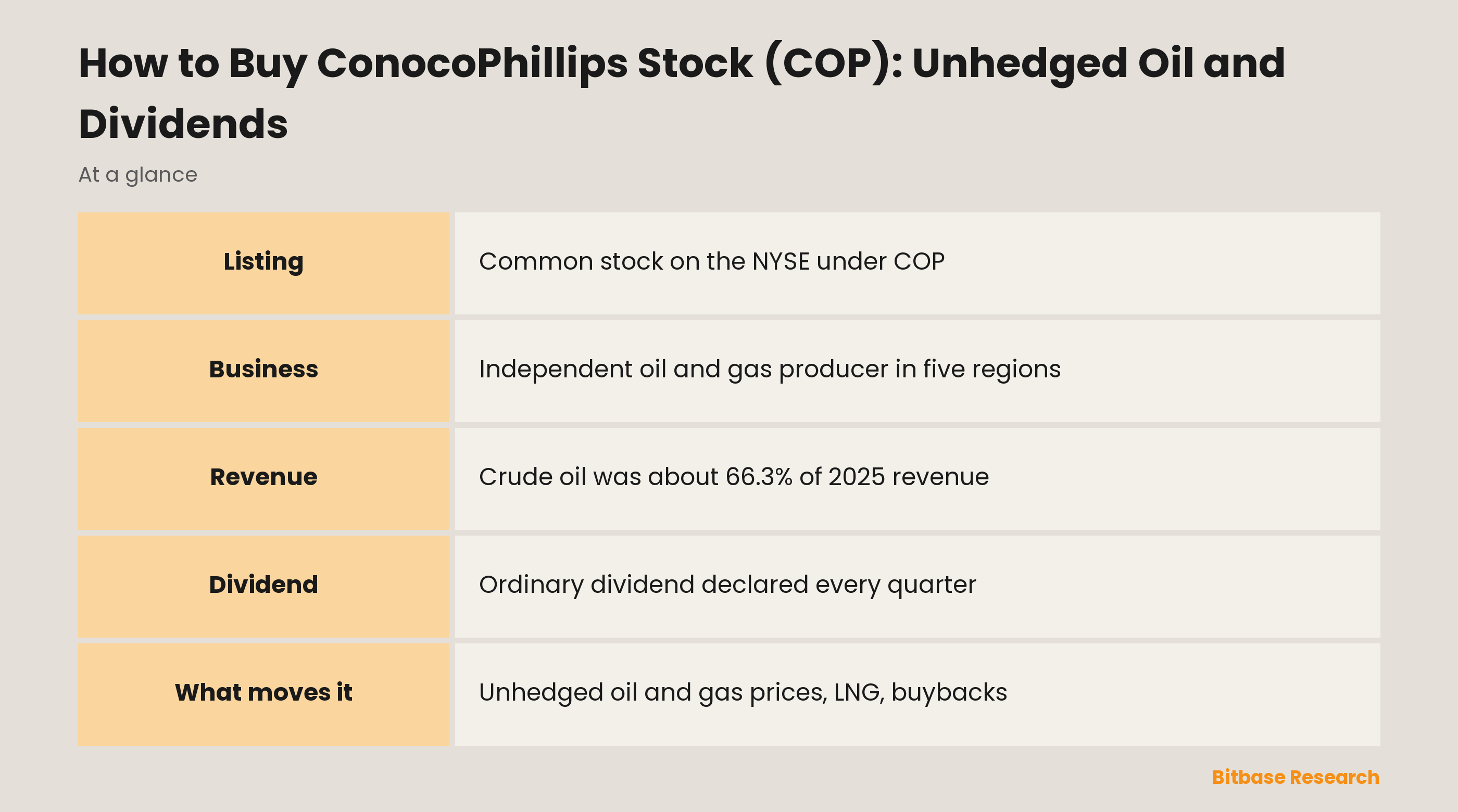
Any brokerage account that reaches the New York Stock Exchange can buy ConocoPhillips common stock, which trades there under the ticker COP. What the share holds is a producer and little else: refining left as Phillips 66 in 2012, and the company calls itself unhedged, so oil and gas prices flow straight into its results. Crude oil alone brought in about 66.3% of 2025 revenue. Below: where the oil and gas comes from, how to place the order, and what the filings tie most closely to the share.
What Does ConocoPhillips Do?
ConocoPhillips explores for, produces, transports and sells crude oil, bitumen, natural gas, natural gas liquids (NGLs) and liquefied natural gas (LNG). Its annual report calls it "an independent E&P company headquartered in Houston, Texas," E&P meaning exploration and production, and by mid-2026 it had operations and activities in 15 countries.
ConocoPhillips was incorporated in Delaware in 2001 to combine Conoco Inc. and Phillips Petroleum Company, and the deal closed on 30 August 2002. In April 2012 it separated its downstream business, refining and marketing, into an independent listed company, Phillips 66. COP has been purely upstream since, earning on what it produces and the price that output fetches.
The business is reported in five segments, each one a region.
Lower 48. The contiguous US states, mostly unconventional (shale) plays. By 2025 production it is the largest segment, built on the Delaware, Midland, Eagle Ford and Bakken basins across Texas, New Mexico, North Dakota and Montana.
Alaska. The 10-K calls ConocoPhillips "the largest crude oil producer in Alaska," with major interests in Prudhoe Bay, Kuparuk and the Western North Slope. Willow, in the Western North Slope's Bear Tooth Unit, reached its final investment decision in December 2023, with first oil anticipated in early 2029.
Canada. The Surmont oil sands in Alberta, which yield bitumen through steam injection, and the liquids-rich Montney play in British Columbia. The company has owned all of Surmont since October 2023, when it bought the remaining half from TotalEnergies.
Europe, Middle East and North Africa. Norwegian fields led by Greater Ekofisk, the Waha concession in Libya, the Alba unit off Equatorial Guinea, and Qatari LNG: one producing joint venture plus stakes in the North Field East and North Field South projects.
Asia Pacific. Mainly Australia Pacific LNG (APLNG), a 47.5% joint venture with Origin Energy and Sinopec that turns Queensland coalbed methane into LNG; ConocoPhillips runs the LNG plant on Curtis Island. The segment also covers oil at Penglai in China's Bohai Bay and fields off Sabah in Malaysia.
Beyond these regions, the company holds a direct stake in Phase 1 of Port Arthur LNG on the US Gulf Coast, scheduled to start up in 2027.
How ConocoPhillips Makes Money
Production is sold at the market: the 10-K says commodity sales "are generally made at prevailing market prices at the time of sale," mostly under contracts priced off market indices. The commercial arm also trades third-party volumes to keep pipelines and storage full, so part of revenue is marketing rather than own output.
By product, crude oil accounted for about 66.3% of 2025 revenue, natural gas 15.0% and NGLs 6.3%; the other 12.4% came from bitumen, power and LNG. Volumes look different: in barrels of oil equivalent, crude was 48.2% of 2025 production, NGLs 17.6%, bitumen 5.6% and natural gas 28.5%. Two things open the gap. Gas fetched far less per barrel of oil equivalent than crude, going by the 10-K's average sales prices, and much of the gas comes from LNG joint ventures whose profit is booked as equity in earnings of affiliates, not revenue.
The segment note shows how unevenly the regions contribute:
| Segment | Main assets named in the 10-K | Share of 2025 production | Share of 2025 revenue | Share of 2025 segment net income |
|---|---|---|---|---|
| Lower 48 | Delaware, Midland, Eagle Ford and Bakken | 62.5% | 70.2% | 57.7% |
| Europe, Middle East and North Africa | Norway, Qatar LNG, Libya, Equatorial Guinea | 12.9% | 11.0% | 13.4% |
| Asia Pacific | APLNG, Penglai, Malaysia | 8.8% | 3.0% | 12.8% |
| Alaska | Prudhoe Bay, Kuparuk, Western North Slope | 8.4% | 9.6% | 8.0% |
| Canada | Surmont, Montney | 7.5% | 6.1% | 8.1% |
Calculated from the fiscal 2025 10-K: production includes equity affiliates, and net income shares exclude corporate costs.
Asia Pacific shows the accounting effect most clearly: a small slice of revenue but a far larger slice of profit, because most of its 2025 net income arrived as equity earnings, chiefly from APLNG. That venture sells its LNG under two 20-year agreements, with Sinopec and with Japan's Kansai Electric Power.
Customers are businesses; in 2025 the Lower 48's sales to a single pipeline company alone made up about 10% of consolidated revenue. Selling operations in the US accounted for 79.1% of revenue, although about 29% of production came from outside the country.
In 2025 revenue rose 7.7% with Marathon Oil's assets included for a full year, yet net income fell 13.6%, as lower realized prices met higher operating and depreciation costs from the enlarged asset base.
COP Stock at a Glance
| Item | Detail |
|---|---|
| Exchange | New York Stock Exchange (NYSE) |
| Ticker | COP |
| Security | Common stock |
| Other listed security | 7% Debentures due 2029, also on the NYSE, identified by a CUSIP rather than a ticker |
| Sector | Energy: oil and gas exploration and production |
| Index membership | S&P 500; also held by the Energy Select Sector SPDR ETF (XLE) |
| Headquarters | Houston, Texas |
| Incorporated | Delaware, 2001 |
| Fiscal year | Calendar year, ending 31 December |
| Dividend policy | Ordinary dividend, declared by the board each quarter |
| Stock split | Two-for-one, paid on 1 June 2005 |
| SEC identifier | CIK 1163165 |
For the live quote, market value and yield, see the ConocoPhillips stock page on Bitbase.
How to Buy ConocoPhillips Stock
Because the company is a Delaware corporation listed in New York, there is no depositary receipt to weigh up: the NYSE share is the stock itself. The purchase runs through a broker.
1. Choose a broker that can trade NYSE shares. Outside the US, use a local firm with US market access or an international one, and check who regulates it.
2. Complete the onboarding. A non-US individual is normally asked for IRS Form W-8BEN, the certificate of foreign status the broker relies on when withholding US tax.
3. Fund it. If your savings are not in US dollars, compare the exchange-rate spread as well as the commission.
4. Pick the right line. Search for COP and confirm it reads ConocoPhillips common stock on the NYSE; the 7% Debentures due 2029 trade on the same exchange, but they are bonds.
5. Choose the order type. A market order fills fast, but Investor.gov warns that "the last-traded price is not necessarily the price at which a market order will be executed." A limit order caps the price: "A buy limit order can only be executed at the limit price or lower."
6. Size the position. To invest a fixed sum, ask about fractional shares, and note Investor.gov's warning that "you generally cannot transfer fractional shares to another brokerage firm."
7. File the paperwork. Confirmations and statements document your cost basis and each dividend.
If you live outside the United States, COP dividends are US-source income. The IRS states that "most types of U.S. source income received by a foreign person are subject to U.S. tax of 30%," and that a lower rate, including exemption, may apply under a tax treaty with your country of residence. That is the job of the W-8BEN, and your home country may tax the dividend again.
If you would rather not pick one company, funds can hold COP for you. On 16 October 2026, State Street's holdings files showed ConocoPhillips in both its S&P 500 ETF Trust (SPY) and its Energy Select Sector SPDR ETF (XLE). In SPY it is one holding among roughly five hundred; XLE keeps the oil and gas exposure but spreads it across the sector. Before choosing, it helps to know how an index decides what it holds.
What Moves COP Stock
Oil prices, with no hedge in between. The 10-K calls "commodity prices and the associated realizations" the most significant factor in profitability. A business in this industry, it argues, must be "resilient in lower price environments while also retaining upside during periods of higher prices," and it concludes: "As such, we are unhedged." In 2025 that cut the wrong way: Brent and WTI both averaged about 14% less than in 2024, WTI fell roughly 31% from its January high to its December low, and the company's total realized price dropped 19%.
Gas and LNG, on a separate clock. In 2025, while crude averaged lower, US Henry Hub gas averaged 51% more than a year earlier. Equity earnings from affiliates still fell, which the 10-K attributes to lower LNG and crude prices, while the projects under construction in Qatar and at Port Arthur will set the LNG business's later size.
The Middle East in 2026. The second-quarter 2026 10-Q says tensions in the region, "including the ongoing conflict involving Iran," have increased volatility in energy markets. Brent averaged 54% more that quarter than a year earlier and the company's realized crude price rose 55%, while Henry Hub fell 16%. The filing says the Qatar LNG investments had not been damaged, but production there stayed constrained through the quarter; Qatar was about 4% of total company production in 2025. One event can lift prices for most of the portfolio and cut volumes in a corner of it.
Capital returns. The company expects to return "greater than 30 percent of cash from operating activities through cycles" through a growing ordinary dividend and repurchases; in 2025 the two came to 46% of operating cash flow. Buybacks are the flexible part, and the 10-K notes they were suspended in the oil downturn that began in early 2020.
Deals and disposals. Marathon Oil, acquired in November 2024, explains most of the 2025 growth in output: reported production rose 20%, but only 2.5% after adjusting for acquisitions and disposals. The company has since sold non-core Lower 48 assets and says sales closed in the third quarter of 2026 met its disposal target. In July 2026 it also agreed to acquire a 42% stake in a non-operated joint venture redeveloping four producing oil fields near Kirkuk in northern Iraq, expected to close by the end of 2026, subject to approvals.
Long projects and reserves. The 10-K lists Willow among projects whose permits interest groups have challenged. The slower test is whether reserves keep pace: the company replaced 80% of its 2025 production, or 99% excluding sales and purchases of reserves.
A new chief executive. Andy O'Brien, previously chief financial officer, became president and CEO on 1 September 2026, and Ryan Lance became executive chair.
Oil prices move every producer at once, which makes the Exxon Mobil stock guide a useful comparison: Exxon also refines crude and makes petrochemicals, so the same swing lands on a different mix of businesses.
Risks to Weigh With COP
From Item 1A of the 10-K, these parts bear most directly on the share.
Commodity prices. "Our operating results, our ability to execute on our strategy and the carrying value of our assets are exposed to the effects of volatile commodity prices or prolonged periods of low commodity prices." Low prices can also shrink proved reserves and force impairments.
Depletion. "If we do not successfully replace the resources we produce with good prospects for future organic development or through acquisitions, our business will decline."
Host countries and partners. The company recalls that "the expropriation of our oil assets by the Venezuelan government" affected its operations significantly in the past. Many assets are joint ventures run by others, where "we may not be able to influence the decision making or outcomes to align with our interests or goals."
Climate rules and litigation. Since 2017, cities, counties and other entities in several US states and territories have sued oil and gas companies, ConocoPhillips among them, over alleged climate impacts, and in 2024 New York and Vermont passed "polluter pays" laws aimed at energy companies. The company calls the suits meritless but expects substantial legal costs.
Discretionary payouts. "Our Board may determine not to pay a dividend in a quarter or may cease declaring a dividend at any time." A cut to the dividend or to buybacks, it adds, could hurt the stock price.
Add the risks of any single stock: one company in a cyclical industry, with an exchange rate in between if you hold it in another currency. The second-quarter 2026 10-Q reported no material change to these risk factors.
How to Research COP in Its Filings
ConocoPhillips files with the SEC under CIK 1163165 and posts the same reports free of charge on its website. The 10-K is the annual report, 10-Qs cover the quarters, and 8-Ks report events in between, from quarterly results to the 2026 leadership change.
Inside the 10-K, Items 1 and 2, "Business and Properties," give production by field with each interest and operator; Item 7, the MD&A, holds the benchmark and realized price table; Note 22 splits revenue and net income by segment, product and geography; and the supplementary oil and gas data carry reserves and production costs.
Two reading notes save time. Gas is converted to barrels of oil equivalent at six thousand cubic feet per barrel, so a BOE total blends products with very different prices. And the performance graph in Item 5 compares COP with the S&P 500 and a peer group of APA, Chevron, Devon Energy, Diamondback Energy, EOG Resources, ExxonMobil and Occidental Petroleum, each of which has a quote page among the US stock pages on Bitbase.
ConocoPhillips Stock FAQ
Does ConocoPhillips pay a dividend?
Yes, every quarter, with the board deciding each declaration. Until 2024 the company also paid a variable return of cash, or VROC, alongside it; in the fourth quarter of 2024 it folded that payment into the ordinary dividend, which it raised by 8% in December 2025. The current per-share figure appears in each earnings release and 10-Q.
Can I buy ConocoPhillips stock with crypto?
Not in one step. A broker buys COP with US dollars, so you would sell the crypto, move the cash to a brokerage account and then place the order; the sale may be taxable where you live. The two assets also behave differently once held, as how a listed share differs from a crypto asset explains.
Is COP in the S&P 500?
Yes. SPY, State Street's S&P 500 fund, listed it among its holdings on 16 October 2026, as did the energy sector fund XLE. Weights change daily.
Did ConocoPhillips buy Marathon Oil?
Yes, in November 2024. Marathon Oil was an independent exploration and production company with operations across the Lower 48 and in Equatorial Guinea; its shareholders received 0.255 of a ConocoPhillips share for each Marathon Oil share.
Is ConocoPhillips the same company as Phillips 66?
No. ConocoPhillips separated its downstream business into Phillips 66 in April 2012, and the two have been separate listed companies since. Refining and fuel marketing are not part of what a COP share represents.
Has ConocoPhillips stock ever split?
Yes. The board declared a two-for-one split on 7 April 2005, paid as a stock dividend on 1 June 2005, and the 2005 annual report restated earlier per-share figures for it.
Conclusion
The order itself takes minutes once a broker account is open; what deserves the time is the company. A COP share is unhedged exposure to oil and gas prices across five regions, with LNG and Willow setting much of the long-term calendar and a board free to change the dividend every quarter. Read the latest 10-K and 10-Q, the MD&A price table above all, before deciding how much of a portfolio one oil producer should take.
Related reading
Other Bitbase articles on this topic:
- How to Buy Baker Hughes Stock (BKR): Chart, LNG and the Rig Count
- How to Buy BP Stock (BP): Six Shares per ADS and the Dividend
- How to Buy Canadian Natural Resources Stock (CNQ): Oil Sands Owner
- How to Buy Suncor Stock (SU): Oil Sands to Petro-Canada Pumps
Disclaimer: This article is educational content from Bitbase Academy, provided for information only. It explains what a company or fund does and how the instruments referenced here differ from one another; it does not constitute investment, trading, tax, or financial advice, and it is neither a recommendation nor an endorsement of any security, token, or trading strategy. A tokenized stock is issued by a third party and is designed to give economic exposure to an underlying asset: it is not a share, it carries no shareholder rights, and it depends on the issuer's structure, eligibility rules, and redemption terms, which the issuer can change. Perpetual futures are leveraged derivatives that hold no underlying asset and can be liquidated, and trading hours, product availability, and eligibility differ by instrument and by jurisdiction and can change at any time. Written as of October 2026; verify everything yourself through company filings, the issuer's own documentation, and the product pages of the venue you trade on.
References
[1] ConocoPhillips Form 10-K, fiscal 2025: business and properties, segment results, risk factors and dividends (SEC EDGAR) www.sec.gov
[2] ConocoPhillips Form 10-Q for the second quarter of 2026: prices, Qatar, disposals and the Kirkuk agreement (SEC EDGAR) www.sec.gov
[3] ConocoPhillips Form 8-K, 11 August 2026: chief executive succession (SEC EDGAR) www.sec.gov
[4] ConocoPhillips Form 10-K, fiscal 2005: two-for-one stock split (SEC EDGAR) www.sec.gov
[5] State Street SPDR S&P 500 ETF Trust (SPY): fund page and daily holdings www.ssga.com
[6] State Street Energy Select Sector SPDR ETF (XLE): fund page and daily holdings www.ssga.com
[7] Investor.gov (US SEC): Types of Orders www.investor.gov
[8] Investor.gov (US SEC): investor bulletin on fractional share investing www.investor.gov
[9] IRS: NRA Withholding www.irs.gov





