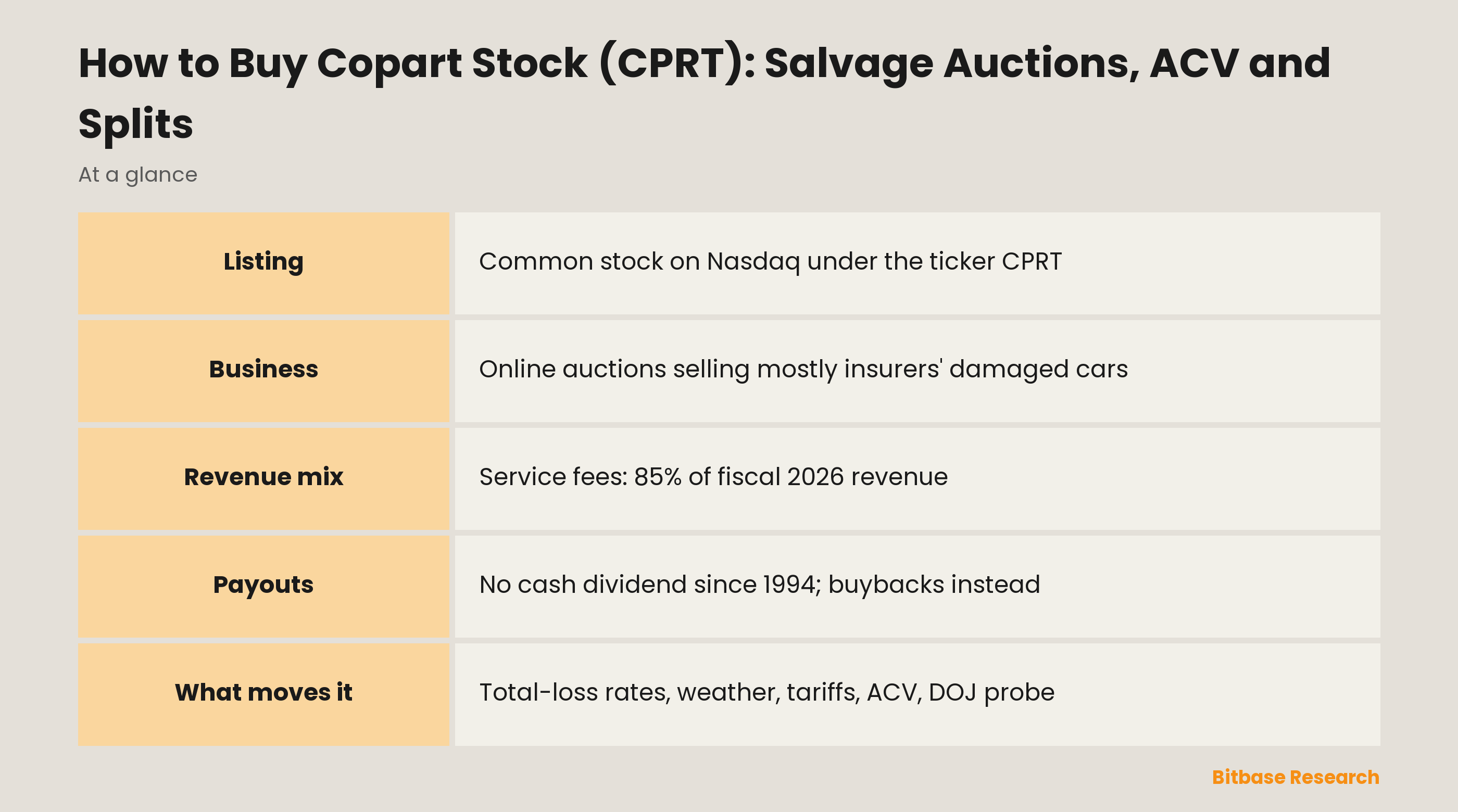
The Copart share that trades on the Nasdaq Global Select Market as CPRT can be bought through any broker with access to US stocks, since common stock is the company's only listed class. What it stands for takes longer to explain: a Dallas company whose online auctions mostly sell damaged cars on behalf of insurers, earning fees rather than owning the vehicles, with service fees making up 85% of fiscal 2026 revenue. Below: the business, the purchase and what its filings say can move the stock, from hurricanes to a federal money-laundering probe and the October 2026 takeover of ACV.
What Does Copart Do?
Copart sells vehicles through online auctions, and most of them are sold on behalf of insurance companies after an accident or a natural disaster. Its annual report calls it "a leading global provider of online auctions and vehicle remarketing services," and it works in 11 countries, from the US, the UK and Germany to Brazil, Spain and three Gulf states. The company was incorporated in California in 1982, became a public company in 1994 and reincorporated in Delaware in January 2012. Its head office is in Dallas, Texas, and the 10-K traces the network back to "a single facility in Vallejo, California."
The chain starts with a crash. An adjuster estimates what the car was worth before the accident and what the repair would cost; if the repair costs more than that value minus the salvage value, the 10-K explains, "the insurance company generally will classify the vehicle as a total loss." The insurer settles with the policyholder, takes the title and assigns the car to a remarketer. Copart tows it to one of its yards and, in the US, waits for the salvage title from the state motor vehicle agency, which "is generally received within 45 to 60 days of vehicle pick-up." Only then is the car sold.
Insurance companies supplied 79% of the vehicles Copart processed in fiscal 2026, against 81% in each of the two years before; dealers, rental car companies, banks, fleet operators, charities and individuals supplied the rest. On the buying side sit about 1 million registered members: dismantlers, which Copart believes are the largest group by volume, then rebuilders, repair licensees, used vehicle dealers, exporters and, where local rules allow, the general public.
The auctions run on VB3, the company's virtual bidding platform, in two steps: open preliminary bids during the preview days, then a live, internet-only auction in which the BID4U feature keeps bidding for the top preliminary bidder up to that member's ceiling. Copart obtained a US patent covering aspects of VB3 in 2008.
Around the insurance core sit other channels: Copart Dealer Services for trade-ins, BluCar for banks, fleets and rental firms, CashForCars sites that buy cars from the public, National Powersport Auctions for motorcycles, boats and RVs, and Purple Wave, an online auction house for construction, farm and fleet equipment in which Copart bought an 80% stake in October 2023. In the UK, it also sells used parts through Green Parts Specialist.
The biggest addition came after the fiscal year ended. On 16 October 2026 Copart completed its all-cash acquisition of ACV Auctions, a digital marketplace through which dealers sell used vehicles to other dealers. ACV's shares stopped trading on the New York Stock Exchange, and ACV now operates as an independent subsidiary under its existing leadership. The 10-K had listed ACV among Copart's largest US rivals, together with RB Global (which owns Insurance Auto Auctions), Openlane, Manheim and Carvana, the last covered in our Carvana stock guide.
How Copart Makes Money
Copart reports two revenue lines. Service revenue is the fees around an auction: purchasing, listing and selling fees, towing to the yard, title processing, storage, bidding and loading, recognized "as net revenue (not gross vehicle selling price)" when the car sells. Vehicle sales is the full price of cars Copart has bought and resold for its own account, mostly under purchase contracts with UK insurers and from individuals selling through CashForCars. In fiscal 2026, the year ended 31 July, service revenue was 85% of the total and vehicle sales 15%.
Sellers choose among three programs: a fixed fee per car (the Consignment Program), a set share of each sale price for all of a seller's vehicles in a market (the Percentage Incentive Program), or an outright purchase at a formula price tied to pre-accident value, offered mainly in the UK. Because many fees are linked to the selling price, auction prices drive revenue even when Copart never owns the car.
The company reports two segments, split by geography:
| Segment | Share of fiscal 2026 revenue | Share of fiscal 2026 operating income | Operating income as share of segment revenue | Service revenue, change on fiscal 2025 |
|---|---|---|---|---|
| United States | 81.6% | 86% | 37% | −1.8% |
| International | 18.4% | 14% | 27% | +12.4% |
The two middle-right columns are calculated from the segment note of the fiscal 2026 10-K.
It was a flat year. Total revenue rose 0.4%, operating income fell 2.6% and net income attributable to Copart fell 4.4%. US service revenue declined because fiscal 2025 had included one-time hurricane revenue and volume fell, partly offset by higher revenue per car; International grew on revenue per car, volume and exchange rates.
Buyers reach Copart from abroad: in fiscal 2026, 38.2% of the US vehicles sold, counted in units, went to international members. No single customer accounted for more than 10% of revenue in any of the last three fiscal years, although the 10-K warns that "a limited number of vehicle sellers historically have collectively accounted for a substantial portion of our revenues." On 31 July 2026 the only use of the company's revolving credit facility was letters of credit, and the 10-K says it expected to fund the ACV price from cash flows from operations.
CPRT Stock at a Glance
| Feature | CPRT |
|---|---|
| Exchange | Nasdaq Global Select Market |
| Ticker | CPRT |
| Security | Common stock, the only class registered under Section 12(b) |
| Listed since | 17 March 1994 |
| Sector | Online vehicle auctions and remarketing services |
| Index membership | S&P 500 and Nasdaq-100 |
| Headquarters | Dallas, Texas |
| Incorporated | California in 1982; Delaware since January 2012 |
| Fiscal year | Ends 31 July |
| Dividend | No cash dividend since the 1994 listing |
| Stock splits | Four two-for-one splits between 2012 and 2023 |
| SEC identifier | CIK 900075 |
Quotes, market value and trading volume change by the second; for live figures, open the Copart stock page on Bitbase.
How to Buy Copart Stock
Copart is a Delaware corporation with a single listed class, so there is no depositary receipt to weigh against a local share and no Class A or Class B to choose between. The purchase runs in six steps:
1. Find a broker that routes orders to Nasdaq. Outside the US, that is usually a local firm with a US equities service or an international broker. Check which legal entity holds your account and which authority supervises it.
2. Pass the account checks. Brokers verify identity, and non-US individuals are normally asked for IRS Form W-8BEN; the IRS tells a foreign beneficial owner to "give Form W-8 BEN to the withholding agent or payer."
3. Fund the account. If your savings are not in US dollars, the conversion rate and any currency fee belong in your cost.
4. Search for CPRT. The result should read Copart, Inc. common stock on Nasdaq; the 10-K cover lists CPRT as the only trading symbol.
5. Choose the order type. A market order fills at the price available when it reaches the market, while the SEC describes a limit order as "an order to buy or sell a stock at a specific price." To invest a fixed sum, ask whether your broker sells fractional shares and on what terms.
6. Keep the confirmation. Trade records establish your cost basis for the day you sell.
For investors outside the US. Copart pays no dividend, so there is currently none for US tax to be withheld from. The general rule, in the IRS's words, is that "most types of U.S. source income received by a foreign person are subject to U.S. tax of 30%," and a lower rate or exemption may apply under a tax treaty. How a gain on sale is taxed depends on where you live.
Through index funds. CPRT is held by funds tracking the S&P 500 or the Nasdaq-100 (see the FAQ), so owning one of them gives a small, indirect stake.
What Moves CPRT Stock
Total loss frequency. The 10-K defines it as "the percentage of cars involved in accidents that insurance companies salvage rather than repair," driven by repair costs, used car values and auction returns, and states: "We believe the long-term trend of increases in total loss frequency will continue." Newer cars, with airbags, cameras and electrified drivetrains, are in its view "more costly to repair and, accordingly, more likely to be deemed a total loss." Against that, sharp rises in used car prices can make repairs worthwhile again, and accident avoidance systems or, if widely adopted, autonomous vehicles could cut accident rates. The company puts the average age of cars on the road at 11.4 years in 2013 and 13.0 years in 2026.
Weather. Winter brings more accidents, and "most of our facilities process 5% to 20% more vehicles than at other times of the year." Mild weather shrinks supply; big storms strain yard capacity and raise costs. After Hurricanes Helene and Milton in the fall of 2024, Copart handled tens of thousands of flood-damaged vehicles in South Florida, and that one-time revenue makes fiscal 2026 look weaker by comparison.
Foreign buyers, tariffs and currencies. Since 2025, the 10-K notes, there has been "a material increase and considerable volatility" in US tariffs, and some governments have answered with tariffs of their own. Import rules abroad decide how many US cars foreign members can take; the filing recalls a 2008 Mexican decree that restricted such imports. Copart does "not engage in foreign currency hedging arrangements," and it believes the dollar's exchange rate affects auction participation by international buyers.
Integrating ACV. When the deal was announced, Copart said it expected the purchase to be neutral to earnings per share in the first full year of ownership and accretive in fiscal 2028 and beyond. Those are expectations; the fiscal 2027 quarterly reports will show whether the combination works.
Leadership and pay. Jeff Liaw, Copart's third chief executive, stepped down on 31 July 2026, and Jay Adair, who had led the company as CEO before, took the role back; Jane Pocock, who had run Copart UK, became President on 1 August. At the annual meeting on 1 December 2026, shareholders vote on an option over 20,000,000 shares granted to Adair, which the board intends as his only substantive cash or equity pay for ten years; if they reject it, the option is forfeited.
Buybacks. Copart repurchased 43,433,164 shares in fiscal 2026 after buying none in the two previous years, and 282 million shares remained available under the program at 31 July 2026. The weighted average diluted share count fell 2.1%, so earnings per share fell less than net income.
Insurer Contracts, a DOJ Probe and Other CPRT Risks
These items from the fiscal 2026 risk factors bear most directly on a CPRT share:
Concentrated sellers. "Certain of our arrangements with vehicle sellers are non-exclusive and may be terminated or modified by the seller on limited notice or without cause," and sellers "have terminated agreements with us in the past in particular markets."
A federal investigation. The Consumer Protection Branch of the US Department of Justice "is conducting an ongoing investigation into potential violations by the Company of certain money laundering laws related to its practices and procedures for preventing and detecting money-laundering activity by its auction platform members." Copart received a DOJ letter in October 2023, is cooperating, and says it is "unable to predict the range of possible loss."
Bypass by competitors. Large dismantlers such as LKQ and dismantler trade groups "may purchase salvage vehicles directly from insurance companies, thereby bypassing vehicle remarketing companies like Copart entirely."
Systems. The auction platforms are built in-house, and an outage would halt sales. In March 2023 "one of our immaterial subsidiaries suffered a ransomware attack."
Insider influence. Executive officers, directors and their affiliates owned "more than 10% of our issued and outstanding common stock" at 31 July 2026, enough for "significant influence" if they act together.
Two risks sit at the level of the share. A single stock ties your money to one company. And there is no dividend to cushion a weak year: "We have not paid a cash dividend since becoming a public company in 1994. We currently intend to retain any earnings for use in our business."
How to Research CPRT Yourself
Copart's SEC filings sit under CIK 900075. Mind the calendar: the fiscal year ends on 31 July, so the first fiscal quarter covers August to October. The fiscal 2026 10-K was filed on 29 September 2026, and quarterly results came by 8-K on 20 November 2025, 19 February 2026, 21 May 2026 and 10 September 2026.
In the 10-K, the segment note sets US and International results side by side, the MD&A explains each revenue change, and the commitments note carries the DOJ matter. For ACV, read the September and October 2026 8-Ks; for the CEO option, the proxy statement for the December meeting.
One check avoids a common mistake: per-share history before August 2023 has been restated for the splits, so compare figures on the same basis. Live quotes are on the stock page linked above, and the full list of US stock pages on Bitbase covers other companies, including car insurers, the group that supplies most of Copart's vehicles, such as the one in our Progressive stock guide.
Copart Stock FAQ
Can I buy Copart stock with crypto?
Not directly. CPRT shares are bought through a brokerage account in US dollars, so you would first sell crypto for cash and move the money to the broker, and that sale may be taxable where you live. A share also carries rights a token does not, as our guide to how a share differs from a crypto asset explains.
Does Copart pay a dividend?
No. Copart has not paid a cash dividend since its 1994 listing and says it intends to keep earnings for the business. It returns cash through share repurchases, which it can stop at any time.
Is CPRT in the S&P 500 and the Nasdaq-100?
Yes, both. On 9 November 2026 Copart appeared in the daily holdings of SPY, the S&P 500 fund, and of Invesco QQQ, which tracks the Nasdaq-100. Index weights change daily.
Has Copart stock ever split?
Yes. Copart's filings record four two-for-one splits, each paid as a stock dividend, dated 28 March 2012, 10 April 2017, 3 November 2022 and 21 August 2023. Together they turned one share held before the 2012 split into 16. The 2022 split first needed shareholders to approve more authorized shares.
What is ACV, and why did Copart buy it?
ACV Auctions runs a digital marketplace where car dealers buy and sell used vehicles from one another. Copart bought it for cash, closing on 16 October 2026, to add dealer wholesale to its insurance salvage business; ACV keeps its own management.
Conclusion
Copart's results rest on how often insurers decide a damaged car is not worth fixing, and on how many buyers worldwide want those cars. Fees, not vehicle ownership, make up most of its revenue, which ties earnings to selling prices, used car values, weather and foreign demand. Fiscal 2027 adds open questions on ACV, the DOJ investigation and the CEO's option. Read the latest 10-K and 10-Q with those in mind, and decide how much of your portfolio one auction company should carry.
Related reading
Other Bitbase articles on this topic:
- How to Buy AutoZone Stock (AZO): Mega Hubs, Buybacks, No Dividend
- How to Buy Carnival Stock (CCL): One Listing, Eight Cruise Lines
- How to Buy Chipotle Stock (CMG): No Dividend, a 50-for-1 Split
- How to Buy Restaurant Brands Stock (QSR): Burger King and QSP
Disclaimer: This article is educational content from Bitbase Academy, provided for information only. It explains what a company or fund does and how the instruments referenced here differ from one another; it does not constitute investment, trading, tax, or financial advice, and it is neither a recommendation nor an endorsement of any security, token, or trading strategy. A tokenized stock is issued by a third party and is designed to give economic exposure to an underlying asset: it is not a share, it carries no shareholder rights, and it depends on the issuer's structure, eligibility rules, and redemption terms, which the issuer can change. Perpetual futures are leveraged derivatives that hold no underlying asset and can be liquidated, and trading hours, product availability, and eligibility differ by instrument and by jurisdiction and can change at any time. Written as of November 2026; verify everything yourself through company filings, the issuer's own documentation, and the product pages of the venue you trade on.
References
[1] Copart Form 10-K for fiscal 2026 (SEC EDGAR) www.sec.gov
[2] Copart fiscal 2026 Form 10-K, XBRL cover page (SEC EDGAR) www.sec.gov
[3] Copart fourth-quarter fiscal 2026 results release, filed with Form 8-K (SEC EDGAR) www.sec.gov
[4] Copart release announcing the ACV agreement, September 2026 (SEC EDGAR) www.sec.gov
[5] Copart release on completing the ACV acquisition, October 2026 (SEC EDGAR) www.sec.gov
[6] Copart release on the CEO transition, June 2026 (SEC EDGAR) www.sec.gov
[7] Copart release on Jane Pocock's promotion to President, July 2026 (SEC EDGAR) www.sec.gov
[8] Copart Form 8-K on the CEO stock option, October 2026 (SEC EDGAR) www.sec.gov
[9] Copart proxy statement for the 2026 annual meeting (SEC EDGAR) www.sec.gov
[10] Copart Form 10-K for fiscal 2023 (SEC EDGAR) www.sec.gov
[11] Copart Form 10-K for fiscal 2017 (SEC EDGAR) www.sec.gov
[12] Copart Form 10-K for fiscal 2012 (SEC EDGAR) www.sec.gov
[13] State Street, SPY daily holdings file www.ssga.com
[14] Invesco, About Invesco QQQ www.invesco.com
[15] SEC, Trade Execution: What Every Investor Should Know www.sec.gov
[16] IRS, NRA Withholding www.irs.gov
[17] IRS, About Form W-8 BEN www.irs.gov





