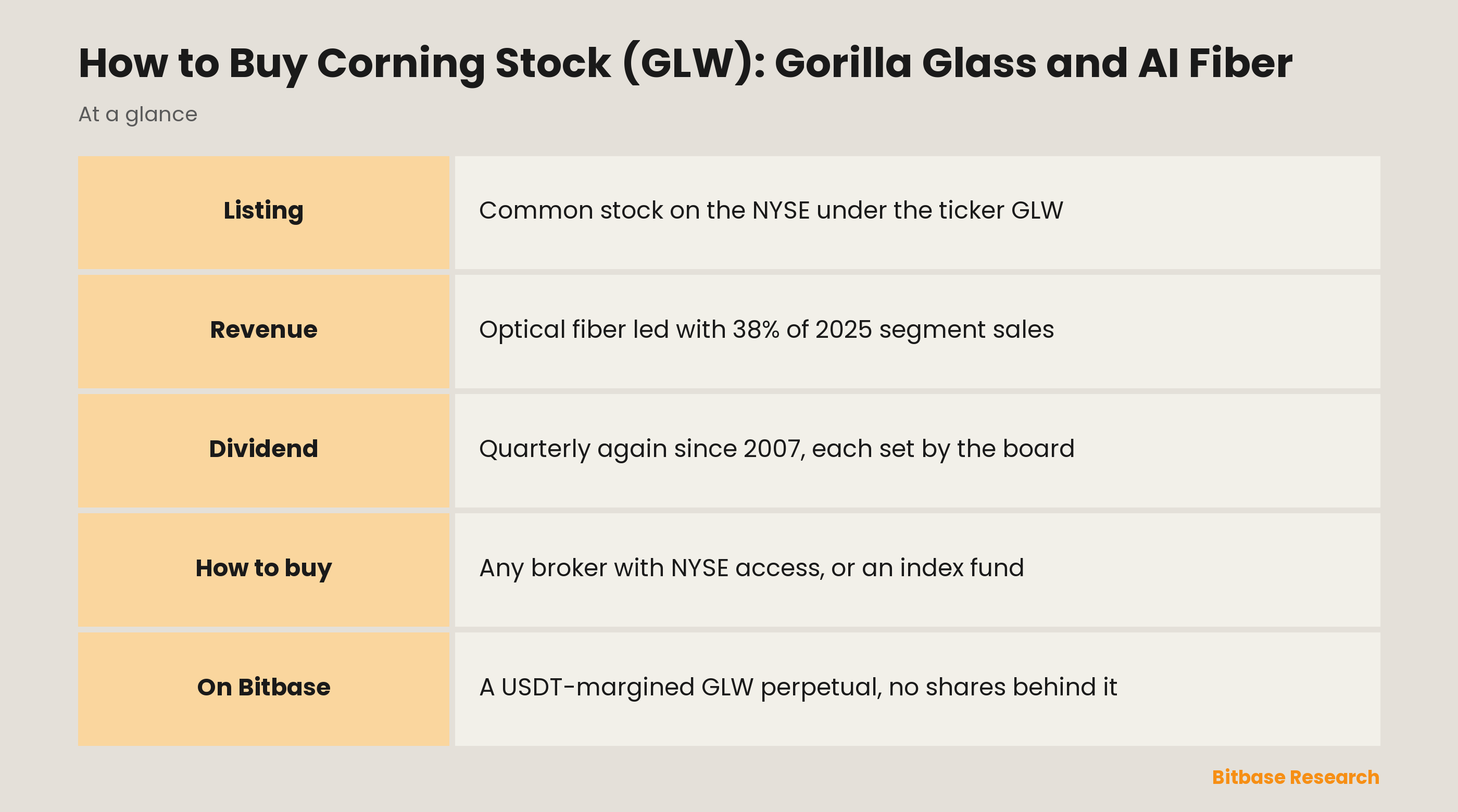
With nothing more than a brokerage account that reaches the New York Stock Exchange, you can buy Corning stock, which trades under the ticker GLW. The company that invented low-loss optical fiber in 1970 now sells more fiber, cable and connectivity than anything else: Optical Communications made up 38% of its segment net sales in 2025, ahead of display glass at 23%. Bitbase does not sell GLW shares; it lists a USDT-margined GLW perpetual contract, which tracks the share price without owning a single share.
What Does Corning Do?
Corning is a materials company whose annual report cites expertise in "glass science, ceramic science and optical physics." Most of what it sells is glass or ceramic built for a demanding job: carrying light through a data center, protecting a phone screen, cleaning a car's exhaust or forming the base of a television panel.
The company "traces its origins to a glass business established in 1851." The present corporation was incorporated in New York in December 1936, took the name Corning Incorporated on 28 April 1989 after decades as Corning Glass Works, and is still based in Corning, New York. Two inventions explain much of today's business: the world's first low-loss optical fiber in 1970, and, in the early 1970s, a cellular ceramic substrate "that is now the standard for catalytic converters in vehicles worldwide."
The 2025 annual report sorts the company into five reportable segments plus one catch-all group.
Optical Communications sells optical fiber, cable and connectivity hardware to telecom carriers and to enterprises, including hyperscale data centers. Some of its newer products are aimed at generative AI networks, such as SMF-28e Contour, "a 40% smaller fiber delivering improved bend resistance in high-density environments."
Display makes glass substrates for LCD and OLED panels used mainly in televisions, notebook computers, monitors, tablets and handheld devices. Its plants in China, South Korea and Taiwan use a fusion process Corning invented, and the filing calls Corning "the largest worldwide producer of glass substrates for flat panel displays."
Specialty Materials is home to Gorilla Glass, the chemically strengthened cover glass used on phones, tablets, laptops and smartwatches, along with optical materials and components for semiconductor equipment. The 10-K notes that Corning "collaborated with Apple" on the color-infused back glass of the iPhone 15 and iPhone 15 Plus.
Automotive combines ceramic substrates and filters for emissions control with technical glass for vehicle interiors and windows.
Life Sciences sells laboratory plastics, cell culture products and labware under the Corning, Falcon, PYREX and Axygen brands, mostly through distributors.
Hemlock and Emerging Growth Businesses collects everything else, chiefly the high-purity polysilicon of Hemlock Semiconductor Group, together with solar wafers and modules and pharmaceutical glass tubing and vials.
That map was redrawn in 2026. From the first quarter, Corning reports four segments: Optical Communications, Glass Innovations (Display and Specialty Materials managed as one), Automotive, and Solar (Hemlock's polysilicon plus the solar wafer and module businesses). Life Sciences fell below the size threshold for separate reporting and now sits with smaller units in "Life Sciences and Emerging Growth Businesses."
Rivals named in the 10-K include Amphenol, Fujikura, Sumitomo and Prysmian in optical communications; AGC and Nippon Electric Glass in display glass; and, among others, Thermo Fisher Scientific and Danaher in life sciences.
How Corning Makes Money
Corning earns its money selling physical goods, booked as revenue when control passes to the customer. Reported net sales rose 19% in 2025, and gross margin reached 36% of net sales, three percentage points higher than in 2024, which the company attributes to higher volume plus price increases, cost cuts and productivity.
Segment figures need one caveat. Management measures each segment at fixed, long-term exchange rates it sets itself, closely aligned with its hedges, so segment results leave out swings in the yen, won, yuan, New Taiwan dollar, peso and euro. In 2025 segment net sales therefore added up to more than reported net sales, and the 10-K identifies the yen inside Display as the largest adjustment.
On that basis, 2025 segment net sales split as follows: Optical Communications 38%, Display 23%, Specialty Materials 13%, Automotive 11%, Life Sciences 6%, and Hemlock and Emerging Growth Businesses 9%.
Optical Communications carried the year. Its segment net sales grew 35%, lifting its share from about 32% in 2024, and segment net income rose 71%. The company credits "strong demand for our Generative AI products" in the enterprise business, and data center interconnect and fiber-to-the-home demand among carriers.
The other lines moved less. Display slipped 5%, mainly because Corning reset the internal yen rate used for segment results from 107 to 120 per dollar. Specialty Materials grew 10% on "continued strong demand for premium glass for mobile devices." Automotive fell 3% on a softer heavy-duty diesel market and currency effects, and Life Sciences was flat. The Hemlock group grew 33% on polysilicon and solar module sales, yet it slipped to a segment loss while new capacity was being ramped up.
Each business depends on a handful of buyers. In 2025, two end customers made up 28% of Optical Communications segment net sales, three made up 59% of Display, two 43% of Specialty Materials, three 61% of Automotive and two 45% of Life Sciences; the 10-K names none of them.
By customer location, the United States was the largest single country, at about 41% of 2025 segment net sales, while Asia Pacific as a whole took about 47%. Some customers also pay ahead: Corning takes deposits that secure its products under long-term supply agreements lasting up to 10 years.
GLW Stock at a Glance
| Item | Detail |
|---|---|
| Exchange | New York Stock Exchange |
| Ticker | GLW |
| Share class | Common stock, the only equity class registered for exchange trading |
| Industry | Specialty glass, ceramics and optical communications products |
| Index membership | S&P 500, held by SPY on 28 October 2026 |
| Headquarters | Corning, New York |
| Incorporated | New York, December 1936 |
| Former name | Corning Glass Works, until April 1989 |
| Fiscal year | Calendar year, ending 31 December |
| Listed options | Chicago Board Options Exchange |
| Dividend | Quarterly, each declared by the board; paid again since 2007 |
| Share buybacks | Board authorization from 2019 with no expiration date |
The live quote and price chart are on Corning's stock page on Bitbase.
How to Buy Corning Stock
An ordinary broker order for GLW comes down to five steps:
1. Choose a broker that offers NYSE-listed shares and takes customers where you live.
2. Complete the account opening and identity verification. Non-US residents normally complete Form W-8BEN at this stage.
3. Deposit funds. If your money is not in US dollars, the currency conversion becomes part of what the shares cost you.
4. Enter GLW and pick an order type. A market order buys at the prevailing price; a limit order names the most you will pay and may stay unfilled.
5. Set the quantity. Whole shares are available everywhere, fractions only where the broker supports them.
From outside the United States, there is no depositary receipt to think about: GLW is Corning's own common stock, the same shares a US investor holds. Residence matters for dividend tax. The IRS states that "Most types of U.S. source income received by a foreign person are subject to U.S. tax of 30%," and a tax treaty may lower that rate; Form W-8BEN is what a foreign individual gives the payer "whether or not you are claiming a reduced rate." Treat this as general information, not tax advice.
Through an index fund, Corning comes as one small holding among hundreds: SPY, which tracks the S&P 500, held it on 28 October 2026.
Trading GLW on Bitbase
Bitbase does not offer Corning shares. What it lists is a GLW perpetual futures contract: margin and settlement are in USDT, the price tracks GLW, and the contract has no expiry date. Because no share stands behind it, a position collects no dividend and carries no vote. Instead it allows a long or a short position with leverage, and the contract keeps trading while the New York Stock Exchange is closed overnight and at weekends.
Every so often, holders on one side pay a funding amount to the other, with the busier side paying, which keeps the contract near its reference price. When a position runs out of margin, liquidation is judged on the mark price rather than the last trade. Because the NYSE is closed far more hours than it is open, the contract can wander from the level at which GLW next opens. The guide to stock perpetual futures walks through both mechanisms.
The GLW contract rules on Bitbase set the funding interval, the margin tiers, the maximum leverage and the pricing used while the NYSE is closed, so read them before opening a position. Other stocks available in contract or token form are listed on Bitbase's TradFi page.
What Moves Corning Shares
Network and data center spending. With Optical Communications at 38% of segment net sales, GLW follows how much carriers and cloud operators spend on networks. The risk factors say this business "faces risks related to fluctuations in telecommunication and hyperscale data center capital spending."
The NVIDIA partnership. On 6 May 2026, Corning and NVIDIA announced a multiyear commercial and technology partnership. Corning said it would raise its US optical connectivity manufacturing capacity 10x and its US fiber production capacity by more than 50%, with three new plants in North Carolina and Texas. Its third-quarter 10-Q pairs a customer deposit under a long-term supply agreement that runs to 31 December 2029 with a warrant issued to that customer. Those were plans when announced, not finished plants.
The yen. Display carries Corning's biggest currency exposure, the Japanese yen. The company hedges it with contracts whose gains and losses run through reported income but are kept out of segment results. Display's 5% decline in 2025 came mainly from the reset of the internal yen rate, while price increases introduced in the second half of 2024 offset much of its effect.
Phone launches. Specialty Materials depends on demand for "premium glass for mobile devices," and two customers made up 43% of its 2025 sales. Phone makers' product cycles therefore matter here, and the 10-K names Apple as a collaborator.
The solar ramp. Corning's newest bet is US solar: Hemlock polysilicon, a solar manufacturing facility in Hemlock, Michigan, and a module plant bought in April 2025. Sales grew 33% in 2025, but the group posted a segment loss on "temporarily higher costs to ramp up capacity," and the risk factors cite "dependence on government manufacturing tax incentives." Since 2026 it has been reported as its own segment, Solar.
Targets and share count. Corning's Springboard growth plan, launched in the third quarter of 2023, met its sales and margin targets a year early, and the third-quarter 10-Q says the sales target set when the plan was updated in May 2026 was beaten one quarter early. An at-the-market program signed in September 2026 lets Corning sell new shares over time, though none had been sold by 30 September, and no shares were bought back in the first nine months of 2026.
GLW Risks in Corning's Own Words
Two segments carry the profits. "Corning's Optical Communications and Display segments generate a significant amount of the Company's profits and cash flow; any significant decrease in pricing, volume or market share could have a material and negative impact on our financial results."
A short customer list. "A relatively small number of end customers account for a high percentage of our net sales in each of our business segments," and losing a key one "could result in a substantial loss of sales and reduction in anticipated cash flows."
Specialized, single-site plants. Corning warns that "due to the specialized nature of our products and single-site manufacturing locations," a disrupted plant, many of them in Asia Pacific, may have no replacement capacity. Some key materials and equipment are "sole-sourced or available only from a limited number of suppliers."
Currency and trade. "A large portion of our sales, costs, profit and cash flows are transacted in non-U.S. dollar currencies," and quotas, tariffs and capital controls "can affect the demand for our products and services."
The stock and the perpetual. "The Board's decision to declare and pay future dividends will depend on our income and liquidity position, among other factors," and any shares sold through the at-the-market program or issued when warrants are exercised would add to the share count. On the perpetual, leverage magnifies losses, funding adds up over a long hold, and if GLW opens well away from the contract's overnight level, a position can be liquidated before you have time to act.
How to Research GLW Yourself
Corning files on SEC EDGAR under CIK 24741. In the 2025 10-K, Item 1 describes the segments, Item 1A holds the risk factors and the customer-concentration table, Item 7 has the segment analysis, and Note 18 has the segment and country tables. From 2026 the 10-Qs use the four-segment structure, and the third-quarter 10-Q states that prior-period amounts were not recast to its new currency method, so compare segment figures across years with care. Quarterly results arrive on Form 8-K, the proxy statement covers the annual meeting, and investor.corning.com keeps the dividend history.
Corning Stock FAQ
Does Corning pay a dividend?
Yes, every quarter. Corning announced on 9 July 2001 that it was discontinuing its common stock dividend, and it resumed in 2007 with a quarterly dividend announced on 18 July and paid on 28 September. In 2026, payments went out on 30 March, 29 June and 29 September, with the next one payable on 11 December. Each one is declared by the board; the per-share amount is on Corning's investor site.
Has Corning stock ever split?
Yes. Corning's 2000 annual report records a three-for-one split, paid as a stock dividend on 3 October 2000 to shareholders of record on 5 September 2000.
Is Corning in the S&P 500?
Yes. SPY, the State Street fund that tracks the S&P 500, held Corning on 28 October 2026. Index lists change, hence the date.
What is the Corning and NVIDIA partnership?
It is a multiyear commercial and technology partnership, announced on 6 May 2026, to expand US manufacturing of optical connectivity for AI data centers. Alongside it, NVIDIA bought a pre-funded warrant over up to 3 million Corning shares and received a traditional warrant over up to 15 million more; each expires no later than three years after issue.
Can I buy Corning stock with crypto?
Not directly. Brokers sell GLW shares for dollars or another fiat currency, so any crypto must first be sold for money. On Bitbase, USDT buys exposure through the GLW perpetual instead, a leveraged derivative that tracks Corning's price without being stock: no dividend, no vote, and a real risk of liquidation. Buying stocks with crypto compares the routes.
When does Corning report earnings?
Four times a year on a calendar fiscal year. Results for 2025 came on Form 8-K on 29 April, 29 July and 28 October 2025 and on 28 January 2026, and the 10-K followed on 12 February 2026. In 2026, quarterly results were filed on 28 April, 28 July and 27 October.
Conclusion
Buying Corning stock is a routine NYSE order; understanding it takes more work, because GLW bundles businesses with different cycles. Fiber for networks and AI data centers now leads, display and phone glass follow and solar is still ramping, with a few large customers in every segment. For price exposure without shares, the GLW perpetual on Bitbase is a separate, leveraged instrument with costs of its own.
Related reading
Other Bitbase articles on this topic:
- How to Buy Fortinet Stock (FTNT): FortiGate, ASICs, No Dividend
- How to Buy Hewlett Packard Enterprise Stock (HPE): After Juniper
- How to Buy Lumentum Stock (LITE): Lasers, NVIDIA Stake and Perps
Disclaimer: This article is educational content from Bitbase Academy, provided for information only. It explains what a company or fund does and how the instruments referenced here differ from one another; it does not constitute investment, trading, tax, or financial advice, and it is neither a recommendation nor an endorsement of any security, token, or trading strategy. A tokenized stock is issued by a third party and is designed to give economic exposure to an underlying asset: it is not a share, it carries no shareholder rights, and it depends on the issuer's structure, eligibility rules, and redemption terms, which the issuer can change. Perpetual futures are leveraged derivatives that hold no underlying asset and can be liquidated, and trading hours, product availability, and eligibility differ by instrument and by jurisdiction and can change at any time. Written as of October 2026; verify everything yourself through company filings, the issuer's own documentation, and the product pages of the venue you trade on.
References
[1] Corning 2025 Form 10-K (SEC EDGAR) www.sec.gov
[2] Corning Form 10-Q for the third quarter of 2026 (SEC EDGAR) www.sec.gov
[3] NVIDIA and Corning joint press release, May 2026: long-term partnership (SEC EDGAR) www.sec.gov
[4] Corning Form 8-K, May 2026: warrants issued to NVIDIA (SEC EDGAR) www.sec.gov
[5] Corning 2001 Form 10-K: dividend discontinued in July 2001 (SEC EDGAR) www.sec.gov
[6] Corning press release, July 2007: quarterly common stock dividend (SEC EDGAR) www.sec.gov
[7] Corning 2000 annual report on Form 10-K405: three-for-one stock split (SEC EDGAR) www.sec.gov
[8] State Street: SPY daily holdings, 28 October 2026 www.ssga.com
[9] IRS: NRA withholding www.irs.gov
[10] IRS: About Form W-8 BEN www.irs.gov





