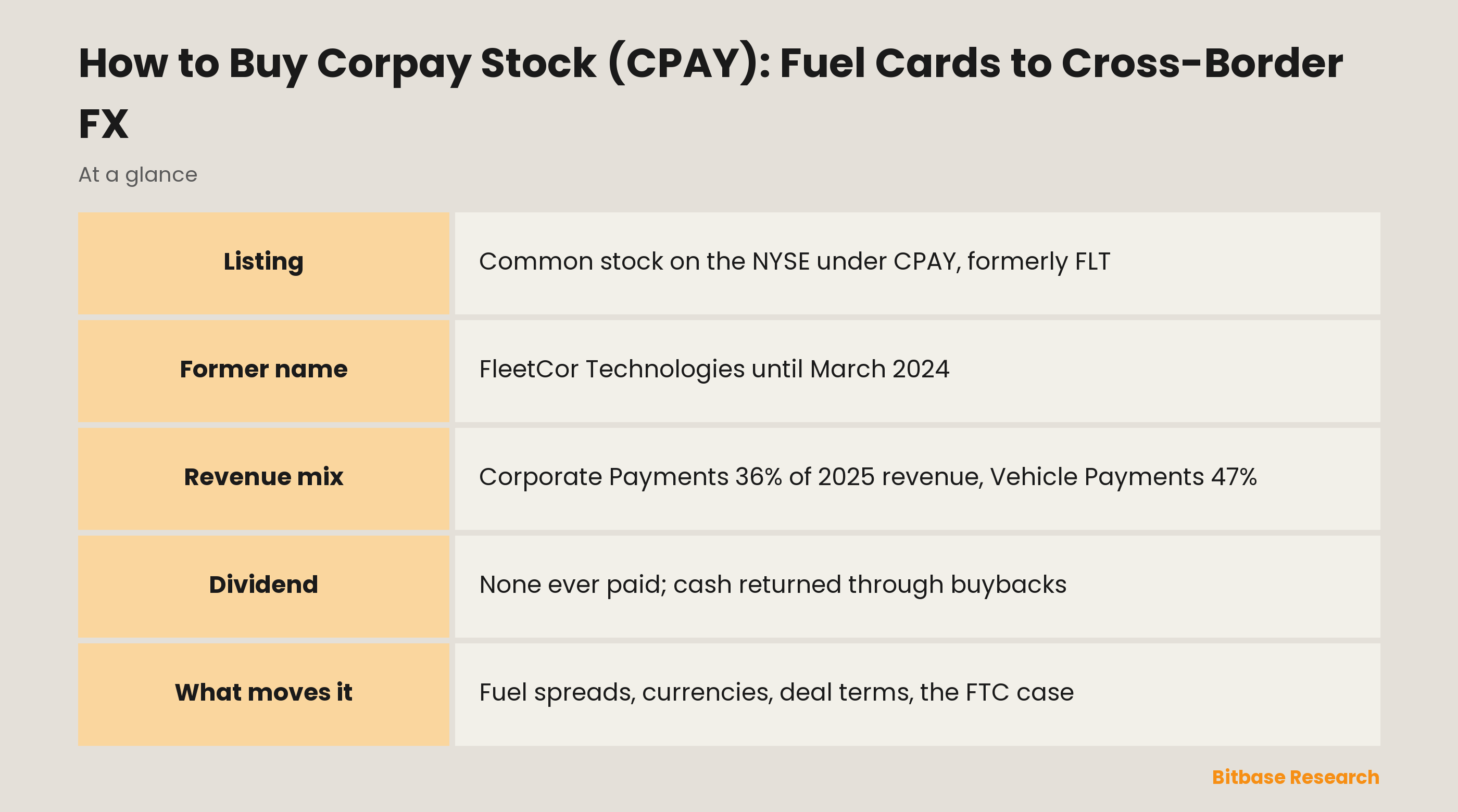
A CPAY order can go through any broker that offers US shares, because Corpay's common stock is listed on the New York Stock Exchange under that ticker. Until March 2024 the company was called FleetCor Technologies, and the new name follows a shift in its revenue: Corporate Payments, the unit that pays suppliers and moves money across borders, rose from 26% of revenue in 2023 to 36% in 2025 and 41% in the first nine months of 2026, while Vehicle Payments, home of the fuel cards it grew up on, slipped below half. Below: the segments, the buying steps and what moves the stock.
What Does Corpay Do?
Corpay describes itself as "a global corporate payments company that helps businesses and consumers better manage and pay their expenses in a simple, controlled manner." It was incorporated in 2000, is registered in Delaware and is based in Atlanta, Georgia. Ron Clarke has been chief executive since August 2000 and chairman since March 2003. At the end of 2025 it employed about 11,800 people in 34 countries.
The business is reported in four parts. Corporate Payments handles a company's outgoing bills. Its accounts payable service pays approved invoices by virtual card, ACH transfer, wire or check. A virtual card is "a single-use card number for a specific amount, usable within a defined timeframe"; Corpay's runs on the Mastercard network, and vendors must join Corpay's own acceptance network to take it. It also issues purchasing and travel cards and converts currencies through spot, forward and option contracts for payments to close to 200 countries. To move that liquidity, the 10-K says, Corpay may use its own network, SWIFT "and even stablecoins."
Much of this unit was bought: Paymerang in July 2024, GPS Capital Markets in December 2024 and Alpha Group International, a London-listed foreign exchange provider to companies and investment funds, on 31 October 2025.
Vehicle Payments is the older half. Fleets use its fuel cards to pay for and control fuel, which the 10-K calls "fuel type agnostic," from diesel to electric charging. In Brazil it operates Sem Parar, a toll network of windshield tags with more than 7.5 million tagholders, plus apps for paying vehicle taxes and fines. The segment is also being pruned: the PayByPhone parking app was sold in March 2026 and the vehicle maintenance business in a sale completed on 2 November 2026.
Lodging Payments books hotel rooms for travelling workforces, airline crews and stranded passengers, and insurers' displaced policyholders. Other holds gift card programmes for retailers in 66 countries and payroll cards in North America.
The 10-K names banks as the main rivals, plus specialists such as American Express and Coupa in corporate payments and WEX and Edenred in fuel cards. Our American Express stock guide covers the first of those.
How Corpay Makes Money
Revenue is booked net of the underlying cost, so a tank of fuel or a hotel night counts only as the fees and margin Corpay keeps.
| Segment | Share of 2025 revenue | Share of 2025 segment operating income | Main sources of revenue |
|---|---|---|---|
| Vehicle Payments | 47% | 54% | Transaction, card and network fees, interchange, late fees and fuel price spreads |
| Corporate Payments | 36% | 32% | Interchange or spread on payables, the gap between customer and wholesale exchange rates, float |
| Lodging Payments | 10% | 10% | The difference between what customers pay and what hotels receive, or hotel commissions |
| Other | 6% | 4% | Processing fees on gift and payroll cards |
Operating income shares are calculated from the 10-K segment table; the Vehicle Payments figure includes gains on businesses sold in 2025.
Revenue rose 14% in 2025, or 10% on the company's organic measure, which strips out deals, fuel prices and currency moves. Corporate Payments grew 34% as reported and 17% organically. Its spend volume rose 50%, but revenue per dollar of spend fell to 0.63% from 0.71%, which the 10-K puts down to "new payables and cross-border enterprise clients." Lodging revenue fell 4% as room nights dropped 6%.
The United States produced 49% of 2025 revenue, Brazil 16%, the United Kingdom 14% and other countries 21%. Fuel matters less than the old name suggests: about 8% of revenue was directly influenced by the price of fuel and about 4% came from fuel price spreads, the gap between what a fleet is charged and what the station is paid.
CPAY Stock at a Glance
| Feature | CPAY |
|---|---|
| Exchange | New York Stock Exchange |
| Ticker | CPAY since 25 March 2024; previously FLT |
| Security | Common stock, the only class registered under Section 12(b) |
| Former name | FleetCor Technologies, Inc. |
| Sector | Business payments: payables, cross-border FX, fuel and toll cards, lodging |
| Index membership | S&P 500, since 2018 |
| Headquarters | Atlanta, Georgia |
| Incorporated | Delaware |
| Fiscal year | Calendar year, ending 31 December |
| Payouts | No dividend ever paid; cash is returned through buybacks |
| SEC identifier | CIK 1175454 |
Prices and market value move all day; the Corpay stock page on Bitbase shows them live.
How to Buy Corpay Stock
Corpay is a US company, so no depositary receipt is involved: the NYSE line is the common stock itself.
1. Find a broker that reaches the NYSE. Abroad, that is a local firm with US market access or an international broker; check which regulated entity holds your account.
2. Open the account. Non-US residents are usually asked for IRS Form W-8BEN, which goes to the broker or withholding agent when it requests one.
3. Fund it. If your money is in pounds, euros or another currency, the exchange rate is part of the cost.
4. Search CPAY. The line should read Corpay, Inc. common stock on the NYSE; older charts and research may still show FLT and the FleetCor name.
5. Choose the order type. FINRA explains that a market order gives the best chance of a fill but no set price, while a limit order sets the worst price you will accept and may not fill.
6. Decide the size. Fractional shares let you invest a fixed amount, but FINRA notes that not every broker offers them for every stock and that fractional holders may lack voting rights.
Tax abroad. The IRS withholds 30% from most US-source income paid to foreign persons unless a treaty lowers the rate. Corpay pays no dividend, so for now that rule has nothing to act on.
Through a fund. As an S&P 500 member, Corpay sits inside index funds that track the benchmark, such as SPY.
What Moves CPAY Stock
Fuel prices and spreads. Higher pump prices lift fees charged as a percentage of each purchase, but spreads tighten when a station's wholesale cost rises faster than the retail price, so a fuel spike does not simply help.
Currencies. About 49% of 2025 revenue was earned in US dollars, down from 52%. The rest moves with the Brazilian real, British pound, euro and five other currencies the 10-K names.
Deal terms with dates. Mastercard bought a 2.3% interest in Corpay's cross-border business, closed on 1 December 2025, and from 1 August 2027 has six months to sell it back; otherwise Corpay can buy it back from 1 May 2028. Corpay also owns about 35% of the TPG partnership that acquired AvidXchange in October 2025 and may buy the rest 33 months after closing.
Pruning and buybacks. Each sale changes the comparison base. Cash has also gone into buybacks: the program begun in 2016 had retired 40.9 million shares by 30 September 2026, and shares outstanding fell about 6% between the February and October 2026 filing covers.
Stablecoins. Corpay may use them in cross-border payments, yet the 10-K also lists their wider adoption as a threat. Our guide to stablecoins explains how they work.
Fuel, Credit and Regulatory Risks at Corpay
From Item 1A of the 10-K, these bear most directly on the stock:
Credit and fraud. Corpay extends credit to many fleet and business customers. "If we fail to adequately assess and monitor credit risks or fraud of or by, our customers or third parties, we could experience an increase in credit loss."
Pricing rules. "Any restrictions on our ability to price our products and services, including caps on late fees and finance charges, network fee changes or requirements to modify billing, disclosure or dispute practices, could materially and adversely affect our revenue."
The FTC case. In 2019 the FTC sued the company, then FleetCor, and Ron Clarke over marketing practices, principally in its US direct fuel card business. A federal court found against them on liability in 2022, and the Eleventh Circuit upheld the judgment against the company in January 2026. On 1 July 2026 Corpay agreed terms of a proposed consent order with FTC staff, which still needs approval from the FTC Commissioners and the court; if it "is not approved or if there are any changes to the terms," the 10-Q says, "the Company could incur additional redress and/or penalties."
Mastercard. "If we do not comply with Mastercard requirements, it could seek to fine us, suspend us or terminate our registration, which allows us to process transactions on its networks."
Acquisitions and debt. "Our expansion through acquisitions may divert our management's attention and result in unexpected operating or integration difficulties or increased costs and dilution to our stockholders, and we may never realize the anticipated benefits." Alpha was paid for with borrowings under the company's credit facility.
New payment rails. "The success of stablecoin and blockchain-based payments could increase price competition and diminish volume on our existing solutions."
Two plain facts sit above these. A single stock concentrates your money in one company, and CPAY pays no dividend, so any return comes from the share price alone.
How to Research CPAY Yourself
Corpay files with the SEC under CIK 1175454. Filings before March 2024 carry the FleetCor name, and many current file names still begin with "flt", so search by CIK. In 2026 quarterly results came with 8-Ks on 4 February, 7 May, 5 August and 4 November, and corpay.com also carries the SEC reports.
In the 10-K, Item 1A holds the risks and the legal proceedings note the FTC case, while an MD&A table sets segment revenue beside spend volume, transactions and room nights.
Read organic growth, a company measure, next to the reported figure, and use recast tables, since 2026 filings moved outsourced card processing into Other. Bitbase's full list of US stock pages covers other companies.
Corpay Stock FAQ
Can I buy Corpay stock with crypto?
Not directly. CPAY shares are bought through a brokerage account in US dollars, so crypto has to be sold for cash and the money sent to the broker first, a sale that may be taxable where you live. A share also carries rights in a registered company that a token does not, as our comparison of crypto and stocks explains.
Does Corpay pay a dividend?
No. The 10-K says the company has "never declared or paid any dividends" on its common stock, does not expect to in the foreseeable future, and is restricted by its credit agreements.
Is Corpay the same company as FleetCor?
Yes. FleetCor Technologies, Inc. became Corpay, Inc. on 24 March 2024, and from 25 March 2024 its stock traded on the NYSE as CPAY instead of FLT. The SEC identifier, CIK 1175454, stayed the same.
Is CPAY in the S&P 500?
Yes. The 10-K says Corpay has been a member since 2018, and State Street's holdings file for SPY, which tracks the index, listed it on 9 November 2026.
Does Corpay use stablecoins?
The 10-K says its cross-border business may use "even stablecoins" to move liquidity, and it lists their broad adoption as a competitive risk.
Conclusion
Corpay is moving from fuel cards toward paying business bills, yet Vehicle Payments still brings in the most revenue and the largest share of segment profit. The figures to follow are the Corporate Payments share of revenue, what it keeps per dollar of spend, the fuel and currency exposure, and the fate of the FTC consent order. Work through the latest 10-K and quarterly release with those in mind, set reported against organic growth, and decide how much a company that returns cash only through buybacks should weigh in your portfolio.
Related reading
Other Bitbase articles on this topic:
- How to Buy Atlassian Stock (TEAM): Jira, Cloud Shift and Perps
- How to Buy Autodesk Stock (ADSK): AutoCAD, Revit and MaintainX
- How to Buy Baidu Stock (BIDU): Search, AI Cloud and Apollo Go
- How to Buy Take-Two Stock (TTWO): GTA VI, Zynga and Perps
Disclaimer: This article is educational content from Bitbase Academy, provided for information only. It explains what a company or fund does and how the instruments referenced here differ from one another; it does not constitute investment, trading, tax, or financial advice, and it is neither a recommendation nor an endorsement of any security, token, or trading strategy. A tokenized stock is issued by a third party and is designed to give economic exposure to an underlying asset: it is not a share, it carries no shareholder rights, and it depends on the issuer's structure, eligibility rules, and redemption terms, which the issuer can change. Perpetual futures are leveraged derivatives that hold no underlying asset and can be liquidated, and trading hours, product availability, and eligibility differ by instrument and by jurisdiction and can change at any time. Written as of November 2026; verify everything yourself through company filings, the issuer's own documentation, and the product pages of the venue you trade on.
References
[1] Corpay Form 10-K for 2025 (SEC EDGAR) www.sec.gov
[2] Corpay 2025 Form 10-K, XBRL cover page (SEC EDGAR) www.sec.gov
[3] Corpay 2025 Form 10-K, XBRL revenue by segment and country (SEC EDGAR) www.sec.gov
[4] Corpay 2025 Form 10-K, XBRL segment results (SEC EDGAR) www.sec.gov
[5] Corpay Form 10-Q for the third quarter of 2026 (SEC EDGAR) www.sec.gov
[6] FleetCor Form 8-K of March 2024: name change to Corpay and new ticker CPAY (SEC EDGAR) www.sec.gov
[7] State Street SPDR S&P 500 ETF Trust (SPY): fund page and daily holdings www.ssga.com
[8] FINRA: Order Types www.finra.org
[9] FINRA: Investing in Fractional Shares www.finra.org
[10] IRS: NRA Withholding www.irs.gov
[11] IRS: About Form W-8 BEN www.irs.gov





