
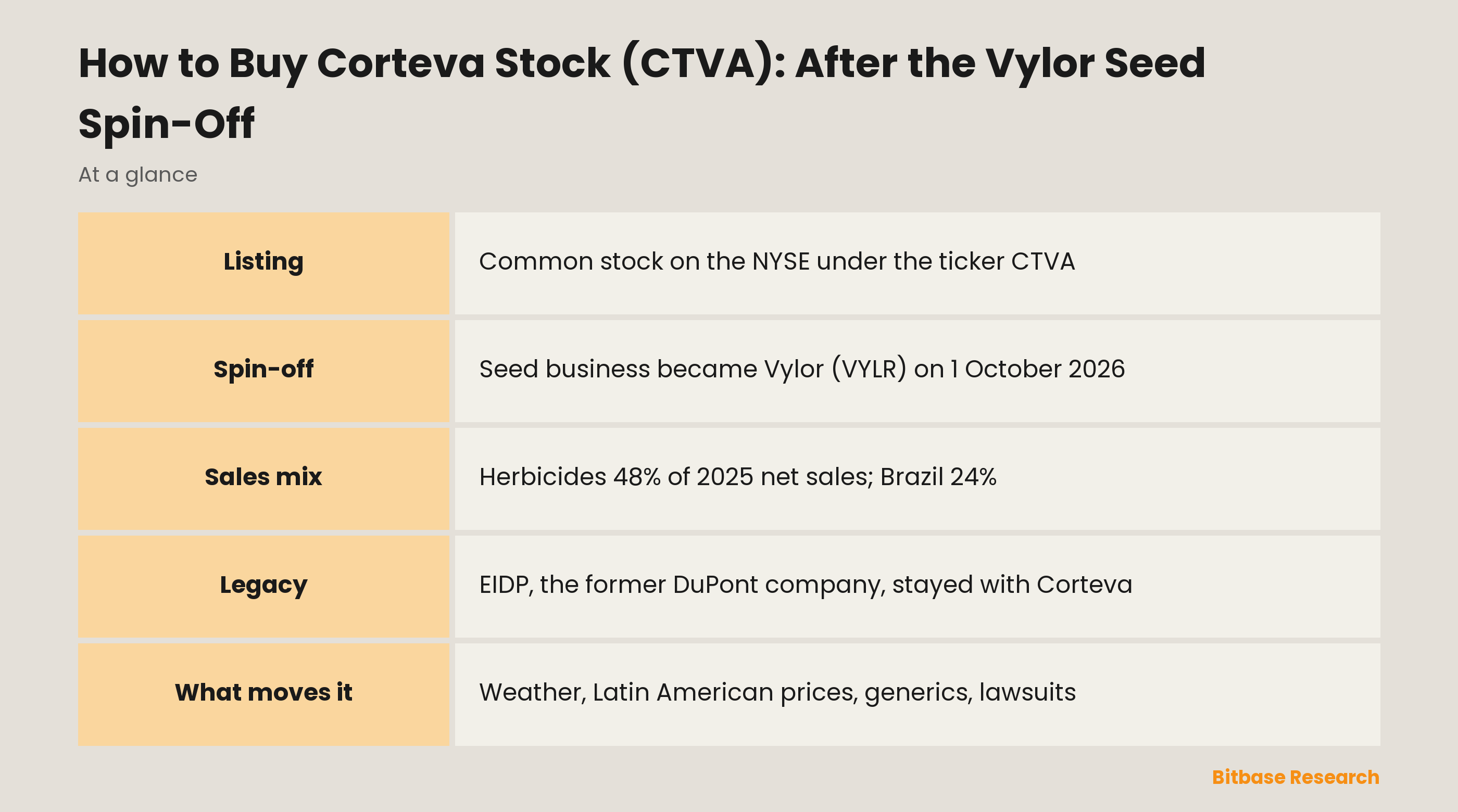
Corteva shares are listed on the New York Stock Exchange as CTVA, so any broker that offers US stocks can take the order. Since 1 October 2026 the share stands for a narrower company: the seed business left as Vylor, and what stayed sells crop protection, with herbicides at 48% of its 2025 net sales. Below: what Corteva sells now, how to buy it, and the lawsuits and legacy liabilities that came with the split.
What Does Corteva Do?
Corteva sells products that farmers apply to protect crops "against weeds, insects and other pests, and disease," along with nitrogen management and seed-applied technologies. It describes itself as "a leader in global herbicides, insecticides, nitrogen stabilizers, pasture and range management herbicides and biologicals and other nature-based products."
That description is recent. Corteva became independent on 1 June 2019, when DowDuPont separated its agriculture business and listed it on the NYSE as CTVA. For seven years it ran two segments, Seed and Crop Protection. On 1 October 2026 the seed segment became Vylor Inc., an "advanced seed and genetics company" listed on the NYSE as VYLR. Holders of record on 24 September 2026 received one Vylor share per Corteva share, with cash for fractions, in a distribution intended to be tax-free for US federal income tax purposes.
The ticker stayed with crop protection, and so did EIDP, Inc., the subsidiary formerly called E. I. du Pont de Nemours and Company, which matters for the liabilities below. The two companies still do business: the separation agreements include a Global Master Seed Treatment Supply Agreement between Corteva Agriscience and Pioneer Hi-Bred International, on the Vylor side.
Its 10-K brand list runs from herbicides such as Arylex and Rinskor to the nitrogen stabilizers Instinct and N-Serve. Biologicals grew partly by acquisition: Stoller and Symborg joined on 1 March 2023, and Biotelliga, a New Zealand biological pest and disease control company, on 1 June 2026.
Some raw materials are "supplied by a few major suppliers." A restructuring program stopped some production in Pittsburg, California, and in June 2026 was extended to an intended halt at Asturias, Spain. The 10-K names BASF, Bayer, FMC, Syngenta and ChemChina among key competitors, alongside "companies trading in generic crop protection chemicals." Luke Kissam, formerly chairman, president and CEO of Albemarle, became chief executive at the separation, and Greg Page chairs the board.
How Corteva Makes Money
Vylor was treated as the accounting successor, so the old Corteva history now belongs to the seed company. Figures for today's Corteva come from combined financial statements filed on 1 October 2026, which carve the crop protection business out of the former group and "may not reflect the financial statements had New Corteva been a stand-alone company."
On that basis, net sales rose 4% in 2025 after falling 6% in 2024:
| Product line | Share of 2025 net sales | Change from 2024 | Brands listed in the 10-K |
|---|---|---|---|
| Herbicides | 48% | up 4% | Arylex, Enlist One, Rinskor |
| Insecticides | 21% | down 3% | Delegate, Intrepid, Transform |
| Fungicides | 15% | up 5% | Zorvec, Inatreq, Vessarya |
| Biologicals | 7% | up 9% | Utrisha N, BlueN |
| Other | 10% | up 15% | Not broken out in the note |
Shares are rounded, so they add to slightly more than 100.
By customer location, North America produced 37% of 2025 net sales and the United States alone 33%. Latin America produced 31%, Brazil by itself 24%, so one country's farm economy, currency and pricing weigh heavily. EMEA produced 21% and Asia Pacific 11%.
Cost of goods sold took about 60% of net sales in 2025, down from 63% in 2024, and research and development about 6%. Corteva also lends to buyers: its trade notes receivable are mainly "deferred payment loan programs for the sale of crop protection products to customers," with terms of a year or less, concentrated in North America.
CTVA Stock at a Glance
| Feature | CTVA |
|---|---|
| Exchange | New York Stock Exchange |
| Ticker | CTVA |
| Security | Corteva, Inc. common stock, its only class registered under Section 12(b) |
| Not the same security | CTAPrA and CTAPrB, preferred shares of the subsidiary EIDP, Inc. |
| Business | Herbicides, insecticides, fungicides, biologicals, nitrogen stabilizers |
| Independent since | 1 June 2019, separated from DowDuPont |
| Seed spin-off | Vylor Inc. (VYLR), one for one on 1 October 2026 |
| Index | Held by State Street's S&P MidCap 400 fund (MDY) on 5 November 2026 |
| Headquarters | Indianapolis, Indiana |
| Incorporated | Delaware |
| Fiscal year | Calendar year, ending 31 December |
| SEC identifier | CIK 1755672 |
Quotes, market value and yield move all session long; live figures are on the Corteva stock page on Bitbase.
How to Buy Corteva Stock
Corteva is a US company, so no depositary receipt is involved:
1. Pick a broker that reaches the NYSE, local or international, and check which legal entity holds your account and who regulates it.
2. Complete the account checks. Investors outside the US are typically asked for IRS Form W-8BEN, which the IRS says to submit "when requested by the withholding agent or payer."
3. Fund it. Converting from another currency costs a spread, so weigh it alongside the commission.
4. Find the right line. Search CTVA and confirm it reads Corteva, Inc. common stock; CTAPrA and CTAPrB are preferred shares of a different issuer.
5. Choose the order type. A market order fills at the going price; a limit order caps what you pay and may not fill.
6. Size the position. Some brokers sell fractional shares; terms, including voting, depend on the broker.
7. Keep the records of your cost basis and dividends.
Tax for investors abroad. The IRS says "most types of U.S. source income received by a foreign person are subject to U.S. tax of 30%," with a lower rate possible under a tax treaty; your home country may tax dividends too.
If you held CTVA on the record date, you also received Vylor, and your original cost is normally divided between the two holdings; check your broker statement or a tax adviser.
Through a fund. An S&P MidCap 400 index fund holds CTVA as one position among hundreds (see the FAQ on index membership).
What Moves CTVA Stock
Weather and pests. The 10-K says weather "can affect the presence of disease and pests on a regional basis and, accordingly, can positively or adversely affect the demand for crop protection products." The 10-Q cites dry weather in EMEA in the second quarter of 2026.
Latin American pricing. In the first half of 2026, the Crop Protection segment's net sales rose 3%: volume added 2% and currency 4%, while price took away 3%, "primarily due to market dynamics in Latin America." The volume gain came from "demand for new products."
Generics and new chemistry. When a patent expires, or a generic launches "at-risk," the 10-K says Corteva "can lose a major portion of revenues for that product." Biologicals, up 9% in 2025, are one line to watch for the shift to newer products.
Regulators. Products need approval and periodic re-registration in each market, and the 10-K warns that federal staff cuts or a shutdown "may significantly impact the timelines for reviewing our regulatory submissions and re-registrations."
The separation lawsuit. On 1 October 2026, "15 states and one sovereign" sued in federal court in Indiana to challenge the split, raising fraudulent conveyance allegations. On 9 October the court issued a temporary restraining order that barred dividends and buybacks; on 10 October it stayed the order pending an emergency motion to the Seventh Circuit, relying on Corteva's statement that it did not intend to declare dividends or repurchase shares meanwhile. The order does not undo the separation, and Corteva says it "strongly contests" the claims.
PFAS and legacy claims. Because EIDP stayed, so did its exposure to PFAS claims from former DuPont operations. A 2021 agreement splits certain PFAS costs with Chemours and DuPont; in September 2026 the companies settled statewide claims with North Carolina; in July 2026 New York's attorney general sued; and the notes list natural resource damage suits by 31 states, the District of Columbia and three US territories.
Approvals, Generics and Legacy Claims at Corteva
These come from the 10-K filed before the split and bear on the company that remains.
Approval. "Corteva may not be able to obtain or maintain the necessary regulatory approvals for some of its products."
Resistance. Weed and insect "resistance may develop faster than Corteva can respond with new technologies."
Competition. The industry "is highly competitive and has undergone consolidation," and generics compete on price once patents lapse.
Product claims. "Claims alleging harm to the public and the environment may be brought against Corteva, notwithstanding years of scientific evidence and regulatory determinations supporting the safety of crop protection products."
Indemnities. Cover from DuPont and Dow "may not be sufficient to protect the company against the full amount of such liabilities."
Scale. Each company after the split would be "smaller, less diversified" and "more exposed to industry-specific risks."
Two more sit above the business. A single holding concentrates your money in one business. And the payout is uncertain: Corteva paid four quarterly dividends in each of 2024 and 2025, but since the split the dividend has been tied to the litigation, so check the latest filings for the new policy.
Reading Corteva's Filings After the Split
Corteva files on SEC EDGAR under CIK 1755672, together with EIDP. The 2025 10-K and the 2026 10-Qs describe the old two-segment company; for crop protection on its own, read the Form 8-K filed on 1 October 2026, which attaches combined statements for 2023 to 2025, interim statements for the first half of 2026 and pro forma figures. Note 4 has the product and regional tables used here, Note 14 the contingent liabilities, including PFAS.
Lawsuit updates come as 8-Ks, such as the one of 13 October 2026. Compare the first post-split quarterly report with the combined statements, not with older annual reports, which now tell Vylor's history.
For the farm cycle from the equipment side, see our Deere stock guide; for another chemicals business, our Linde stock guide. Other companies are on Bitbase's US stock pages.
Corteva Stock FAQ
Can I buy Corteva stock with crypto?
Not directly. A broker sells CTVA for US dollars, so you would first sell the crypto for cash, a sale that can be taxable at home. A share also carries rights in a registered company that a token lacks, a point covered in how a share differs from a crypto asset.
Does Corteva pay a dividend?
It did before the split: four quarterly dividends in each of 2024 and 2025 and payments in the first two quarters of 2026. Since October 2026 the question is tied to the states' lawsuit, in which Corteva told the court it did not intend to declare dividends while its appeal motion is pending. Check the latest 8-K.
What is Vylor, and do I get it if I buy CTVA now?
Vylor is the former Corteva seed business, trading on the NYSE as VYLR since 1 October 2026. Only holders of record on 24 September 2026 received it; buying CTVA now gets you the crop protection company alone.
Is CTVA in the S&P 500?
On 5 November 2026, State Street's SPY holdings file did not list Corteva, while its S&P MidCap 400 fund, MDY, did, and Vylor appeared in SPY. Membership can change, so check a fund's current holdings.
Is Corteva still part of DuPont?
No. Corteva has been independent since 1 June 2019. Its subsidiary EIDP, Inc. is the former E. I. du Pont de Nemours and Company, which is why DuPont-era liabilities and two EIDP preferred shares still appear in its filings.
Conclusion
Buying CTVA takes a broker with NYSE access, the Corteva, Inc. common stock line and either a market or a limit order. Knowing what you own takes longer, because the share changed in October 2026: it is now a herbicide-led crop protection company, exposed to Brazil and to generics, and holding EIDP's legacy claims. Read the combined statements filed with the October 2026 8-K, follow the lawsuit in new filings, and decide what share of your portfolio one agricultural chemicals company deserves.
Related reading
Other Bitbase articles on this topic:
- How to Buy AngloGold Ashanti Stock (AU): A UK Gold Miner on NYSE
- How to Buy ArcelorMittal Stock (MT): Real Shares, Not an ADR
- How to Buy Cameco Stock (CCJ): Uranium, Westinghouse, Vote Caps
- How to Buy PPG Stock (PPG): Coatings and Dividends Since 1899
Disclaimer: This article is educational content from Bitbase Academy, provided for information only. It explains what a company or fund does and how the instruments referenced here differ from one another; it does not constitute investment, trading, tax, or financial advice, and it is neither a recommendation nor an endorsement of any security, token, or trading strategy. A tokenized stock is issued by a third party and is designed to give economic exposure to an underlying asset: it is not a share, it carries no shareholder rights, and it depends on the issuer's structure, eligibility rules, and redemption terms, which the issuer can change. Perpetual futures are leveraged derivatives that hold no underlying asset and can be liquidated, and trading hours, product availability, and eligibility differ by instrument and by jurisdiction and can change at any time. Written as of November 2026; verify everything yourself through company filings, the issuer's own documentation, and the product pages of the venue you trade on.
References
[1] Corteva Form 10-K for 2025 (SEC EDGAR) www.sec.gov
[2] Corteva 2025 Form 10-K, XBRL cover page (SEC EDGAR) www.sec.gov
[3] New Corteva combined financial statements 2023–2025, filed with Form 8-K on 1 October 2026 (SEC EDGAR) www.sec.gov
[4] Corteva Form 8-K, 1 October 2026: Vylor as accounting successor (SEC EDGAR) www.sec.gov
[5] Corteva Form 8-K: separation of Vylor completed (SEC EDGAR) www.sec.gov
[6] Corteva press release: board approves Vylor distribution (SEC EDGAR) www.sec.gov
[7] Corteva Form 10-Q for the second quarter of 2026 (SEC EDGAR) www.sec.gov
[8] Corteva Form 8-K, 13 October 2026: litigation over the separation (SEC EDGAR) www.sec.gov
[9] Corteva press release: Luke Kissam named CEO of the crop protection company (SEC EDGAR) www.sec.gov
[10] Corteva press release: board of the crop protection company, Greg Page as chair (SEC EDGAR) www.sec.gov
[11] Corteva Form 8-K, 24 September 2026: EIDP stays with the crop protection business (SEC EDGAR) www.sec.gov
[12] Corteva press release on Vylor's Form 10, 24 September 2026 (SEC EDGAR) www.sec.gov
[13] State Street SPDR S&P MidCap 400 ETF Trust (MDY): daily holdings www.ssga.com
[14] State Street SPDR S&P 500 ETF Trust (SPY): daily holdings www.ssga.com
[15] IRS: NRA Withholding www.irs.gov
[16] IRS: About Form W-8 BEN www.irs.gov





