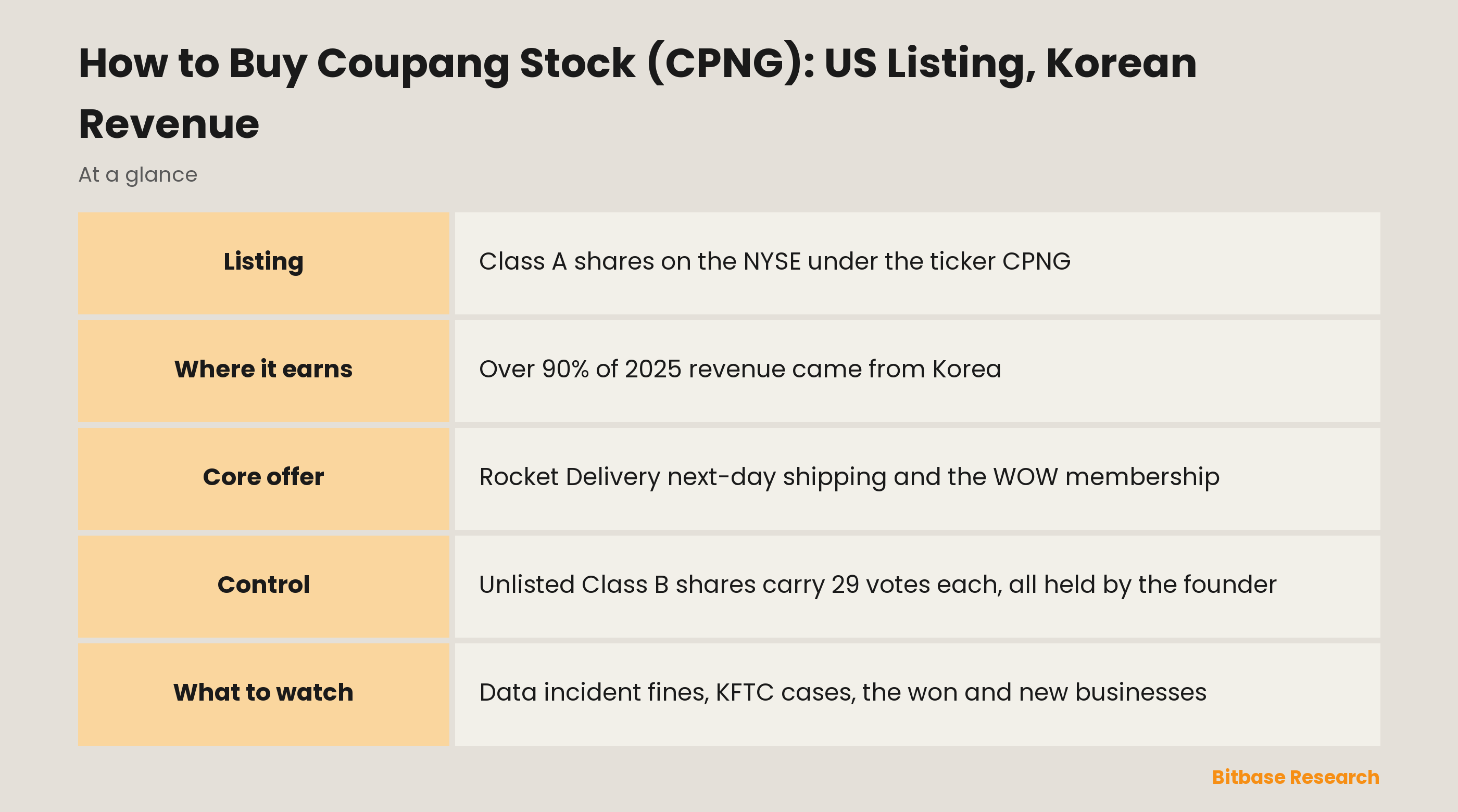
The NYSE ticker CPNG belongs to Coupang's Class A common stock, so a broker that offers US shares can fill the order directly, with no depositary receipt in between, even though most of the business happens in South Korea. Coupang is a Delaware corporation with a Seattle address that files 10-Ks with the SEC, yet over 90% of its 2025 revenue was earned in Korea, and the listed stock carries one vote per share against 29 for the unlisted Class B held by its founder. Below: how Rocket Delivery and WOW earn money, how an order works, and what the filings have said since the November 2025 data incident.
What Does Coupang Do?
Coupang is built around an online store in Korea that it controls from warehouse to doorstep. The 10-K describes a company that "provides retail, restaurant delivery, video streaming, and fintech services" under brands that include Coupang, Eats, Play, Rocket Now and Farfetch, with customers in over 190 countries and territories. Bom Kim founded it and has been chief executive since May 2010, according to the 2021 IPO prospectus; the first website went live in 2010 and the first app in 2011.
The core offer is Rocket Delivery: free next-day delivery "for orders placed anytime of the day, even seconds before midnight," across millions of products. Coupang can promise that because it holds much of the stock itself and runs its own fulfillment and logistics network. Alongside its own inventory sits a marketplace for third-party merchants, many of them small and medium-sized businesses; more than 75% of its SME sellers in Korea are based outside Seoul. Merchants can hand storage and shipping to Coupang through a service called FLC. Rocket Fresh delivers groceries, and a private label arm sells products under Coupang's own brands.
Tying it together is the WOW membership, a paid subscription whose benefits include Rocket Fresh, no minimum spend for Rocket Delivery, free return shipping, free delivery and discounts on Eats orders, and streaming.
Around that core sit newer businesses. Eats is a restaurant ordering and delivery app in Korea, and Rocket Now a merchant order and on-demand delivery service in Japan. Play streams video. Pay is its digital payments service in Korea. In Taiwan Coupang runs retail operations and has launched Rocket Overseas, which connects its small sellers with customers there. Farfetch is a global marketplace for luxury fashion whose business and assets Coupang acquired in January 2024.
At the end of 2025 Coupang directly employed about 108,000 people, most of them frontline fulfillment and logistics staff in Korea, which the 10-K says makes it "one of the largest private sector employers in the country."
How Coupang Makes Money
Coupang reports two segments. Product Commerce is the Korean retail business, owned inventory and marketplace together, plus Rocket Fresh, WOW in Korea and the advertising sold on those pages. Developing Offerings collects everything else: Eats, Rocket Now, Play, fintech, Taiwan and Farfetch.
| Segment | Share of 2025 revenue | Revenue growth in 2025 | Growth at constant currency | What it covers |
|---|---|---|---|---|
| Product Commerce | 86% | 11% | 16% | Korean retail, marketplace, Rocket Fresh, WOW and related ads |
| Developing Offerings | 14% | 38% | 40% | Eats, Rocket Now, Play, fintech, Taiwan and Farfetch |
Percentages are worked out from the 10-K's revenue-by-segment table. Total revenue rose 14% in 2025, or 18% at constant currency.
The two segments sit on opposite sides of break-even. Product Commerce earned a positive segment adjusted EBITDA in 2025, while Developing Offerings posted a loss on the same measure that was 58% larger than in 2024. In effect, the Korean store's earnings cover the newer businesses' losses.
A second split runs by type of revenue. Net retail sales, goods Coupang owns and sells itself, made up about 76% of 2025 revenue. Net other revenue, about 24%, covers commissions from marketplace merchants, Eats orders, advertising and WOW subscription fees; it grew 28% in 2025, faster than retail. On marketplace orders Coupang is "not the merchant of record" and books only its fee.
Two quarterly metrics explain Product Commerce growth: active customers, anyone who ordered at least once in the quarter, who numbered 24.6 million in the fourth quarter of 2025, up 8%; and net revenues per active customer, how much each of them spent.
Measured by the legal entity that earned it, "over 90% of our total net revenues are from Korea," the 10-K says. Results are reported in dollars but earned mostly in Korean won, and in 2025 exchange rates took 5 percentage points off Product Commerce revenue growth.
Profit has been thin and recent: Coupang earned a net profit in 2025, at a net income margin of 0.6%, then reported a net loss for the third quarter of 2026, a quarter that included costs from a warehouse fire.
CPNG Stock at a Glance
| Feature | CPNG |
|---|---|
| Exchange | New York Stock Exchange |
| Ticker | CPNG |
| Listed security | Class A common stock, one vote per share; the only class registered under Section 12(b) |
| Other class | Class B common stock, 29 votes per share, not listed, all beneficially owned by founder Bom Kim |
| Sector | Online retail and marketplace, with food delivery, streaming, payments and luxury fashion |
| Index membership | Not in the S&P 500, based on State Street's SPY holdings file dated 9 November 2026 |
| Registered address | Seattle, Washington |
| Incorporated | Delaware; converted from a limited liability company just before the March 2021 IPO |
| Fiscal year | Calendar year, ending 31 December |
| Dividends | None paid; none expected "in the foreseeable future" |
| SEC identifier | CIK 1834584 |
Prices, market value and trading volume change constantly; the Coupang stock page on Bitbase shows live figures.
How to Buy Coupang Stock
What you buy is the Class A common stock of Coupang, Inc., a US company. There is no ADR and, on the 10-K cover, no second trading line, so investors in Korea and elsewhere all go through a broker that offers US shares.
1. Find a broker with NYSE access. Abroad that may be a local broker with a US-stock service or an international firm; check which entity holds your account and who regulates it.
2. Pass the account checks. Non-US individuals usually fill in IRS Form W-8BEN here to document their foreign status for US tax purposes.
3. Fund it in dollars. Converting from won, euros or another currency costs money, so compare exchange rates as well as commissions.
4. Search the ticker. Enter CPNG and confirm the line reads Coupang, Inc. Class A common stock on the NYSE.
5. Choose the order type. A market order fills at the best available price; a limit order fills only at your chosen price or better. FINRA gives regular US market hours as 9:30 a.m. to 4 p.m. Eastern time.
6. Decide the size. Fractional shares let you invest a fixed amount, but FINRA warns that "you often can't trade fractional shares outside of regular market hours" and that, "as a fractional share owner, you might not have shareholder voting rights." Keep confirmations and statements as proof of cost.
Withholding for non-US holders. The IRS says that "most types of U.S. source income received by a foreign person are subject to U.S. tax of 30%," with a lower rate or exemption possible under a tax treaty. Coupang pays no dividend, so for now there is no dividend for that withholding to reach; gains on a sale can still be taxable where you live.
Through funds. Coupang is not in the S&P 500, so an S&P 500 index fund will not give you exposure. Broader funds may hold it; check the fund's published holdings list.
What Moves CPNG Stock
Active customers and spend. In the third quarter of 2026 active customers grew 2% to 25.2 million, after 10% a year earlier, while revenue per active customer rose 6% at constant currency. The 10-Q says growth rates for the first nine months of 2026 "were negatively affected by the Incident's impact on the growth rate in Product Commerce Active Customers."
The data incident and its bill. The investigation into the November 2025 incident at Coupang Corp., the Korean subsidiary, found that a former employee had obtained contact and delivery details tied to about 33 million accounts but "only saved limited data from approximately 3,000 customer accounts." Vouchers issued to notified customers were booked as reductions of revenue as they were used; redemption ended in mid-April 2026. On 10 June 2026 Korea's Personal Information Protection Commission announced two administrative fines, one for the incident and one for an unrelated advertising-data matter. Coupang Corp. appealed to the Seoul Administrative Court on 7 October 2026, and on 8 October received approval to pay the fines in six installments over two years.
Korean competition cases. The Korea Fair Trade Commission fined Coupang Corp. in 2024 over product ranking disclosure, a finding still under appeal, and prosecutors indicted Coupang Corp. and its private label subsidiary on the same facts in May 2025. Two more KFTC cases concern Eats. In one, an examiner argued that bundling Eats benefits with WOW is impermissible; a ruling against Coupang could mean customers "would need to purchase this benefit separately." Hearings in both took place in October 2026.
The cost of new businesses. Developing Offerings revenue grew 23% in the third quarter of 2026 and its segment adjusted EBITDA loss narrowed, but the segment still loses money.
The won. A weaker won lowers reported growth even when Korean sales hold up; exchange rates took 3 percentage points off Product Commerce growth in the third quarter of 2026.
Warehouse fires. A fire extensively damaged the Deokpyeong fulfillment center in June 2021, and in July 2026 another "significantly damaged" a leased center in Incheon; its costs deepened the operating loss Coupang reported for the third quarter of 2026. Insurance claims are being pursued with uncertain recovery.
Buybacks. Coupang bought back 56.4 million Class A shares in the first nine months of 2026 under a program with no expiration date, though it is "not obligated to repurchase any portion" of it.
Data, Regulators and Founder Control at Coupang
The 10-K warns that "investing in our Class A common stock involves a high degree of risk." These items are the most specific to Coupang.
The data incident. Coupang has "experienced, and may again experience, a data incident" that could "subject us to investigation, possible sanctions, and other actions and penalties." The 10-Q adds that Korean authorities "may potentially impose additional financial penalties," and that their investigations "have resulted in criminal complaints against certain of our current and former executives and employees." In the United States, a securities class action filed on 6 January 2026 covers buyers of Class A stock between 7 May and 16 December 2025.
Korean law. Because most operations are in Korea, "certain of our Korean affiliates' executives may be held either directly or vicariously criminally liable" for the actions of Korean affiliates and their staff. Fair trade, labor and workplace safety rules are described as "detailed and complex" and still evolving.
Competition and losses. Coupang "could lose market share" to rivals that run from offline and online retailers to food delivery apps and AI shopping tools. It has "had a history of net losses," "may not maintain profitability," and plans "to continue to forgo short-term financial performance for long-term growth."
Payments, acquisitions and geography. Coupang relies on Pay for much of its payment processing; the Farfetch purchase "creates incremental risk," including in regions where it had no operations; and "escalations in tensions between North Korea and Korea" could hurt the economy most of its customers live in.
Founder control. Bom Kim beneficially owns all of the Class B stock, which carried 74.1% of the voting power at the end of 2025 although it made up about 9% of the shares outstanding. The 10-K says this "may limit your ability to influence the outcome of important transactions." Class B shares convert to Class A on most transfers.
Two risks come with the share itself. A single company concentrates your money in one business and, here, mostly one country. And there is no dividend income: Coupang has never paid a cash dividend and does not expect to, and some Korean subsidiaries face legal limits on paying dividends to the parent.
How to Research CPNG Yourself
Coupang files under CIK 1834584 on SEC EDGAR: an annual 10-K, 10-Qs for the first three quarters, and 8-Ks that carry each earnings release, which in 2026 came on 26 February, 5 May, 4 August and 3 November. The company says it may also announce material information on ir.aboutcoupang.com and news.coupang.com.
In the 10-K, the risk factors and the cybersecurity section cover the data incident, and the MD&A holds the segment table, the two customer metrics and the constant currency figures. The note called Commitments and Contingencies tracks the incident, the KFTC cases and the lawsuits, and each 10-Q updates it.
Compare reported and constant currency growth side by side, and when a quarter includes fire losses or fines, read both the reported line and the one that excludes them. For comparison, the MercadoLibre stock guide covers another regional marketplace with a payments arm, and the DoorDash stock guide a delivery business similar to Eats. Real-time prices sit on the Coupang page linked under the summary table, and Bitbase's index of US stock pages lists other companies.
Coupang Stock FAQ
Can I buy Coupang stock with crypto?
Not directly. CPNG shares are bought with US dollars through a brokerage account, so crypto has to be converted to cash and wired to the broker first, a sale that can trigger tax depending on your country. The share you end up with is a registered stake in Coupang, Inc., which is how a stock differs from a crypto asset.
Does Coupang pay a dividend?
No. The 10-K says Coupang has never declared or paid cash dividends and does not expect to "in the foreseeable future," and that any future dividend is up to the board. Returns to shareholders have come through buybacks instead.
Is CPNG in the S&P 500?
No. Coupang did not appear in State Street's daily holdings file for SPY dated 9 November 2026. The 10-K notes that S&P Dow Jones Indices, after once excluding companies with multiple share classes, now admits them again.
Is Coupang a Korean or an American company?
Legally American, commercially Korean. Coupang, Inc. is a Delaware corporation with a Seattle address, listed only on the NYSE and filing 10-Ks with the SEC. Most of its roughly 108,000 employees work in Korea, and over 90% of 2025 revenue came from there.
What happened in the Coupang data incident?
In November 2025 Coupang found that a former employee had accessed customer accounts and obtained names, phone numbers, delivery addresses and email addresses linked to about 33 million accounts; no payment or login data was taken. Vouchers went to notified customers in 2026, and Coupang is appealing two fines Korea's privacy regulator announced in June 2026.
Conclusion
Coupang is a Korean retailer in an American legal shell: its corporate law, filings and listing are American, while its customers, regulators and currency are mostly Korean. That combination puts three questions in front of any buyer: whether Korean shoppers keep returning after the data incident, whether Eats, Taiwan and Farfetch can stop absorbing what the Korean store earns, and how comfortable you are owning a vote that counts for one twenty-ninth of the founder's. The latest 10-Q answers the first two better than any headline; the third is set out in the company's certificate of incorporation.
Related reading
Other Bitbase articles on this topic:
- How to Buy AutoZone Stock (AZO): Mega Hubs, Buybacks, No Dividend
- How to Buy Carnival Stock (CCL): One Listing, Eight Cruise Lines
- How to Buy Chipotle Stock (CMG): No Dividend, a 50-for-1 Split
- How to Buy Ross Stores Stock (ROST): Off-Price, No Online Store
Disclaimer: This article is educational content from Bitbase Academy, provided for information only. It explains what a company or fund does and how the instruments referenced here differ from one another; it does not constitute investment, trading, tax, or financial advice, and it is neither a recommendation nor an endorsement of any security, token, or trading strategy. A tokenized stock is issued by a third party and is designed to give economic exposure to an underlying asset: it is not a share, it carries no shareholder rights, and it depends on the issuer's structure, eligibility rules, and redemption terms, which the issuer can change. Perpetual futures are leveraged derivatives that hold no underlying asset and can be liquidated, and trading hours, product availability, and eligibility differ by instrument and by jurisdiction and can change at any time. Written as of November 2026; verify everything yourself through company filings, the issuer's own documentation, and the product pages of the venue you trade on.
References
[1] Coupang Form 10-K for 2025 (SEC EDGAR) www.sec.gov
[2] Coupang 2025 Form 10-K, XBRL cover page (SEC EDGAR) www.sec.gov
[3] Coupang Form 10-Q for the third quarter of 2026 (SEC EDGAR) www.sec.gov
[4] Coupang third-quarter 2026 results release, filed with Form 8-K (SEC EDGAR) www.sec.gov
[5] Coupang Form 8-K of 16 December 2025, Item 1.05: cybersecurity incident (SEC EDGAR) www.sec.gov
[6] Coupang IPO prospectus (Form 424B4), 10 March 2021 (SEC EDGAR) www.sec.gov
[7] State Street SPDR S&P 500 ETF Trust (SPY): fund page and daily holdings www.ssga.com
[8] FINRA: Investing in Fractional Shares www.finra.org
[9] IRS: NRA Withholding www.irs.gov





