
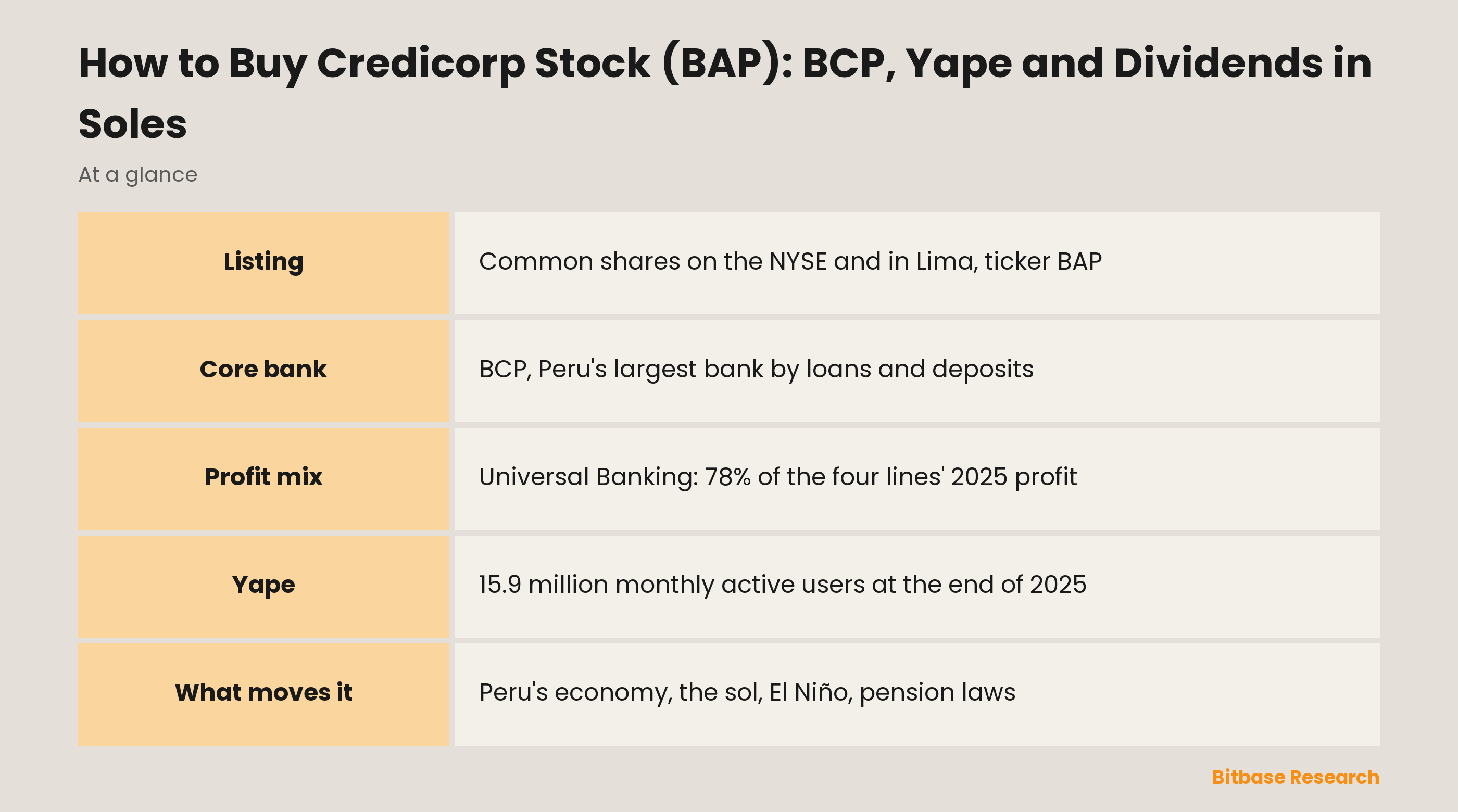
Because Credicorp's own common shares trade on the New York Stock Exchange under BAP, any broker with NYSE access can fill the order, and no depositary receipt sits in between. The company is a Bermuda holding company, yet almost everything it owns works in Peru: Banco de Crédito del Perú (BCP), the country's largest bank by loans and deposits, and Yape, a payments app with 15.9 million monthly active users at the end of 2025. Below: the business, the order and the risks, El Niño included.
What Does Credicorp Do?
Credicorp Ltd. was formed in Bermuda on 17 August 1995 "in order to act as a holding company for, and to coordinate the policy and administration of our subsidiaries." It owns 97.74% of BCP, a bank with more than 135 years in Peru, and all or nearly all of its other subsidiaries, grouped in four lines of business.
Universal Banking is BCP, first among Peruvian banks by assets, deposits and loans with close to 29% of loans and 33% of deposits according to the regulator SBS, plus BCP Bolivia. Microfinance is Mibanco in Peru and Mibanco Colombia, which lend to small and micro businesses. Insurance and Pensions combines Grupo Pacífico, an insurer, with Prima AFP, a private pension fund manager. Investment Management and Advisory covers Credicorp Capital in Peru, Colombia and Chile, and ASB Bank Corp. in Panama.
Yape, which grew up inside BCP, had 15.9 million monthly active users and 19.1 million registered users at the end of 2025, organised in three lines: payments, financial services such as small loans, and e-commerce. In Chile, Tenpo Bank Chile, part of a digital wallet controlled by Credicorp's venture arm Krealo, received a banking licence on 19 January 2026.
BCP's main rivals, per the 20-F, are BBVA's Peruvian bank, Interbank and Scotiabank Peru. Our BBVA stock guide covers the parent of the number-two lender.
How Credicorp Makes Money
The segment note in the 2025 20-F reports each line's income from outside customers and its net profit; Universal Banking dominates both:
| Line of business | Share of 2025 external income | Share of 2025 net profit of the four lines |
|---|---|---|
| Universal Banking | 71% | 78% |
| Microfinance | 14% | 6% |
| Insurance and Pensions | 10% | 13% |
| Investment Management and Advisory | 5% | 3% |
Shares are calculated from the XBRL segment table, leaving out holding-company costs and eliminations.
Profit moved more than revenue. Net profit attributable to Credicorp's shareholders rose about 26% in 2025, while provisions for credit losses in Universal Banking fell by roughly a third. Microfinance earned 68% more than in 2024 as its provisions came down. Insurance and Pensions grew after Credicorp bought out its health-insurance partner Banmédica in 2025.
Yape is starting to pay its way. In the third quarter of 2026 it contributed 9.8% of Credicorp's risk-adjusted revenues, up from 6.4% a year earlier, and lending made up 31% of Yape's own risk-adjusted revenues.
BAP Stock at a Glance
| Feature | BAP |
|---|---|
| Exchange | New York Stock Exchange; also the Bolsa de Valores de Lima (BVL) |
| Ticker | BAP on both exchanges, quoted in US dollars |
| Security | Common shares, the only class registered under Section 12(b) |
| On the NYSE since | 25 October 1995 |
| Sector | Banking, microfinance, insurance, pensions and investment management |
| Incorporated | Bermuda, 1995 |
| Offices | Registered in Hamilton, Bermuda; run from BCP's offices in Lima |
| Annual report | Form 20-F, IFRS, figures in Peruvian soles |
| Fiscal year | Calendar year, ending 31 December |
| Dividend | Policy of at least 25% of consolidated net profit, normally once a year |
| Fund holdings | iShares MSCI Emerging Markets ETF (holdings report for 31 August 2026) |
| SEC identifier | CIK 1001290 |
Price, market value and dividend yield change with every trade; for live figures, see the Credicorp stock page on Bitbase.
How to Buy Credicorp Stock
What trades in New York is not an ADR but the same common share that trades in Lima; the 20-F says approximately 90% of the shares were held in the United States. Six steps:
1. Choose a broker that reaches the NYSE, local or international, and check which regulated entity holds your account.
2. Open and verify the account. Non-US clients usually document their tax status on IRS Form W-8BEN.
3. Fund it. Paying in a currency other than dollars adds a conversion, so compare the exchange rate as well as the commission.
4. Search for BAP and make sure the result reads Credicorp Ltd. on the NYSE.
5. Choose the order type. A market order buys at the next available price; a limit order caps what you pay but may not fill, which helps when Peruvian news moves the stock before the New York open.
6. Keep the records. Confirmations and statements show your cost and every dividend received.
Dividends and tax. The 20-F states that "Credicorp's dividends are paid without withholding tax at the source", and that shareholders owe no Bermuda tax on their shares for 2025. You may still owe tax where you live. For US holders, the 20-F adds that Credicorp has not determined whether it has been, or will be, a passive foreign investment company, a status with heavier tax rules.
Through funds. The iShares MSCI Emerging Markets ETF listed Credicorp among its holdings on 31 August 2026, a small, indirect exposure. Our Itaú Unibanco stock guide covers another Latin American bank traded in New York.
What Moves BAP Stock
Peru's economy and politics. The 20-F is plain: "our results primarily depend on economic activity in Peru." It lists inflation, currency depreciation, exchange controls and caps on interest rates among the risks, and recalls the crisis after a failed coup by then-president Pedro Castillo in December 2022. Peru held general elections on 12 April 2026, with a presidential runoff to follow.
El Niño. The filing links El Niño to heavy rain, floods and landslides along Peru's northern coast and in the Andes; the 2023 coastal episode hit fishing, agriculture and manufacturing. In the third quarter of 2026 provisions rose 37.4% from a year earlier after Credicorp's El Niño assessment moved to a "Very Strong" base scenario, even as non-performing loans fell to 3.9% of the portfolio.
The sol. Credicorp reports in soles while BAP is quoted in dollars, so a weaker sol shrinks the dollar value of the same profit. Peru is also partly dollarised: at the end of 2025, 21.9% of private-sector loans and 31.4% of deposits were in dollars, and a higher exchange rate raises the burden on borrowers who earn in soles.
Pension laws. Congress has repeatedly let workers withdraw private pension savings; the 20-F counts an eighth withdrawal, approved in September 2025. Each round takes money out of the funds Prima AFP manages, while the pension reform's regulations, approved the same month, open the sector to banks and insurers.
Yape's earnings. The third-quarter 2026 release put Yape's revenue per monthly user at nearly twice its cost per user; each quarter shows whether that gap holds.
Peru, El Niño and Other Risks in Credicorp's 20-F
One country. Most operations of BCP, Pacífico and Prima are in Peru, as are most customers of ASB in Panama. A recession or a sharp fall in the sol hits almost the whole group at once.
Credit quality. The 20-F warns: "A deterioration in the quality of our loan portfolio may adversely affect our results of operations." The third-quarter 2026 release linked part of the rise in provisions to a greater contribution from higher-yielding portfolios.
Insurance and models. Pacífico needs premiums that match later claims, and the 20-F warns that "Errors or inaccuracies in risk models can have an adverse economic impact" on the business.
Holding-company dividends. In the 20-F's words, "our ability to make dividend payments, if any, and to pay corporate expenses depends on the receipt of dividends and other distributions from our operating subsidiaries," which face capital and reserve rules.
Legal and governance. Credicorp and three subsidiaries face proceedings in Peru over the disclosure of campaign contributions linked to the 2011 and 2016 presidential elections, still pending before the courts. As a Bermuda company, the 20-F notes, "it may be difficult to serve process on or enforce judgments against us." And a single stock concentrates your money in one company.
How to Research BAP Yourself
Credicorp's filings are on SEC EDGAR under CIK 1001290: the 20-F each spring (the 2025 report was filed on 27 April 2026) and 6-Ks for events, including the quarterly earnings releases. The website named in the 20-F is grupocredicorp.com.
In the 20-F, Item 3.D lists the risk factors, Item 4 describes BCP, Mibanco, Pacífico, Prima and Yape, Item 7.A names the major shareholders, and Item 8.A sets out the dividend policy with a table of payments since 2002. The segment note splits income and profit by line of business. The figures are in soles, so compare growth rates rather than converted amounts. The quarterly release adds loan growth, bad loans, Yape's users and an outlook for Peru. Live quotes are on the stock page linked above, and the full list of US stock pages on Bitbase covers other companies.
Credicorp Stock FAQ
Can I buy Credicorp stock with crypto?
Not directly. BAP shares are bought through a brokerage account in US dollars, so crypto must first be sold for cash and transferred to the broker, which may be a taxable sale where you live. A share carries voting and dividend rights in a registered company, which is how a share differs from a crypto asset.
Is BAP an ADR?
No. The 20-F cover registers one class, Credicorp's common shares, and those shares themselves trade on the NYSE, one vote each.
Does Credicorp pay a dividend?
Yes, normally once a year. The policy is to pay at least 25% of consolidated net profit in cash, declared in April or later, and the board may go below 25% if conditions such as subsidiary dividends or capital requirements are not met. The dividend is set in soles and paid in US dollars. In 2024 the board also declared a second dividend in August.
Where else does BAP trade?
On the Bolsa de Valores de Lima, which the 20-F calls the principal non-US market for the shares. They are quoted in US dollars and use the symbol BAP on both exchanges.
Who are Credicorp's largest shareholders?
At the end of 2025, Atlantic Security Holding Corporation, a Credicorp subsidiary, held 15.49% of the shares, and the family of chairman Luis Romero Belismelis held 12.29%. The 20-F says Credicorp is not directly or indirectly controlled by another corporation or by any foreign government.
Conclusion
Credicorp is a single bet on Peru wrapped in a Bermuda company: one bank earns most of the profit, an app is changing how that bank makes money, and the weather, the pension laws and the sol all feed into the result. Read the latest 20-F and earnings release, compare the credit losses of a calm year with those of 2023, and decide how much one country's banking system should weigh in your portfolio.
Related reading
Other Bitbase articles on this topic:
- How to Buy Bradesco Stock (BBD): Two ADSs and Monthly Payouts
- How to Buy Citizens Financial Stock (CFG): Private Bank Growth
- How to Buy Fifth Third Stock (FITB): Comerica Deal and NYSE Move
- How to Buy M and T Bank Stock (MTB): CRE Retreat, Stablecoin Risk
Disclaimer: This article is educational content from Bitbase Academy, provided for information only. It explains what a company or fund does and how the instruments referenced here differ from one another; it does not constitute investment, trading, tax, or financial advice, and it is neither a recommendation nor an endorsement of any security, token, or trading strategy. A tokenized stock is issued by a third party and is designed to give economic exposure to an underlying asset: it is not a share, it carries no shareholder rights, and it depends on the issuer's structure, eligibility rules, and redemption terms, which the issuer can change. Perpetual futures are leveraged derivatives that hold no underlying asset and can be liquidated, and trading hours, product availability, and eligibility differ by instrument and by jurisdiction and can change at any time. Written as of November 2026; verify everything yourself through company filings, the issuer's own documentation, and the product pages of the venue you trade on.
References
[1] Credicorp, Form 20-F for 2025 (SEC EDGAR) www.sec.gov
[2] Credicorp 2025 Form 20-F, XBRL cover page (SEC EDGAR) www.sec.gov
[3] Credicorp 2025 Form 20-F, operating segments (XBRL) www.sec.gov
[4] Credicorp, 3Q26 earnings release, Form 6-K (SEC EDGAR) www.sec.gov
[5] iShares MSCI Emerging Markets ETF, Form N-PORT holdings, 31 August 2026 (SEC EDGAR) www.sec.gov





