
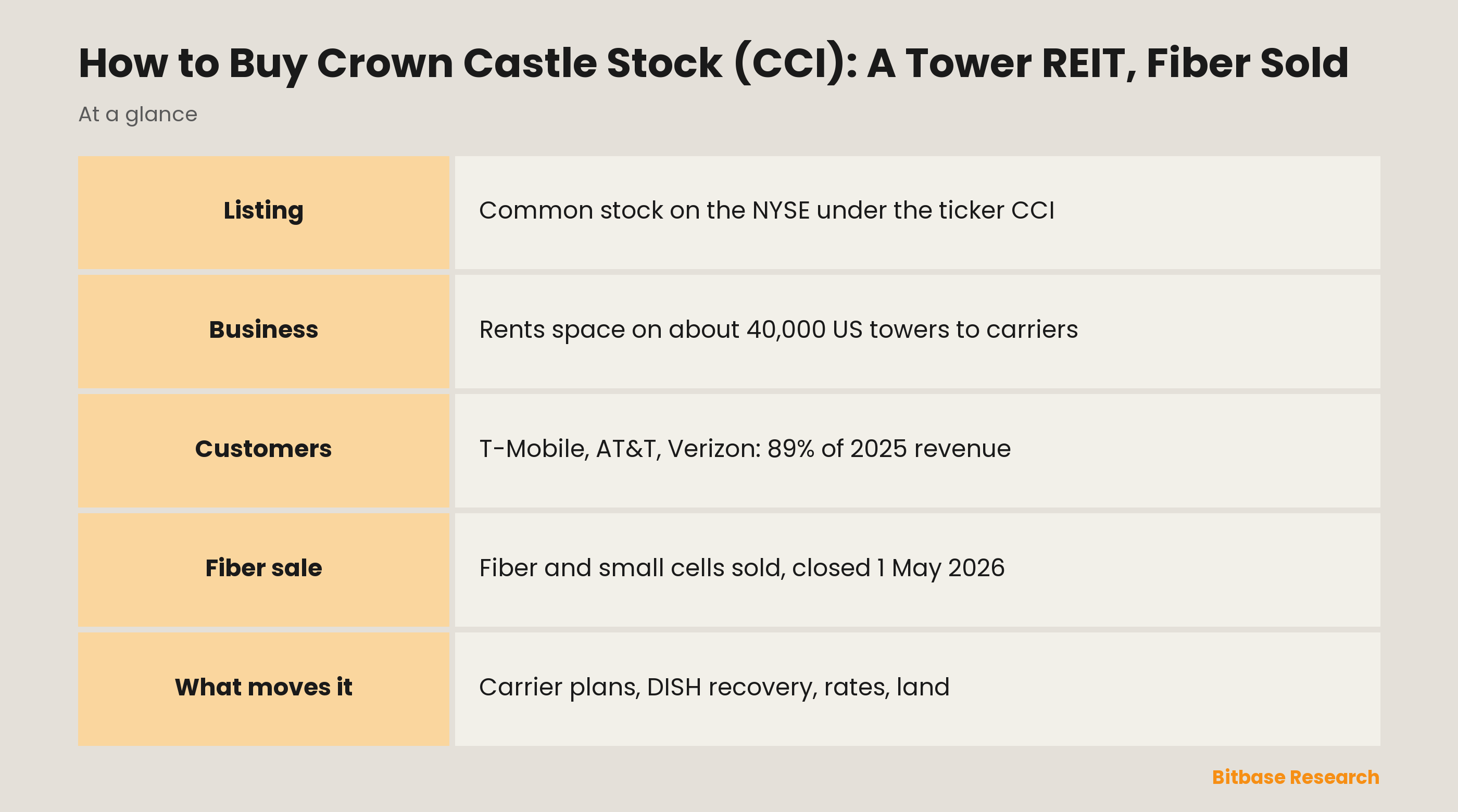
Every Crown Castle share trades on the New York Stock Exchange under the ticker CCI, so a brokerage account that reaches US equities is all the setup an order needs. What the share represents changed on 1 May 2026, when the company closed the sale of its fiber and small cell businesses and became a landlord for roughly 40,000 US cell towers. Three carriers, T-Mobile, AT&T and Verizon Wireless, produced 89% of its 2025 revenue, a dependence that runs through the rent model, the 2025 dividend cut and the DISH default covered below.
What Does Crown Castle Do?
Crown Castle owns towers and rights to the ground beneath them, and rents space on them to wireless carriers. A carrier mounts its antennas and radios at an agreed height and pays monthly rent under a long contract; Crown Castle owns and maintains the structure.
The 2025 Form 10-K put about 56% of the towers in the 50 largest US basic trading areas and about 71% in the 100 largest, and the "U.S." in its filings includes Puerto Rico. The majority of the sites came from the carriers themselves, including deals with AT&T in 2013 and T-Mobile in 2012. The registrant is a Delaware corporation based in Houston, Texas, and the 10-K traces it to a predecessor organized in 1995.
For years the company was broader. Next to the towers it built about 105,000 small cell nodes, counting those under contract, and roughly 90,000 route miles of fiber. In March 2025 it agreed to sell that whole Fiber segment: Zayo Group Holdings took fiber solutions, and Arium Networks, owned by an EQT infrastructure fund, took small cells. When the deal closed on 1 May 2026, the company's release called Crown Castle "the only U.S. focused, large publicly traded pure-play tower company."
A small services arm remains: site acquisition, zoning, permitting and engineering for equipment tenants plan to add. Since July 2023 Crown Castle no longer installs that equipment itself.
The tax label matters as much as the business. Crown Castle operates as a real estate investment trust (REIT), so it can deduct the dividends it pays when computing federal taxable income, provided it distributes at least 90% of its REIT taxable income each year.
How Crown Castle Makes Money
Rent is almost the whole income statement: site rental revenue was 95% of net revenues in 2025. The 10-K describes the contract template as initial terms usually of five to 15 years, renewal periods of generally five years each at the tenant's option, limited termination rights and built-in rent escalators. Contracts renew automatically unless the tenant gives notice, and yearly retention has been "generally between 98% and 99%."
A tower costs little to run. Ground lease payments make up about 75% of site rental operating costs, and sustaining capital spending typically runs at about 1% of net revenues. At the end of 2025 a tower carried about 2.4 tenants on average.
| Revenue driver | How it works | What the filings report |
|---|---|---|
| Long tenant contracts | Initial terms of 5 to 15 years with tenant renewal options | Retention generally 98% to 99% a year |
| Escalators | Rent rises on a contractual schedule | Reported in each quarterly billings bridge |
| New leasing | Tenants add equipment, or new tenants arrive | About 2.4 tenants per tower at end of 2025 |
| Non-renewals | Cancellations, terminations and rate cuts | Sprint-related churn expected each year through 2034 |
| Services | Site acquisition, zoning, permitting, engineering | Billed per project, not recurring |
The customer list is short. In the 10-K's concentration table, T-Mobile supplied 40% of 2025 consolidated revenues, AT&T 27% and Verizon Wireless 22%, a combined 89%, up from 87% in 2023. For the first nine months of 2026 the third-quarter 10-Q put the three at about 93% of site rental revenues.
Site rental revenue fell about 5% in 2025, mostly from contracted churn after the T-Mobile and Sprint merger: under a January 2022 agreement with T-Mobile, the 10-K expects Sprint-related cancellations each year through 2034, within the historical non-renewal range of 1% to 2% of annual tower site rental revenue. DISH, discussed below, stopped making required payments.
Land is the other half of the economics. In the 2025 10-K, about 40% of tower gross margin came from land Crown Castle owns outright or through perpetual easements, and about 60% from land it leases or otherwise controls, with an average remaining ground lease life of about 35 years including its renewal options. By the third quarter of 2026 the owned share was about 45%, and management lists buying more of that land as a priority.
CCI Stock at a Glance
| Item | CCI |
|---|---|
| Exchange | New York Stock Exchange (NYSE) |
| Ticker | CCI |
| Security | Common stock, the only class registered under Section 12(b) |
| Tax status | Real estate investment trust |
| Business | US cell towers and the land under them, leased to wireless carriers |
| Index membership | S&P 500 |
| Headquarters | Houston, Texas |
| Incorporated | Delaware |
| Fiscal year | Calendar year, ending 31 December |
| Payouts | Quarterly cash dividend, declared by the board each quarter |
| SEC identifier | CIK 1051470 |
Quotes, market value and yield move with every trade; the live figures sit on the Crown Castle stock page on Bitbase.
How to Buy Crown Castle Stock
Crown Castle is a US company listed in New York, so no depositary receipt is involved: the CCI line on the NYSE is the common stock itself. A purchase takes seven steps at a broker:
1. Pick a broker that offers NYSE-listed shares, and check which entity holds your shares and who regulates it.
2. Open the account and pass identity checks. Non-US individuals generally provide IRS Form W-8BEN; the IRS says to "submit Form W-8 BEN when requested by the withholding agent or payer."
3. Deposit funds. If your account currency is not the US dollar, the exchange spread can cost more than the commission.
4. Search for CCI and check the name. The result should read Crown Castle Inc. common stock on the NYSE, the only security on the 10-K cover's Section 12(b) list.
5. Choose the order type. FINRA describes a market order as the one that "provides the most certainty that your order will be executed," while "a buy limit order can be executed only at or below the limit price."
6. Decide on fractional shares. FINRA notes that fractional trading "varies by brokerage firm," and that "as a fractional share owner, you might not have shareholder voting rights."
7. Track each distribution. For a REIT, the annual tax breakdown of each payment matters.
What a REIT payout means for tax. This is general information, not tax advice. In the 10-K's 2025 table, about 17% of each payment was a non-taxable distribution for US income tax purposes; most of the rest was ordinary dividend income eligible for the Section 199A deduction that some US holders can take. For holders abroad, the IRS says "most types of U.S. source income received by a foreign person are subject to U.S. tax of 30%," and a tax treaty can lower that rate. IRS Publication 515 adds that a REIT distribution on stock regularly traded in the US counts as a dividend, not a US real property gain, if the holder owned no more than 10% of the stock in the year before payment. Your home country may tax it again.
Through funds. On 6 November 2026, Crown Castle Inc. appeared in State Street's daily holdings files for SPY, which tracks the S&P 500, and for XLRE, its real estate sector fund. The best-known listed peer is covered in our American Tower stock guide; unlike Crown Castle, it also owns towers abroad and data centers.
What Moves CCI Stock
One carrier's network plans. With T-Mobile alone at 40% of 2025 revenue, how that carrier builds and merges its network shows up in Crown Castle's rent roll; the Sprint deal turned a merger of two tenants into cancellations that run to 2034. For the carrier side, see our T-Mobile stock guide.
The DISH default and its recovery. The 10-K says Crown Castle had derived a meaningful portion of revenue and expected growth from DISH Wireless. On 12 January 2026 it delivered a notice of default and termination after DISH failed to make required payments, asserting that DISH owes all remaining payments under the agreements. On 12 May 2026 the Federal Communications Commission ordered DISH's parent, EchoStar, to fund a trust for qualified claims, including site lease obligations, as a condition of a spectrum license deal; on 30 June 2026 DISH filed for Chapter 11. Crown Castle is pursuing both routes and expects its remaining net balance with DISH to be recoverable, though "the ultimate resolution of this matter remains subject to uncertainty." In the third quarter of 2026, organic billings growth was 3.5% before the DISH and Sprint effects, yet site rental revenue fell about 5%.
Life after the fiber sale. By the end of June 2026 the company had completed its entire new share repurchase program, and it repaid notes maturing in June and July and bought back some bonds in the market. At the end of the third quarter 97% of its debt carried fixed rates, against about 19% of debt at variable rates in February 2026. Fewer shares and lower interest expense lifted adjusted funds from operations (AFFO) per share by 11% in the third quarter of 2026 even as revenue fell.
Interest rates. A REIT that pays out most of its taxable income relies on debt markets; the 10-K says a Federal Reserve rate increase "would increase our cost of borrowing," recalling the rise in the federal funds rate from 0.20% to 5.33% between March 2022 and August 2023.
Spectrum and carrier spending. The 10-K points to FCC spectrum auctions and licenses, 5G upgrades and rising data use as the sources of future tower demand. When carriers slow spending, leasing slows too: in its third-quarter 2026 release, management said core leasing would land near the bottom of its range for the year.
Leadership turnover. Christian Hillabrant became President and Chief Executive Officer in September 2025. In February 2026 a restructuring plan began cutting tower and corporate headcount in continuing operations by about 20%, and in September 2026 the company announced that its chief operating officer would leave and its chief financial officer would retire in March 2027.
Carrier Concentration and Debt in Crown Castle's Filings
Several risk factors in the 2025 10-K concern the fiber business that has since been sold. These still bear on a tower-only CCI share:
Few tenants. "A substantial portion of our revenues is derived from a small number of tenants, and the loss, consolidation or financial instability of any of such tenants may materially decrease revenues, reduce demand for our communications infrastructure and services and impact our dividend per share growth." DISH shows the risk in practice.
Pricing pressure. "As a result of competition in our industry, we may find it more difficult to negotiate favorable rates on our new or renewing tenant contracts." The 10-K names American Tower and SBA Communications among its largest competitors, along with carriers that own their own towers.
Technology that needs fewer towers. Network sharing, signal combining and virtualization could reduce what carriers place on towers, and "WiFi, satellite (such as low earth orbiting) and mesh transmission systems may serve as substitutes for, or alternatives to, leasing on communications infrastructure."
Land rights. The business may suffer if Crown Castle fails "to retain rights to our communications infrastructure, including the rights to land under our towers." Some sites are operated under master leases from bankruptcy-remote subsidiaries of AT&T and T-Mobile, where such a subsidiary's bankruptcy could cost Crown Castle its interest in the site.
Debt. "Our substantial level of indebtedness could adversely affect our ability to react to changes in our business," and failing a covenant could accelerate the debt.
REIT rules. "Failure to remain qualified as a REIT would result in our inability to deduct dividends to stockholders when computing our taxable income, thereby increasing our tax obligations and reducing our available cash."
Two further risks belong to the shareholder. A single stock ties your money to one company and, here, to three carriers' budgets. And the dividend can fall: the board cut the quarterly payment by about 32% in the second quarter of 2025, citing a capital allocation framework focused on "free cash flow generation and financial flexibility." The company expects to raise the dividend per share as cash flows grow, but each payment remains at the board's discretion.
How to Research CCI Yourself
Crown Castle files with the SEC under CIK 1051470. In 2026 its quarterly earnings releases came on 4 February, 22 April, 22 July and 21 October, each furnished with an 8-K. On 4 November 2026 it amended the third-quarter release to reclassify one cash payment, so use the latest version.
In the 10-K, read the business overview for portfolio, land and contract terms, the concentration table for each carrier's share, the equity note for the tax breakdown of each dividend, and the subsequent events note for the DISH termination. The quarterly releases split site rental billings into core leasing, escalators and non-renewals, which shows the trend better than headline revenue. FFO and AFFO are non-GAAP measures reconciled to net income in each release, not substitutes for it. Live quotes are on the stock page above, and the full list of US stock pages on Bitbase covers other listed companies, including other REITs.
Crown Castle Stock FAQ
Can I buy Crown Castle stock with crypto?
Not directly. CCI shares are bought through a brokerage account in US dollars, so crypto would first have to be sold for cash, possibly a taxable sale where you live, and the money moved to the broker. A share is a registered claim on the company with dividend and voting rights, which is how a share differs from a crypto asset.
Does Crown Castle pay a dividend?
Yes. Crown Castle has declared regular quarterly dividends since the first quarter of 2014. The board reduced the payment in the second quarter of 2025 and has held it at that level since, through the dividend declared on 5 November 2026. Each dividend needs board approval, and part of a payment can be a non-taxable distribution.
Is Crown Castle a REIT?
Yes. It operates as a real estate investment trust for US federal income tax purposes and must distribute at least 90% of its REIT taxable income each year. Its taxable REIT subsidiaries still pay corporate income tax, and its Puerto Rico towers can owe foreign income taxes.
Who bought Crown Castle's fiber and small cell businesses?
Zayo Group Holdings bought fiber solutions, and Arium Networks, a company of an EQT Active Core Infrastructure fund, bought small cells. Both closed on 1 May 2026 under a stock purchase agreement signed on 13 March 2025.
Is CCI in the S&P 500?
Yes. On 6 November 2026, Crown Castle Inc. was a line in State Street's daily holdings file for SPY, the fund that tracks the S&P 500. Index weights change daily.
Conclusion
Crown Castle is now a simpler company than it was two years ago: towers, the ground beneath them and three dominant tenants. What deserves judgment is how durable carrier rent proves once Sprint churn and the DISH loss pass through, how much land the company can buy, and whether the post-sale balance sheet supports the dividend growth it says it expects. Read the latest 10-K and quarterly release, follow the billings bridge rather than the revenue line, and size the position for a business that rests on three customers.
Related reading
Other Bitbase articles on this topic:
- How to Buy CBRE Stock (CBRE): Deals, Buildings and No Dividend
- How to Buy Extra Space Storage Stock (EXR): Rent and Reinsurance
- How to Buy Iron Mountain Stock (IRM): From Boxes to Data Centers
- How to Buy Ventas Stock (VTR): Senior Housing and the REIT Payout
Disclaimer: This article is educational content from Bitbase Academy, provided for information only. It explains what a company or fund does and how the instruments referenced here differ from one another; it does not constitute investment, trading, tax, or financial advice, and it is neither a recommendation nor an endorsement of any security, token, or trading strategy. A tokenized stock is issued by a third party and is designed to give economic exposure to an underlying asset: it is not a share, it carries no shareholder rights, and it depends on the issuer's structure, eligibility rules, and redemption terms, which the issuer can change. Perpetual futures are leveraged derivatives that hold no underlying asset and can be liquidated, and trading hours, product availability, and eligibility differ by instrument and by jurisdiction and can change at any time. Written as of November 2026; verify everything yourself through company filings, the issuer's own documentation, and the product pages of the venue you trade on.
References
[1] Crown Castle Form 10-K for 2025 (SEC EDGAR) www.sec.gov
[2] Crown Castle 2025 Form 10-K, XBRL cover page (SEC EDGAR) www.sec.gov
[3] Crown Castle Form 10-Q for the third quarter of 2026 (SEC EDGAR) www.sec.gov
[4] Crown Castle press release on closing the fiber and small cell sale, 1 May 2026 (SEC EDGAR) www.sec.gov
[5] Crown Castle third-quarter 2026 earnings release, as amended 4 November 2026 (SEC EDGAR) www.sec.gov
[6] Crown Castle quarterly dividend declaration, 5 November 2026 (SEC EDGAR) www.sec.gov
[7] Crown Castle Form 8-K on the 2026 restructuring plan, 4 February 2026 (SEC EDGAR) www.sec.gov
[8] Crown Castle Form 8-K on leadership changes, 14 September 2026 (SEC EDGAR) www.sec.gov
[9] State Street SPDR S&P 500 ETF Trust (SPY): daily holdings file, as of 6 November 2026 www.ssga.com
[10] FINRA, Order Types www.finra.org
[11] FINRA, Investing in Fractional Shares www.finra.org
[12] IRS, NRA Withholding www.irs.gov
[13] IRS, About Form W-8 BEN www.irs.gov
[14] IRS, Publication 515: Withholding of Tax on Nonresident Aliens and Foreign Entities www.irs.gov





