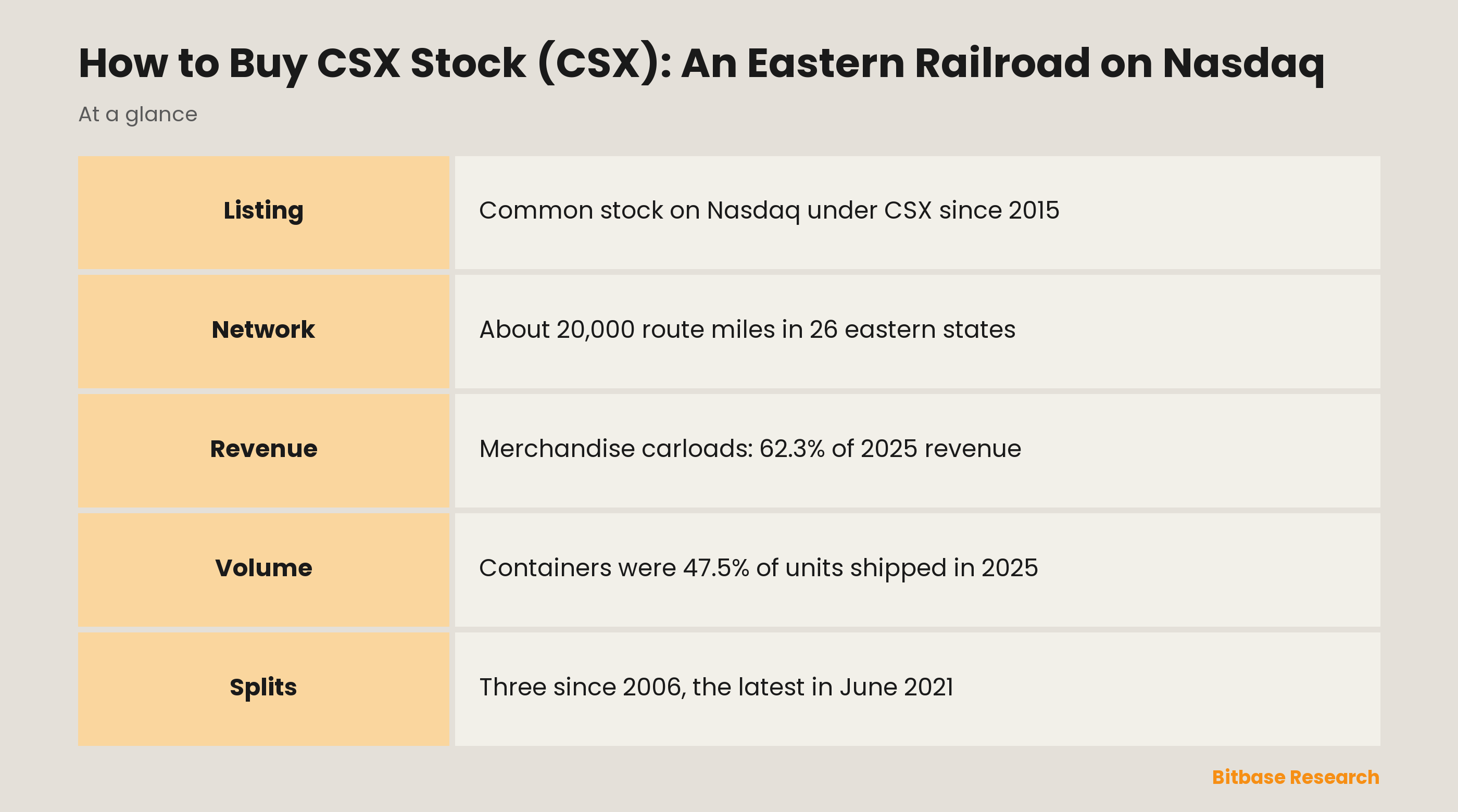
Your CSX order goes through any brokerage account with access to Nasdaq, where CSX Corporation's common stock has traded under the ticker CSX since the company moved its listing from the New York Stock Exchange in December 2015. Each share is a stake in a freight railroad of approximately 20,000 route miles in 26 states east of the Mississippi River, with a lineage that reaches back to the Baltimore and Ohio Railroad, chartered in 1827. Merchandise carloads such as chemicals, farm products, vehicles and metals earn most of its revenue, while intermodal containers account for nearly half of what it moves. Below: how the railroad earns its money, how to place the order and which risks its own filings flag.
What Does CSX Do?
CSX Corporation is a holding company based in Jacksonville, Florida. Its principal operating subsidiary, CSX Transportation, Inc. (CSXT), runs the railroad, serving major population centers in 26 states east of the Mississippi, the District of Columbia and the Canadian provinces of Ontario and Quebec. The network reaches more than 70 ocean, river and lake port terminals and connects with other Class I railroads and roughly 250 short-line and regional railroads.
The 10-K traces the company's heritage to the Baltimore and Ohio Railroad, "the nation's first common carrier." CSX Corporation itself was incorporated in Virginia in 1978 and completed the merger of the Chessie System and Seaboard Coast Line Industries in 1980. Buying key portions of Conrail in 1997 linked New England and the New York area with Chicago and the Midwest, and the acquisition of Pan Am Systems on 1 June 2022 extended its reach in the Northeast. CSX and Norfolk Southern still own Conrail jointly, with CSX holding a 42% economic interest and 50% of the votes.
The filing organizes the network around four corridors. I-90, the "waterlevel route," links Chicago with New York and New England on a mostly double-tracked line with few grades. I-95 joins Charleston, Jacksonville and Miami with Baltimore, Philadelphia and New York. The Southeastern Corridor runs from the western gateways of Chicago, St. Louis and Memphis through Nashville, Birmingham and Atlanta. The coal network ties mines in Appalachia and the Illinois basin to utilities, industrial areas and ports.
Several subsidiaries sit around the railroad. Quality Carriers, acquired on 1 July 2021, is "the largest provider of bulk liquid chemicals truck transportation in North America." CSX Intermodal Terminals runs container terminals and local drayage, TDSI handles vehicle distribution for the auto industry, and TRANSFLO transfers products from rail cars to trucks for customers the railroad does not reach directly. The company reports two operating segments, rail and trucking.
Its main rail competitor is Norfolk Southern Railway, which, in the 10-K's words, "operates throughout much of the Company's territory." Trucking companies on similar routes compete as well, and barges, ships and pipelines to a lesser extent.
How CSX Makes Money
CSX sells transportation by the carload, the container and the truckload. In the table, each share is computed from the 10-K's 2025 revenue table and each change is as the filing reports it.
| Market | Business line | Share of 2025 revenue | Change from 2024 |
|---|---|---|---|
| Chemicals | Merchandise | 19.7% | Down 3% |
| Agricultural and food products | Merchandise | 11.5% | Down 2% |
| Automotive | Merchandise | 8.4% | Down 4% |
| Forest products | Merchandise | 6.9% | Down 7% |
| Metals and equipment | Merchandise | 6.2% | Up 1% |
| Minerals | Merchandise | 5.9% | Up 8% |
| Fertilizers | Merchandise | 3.7% | Up 3% |
| Intermodal | Intermodal | 14.7% | Up 1% |
| Coal | Coal | 13.5% | Down 15% |
| Trucking (Quality Carriers) | Trucking | 5.8% | Down 3% |
| Other | Other | 3.8% | Up 6% |
Added up, merchandise brought in 62.3% of the year's revenue. Counting units instead of dollars gives a different picture: intermodal handled 47.5% of all 2025 shipments, merchandise 41.1% and coal 11.4%. A container moved by intermodal earns far less per unit than a carload of chemicals, which is why the business line with nearly half the volume supplies about a seventh of the revenue.
Intermodal works through approximately 30 terminals and, according to the filing, "transports mainly manufactured consumer goods in containers." Coal splits into two markets: "Most of the export coal the Company transports is used for steelmaking, while the majority of domestic coal the Company ships is used for electricity generation." Other revenue includes regional subsidiary railroads and charges such as demurrage and storage.
Total revenue fell 3% in 2025, which the 10-K attributes mainly to export coal, "which includes the impact of lower global benchmark rates," along with lower merchandise volume and lower fuel recovery; merchandise pricing and more intermodal traffic partly offset it. Coal revenue fell 15% on a 2% drop in volume, so revenue per unit dropped 13%.
CSX measures profitability as operating margin, operating income as a share of revenue. It was 32.1% in 2025, down from 36.1% in 2024, and the 2025 figure absorbed a non-cash charge after the goodwill of Quality Carriers was "fully impaired as of September 30, 2025." The third quarter of 2026 looked stronger: the earnings release reported revenue up 12% year over year, total volume up 5%, intermodal volume up 7% and an operating margin of 39.1%, an improvement of 880 basis points.
CSX Stock at a Glance
| Feature | CSX |
|---|---|
| Listing venue | Nasdaq Global Select Market, since the opening of trading on 22 December 2015 (previously the NYSE) |
| Ticker | CSX |
| Security | Common stock, one vote per share; no other class is registered on the 10-K cover |
| Preferred stock | Authorized but none outstanding |
| Sector | Industrials, freight rail |
| Index membership | S&P 500; Nasdaq-100 (see the FAQ for the holdings files) |
| Headquarters | Jacksonville, Florida |
| Incorporated | Virginia, 1978 |
| Fiscal year | Calendar year, ending 31 December |
| Dividends | Quarterly cash dividend; the board raised it 8% in February 2026 |
| Share buybacks | A new repurchase program was authorized in May 2026, on top of the 2023 one |
| Stock splits | Two-for-one in 2006; three-for-one in 2011 and in 2021 |
| SEC identifier | CIK 277948 |
| CUSIP | 126408103 |
A Nasdaq listing and a place in the Nasdaq-100 are separate facts, one about where the shares trade and one about an index; how the Nasdaq exchange, the company and the index differ untangles the names. For the live CSX share price, market value and yield, use the CSX stock page on Bitbase.
How to Buy CSX Stock
CSX is a US company with a single class of common stock on Nasdaq, so there is no depositary receipt or second share class to choose between. The steps:
1. Choose a broker that offers US-listed shares. Outside the US, that can be a local firm with US market access or an international broker; check which regulator supervises it.
2. Open and verify the account. Expect identity checks. Non-US residents are normally asked for IRS Form W-8BEN, which the IRS says to give "to the withholding agent or payer if you are a foreign person."
3. Fund it. Currency conversion has its own cost, so compare the spread as well as the commission.
4. Find the right security. Because the ticker and the company name are the same word, check that the result reads CSX Corporation common stock on Nasdaq; CUSIP 126408103 identifies it.
5. Pick an order type. FINRA says a market order "provides the most certainty that your order will be executed," but "you might not get the price you saw or were originally quoted, especially in fast-moving markets." With a limit order you set the price: "A buy limit order can be executed only at or below the limit price."
6. Decide between whole and fractional shares. Not every broker offers fractions, and FINRA notes that some batch them, "collecting customer orders throughout the day and then executing them as orders of whole shares." It adds that "at the moment, you can't transfer fractional shares to another brokerage firm."
7. Submit and save the confirmation. It records your cost basis, which you will need when you sell.
Investors outside the US should expect withholding on dividends. The IRS explains that "most types of U.S. source income received by a foreign person are subject to U.S. tax of 30%," and that a reduced rate or exemption may apply where the investor's country has a tax treaty with the United States. Your home country may tax the dividend too.
Index funds are the indirect route. CSX appeared in State Street's daily holdings of SPY, its S&P 500 fund, on 29 October 2026, and in the quarterly holdings report that Invesco QQQ, a Nasdaq-100 tracker, filed for 30 June 2026. In each it is one holding among a hundred or more.
What Moves CSX Stock
Export coal and seaborne prices. Coal is a small share of volume but a volatile one. The 10-K names "slower rates of economic growth in Asia, contraction of European economies, and changes in the global supply of seaborne coal or price of seaborne coal" as pressures on export coal; in 2025, with lower global benchmark rates, coal revenue fell 15%. In the third quarter of 2026 export shipments rose again, helped by "increased production from re-opened mines." Domestic coal depends on power plants, whose coal burn the 10-K links partly to natural gas prices.
Containers and the truck market. Intermodal sells itself as a cheaper alternative to long-haul trucking, so conditions on the highway matter. In 2025 intermodal volume rose 4% on higher port volumes and new business. In the third quarter of 2026, domestic shipments grew on customer wins, new services and "a tightening truck environment," and intermodal revenue rose 20%.
Diesel and surcharges. Fuel is both an expense and, through surcharges, a source of revenue. In the third quarter of 2026, fuel expense climbed "mostly due to a 67% increase in locomotive fuel prices," while increased fuel surcharge revenue was the first reason the 10-Q gave for revenue growth.
Weather and network work. Hurricane Helene forced a rebuild of the Blue Ridge subdivision, which reopened in September 2025, and the 10-K blames part of 2025's cost increase on congestion "primarily driven by work on the Howard Street tunnel and severe winter weather."
A new leadership team. Steve Angel, formerly chief executive of Linde, became CEO in September 2025, Kevin Boone became chief financial officer a month later, and the chief operating officer's retirement was announced in October 2026. Angel's October 2026 earnings release looks forward to "making continued progress toward best-in-class performance in 2027," a public target.
Consolidation around it. The 10-K records that Norfolk Southern, its main rival, has agreed to merge with Union Pacific "to form the nation's only transcontinental rail network," subject to approval by the Surface Transportation Board (STB). The details of that deal sit in the Union Pacific stock guide. CSX's own risk factors add that "any currently proposed or other future consolidation in the rail industry could materially affect the regulatory and competitive environment in which the Company operates."
Regulation. The STB regulates rates for non-exempt traffic, conditions of service and acquisitions of rail carriers, and CSX warns that new rules on "competitive access or revenue adequacy" could have a material adverse effect on its results.
CSX Risks: Hazmat, Coal, Labor and Storms
The 10-K's risk factors run to several pages; these are the most specific to this railroad.
Hazardous materials. "Under federal regulations, CSXT is required to transport certain hazardous materials under the legal duty referred to as the common carrier mandate regardless of risk or potential exposure to loss." An accident with such a load could bring claims beyond insurance cover.
A shrinking coal base. "Over time, changing dynamics in the U.S. and global energy markets, including the impacts of regulation and alternative fuel sources, have resulted in lower energy production from coal-fired power plants in CSX's service territory."
Labor. The company had about 23,000 employees at the end of 2025, roughly 16,900 of them union members. "If, however, CSX is unable to negotiate acceptable agreements, the employees covered by the Railway Labor Act could strike."
Storms. "Hurricanes as well as storm and flooding events have impacted the Company's network in the past, leading to interrupted service and damage to track structure and equipment." The Blue Ridge rebuild is a recent example.
Cyber attacks. The filing says the company "may be at increased risk of experiencing a cyber-attack as a result of being a component of the critical U.S. infrastructure."
New competition from trucks. It warns that automation, autonomy or electrification making other modes cheaper or better "could negatively impact the Company's competitive position."
The stock adds its own risks: a single holding ties your result to one company, two decades of dividend increases are a record rather than a guarantee, and investors who earn in another currency carry exchange-rate risk on top.
How to Research CSX Yourself
CSX files on SEC EDGAR under CIK 277948: an annual 10-K in February, quarterly 10-Qs, and 8-Ks whenever results or executive changes are announced. The October 2026 earnings 8-K attaches a quarterly financial report with volume and revenue by market plus operating statistics such as train velocity and dwell, the quickest way to see whether a quarter's change came from more carloads, higher revenue per unit or a smoother network. Earnings webcasts and presentation materials are posted at investors.csx.com.
The proxy statement filed on 30 March 2026 covers the board and executive pay. The 10-K's performance graph benchmarks the stock against the S&P 500 and the Dow Jones U.S. Transportation Average. Bitbase's stock list gathers quote pages for other US-listed companies.
CSX Stock FAQ
Does CSX pay a dividend?
Yes, quarterly in cash. The 10-K says the 2025 raise was "the 21st consecutive increase in CSX's annual dividend," and the board approved another 8% increase in February 2026. Each payment is declared by the board and can change.
Can I buy CSX stock with crypto?
Not directly. Brokers sell CSX shares for US dollars, so you would sell the crypto for cash first, and in many countries that sale is taxable. A CSX share is registered stock with voting and dividend rights; what separates owning a stock from owning crypto goes through the rest.
Has CSX stock ever split?
Three times since 2006, according to company 8-K filings: two-for-one in August 2006, then three-for-one in June 2011 and June 2021. The 2021 split was paid as a stock dividend, two extra shares for each share held on 18 June 2021. Together they turned one pre-2006 share into eighteen.
What exchange is CSX listed on?
Nasdaq. CSX left the New York Stock Exchange at the close on 21 December 2015 and began trading on the Nasdaq Global Select Market the next morning, keeping the CSX ticker.
Is CSX in the S&P 500 and the Nasdaq-100?
Yes to both, judging by fund holdings: SPY, an S&P 500 tracker, listed CSX on 29 October 2026, and Invesco QQQ, a Nasdaq-100 tracker, held it on 30 June 2026.
Is CSX part of the Union Pacific and Norfolk Southern merger?
No. The agreement described in CSX's 10-K is between Norfolk Southern and Union Pacific, and it needs STB approval. In its own filings, CSX discusses rail consolidation under competition and risk factors.
Conclusion
Buying CSX is a standard Nasdaq trade: a broker with US access, the CSX ticker and a market or limit order. What you get is a share of an eastern railroad that earns most of its money from merchandise carloads, moves almost half its units as containers and still feels the swings of export coal and diesel. Read the latest 10-K and quarterly report, and follow the merger next door, before deciding how much of one railroad belongs in your portfolio.
Related reading
Other Bitbase articles on this topic:
- How to Buy Boeing Stock (BA): 737 Output, Backlog, Dividend
- How to Buy Canadian National Railway Stock (CNI): Two Tickers
- How to Buy Cintas Stock (CTAS): Uniform Rentals and UniFirst
- How to Buy Republic Services Stock (RSG): Landfills, Gates Stake
Disclaimer: This article is educational content from Bitbase Academy, provided for information only. It explains what a company or fund does and how the instruments referenced here differ from one another; it does not constitute investment, trading, tax, or financial advice, and it is neither a recommendation nor an endorsement of any security, token, or trading strategy. A tokenized stock is issued by a third party and is designed to give economic exposure to an underlying asset: it is not a share, it carries no shareholder rights, and it depends on the issuer's structure, eligibility rules, and redemption terms, which the issuer can change. Perpetual futures are leveraged derivatives that hold no underlying asset and can be liquidated, and trading hours, product availability, and eligibility differ by instrument and by jurisdiction and can change at any time. Written as of October 2026; verify everything yourself through company filings, the issuer's own documentation, and the product pages of the venue you trade on.
References
[1] CSX Corporation Form 10-K, fiscal 2025: business, revenue by market and risk factors (SEC EDGAR) www.sec.gov
[2] CSX Corporation Form 10-Q for the quarter ended 30 September 2026 (SEC EDGAR) www.sec.gov
[3] CSX Form 8-K, 21 October 2026: third quarter 2026 results and quarterly financial report (SEC EDGAR) www.sec.gov
[4] CSX Form 8-K, 13 October 2026: retirement of the chief operating officer (SEC EDGAR) www.sec.gov
[5] CSX Form 8-K, 10 December 2015: listing transfer from the NYSE to Nasdaq (SEC EDGAR) www.sec.gov
[6] CSX release, 4 June 2021: three-for-one stock split (Form 8-K, SEC EDGAR) www.sec.gov
[7] CSX Form 8-K, 4 May 2011: three-for-one stock split (SEC EDGAR) www.sec.gov
[8] CSX Form 8-K, 18 July 2006: two-for-one stock split (SEC EDGAR) www.sec.gov
[9] CSX Corporation Form 10-K, fiscal 2022: acquisition of Pan Am Systems (SEC EDGAR) www.sec.gov
[10] CSX Corporation Form 10-K, fiscal 2021: acquisition of Quality Carriers (SEC EDGAR) www.sec.gov
[11] State Street SPDR S&P 500 ETF Trust (SPY): fund page and daily holdings www.ssga.com
[12] Invesco QQQ Trust: Form N-PORT-P holdings report for 30 June 2026 (SEC EDGAR) www.sec.gov
[13] Invesco QQQ Trust summary prospectus, 22 December 2025: objective of tracking the Nasdaq-100 Index (SEC EDGAR) www.sec.gov
[14] FINRA: Order Types www.finra.org
[15] FINRA: Investing in Fractional Shares, 26 June 2025 www.finra.org
[16] IRS: NRA Withholding www.irs.gov
[17] IRS: About Form W-8 BEN www.irs.gov





