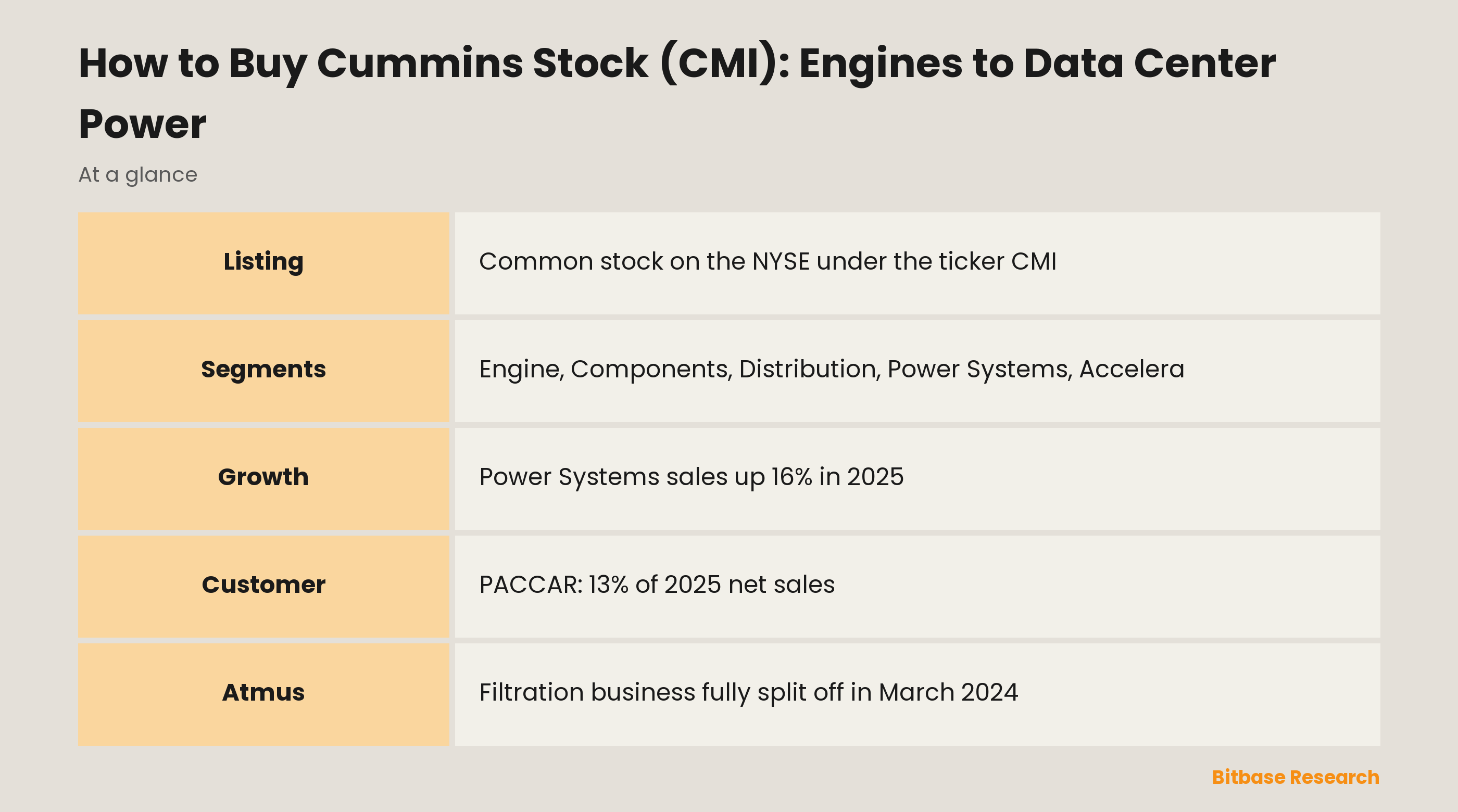
Everything you need to buy Cummins stock fits into one brokerage account with access to the New York Stock Exchange, where the company's common shares trade under the ticker CMI. The Columbus, Indiana manufacturer began in 1919 as one of the first diesel engine makers, yet in 2025 its Power Systems and Distribution segments grew 16% and 9% on power generation demand that the 10-K ties especially to data center and commercial customers, while heavy-duty truck engine sales fell 18%.
What Does Cummins Do?
Cummins Inc. was founded in 1919 as Cummins Engine Company in Columbus, Indiana, took its current name in 2001, and is still incorporated and headquartered in Indiana. The 10-K calls it "a global power leader": it builds engines, the parts around them, generators and electrified powertrains, and sells them to equipment makers, distributors and dealers, backed by about 640 distributor locations and more than 13,000 certified dealer locations in roughly 190 countries and territories. Its workforce numbered about 67,400 at the end of 2025, and Jennifer Rumsey has been chair and chief executive since 2023.
The business is reported in five segments:
Engine builds diesel, natural gas and gasoline engines of 15 liters and smaller for heavy-duty trucks, medium-duty trucks and buses, pick-ups and off-highway machines. Its named heavy-duty truck customers are PACCAR, Traton and Daimler Truck, and in North America it supplies pick-up engines to Stellantis.
Components sells what surrounds an engine: axles, brakes, aftertreatment systems that convert exhaust pollutants into harmless emissions, turbochargers, fuel systems, controls and software, plus automated transmissions from a 50/50 joint venture with Eaton.
Distribution is the main sales, service and support channel, organized as seven regions that sell generator systems, engines and parts and carry out repairs.
Power Systems makes standby and prime power generators, engines of 16 liters and larger rated up to 4,400 horsepower for mining, oil and gas, marine, rail and defense, and Stamford and AVK alternators.
Accelera develops battery and electric powertrain systems, still early in commercialization. In 2025 Cummins fully impaired its electrolyzer goodwill and said it intends to stop new commercial activity there; on 31 March 2026 it sold its low pressure fuel cell business. Accelera also owns 30% of Amplify Cell Technologies, a battery cell venture with Daimler Truck and PACCAR not expected to start production until 2028.
Outside the segments sit engine joint ventures with Dongfeng, Beiqi Foton and Chongqing Machinery and Electric in China and Tata Cummins in India, plus a controlling interest in Cummins India Ltd., which is listed on Indian exchanges.
How Cummins Makes Money, Segment by Segment
Segments are measured by EBITDA, earnings before interest, taxes, depreciation and amortization. From the 2025 10-K:
| Segment | What it sells | Share of 2025 segment sales | Sales change vs 2024 | 2025 EBITDA as % of sales |
|---|---|---|---|---|
| Engine | Truck, pick-up and off-highway engines | 26% | Down 7% | 12.7% |
| Components | Axles, brakes, aftertreatment, turbochargers | 25% | Down 13% | 13.8% |
| Distribution | Sales, parts and service network | 30% | Up 9% | 14.6% |
| Power Systems | Generators, large engines, alternators | 18% | Up 16% | 22.7% |
| Accelera | Batteries and electric powertrains | 1% | Up 11% | Loss |
Shares are counted before intersegment eliminations, which are large here because the segments trade with one another; in 2025 they removed 18.6% of total segment sales.
Consolidated net sales slipped 1% in 2025. The 10-K blames weaker on-highway truck demand and the absence of Atmus Filtration, divested early in 2024, and credits power generation, "especially data center and commercial markets," with much of the offset. Within Engine, heavy-duty truck sales fell 18% and medium-duty truck and bus sales 13%, as North American shipments dropped 27% and 31% respectively.
PACCAR, the only customer above a tenth of sales, took 13% of 2025 net sales, down from 16% in 2024, after 81 years of buying Cummins engines. With Traton, Daimler and Stellantis, it made up 31% of 2025 sales.
The United States and Canada produced 59.9% of 2025 net sales and the rest of the world 40.1%. Cummins also books its share of joint venture profits, and the 10-K says more than half of those earnings come from investees based in China.
CMI Stock at a Glance
| Fact | CMI |
|---|---|
| Exchange | New York Stock Exchange |
| Ticker | CMI |
| Security | Common stock, the only class registered on the 10-K cover |
| Sector | Engines, components and power generation equipment |
| Index membership | S&P 500 |
| Headquarters | Columbus, Indiana |
| State of incorporation | Indiana |
| Founded | 1919, as Cummins Engine Company |
| Fiscal year | Calendar year, closing 31 December |
| Dividends | Paid quarterly, increased for 17 consecutive years as of 2026 |
| Former subsidiary | Atmus Filtration (ATMU), fully separated in March 2024 |
| SEC identifier | CIK 26172 |
| CUSIP | 231021106 |
Quotes, market value and yield shift through every session; the Cummins stock page on Bitbase shows them live.
How to Buy Cummins Stock
With one US listing and one class of common stock, there is nothing to choose between. Through a broker:
1. Open an account that trades NYSE stocks. Abroad, use a local or international broker with US market access, and check who holds your shares and who regulates it.
2. File the tax form. The IRS tells a foreign beneficial owner to "give Form W-8 BEN to the withholding agent or payer," which for a share account is normally the broker.
3. Fund the account. Currency conversion into dollars costs a spread, so compare it along with commissions.
4. Look up CMI. Check that the listing reads Cummins Inc. common stock on the NYSE; Cummins India Ltd. and Atmus Filtration are separate companies.
5. Pick an order type. FINRA notes that brokers "typically enter your order as a market order unless you specify otherwise." A limit order caps your price, but "there's a chance your order doesn't get executed at all."
6. Decide on whole or fractional shares. FINRA cautions that "at the moment, you can't transfer fractional shares to another brokerage firm."
Investors abroad face US withholding on dividends: per the IRS, "most types of U.S. source income received by a foreign person are subject to U.S. tax of 30%," though a treaty may reduce it, and the W-8BEN is where you claim that rate. Tax at home may apply on top.
Holding Cummins through a fund is the indirect option. State Street's SPDR S&P 500 ETF Trust (SPY) includes CMI in its holdings file dated 29 October 2026, so any S&P 500 tracker gives you a piece of Cummins.
What Moves CMI Stock
North American truck orders. Truck engines and components remain a large part of sales, and PACCAR alone took 13% in 2025. When North American heavy-duty and medium-duty shipments fell that year, Engine and Components sales dropped with them; in the 2026 second-quarter release, Rumsey cited "improving North American truck markets."
Power for data centers. In 2025 power generation sales rose 24% in Distribution and 19% in Power Systems, and the 10-K says demand for its data center products extends "out six to eight quarters." Power Systems sales were up 19% in the second quarter of 2026, and in June Cummins agreed to supply natural gas generator sets to a Texas data center through 2030.
Emissions rules in flux. In February 2026 the EPA repealed all greenhouse gas emission standards for on-highway vehicles and engines, effective 20 April 2026, and the 10-Q warns that Cummins' compliance credits could end up worth little. After the EPA proposed changes to upcoming emissions rules, Cummins reset its model year 2027 plans, saying it would launch its new X10 and X15 engines "through a measured production ramp while maintaining select legacy product availability in 2027."
China. Engine international sales rose 23% in the second quarter of 2026 on Chinese construction demand, and most joint venture earnings come from China, so a slowdown there would hit sales and equity income together.
Accelera's losses. The segment's EBITDA was negative in 2024 and 2025, partly from restructuring charges, and how fast those losses narrow feeds into earnings.
Dividends and buybacks. The board raised the quarterly dividend 10% in July 2026, and Cummins bought back stock in the first half of 2026, finishing its 2019 authorization and moving on to the 2021 one.
Hazards Cummins Spells Out for Shareholders
Of the 10-K's risk factors, these bear most directly on CMI:
Life after the emissions settlement. In December 2023 Cummins reached an agreement in principle with the EPA, the California Air Resources Board, the Justice Department and the California Attorney General's Office over emissions certification of engines used mainly in about one million US pick-up trucks; it became final and effective in April 2024. The company says it has incurred, "and likely will incur, other additional claims, costs and expenses" tied to those matters, and further non-compliance would likely bring stipulated penalties.
Customers who build their own engines. Daimler, PACCAR, Traton, Volvo and others already make some engines in-house, and "there can be no assurance that these customers will continue to outsource, or outsource as much of, their engine production in the future."
The move away from diesel. The 10-K names China, India and Germany among countries planning diesel bans, and concedes Cummins "may not be successful in developing segment-leading electrified powertrains."
Partners it does not control. Joint ventures supply a significant share of net income, yet "we do not unilaterally control their management or their operations."
Cycles and capacity. "Our markets are cyclical in nature," so plants can sit idle in a downturn or run short in a boom. Tariffs add uncertainty, although their net cost was immaterial to 2025 profitability.
Then come the risks of any single share: one company drives the price, the board decides the dividend, and anyone spending another currency also carries dollar exchange risk.
A Reading Map for Cummins Filings
Every 10-K, 10-Q and 8-K Cummins files is on EDGAR under CIK 26172. So far in 2026, quarterly results have come by 8-K in early February, early May and early August.
In the 10-K, Item 1 names the largest customers, and Item 7 breaks Engine sales down by market and Power Systems sales by product line, the clearest place to track the data center trend. Note 21 covers the Atmus split-off, Note 22 the Accelera charges and Note 14 the emissions settlement.
For comparison, Item 5 lists the peer group behind the stock performance graph, among them Caterpillar, Deere, PACCAR, Eaton and Volvo. Quotes for other US-listed companies are on Bitbase's US stock pages.
Cummins Stock FAQ
Does Cummins pay a dividend?
Yes, quarterly. The board raised it 10% in July 2026, and the second-quarter release says the company "has increased the quarterly dividend to shareholders for 17 consecutive years."
Can I buy Cummins stock with crypto?
Not directly. Brokers sell CMI for US dollars, so crypto must first be sold for cash and moved to a brokerage account, a sale that can be taxable where you live. A separate explainer covers buying stocks with crypto.
Is CMI in the S&P 500?
Yes. CMI appears under CUSIP 231021106 in State Street's holdings file for the SPDR S&P 500 ETF Trust as of 29 October 2026.
What happened to Atmus Filtration?
Cummins let go of its filtration business, Atmus Filtration Technologies, in two steps. Atmus began trading on the NYSE as ATMU on 26 May 2023, and in the IPO completed on 30 May Cummins disposed of 19.5% of it. On 18 March 2024 a tax-free split-off of the remaining 80.5% followed: Cummins shareholders swapped CMI shares for Atmus shares, with a 7% discount on the exchange ratio. Cummins handed over all 67 million Atmus shares and took back 5.6 million of its own.
Is Cummins India the same stock as CMI?
No. Cummins India Ltd. is a separate company listed in India, in which Cummins Inc. holds a controlling interest. Buying it on an Indian exchange is a different investment from buying CMI in New York.
Conclusion
To own CMI you need a broker with NYSE access, a check that the line is Cummins Inc. common stock, and a market or limit order. Behind the ticker is a century-old engine maker whose recent growth has come from generators, while truck cycles, China and emissions rules still swing its results. Read the segment tables and risk factors in the latest 10-K before sizing a position.
Related reading
Other Bitbase articles on this topic:
- How to Buy Boeing Stock (BA): 737 Output, Backlog, Dividend
- How to Buy Canadian National Railway Stock (CNI): Two Tickers
- How to Buy Cintas Stock (CTAS): Uniform Rentals and UniFirst
- How to Buy Trane Technologies Stock (TT): Ex-Ingersoll-Rand HVAC
Disclaimer: This article is educational content from Bitbase Academy, provided for information only. It explains what a company or fund does and how the instruments referenced here differ from one another; it does not constitute investment, trading, tax, or financial advice, and it is neither a recommendation nor an endorsement of any security, token, or trading strategy. A tokenized stock is issued by a third party and is designed to give economic exposure to an underlying asset: it is not a share, it carries no shareholder rights, and it depends on the issuer's structure, eligibility rules, and redemption terms, which the issuer can change. Perpetual futures are leveraged derivatives that hold no underlying asset and can be liquidated, and trading hours, product availability, and eligibility differ by instrument and by jurisdiction and can change at any time. Written as of October 2026; verify everything yourself through company filings, the issuer's own documentation, and the product pages of the venue you trade on.
References
[1] Cummins Form 10-K for 2025 (SEC EDGAR) www.sec.gov
[2] Cummins Form 10-Q for the quarter ended 30 June 2026 (SEC EDGAR) www.sec.gov
[3] Cummins second-quarter 2026 results release, filed with Form 8-K on 4 August 2026 (SEC EDGAR) www.sec.gov
[4] State Street: SPY daily holdings, 29 October 2026 www.ssga.com
[5] FINRA: Order Types www.finra.org
[6] FINRA: Investing in Fractional Shares www.finra.org
[7] IRS: NRA Withholding www.irs.gov
[8] IRS: About Form W-8 BEN www.irs.gov





